Showing posts with label political economics. Show all posts

Sunday, January 24, 2021

Brexit appears to be causing many unexpected pain

This January is the first month of Brexit, the British withdrawal from the European Union after 47 years of membership. Brexit was approved by a majority of voters in 2016, the same year Donald Trump was elected.

Much like Americans that year, the Brits had their opinions and ignored anything in the press to the contrary. As might be expected, some news headlines reflect problems and surprises as a result of Brexit implementation:

It's still early in the game, of course. But the implementation of Brexit is the only significant nationalist movement that we can watch with clear democratic vision. Initially, it appears that this Wikipedia quote is right on: "The broad consensus among economists is that Brexit will likely harm the UK's economy and reduce its real per capita income in the long term, and that the referendum itself damaged the economy."

Of course, 80 years from now the world's economy will barely resemble today (at least partly because of our current confrontation with a pandemic). Still, it seems fair to assume that, led by right wing nationalists (the majority of whom are racists), the British have pretty much abandoned their economy as they knew it to assert their "freedoms" in the face of an "oppressive" or "too immigration favorable" multinational bureaucracy.

In effect, the British have achieved what the Trump Administration attempted to accomplish for the U.S. - total one-on-one trade treaties and closed borders. The results are exactly what a person who can read-and-write would expect. Consider this video on the shift in freight transport to and from E.U. member Ireland:

It would be unkind to wish significant economic damage on the U.K. But one can hope that for future reference we will be able to point to Brexit as an example of why right wing nationalism is a bad idea without even having to refer to Hitler.

Wednesday, December 2, 2020

Covid-19, unemployment, & realigned world trade: Extended Economic Distortion begins to take shape

We are nearing the end of a year of pandemic after four years of the Trump Administration. It is not surprising that Covid-19, unemployment associated with changes in consumer habits, and a realignment of world trade towards the Pacific-Southeast Asian nations are creating a picture of a probable Extended Economic Distortion within the U.S.


The Pandemic

The Covid-19 pandemic has worsened severely. As of November 30, here in California's hospitalizations exceeded the previous high as can be seen in this chart...

...while the 7-day death rate climb has just begun - 133 days after the hospitalization rise exactly as last time. These charts do not reflect Thanksgiving infections and, with Christmas and New Years coming up, hospitalizations will continue to skyrocket probably through February. (It has become clear that Californians are no better than any others waiting for the vaccine while protecting the vulnerable among them.)


Unemployment

Expanded unemployment has, and will continue to, create difficult economic pressures. Obviously, a runaway pandemic is going to put pressure on businesses directly serving the public. Many restaurants and retailers have closed. But that isn't the major issue.

The most immediate issue is the impact of expiring expanded unemployment related benefits enacted to reduce economic losses from the Covid-19 pandemic. By the end of December the last of the aid will be paid out that Congress provided through a series of emergency measures in the spring.

Direct checks of $1,200 per person to most U.S. households, $600 a week in supplemental unemployment benefits and hundreds of billions of dollars in support for small businesses reduced the effects through the summer. But according to U.S. employment data the number of people out of work for more than six months (the indicator of long-term unemployment) rose 1.2 million in October, to 3.6 million - a rise - and is likely to continue to increase well into 2021. In addition, workers are facing these realities:

  • Nearly four million Americans are receiving benefits under the pandemic compensation program, a number that doubled in the past month and which will keep rising as more people reach the end of their 26-week state benefits.
  • There are 9.3 million people receiving Pandemic Unemployment Assistance, a program to cover people left out of the normal unemployment system, such as freelancers and self-employed workers, as well as those unable to work because of pandemic-related child care issues and similar obstacles.
  • Tens of millions of workers will lose access to federally mandated paid sick and family leave from the Families First emergency program which required many employers to provide workers with two weeks of coronavirus-related sick leave at full pay and up to 12 weeks of family and medical leave to care for family members at two-thirds pay.

All this must be viewed in the context of an October 2020 report titled Household Financial Fragility during COVID-19: Rising Inequality and Unemployment Insurance Benefit Reductions which makes us acutely aware that even in January 2020 when our economy was thought to be booming a large majority of American households were dependent upon that next paycheck to cover their cost of housing and food.

In theory Congress could extend, modify-and-extend, or create new programs. Recent headlines indicate a compromise bill proposed by nine Senators has some support. But the divided national political scene as reflected by the Republican Senate versus Democratic House - Senate Majority Leader Mitch McConnell (R-KY) versus Speaker of the House Nancy Pelosi (D-CA) - will not make that easy.

We will know by the end of January 2021 the level of success of McConnell's election 2024 goal to make Joe Biden seem responsible for an economic disaster by minimizing benefits to unemployed workers.


21st Century Economic Restructuring

As noted here in a September 1 post, the first 20 years of the 20th Century and the first 20 years of the 21st Century solidified major transitions in the economy.

The most significant of the changes was brought about by the embracing of the internet for communications, entertainment, and sales of goods and services. Consider this story:

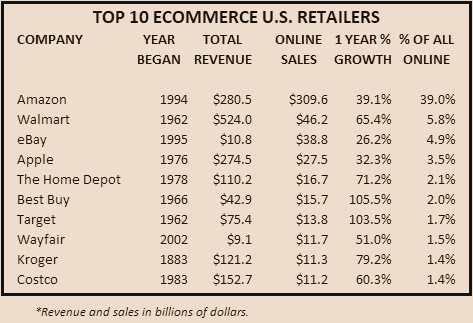
    US ecommerce sales will reach $794.50 billion this year, up 32.4% year-over-year....
    “We’ve seen ecommerce accelerate in ways that didn’t seem possible last spring, given the extent of the economic crisis,” said Andrew Lipsman, eMarketer principal analyst at Insider Intelligence. “While much of the shift has been led by essential categories like grocery, there has been surprising strength in discretionary categories like consumer electronics and home furnishings that benefited from pandemic-driven lifestyle needs.”
    “There will be some lasting impacts from the pandemic that will fundamentally change how people shop,” said Cindy Liu, eMarketer senior forecasting analyst at Insider Intelligence. “For one, many stores, particularly department stores, may close permanently. Secondly, we believe consumer shopping behaviors will permanently change. Many consumers have either shopped online for the first time or shopped in new categories (i.e., groceries). Both the increase in new users and frequency of purchasing will have a lasting impact on retail.”

The numbers in the table below reflect that changing market when comparing the 2019 financial statement total revenue to the most recently reported current esales:

The likelihood that gains in internet sales after Covid-19 will revert to in-store sales is not great. And expected holiday sales will shift further to online. The impact on local retail sales cannot be overstated.

Further, as mentioned in the article above, the real surprise is that online grocery sales have skyrocketed as noted in this Atlanta Constitution article:

    Recent numbers show the pandemic pushed online grocery sales in the U.S. to extraordinary heights. In August 2019, sales were $1.2 billion, according to data gathered by the companies Brick Meets Click and Mercatus. In June 2020, they were $7.2 billion.
    Meanwhile, online sales grew from 3.4% of the grocery buying market in 2019 to 10.2% a year later, according to Mercatus and consumer data firm Incisiv.
    The change is creating thousands of new jobs in Atlanta, from high-tech positions to warehouse and delivery workers.
    Online shoppers will see improved delivery services and a better online user experience as companies compete for their share of the $1 trillion annual U.S. grocery market, industry analyst David J. Livingston said. But some smaller grocers likely won’t be able to keep up and could end up closing as behemoths like Walmart and Amazon continue to take bigger chunks of the online grocery business.
    Grocery store chains are staying competitive by throwing more resources into the fight. Kroger, for instance, has hired the British company Ocado to build a $55 million warehouse in Forest Park where robots will help sort online grocery orders. The chain will begin delivering in the metro area in 2021.
    “We’ll all look back on this year as being possibly the most significant inflection point for online grocery shopping,” said David Hardiman-Evans, Ocado’s senior vice president for North America.

One must also note that the "shoppers" are gig workers reflecting another shift in our economy.


China's Crucial Win in World Trade

China clearly has has offered a 21st Century non-military challenge to U.S. economic strength with a crucial win in world trade, along with a manufacturing focus shift inward.

This must be viewed in the context of China's relative success at suppressing Covid-19 outbreaks. China's one-party unitary national government can impose mandatory lockdowns, testing, and vaccination more effectively than in an undisciplined multiparty federation such as the United States.

China's one-party unitary national government can, and has, turned inward to promote its own consumer economy with the context of the 14th Five-Year Plan and the 2035 Vision to be taken up by the Party Congress next year. Consider this news story:

    President Xi Jinping called on the nation in May to rely more on domestic demand for future growth – dubbing it a dual circulation strategy – and his directive requires significant changes in both internal supply and demand.
    “The pandemic has made it difficult for us to sell abroad, but we do feel as though Chinese customers are less … enthusiastic for foreign brands, especially mid-level products,” said a sales manager at a fashion jewellery brand with shops all over the country.
    “Frankly, it may be becoming fashionable and more politically correct to make and consume good-quality Chinese goods,” he added, asking not to be identified.
    That sentiment seems to be felt by a growing number of Chinese export manufacturers, some of whom say they have started shifting investments to the domestic market even as their exports have seen a huge resurgence recently.
    Orders have been returning to China as other producing countries are still being ravaged by the pandemic, but manufacturers know the trend is most likely unsustainable.

However, China's one-party unitary national government can, and has, turned toward the Pacific-Southeast Asia to join with Australia, Brunei, Cambodia, Indonesia, Japan, Laos, Malaysia, Myanmar, New Zealand, Philippines, Singapore, South Korea, Thailand, and Vietnam to create the Regional Comprehensive Economic Partnership (RCEP). The RCEP, signed November 15, includes almost one-third of the world’s population and about one-third of its gross domestic product. It is the first ever free trade agreement between China, Japan and South Korea – Asia’s largest, second-largest and fourth-largest economies. It's goal is to progressively lower tariffs and aims to counter protectionism, increase investment and allow more free movement of goods.

Brunei, Vietnam, Laos, Cambodia, Thailand, Myanmar, Malaysia, Singapore, Indonesia and the Philippines are members of the Association of Southeast Asian Nations (ASEAN) trade group. It was announced December 1 that the European Union has joined with the ASEAN group in a strategic partnership to "stand up for safe and open trade routes and a free and fair trade" according to German Foreign Minister Heiko Maas after a virtual meeting with his EU and ASEAN counterparts. "Together, we represent more than a billion people and almost 25 per cent of global economic power," noted Maas.

Then, to the surprise of many, President Xi Jinping announced that China “will actively consider” joining the Comprehensive and Progressive Agreement for Trans-Pacific Partnership (CPTPP). Chinese Premier Li Keqiang’s in May noted that “China has a positive and open attitude toward joining the CPTPP”. Were this to be accomplished it would add Canada, Chile, Mexico, and Peru to China's trade group partners.

For Americans who don't remember as far back as four years ago (most Americans), the CPTPP evolved from the Trans-Pacific Partnership (TPP), which failed due to the withdrawal of the United States after Trump took office. Twenty-two TPP provisions that were priorities of the U.S., but not other negotiating partners, were suspended or modified in the CPTPP.

President Barack Obama's push to pass the TPP in 2016 was resisted by the 2016 presidential candidates in both major parties. Clinton and Trump opposed the deal, arguing that it would hurt American workers.

The problem for Clinton was former 2016 presidential candidate socialist U.S. Sen. Bernie Sanders rallied his supporters to urge the Democratic National Committee (DNC) to include language in their platform rejecting the TPP. CNN reporter Eric Bradner wrote, "By keeping specific opposition to the Trans-Pacific Partnership out of the platform, Democrats avoided embarrassing President Barack Obama." Although the DNC's decision was a disappointment to Sanders, he, along with U.S. Sen. Elizabeth Warren, continued to spearhead efforts in the Senate to get their colleagues to vote against Obama's trade deal.

This year, President-elect Joe Biden stated: "When it comes to trade, either we're going to write the rules of the road for the world or China is – and not in a way that advances our values. That's what happened when we backed out of TPP – we put China in the driver's seat. That's not good for our national security or for our workers. TPP wasn’t perfect but the idea behind it was a good one: to unite countries around high standards for workers, the environment, intellectual property, and transparency, and use our collective weight to curb China’s excesses."

What Biden did not foresee was the RCEP, the EU-ASEAN agreement, and China's positive outward reach to the CPTPP.

The problem for the U.S. is that while two-thirds of the original chapters remain in the CPTPP,, among the 22 provisions set aside include such things as investors’ ability to litigate disputes under investment agreements and investment authorizations - which are used mostly for mining and oil investments - are more limited.

Further regarding intellectual property the length of patent protection for innovative medicines has been shortened, technology and information protections have been narrowed, and copyright periods for written materials have also been shortened. Particularly, the stringent requirements that the United States pursued in technological protection measures, rights management information, encrypted satellite and cable signals, and safe harbors for internet service providers have all been removed.

Effectively, the American-East-Coast oriented ignoramuses handed a massive international trade win to China. They didn't protect any American interests or American workers. As Biden said: "We put China in the driver's seat."

The 46 nations within the CPTPP, RCEP, and EU-ASEAN are home to 38% of the world's population and control 50% of the world's Gross Domestic Product (GDP) - 51.64% of the 2019 Nominal GDP, 50.03% of the 2019 Purchasing Power Parity GDP.

The map below with the countries in white (most importantly the United States, India, and Russia) representing non-participants will shape our future Extended Economic Distortion:

The fact that the EU has chosen to get its foot in the door should be a clear warning that the United States no longer has the "collective weight" (to use the term Biden used) it had in the 20th Century. Americans made significant choices at the beginning of the Millenium, choices which will continue to hang over the U.S. economy in complex ways for decades.


The Undercurrent in U.S. Politics Enters the Limelight

The future of the United States is currently bound up in a (almost) fanatical dispute between three points of view. Most certainly the socialists versus the libertarians (recently in the persons of Bernie Sanders versus the Koch Brothers) have chiseled their ideological way into the electorate as reflected in Congress and the state capitols.

But added to that is a formerly "silent" significant minority.

Speaking in Madison, Wisconsin on April 15, 2011, Sarah Palin said everything that needs to be said about that significant minority: "And speaking of President Obama, I think we ought to pay tribute to him today at this Tax Day Tea Party because really he's the inspiration for why we're here today. That's right. The Tea Party Movement wouldn't exist without Barack Obama."

Palin epitomizes what appeals to the significant minority:

  • Of English, Irish, and German ancestry, she was born February 11, 1964 in Sandpoint, Idaho, to "Chuck" Heath (a taxpayer supported science teacher and track-and-field coach) and "Sally" Sheeran (a taxpayer supported school secretary), the third of four children.
  • When she was a few months old, the family moved to Alaska where her father had been hired to teach,  settling in Wasilla, Alaska in 1972.
  • She attended Wasilla High School, where she was head of the Fellowship of Christian Athletes and a member of the 1982 Alaska state champion girls' basketball team and cross-country running team.
  • In 1984, Palin won the Miss Wasilla beauty pageant and she finished second runner-up in the Miss Alaska pageant, where she won the title of "Miss Congeniality".
  • In 1987 she received her bachelor's degree in communications with an emphasis in journalism from the University of Idaho, and then worked as a sportscaster for Anchorage TV stations and a newspaper sports reporter.
  • In August 1988, she eloped with Todd Palin, her high school sweetheart, and they have five children, the youngest of who born in 2008 was prenatally diagnosed with Down syndrome.
  • Todd worked for the oil company BP as an oil-field production operator, retiring in 2009, and owns a commercial fishing business.
  • They are now divorced.

Simply, Palin is a celebrity who foreshadowed the successful candidacy of Donald Trump. It is unclear what would have happened in 2008 had her fame and experience not been limited to Alaska, the third least populous state ahead of only Wyoming and Vermont. Of course, social media such as Twitter and Facebook had not yet completely replaced traditional news sources in 2008 when she ran for Vice-President.

In today's political reality, political candidacy favors celebrity contestants and the significant minority accepts its beliefs from the likes of sportscasters and reality show hosts. The Regional Comprehensive Economic Partnership (RCEP) signed in November 2020 was introduced as a concept in 2011 during the 19th ASEAN Summit. The original proposal for the Trans-Pacific Partnership was made in 2008 with the final agreement stalled by the U.S. disinformation machine in 2016. Sportscasters and reality show hosts cannot compete on a world stage that depends upon 8+ years of informed participation in detailed economic negotiations.

Whatever else you may think, Barack Obama was a well-educated, experienced politician who also was young and black. Future elections will tell us if the U.S. is destined to be a bystander in the world.

Monday, October 19, 2020

Will the dogma "that lives loudly within" Amy Coney Barrett enshrine Koch Brothers Economics?

In her use of the term dogma, Senator Diane Feinstein was discussing Catholic religious dogma with now U.S. Supreme Court nominee and apparent Catholic religious dogma adherent Amy Coney Barrett. Indeed, it is some concern relative to state laws on abortion rights, physician-assisted suicide, and gay marriage.

But what if none of this matters relative to what is important to American national economic and societal structure? What if, as expressed in The New York Times by Kochland author Christopher Leonard "Judge Barrett’s nomination is the latest battleground in [Charles Koch's] decades-long war to reshape American society in a way that ensures that corporations can operate with untrammeled freedom."

What if, indeed!

In a blog post here we have explored in great detail the Koch-funded Neoliberal political organization. In 1958, the father of the Koch Brothers and the Koch Network, Fred C. Koch, became a founding member of the John Birch Society, an American political advocacy group supporting limited government. Over the next 60 years, the Koch wealth has been used particularly by Charles Koch to achieve control of American government. The truth is that with Barrett's nomination Trump has cemented a Neoliberal majority view on the Court.

As noted in the blog post referenced above, the map below indicates which among the 50 U.S. states at the beginning of 2016 had

  1. a Democratic Governor and 
  2. Democrats in control of its legislature. 


In fact, the shift from 1976 to 2016 within the important governments of the United States, the state legislatures, the Koch Network worked hard to bring about the following changes (the Nebraska unicameral legislature is supposedly non-partisan):

After gaining control of most state governments over a period of six decades, in 2016 Neoliberalism gained ideological dominance in the White House with the election of Mike Pence as Vice-President.

 In 1991, Pence became the president of the Indiana Policy Review Foundation, a self-described free-market think tank and a member of the Neoliberal State Policy Network, a position he held until 1993.

More than half of SPN funding comes from DonorsTrust and its sister donor conduit Donors Capital Fund, the preferred funding vehicles of the Koch network of right-wing millionaires, billionaires, and foundations created to funnel money anonymously to network partners.

In 1992, Pence began hosting a Neoliberal ideology daily talk show on WRCR, The Mike Pence Show, in addition to a Saturday show on WNDE in Indianapolis. Beginning on April 11, 1994, Network Indiana syndicated The Mike Pence Show statewide.  From 1995 to 1999, Pence hosted a weekend public affairs TV show also titled The Mike Pence Show on Indianapolis TV station WNDY.

Pence won election to Congress then was elected as Governor. While Governor, in a televised interview appearance with Chris Matthews, Pence advocated eroding the teaching of science in public schools by putting religious dogma on a par with established science, accepting "creationist beliefs" as factual, and thus "teaching the controversy" over evolution and natural selection, and regarding the age of the earth, and letting children decide for themselves what to believe.

This, of course, brings us back to the issue of dogma in politics. In 1980 Charles Koch's brother, the late David Koch, credited the 1976 presidential campaign of Libertarian Roger MacBride as his inspiration for getting involved in politics: "Here was a great guy, advocating all the things I believed in. He wanted less government and taxes, and was talking about repealing all these victimless crime laws that accumulated on the books. I have friends who smoke pot. I know many homosexuals. It's ridiculous to treat them as criminals — and here was someone running for president, saying just that."

In other words, the Koch's are not conservative when it comes social issues. They simply want government totally out of business regulation and funding

Nonetheless, the Koch's have had to accept the dogmatic orthodoxy of Catholic fundamentalists and Christian evangelicals in order to advance their dogma in "these" United States (see maps above). If they must risk state laws on abortion rights, physician-assisted suicide, and gay marriage to "restore" unrestricted capitalism, so be it. In reality none of those laws would ever interfere with the activities of wealthy capitalists anyway.

Religion has a peculiar role in American history and politics. For instance, the Third Clause of Article VI of the Constitution states in part: "No religious Test shall ever be required as a Qualification to any Office or public Trust under the United States." Further, the First Amendment to the U.S. Constitution states: "Congress shall make no law respecting an establishment of religion, or prohibiting the free exercise thereof."

As perhaps half of 13 percent of Americans who know the year the U.S. Constitution was ratified are aware, the establishment of religion is a legal arrangement. It exists in Great Britain, Norway and other countries and existed in varying forms in many more countries in 1789, and in 10 of the original 13 colonies. One religion is designated as the official religion of the government. It is given preferential financial support by the government, which normally has a voice in the appointment of church officials. Frequently, the head of state must be an adherent of that religion.

The exclusion of non-Protestants from public office was practiced well into the 19th century. Disestablishment was not completed in Connecticut until 1818, in Massachusetts until 1833 and in New Hampshire until 1877. Keep that year in focus.

The Constitution forbids Congress to establish a national religion or even permit a religious requirement for someone to hold office. It also forbids congressional interference with religious practices. Or does it?

The year after 1877, in 1878, the U.S. Supreme Court, in Reynolds v. United States, ruled that a law against bigamy was not considered to be religiously discriminatory against members of The Church of Jesus Christ of Latter-day Saints (LDS Church), who were practicing polygamy up until 1890. The Court investigated the history of religious freedom in the United States and quoted a letter from Thomas Jefferson in which he wrote that there was a distinction between religious belief and action that flowed from religious belief. The former "lies solely between man and his God," therefore "the legislative powers of the government reach actions only, and not opinions." The Court determined that the First Amendment forbade Congress from legislating against opinion, but allowed it to legislate against action. Therefore, religious duty was not a suitable defense to a criminal indictment, religious actions could be regulated by law.

So ""Congress shall make no law...prohibiting the free exercise" of religion was interpreted to mean that the term "free exercise" was limited to holding an opinion.

In no way does the Constitution prohibit states from recognizing religions or religious practices nor from prohibiting religions or religious practices. Right? Well, not exactly.

Apparently in 1878 it was determined that Congress could regulate marriage practices. You see, the 14th Amendment only guaranteed religious civil rights by securing "the equal protection of the laws" for every person effectively prohibiting discrimination on the basis of religion.

But marriage laws, for instance, ostensibly don't discriminate on the basis of religion but rather on the "moral" preferences of the legislature. That puts gay marriage potentially back before the courts, as would the "right to life" put abortion and assisted suicide before the court.

If you find this confusing, you are not alone. It will be interesting to see what the Supreme Court will have to say about it all now that we've turned the Judicial Branch over to the American Catholic Church.

On the other hand, the Koch Network hopes it will result in enshrining their economic dogma.

Saturday, July 4, 2020

Living "self-cloistered without self-sufficingness" on the Fourth of July in the year of COVID-19. About a new context for old Californians and others


The Fourth of July in the year of Covid-19 certainly offers a new context for an old Californian.

Four months ago, March 4, 2020, our Mendocino County Health Officer declared a local health emergency due to the COVID-19 pandemic. On that day monitoring the expanding pandemic became a fierce focus in our household.

We are among Californians over the age of 75, among the group identified as having the highest health risk in the pandemic. We are among those who remember Polio epidemics. We are among those who remember parents and grandparents who lived through, but rarely discussed, other disease epidemics. Fortunately through the efforts of public health programs those diseases were eradicated or effectively suppressed.

Subsequent to the availability of a Polio vaccine, we saw and felt the impact of annual flu epidemics, though they were and are limited by imperfect vaccines. We lived through the HIV tragedy feeling the sorrow of death among acquaintances. We read with concern the stories of Ebola.

Truthfully, those of us who have lived most of our lives in the post-1958 "Western world" have simply been lucky.


Why and how to live self-cloistered without self-sufficingness

On the July 4, 2020, aka The Fourth of July, it will have been 160 days or 5⅓ months since the first confirmed Covid-19 case arrived in California, 166 days or 5½ months since the first confirmed U.S case, 230 days or 7⅔ months since the World's first confirmed case occurred. (Click on the timeline to right to see relevant dates.)

It has also been 109 days or 3⅔ months since March 16 when public health officials in seven counties around the Bay Area introduced approximately 7 million residents to the concept of mandated "protective sequestration."

"Protective sequestration, in public health," according to Wikipedia, refers to "social distancing measures taken to protect a small, defined, and still-healthy population from an epidemic (or pandemic) before the infection reaches that population."

It must be truly baffling for Americans who remember living through the four years of rationing and fighting of WWII to watch the widespread lack of patriotism in the current generations. People today have been asked to give up some of the life they led prior to 2020 for less than four months to protect the lives of other Americans and they have balked at the idea.

California's "shelter-in-place" protective sequestration efforts were for the purpose of "flattening the curve" for a sufficient time period to expand hospital capacity to deal with the inevitable infection surge. Based on the charts below reflecting data through June 30, California succeeded in keeping infections down. Now that we are "opening up" it is obvious what's going to happen, what is happening.


By Fathers Day, June 21, the expected Covid-19 infection "First Wave" surge had begun using those hospital beds. In some California hospitals the ICU beds are full.

We do have widespread testing for infections which are very useful for slowing the infection surge. Finding the infected persons allows officials to place them in quarantine. But the data is not yet useful for defining the extent and impact of the surge.

Yes, today more people have been infected compared to yesterday. But those statistics also show that more people have been tested. And what they show is a very small percentage of Californians are infected (see table at right).

Since we know that 10% of the population has been tested, it might be reasonable to assume one could multiply those percentages in the table by 10. But we also know that prior to mid-June most of the testing subjects were people with symptoms. Further, the testing only indicates who is currently infected, not who was infected a month ago or will be infected a week from now.

It also appears from the chart below that death statistics are not good indicators of surge levels.


In fact from the February 6 when the first Californian died, through the end of June, Covid-19 has killed 6,000+ Californians, which is 0.017% of the population. That is over a period of 21 weeks. On average every five weeks an equivalent number of Californians die of heart disease. Of the deaths in California to date, 94.0% are persons 50 years of age and older, indeed 75.4% are 65+.

Today no protective sequestration stay-at-home order is in effect. But with or without an order, a choice exists.

On March 13 we chose to become "self-cloistered without self-sufficingness" The goal is simple. Avoid being hospitalized because of a Covid-19 infection.

The death data suggests that for those of us over 65 being "self-cloistered without self-sufficingness" is prudent. We are "self-cloistered" meaning we are staying at home. Being "without self-sufficingness" simply means acknowledging that we are not self-sufficient, we do not grow all our own food, we do not create our own soap. So to safely sustain the basics of our manner of living within the time of the current pandemic, we choose to interact with people only from a distance mostly through 21st Century technology.

In practice that means ordering food and other necessities online which results in deliveries via the U.S. Postal Service, UPS, FedEx, Instacart, and others.

We have not left our home, our property, since March 13, 2020. That was three days in advance of those first "shelter in place" orders covering the Bay Area, five days in advance of the first Mendocino County order, and one week in advance of the first California state order. On the Fourth of July we will have been "self-cloistered without self-sufficingness" for 3¾ months, or 16 weeks, or 113 days.

But while Californians like us who live in the forest can limit our risk from Covid-19 by staying home, the risk from wildfire is another story. This past Sunday 40 homes were lost to a wildfire in rural Niland. One resident died. For us Covid-19 is an add-on risk

Unfortunately it is one which has seriously damaged the economy.


Labor Day and the Extended Economic Distortion

News reports on Thursday announced that the unemployment rate in mid-June fell to 11.1%. The headlines offered feelings ranging from "great news" to "hopeful." What the headlines didn't say is:
  • unemployment levels remained higher than any time since The Great Depression;
  • there were still nearly 15 million fewer jobs in June than in February;
  • data was collected in mid-June, before coronavirus cases began to surge causing many cities, counties, and states to roll back the phased reopenings that brought many jobless workers back into the labor force;
  • because those unemployed do not include anyone who works only one hour or more a week, the headlines did not indicate that full-time employment remains 12 percent lower than it was in February while part-time employee numbers are above pre-pandemic levels with twice as many working part-time involuntarily; and,
  • on the same day those mid-June unemployment numbers were reported the same news sources reported  that 1.4 million filed new claims for state unemployment benefits last week, the 15th straight week that the figure exceeded 1 million, and another 840,000 filed for benefits under the federal Pandemic Unemployment Assistance program.
Nor did the headlines mention the probable continuing reporting error affecting the level of unemployment:


Finally, with regard to unemployment there is the matter of rising numbers of layoffs becoming permanent:


The number of permanent layoffs has doubled since April reflecting a growing awareness by employers that the "great" economy ended sometime in February replaced by an Extended Economic Distortion discussed here on May 7 in Expect a consumer-based Extended Economic Distortion after the Great Economic Lockdown. In terms of employment we likely will have a clear indication of the level of the problem in the private sector by Thanksgiving. We will not get a clear picture of the impact on the 3 million jobs in California state and local government including school districts until next Spring.

By Labor Day we likely will begin to see from the Covid-19 Hospital Patients graph how extended and how distorted the economy will become prior to a Second Wave which likely will happen if we are unable to produce a reliable vaccine.


This too shall pass, though it may take entire decade

As noted at the beginning of this post, the Fourth of July in the year of Covid-19 certainly offers a new context for old Californians like us.

What we don't know about the cause of the immediate crisis, a virus, after these few months leaves us ignorant of long-term impact on many, many people ages 14-50 who become infected but survive.

What we don't know about the short- and long-term impacts of the crisis on California's economy, the world's 5th largest, is significant. The Trump Administration's trade war and disdain for other economic powers now being reflected in international travel bans imposed against Americans will magnify the damage to California's economy. All this triggered by the pandemic Trump supporters denied was happening while their grandparents were prematurely dying.

As noted in the above-referenced May 5 post, in the 20th Century, beginning intensively in 1929 and lasting 50± years,  massive changes in the legal, economic, political, social, cultural, environmental, and technological subsystems were implemented. This created not only the established reality of two "seniors" ordering goods and receiving entertainment over the internet, but the possibility of a significant percentage of workers effectively working from home.

Covid-19 forced the expanded working-from-home trial which could be indicative of more massive changes in the legal, economic, political, social, cultural, environmental, and technological subsystems. It is not surprising that the pandemic enabled younger generations to push more visibly for major revisions to the legal, economic, political, social, cultural, and environmental subsystems to assure some greater semblance of equity by the mid-21st Century.

Yep, the Fourth of July in the year of Covid-19 certainly offers a new context for an old Californian.

Wednesday, September 25, 2019

The American "greed is good" cabal begin its assault on Greta Thunberg and Mahatma Gandhi


And so it begins. If you haven't heard 16-year-old Climate Activist Greta Thunberg at Monday's United Nations climate summit, you should listen now:

You may have heard that Fox News had to apologize for a moron on one of its shows. Cut CNBC yesterday offered How 16-year-old Greta Thunberg’s rise could backfire on environmentalists as a legitimate piece which falls back on explaining how others may see her as "an indoctrinated child" and how she risks the Climate Change fight noting "how much more divisive and ineffective that change is likely to be." It then explains that "the free market" will fix it all.

Yeah right.

Today, of course, the 1170 page the United Nations body for assessing the science related to climate change, the Intergovernmental Panel on Climate Change (IPCC), released a new report The Ocean and Cryosphere in a Changing Climate. In that report they have at least acknowledged what the U.S. and China officially and quietly concluded last year regarding the projected global mean surface temperature change relative to 1850–1900 for two time periods (see table right). As noted here previously:

    Unfortunately in 2018 in both the U.S. and China formal findings have been made that we have "locked in warming" of 4°± Celsius most likely within 60 years.
   Under the direction of the Trump Administration the National Highway Traffic Safety Administration (NHTSA) with the cooperation of the U.S. Environmental Protection Agency (EPA) and the U.S. Department of Energy (DOE) issued a Draft Environmental Impact Statement (DEIS) for the Safer Affordable Fuel-Efficient (SAFE) Vehicles Rule for Model Year 2021–2026 Passenger Cars and Light Trucks proposing reduced average fuel economy standards for those vehicles.
   The DEIS has determined that the draft official policy of the United States government will be acceptance of a near worst case scenario, a 4.387°C (7.876°F) global temperature rise since 1880 by 2100. That is because any lesser scenario would require deep cuts in carbon emissions to avoid this drastic warming. A lesser scenario “would require substantial increases in technology innovation and adoption compared to today’s levels...which is not currently technologically feasible or economically feasible.”
   In China, home to the world's second largest (and sooner or later, largest) economy, the same conclusion was reached.
   In May a collaborative research team from China published a new analysis that shows the Earth's climate would increase by 4 °C, compared to pre-industrial levels, most likely by 2084. They found that most of the models projected an increase of 4°C as early as 2064 and as late as 2095, with 2084 appearing as the median year.
   "Our ultimate goal is to provide a comprehensive picture of the mean and extreme climate changes associated with higher levels of global warming based on state-of-the art climate models, which is of high interest to the decision-makers and the public," said Dabang Jiang, a senior researcher at the Institute of Atmospheric Physics of the Chinese Academy of Sciences.
   Perhaps some would want to dismiss both governments as being too pessimistic. But the reality is much worse, so much worse.
   For Climate Change will not stop "as early as 2064 and as late as 2095." 

Suffering and death of the unwashed masses has always been an "acceptable" outcome for those who believe in unrestricted capitalism.


The 21st Century Climate Change Black Death is happening now.
                                                                                                          If you're new to this blog here's the link to the listing of the 30+ previous posts in the Blog regarding Climate Change and the Environment.

This post is a part of a series:  climate change black death surrounds us 
                                                                                                         

Thursday, June 6, 2019

Rare Earth Elements: Is a struggling California mine going to save our near-term economic future

Many American companies are holding their breath to see what China is going to do with its, and California's, rare earth elements (REE's). But despite the fact that the Trump Administration in 2017 picked up the pieces of a Democratic failure from 2010, you probably had never heard of REE's even a year ago.

The American news media makes it difficult to follow the real activity of the Trump Administration. It is as if they are parents noticing that their 7-year-old kid used bad words, called other kids names, and yelled a lot without noticing the kid was quietly killing cats to see what happens when they die. And liberals love the coverage. For instance....

On December 20, 2017, liberal media darling NPR ran a story From 'Covfefe' To Slamming CNN: Trump's Year In Tweets. They did not report on that day, or any future day, that the President signed Executive Order 13817 which directed his Administration to develop “'a strategy to reduce the Nation’s reliance on critical minerals' that are largely imported" because of the graph to the right.

The Executive Order was among the important actions taken by Trump in his 11th month in office to prepare for the Trade War with China he would initiate a month later by placing tariffs on solar panels and washing machines. (Oh yeah, and I think that month he called somebody a name in a tweet which got extensive news coverage.)

As explained here during Trump's first month in office in a February 16, 2017, post Why you should fear Trumpism's Steve Bannon: war with China within 8 years and other reasons militant hostility towards China was being advocated from the beginning within Trump's campaign organization.

As explained two years later in a post The U.S. "China threat" disinformation industry. It's ramping up agitation for a war with China in East Asia which America cannot possibly win! "

    One change is recent. In December 2017 and January 2018, the Trump Administration put forth a National Security Strategy and National Defense Strategy that shifted from a focus on terrorism to a focus on China-as-a-hostile-nation. Not surprisingly, key national security positions  are being filled with China hawks from a variety of viewpoints - Neoliberals and Neoconservatives, as well as economic nationalists, all of whom for their own ideological reasons want an aggressive policy toward China.

If you have followed the escalation since that post on February 16, 2017, you know that most recently China indicated it would stop exporting rare earth element (REE) minerals to the U.S. in response to the U.S. hostility. Which brings us to an article published this week U.S. to Ensure Rare-Earth Supply Amid Trade War With China which discusses the newly released Commerce Department Report A Federal Strategy to Ensure Secure and Reliable Supplies of Critical Minerals.

China had given policy-makers reason to be concerned about our dependency on rare earth mineral imports.  Rare earth minerals are used in magnets, catalysts, alloys, glasses,electronics, hybrid vehicles, wind turbines, hard disc drives, portable electronics, microphones, speakers, petroleum refining, diesel additives, alloy making, fuel cells, Nickel-metal hydride batteries, LCD and plasma screens, fiber optics, lasers, medical imaging, tracers in medical applications, fertilizers, water treatment, REE-enriched fertilizers, and feed additives for livestock.

Since 2007, China has restricted exports of REEs and imposed export tariffs, both to conserve resources and to give preference to Chinese manufacturers.  In 2009, China supplied more than 96% of the world's REEs. In 2010 as noted in the Popular Science article Shortage of Rare Earth Minerals May Cripple U.S. High-Tech, Scientists Warn Congress:

    Experts testified that China's state-owned mines had set artificially low prices for the rare earth market, and that Chinese manufacturers had also forced most U.S. rare earth and permanent magnet manufacturers out of business. Rare earth magnets represent a major component in Toyota's Prius hybrid and other clean tech.
On September 22, 2010, China quietly enacted a ban on exports of rare earths to Japan, a move suspected to be in retaliation for the Japanese arrest of a Chinese trawler captain in a territorial dispute.

As Japan and China were (and are) the only sources for rare-earth magnetic material used in the U.S., the Democrat-controlled House Committee on Science and Technology scheduled on September 23, 2010, the review of a detailed bill, a bill which ultimately died in committee in the Democrat-controlled Senate, to subsidize the revival of the American rare-earths industry, including the reopening of the Mountain Pass mine.

Almost all Americans, including most Californians, are unaware that the only producing rare earth mine in the United States is the Mountain Pass Rare Earth Mine, an open-pit mine of rare-earth elements on the south flank of the Clark Mountain Range, just north of the unincorporated community of Mountain Pass, California.

The Mountain Pass deposit was discovered in 1949 by a uranium prospector who noticed anomalously high radioactivity. The Molybdenum Corporation of America bought the mining claims, and began small-scale production in 1952.

Production expanded greatly in the 1960s, to supply demand for europium used in color television screens. Between 1965 and 1995, the mine supplied most of the worldwide rare-earth metals consumption (see graph).

In August 2015, it was reported that the mine was to be shut down following a Chapter 11 bankruptcy filing by its owner Molycorp which had outstanding bonds in the amount of $US 1.4 billion. A year later Molycorp Inc. emerged from bankruptcy as Neo Performance Materials, leaving behind the mine as Molycorp Minerals LLC in its own separate Chapter 11 bankruptcy.

Affiliates of two U.S. investment fund advisors, JHL Capital Group LLC and QVT Financial LP plus a Chinese distributor of RRE's Shenghe Resources Holding Co., a non-voting 10% shareholder which provides technical advice and acts as the main distributor of MP’s products for processing in China, acquired Mountain Pass in July 2017 with the goal of reviving America’s rare earth industry.

Operating under the name MP Materials mining operations resumed in January 2018. According to the South China Morning Post (SCMP) article Caught between Trump and its biggest market, America’s sole rare earths mine is an unusual victim in the US-China trade war: "The operator of the Mountain Pass mine in California said it will kick-start its own processing operation by the end of 2020, after China last week more than doubled an import duty on concentrates to 25 per cent effective June 1." (Click on the image below to view the mine website.)


Getting this up and running as fast as possible seems like a no-brainer  But complex economic and environmental issues control the agenda as mentioned in the SXMP article. Even the Trump Administration had to forego simplicity as the U.S. has not retaliated against the Chinese tariffs on REE's even though Trump wanted to impose a 10 per cent tariff in July.

The mine has a history of environmental issues.  It was acquired by Union Oil (Unocal) in 1977.  A few years later problems became evident, per Wikipedia:

    In the 1980s, the company began piping wastewater up to 14 miles to evaporation ponds on or near Ivanpah Dry Lake, east of Interstate 15 near Nevada. This pipeline repeatedly ruptured during cleaning operations to remove mineral deposits called scale. The scale is radioactive because of the presence of thorium and radium, which occur naturally in the rare-earth ore. A federal investigation later found that some 60 spills—some unreported—occurred between 1984 and 1998, when the pipeline and chemical processing at the mine were shut down. In all, about 600,000 gallons of radioactive and other hazardous waste flowed onto the desert floor, according to federal authorities. By the end of the 1990s, Unocal was served with a cleanup order and a San Bernardino County district attorney's lawsuit. The company paid more than $1.4 million in fines and settlements. After preparing a cleanup plan and completing an extensive environmental study, Unocal in 2004 won approval of a county permit that allowed the mine to operate for another 30 years. The mine also passed a key county inspection in 2007.

The ultimate problem facing the United States and the Trump Administration is that whether American companies pay tariffs on imports of REE"s and products containing REE's, or ultimately use products derived from American REE's. Either way costs are going to rise on things Americans use.

“This trade war, and the fact that the US has not retaliated against the unilateral tariff on our products highlights [America’s] reliance on Chinese rare earth products supply,” Las Vegas-based MP Material’s chief executive, Michael Rosenthal, told the South China Morning Post (link above). “It focuses American manufacturers’ and government officials’ attention back on what we are trying to do and can do.”

The State of California and local communities can benefit from the success of the Mountain Pass Mine as can be seen from their employment site:


You should hope they find the employees they need in this low unemployment time  and, somehow, find a Congressional majority that can assist because there is something you'll need next year that depends on one of the REE's.

In the meantime, we need to ignore Trump's tweets as they do not constitute any lawful directive or official policy - just keep watching for stories about dead cats. One dead Chinese cat could mean a lot of dead American soldiers, sailors and pilots.

Sunday, April 21, 2019

War with China? Hardly! Instead, you need to know about the Belt and Road Initiative gains in Europe

For reasons unclear to this writer, the President of The Deplorables is engaged in a trade war with both Europe and China. One political cartoonist offered this explanation about the Trump Administration view of Europe:


Trump has a more respectful view of China, but he is advocating a war against both. In fact he has launched an American trade war against both. And members of his Administration have threatened China with military action.

On occasion one must puzzle over the aggressive approach taken towards China by Neocons in the Trump Administration. As the world's preeminent nuclear power, the United States technically could win a war against China. But Americans would still lose, even if China never launched one nuclear weapon in response.


At some point, even those who pretend there is no world climate have to acknowledge the wind that would bury everyone east of China in radioactivity - oh, and that includes the U.S. It is as if Trump has gotten his Deplorables to now chant "Death to America."

And let's not get confused about a non-nuclear war. China has 1.4 billion patriotic  people, we have 0.3 billion. Does anyone seriously think we could win a "land war" against 1.4 billion people who live in a country that at it's closest is about 6,000 miles away across an ocean?

The U.S. may be the largest naval power, but in contrast to China we need it just to get raw materials and other imports from, and goods exported to, Africa, Asia and Europe. China has road access to Africa, Asia and Europe.

The American establishment would have us believe that the European Union is obviously much closer to the U.S. than China. Really? Consider these two images:

Between Germany and the near Atlantic Coast of the United States, manufacturers and wholesalers can fly a load of raw materials or goods in a day, or ship a load by ship in 17 days.

Between Germany and the far Pacific Coast of China you can fly a load of raw materials or goods in a day, or ship a load by train in 6 days.

Americans don't talk about the geography that way, that Eurasia is a single continent - one big stretch of land, attached to Africa.

On the other hand, North America, Central America, and South America are one big stretch of land not attached to Eurasia or Africa. Movement between Eurasia/Africa and the Americas can be accomplished only by aircraft or ship.

Of course we can walk or drive the length of the Americas. Yet we consistently alienate our fellow Americans who are doing so. It is almost if some detest and many deny the fact that the U.S. is in the Americas and not Europe.

In the 21st Century the physical isolation of the Americas, particularly North America, will have consequences. 

Then there is the idea that we're in a competition with China to remain the world's economic leader. China and the U.S. already share the status of having the world's largest economy. There are two accepted methods used to compare the size of economies.

The first method uses the traditional nominal gross domestic product (GDP),  the market value of all final goods and services from a nation in a given year estimated by financial and statistical institutions, which are calculated at market or government official exchange rates. The United States has the largest such economy. You know that because every American is wealthy - we must be as we have the largest economy.

The second uses a gross domestic product based on purchasing power parity, created using an international dollar, a standardized unit used by economists, which takes into account the relative cost of local goods, services and inflation rates of the country, rather than using international market exchange rates which may distort the real differences in per capita income. As experienced in the lives of ordinary people everywhere, China has the largest economy in the world.


Apparently this makes some American competitive-Type-A personalities nervous. It shouldn't. Let's just say for argument's sake that that the U.S. and China were to have the same size economy - GDP measured in money. China has four times the population as the United States. So in our hypothetical situation of same size economies, China's economy on a per-capita basis is one-fourth that of the U.S. China has a long ways to go to be competitive with the United States, unless of course we make our own economy collapse...which is possible.

Still, by the end of the 21st Century not only will Climate Change have altered the world significantly, the physical isolation of the Americas will continue to leave the United States dependent on commercial aircraft and ships at the very moment crossing oceans is becoming a different experience, as ports and airports are struggling because of sea level rise and unpredictable storm conditions. Our military has already started to adapt to those facts. But American civilians and their economy, not so much, unlike the Chinese.

If you follow the news ...no, not "that news" that reports the daily antics of Trump which are really unimportant relative to future of the 21st Century world....  Anyway, if you follow the real news of the world you may be aware of Italy’s decision to join China’s $1 trillion Belt and Road Initiative (BRI). You actually may have seen the story in "that news" because the Trump folks complained.

What "that news" most definitely did not tell you about was the November 2017 launch of the Kouvola-Xi’an rail route. If you had read some European newspapers or The China Daily that November you would have seen stories based on this news release and associated map:


China launched a first-of-its-kind cargo train connecting it all the way to Finland — the Kouvola-Xi’an Route is part of the BRI (which again is the Belt and Road Initiative).

China has so far launched similar routes to 42 cities in 14 European countries, with most of them passing through Kazakhstan, Russia, Belarus and Poland to destinations in western and southern Europe. Now they are connected to northern Europe.

Although rail freight still accounts for a fraction of the total China-Europe trade, it is growing fast thanks to subsidies offered by China under its Belt and Road initiative. Last year, a total of 350,000 containers were transported between China and Europe on the main route through Poland and Belarus and that number is expected increase to one million by 2020.

With plans up to 2030 and beyond, the Finnish city has reserved a 300-hectare area for distribution centers storing products made in China, final-assembly factories, logistics companies and other related businesses. The expanded logistics area will also enable to load cargo on trains longer than 1,000 metres.

And now a 60-mile undersea tunnel — it would be the world’s longest undersea rail crossing — is planned with funding from China which would dramatically shorten travel time between Finland and Estonia providing connections to northern Europe.

On the date of that November 2017 news release Trump was at the annual Asia-Pacific Economic Cooperation summit in Vietnam. You would have been distracted by stories about that. Plus the Washington Post offered a story The many ways President Trump would benefit from the GOP’s tax plan.

If you ever wonder what the machines of a trade war look like, they look like this:


   The first direct cargo train route between Finland and China was launched on November 10, 2017. Kouvola Innovation


Except, of course, China doesn't see it primarily as a trade war, just their continuing effort to make life better for a couple billion people by 2049.

European economic leaders are puzzled and put off by the accession of a Deplorable to the leadership position of the U.S. economy.  And since January 2017 when Trump took office, they are both angry and fearful. And they are responding accordingly. Here are headlines you may have missed:
It's not hard to understand why Europeans have opened the door to the expansion of China's rail system.

And it should not be hard for Americans to understand from their own history what it means for a government to facilitate the construction of thousands of miles of railroad tracks to link to the West. Well...that only applies to Americans who understand their own history, particularly those that building railroads to the West began as a Union economic Civil war initiative to block the Confederacy.

That pretty much currently means that The Deplorables of the southern states wouldn't have a clue.

But along with "climate denial" this international trade failure could condemn future American generations to a life of real struggle, not the peculiar challenge of a generation that can afford opioids.

As explained in the last article listed above, Trump is threatening to make roquefort and stilton cheese, wine and aircraft parts less affordable to Americans. Once that cheese and wine is regularly loaded on a train to China, the trade war with Eurasia will have been lost for decades to come.

For more about this subject click this link Belt and Road Initiative.