Showing posts with label Koch. Show all posts

Wednesday, December 2, 2020

Covid-19, unemployment, & realigned world trade: Extended Economic Distortion begins to take shape

We are nearing the end of a year of pandemic after four years of the Trump Administration. It is not surprising that Covid-19, unemployment associated with changes in consumer habits, and a realignment of world trade towards the Pacific-Southeast Asian nations are creating a picture of a probable Extended Economic Distortion within the U.S.


The Pandemic

The Covid-19 pandemic has worsened severely. As of November 30, here in California's hospitalizations exceeded the previous high as can be seen in this chart...

...while the 7-day death rate climb has just begun - 133 days after the hospitalization rise exactly as last time. These charts do not reflect Thanksgiving infections and, with Christmas and New Years coming up, hospitalizations will continue to skyrocket probably through February. (It has become clear that Californians are no better than any others waiting for the vaccine while protecting the vulnerable among them.)


Unemployment

Expanded unemployment has, and will continue to, create difficult economic pressures. Obviously, a runaway pandemic is going to put pressure on businesses directly serving the public. Many restaurants and retailers have closed. But that isn't the major issue.

The most immediate issue is the impact of expiring expanded unemployment related benefits enacted to reduce economic losses from the Covid-19 pandemic. By the end of December the last of the aid will be paid out that Congress provided through a series of emergency measures in the spring.

Direct checks of $1,200 per person to most U.S. households, $600 a week in supplemental unemployment benefits and hundreds of billions of dollars in support for small businesses reduced the effects through the summer. But according to U.S. employment data the number of people out of work for more than six months (the indicator of long-term unemployment) rose 1.2 million in October, to 3.6 million - a rise - and is likely to continue to increase well into 2021. In addition, workers are facing these realities:

  • Nearly four million Americans are receiving benefits under the pandemic compensation program, a number that doubled in the past month and which will keep rising as more people reach the end of their 26-week state benefits.
  • There are 9.3 million people receiving Pandemic Unemployment Assistance, a program to cover people left out of the normal unemployment system, such as freelancers and self-employed workers, as well as those unable to work because of pandemic-related child care issues and similar obstacles.
  • Tens of millions of workers will lose access to federally mandated paid sick and family leave from the Families First emergency program which required many employers to provide workers with two weeks of coronavirus-related sick leave at full pay and up to 12 weeks of family and medical leave to care for family members at two-thirds pay.

All this must be viewed in the context of an October 2020 report titled Household Financial Fragility during COVID-19: Rising Inequality and Unemployment Insurance Benefit Reductions which makes us acutely aware that even in January 2020 when our economy was thought to be booming a large majority of American households were dependent upon that next paycheck to cover their cost of housing and food.

In theory Congress could extend, modify-and-extend, or create new programs. Recent headlines indicate a compromise bill proposed by nine Senators has some support. But the divided national political scene as reflected by the Republican Senate versus Democratic House - Senate Majority Leader Mitch McConnell (R-KY) versus Speaker of the House Nancy Pelosi (D-CA) - will not make that easy.

We will know by the end of January 2021 the level of success of McConnell's election 2024 goal to make Joe Biden seem responsible for an economic disaster by minimizing benefits to unemployed workers.


21st Century Economic Restructuring

As noted here in a September 1 post, the first 20 years of the 20th Century and the first 20 years of the 21st Century solidified major transitions in the economy.

The most significant of the changes was brought about by the embracing of the internet for communications, entertainment, and sales of goods and services. Consider this story:

    US ecommerce sales will reach $794.50 billion this year, up 32.4% year-over-year....
    “We’ve seen ecommerce accelerate in ways that didn’t seem possible last spring, given the extent of the economic crisis,” said Andrew Lipsman, eMarketer principal analyst at Insider Intelligence. “While much of the shift has been led by essential categories like grocery, there has been surprising strength in discretionary categories like consumer electronics and home furnishings that benefited from pandemic-driven lifestyle needs.”
    “There will be some lasting impacts from the pandemic that will fundamentally change how people shop,” said Cindy Liu, eMarketer senior forecasting analyst at Insider Intelligence. “For one, many stores, particularly department stores, may close permanently. Secondly, we believe consumer shopping behaviors will permanently change. Many consumers have either shopped online for the first time or shopped in new categories (i.e., groceries). Both the increase in new users and frequency of purchasing will have a lasting impact on retail.”

The numbers in the table below reflect that changing market when comparing the 2019 financial statement total revenue to the most recently reported current esales:
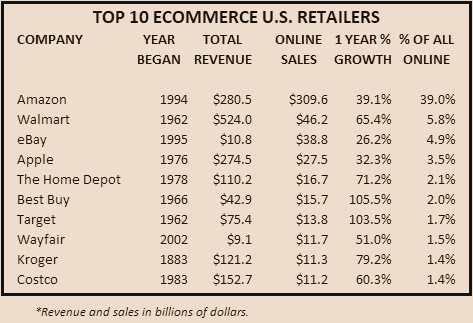
The likelihood that gains in internet sales after Covid-19 will revert to in-store sales is not great. And expected holiday sales will shift further to online. The impact on local retail sales cannot be overstated.

Further, as mentioned in the article above, the real surprise is that online grocery sales have skyrocketed as noted in this Atlanta Constitution article:

    Recent numbers show the pandemic pushed online grocery sales in the U.S. to extraordinary heights. In August 2019, sales were $1.2 billion, according to data gathered by the companies Brick Meets Click and Mercatus. In June 2020, they were $7.2 billion.
    Meanwhile, online sales grew from 3.4% of the grocery buying market in 2019 to 10.2% a year later, according to Mercatus and consumer data firm Incisiv.
    The change is creating thousands of new jobs in Atlanta, from high-tech positions to warehouse and delivery workers.
    Online shoppers will see improved delivery services and a better online user experience as companies compete for their share of the $1 trillion annual U.S. grocery market, industry analyst David J. Livingston said. But some smaller grocers likely won’t be able to keep up and could end up closing as behemoths like Walmart and Amazon continue to take bigger chunks of the online grocery business.
    Grocery store chains are staying competitive by throwing more resources into the fight. Kroger, for instance, has hired the British company Ocado to build a $55 million warehouse in Forest Park where robots will help sort online grocery orders. The chain will begin delivering in the metro area in 2021.
    “We’ll all look back on this year as being possibly the most significant inflection point for online grocery shopping,” said David Hardiman-Evans, Ocado’s senior vice president for North America.

One must also note that the "shoppers" are gig workers reflecting another shift in our economy.


China's Crucial Win in World Trade

China clearly has has offered a 21st Century non-military challenge to U.S. economic strength with a crucial win in world trade, along with a manufacturing focus shift inward.

This must be viewed in the context of China's relative success at suppressing Covid-19 outbreaks. China's one-party unitary national government can impose mandatory lockdowns, testing, and vaccination more effectively than in an undisciplined multiparty federation such as the United States.

China's one-party unitary national government can, and has, turned inward to promote its own consumer economy with the context of the 14th Five-Year Plan and the 2035 Vision to be taken up by the Party Congress next year. Consider this news story:

    President Xi Jinping called on the nation in May to rely more on domestic demand for future growth – dubbing it a dual circulation strategy – and his directive requires significant changes in both internal supply and demand.
    “The pandemic has made it difficult for us to sell abroad, but we do feel as though Chinese customers are less … enthusiastic for foreign brands, especially mid-level products,” said a sales manager at a fashion jewellery brand with shops all over the country.
    “Frankly, it may be becoming fashionable and more politically correct to make and consume good-quality Chinese goods,” he added, asking not to be identified.
    That sentiment seems to be felt by a growing number of Chinese export manufacturers, some of whom say they have started shifting investments to the domestic market even as their exports have seen a huge resurgence recently.
    Orders have been returning to China as other producing countries are still being ravaged by the pandemic, but manufacturers know the trend is most likely unsustainable.

However, China's one-party unitary national government can, and has, turned toward the Pacific-Southeast Asia to join with Australia, Brunei, Cambodia, Indonesia, Japan, Laos, Malaysia, Myanmar, New Zealand, Philippines, Singapore, South Korea, Thailand, and Vietnam to create the Regional Comprehensive Economic Partnership (RCEP). The RCEP, signed November 15, includes almost one-third of the world’s population and about one-third of its gross domestic product. It is the first ever free trade agreement between China, Japan and South Korea – Asia’s largest, second-largest and fourth-largest economies. It's goal is to progressively lower tariffs and aims to counter protectionism, increase investment and allow more free movement of goods.

Brunei, Vietnam, Laos, Cambodia, Thailand, Myanmar, Malaysia, Singapore, Indonesia and the Philippines are members of the Association of Southeast Asian Nations (ASEAN) trade group. It was announced December 1 that the European Union has joined with the ASEAN group in a strategic partnership to "stand up for safe and open trade routes and a free and fair trade" according to German Foreign Minister Heiko Maas after a virtual meeting with his EU and ASEAN counterparts. "Together, we represent more than a billion people and almost 25 per cent of global economic power," noted Maas.

Then, to the surprise of many, President Xi Jinping announced that China “will actively consider” joining the Comprehensive and Progressive Agreement for Trans-Pacific Partnership (CPTPP). Chinese Premier Li Keqiang’s in May noted that “China has a positive and open attitude toward joining the CPTPP”. Were this to be accomplished it would add Canada, Chile, Mexico, and Peru to China's trade group partners.

For Americans who don't remember as far back as four years ago (most Americans), the CPTPP evolved from the Trans-Pacific Partnership (TPP), which failed due to the withdrawal of the United States after Trump took office. Twenty-two TPP provisions that were priorities of the U.S., but not other negotiating partners, were suspended or modified in the CPTPP.

President Barack Obama's push to pass the TPP in 2016 was resisted by the 2016 presidential candidates in both major parties. Clinton and Trump opposed the deal, arguing that it would hurt American workers.

The problem for Clinton was former 2016 presidential candidate socialist U.S. Sen. Bernie Sanders rallied his supporters to urge the Democratic National Committee (DNC) to include language in their platform rejecting the TPP. CNN reporter Eric Bradner wrote, "By keeping specific opposition to the Trans-Pacific Partnership out of the platform, Democrats avoided embarrassing President Barack Obama." Although the DNC's decision was a disappointment to Sanders, he, along with U.S. Sen. Elizabeth Warren, continued to spearhead efforts in the Senate to get their colleagues to vote against Obama's trade deal.

This year, President-elect Joe Biden stated: "When it comes to trade, either we're going to write the rules of the road for the world or China is – and not in a way that advances our values. That's what happened when we backed out of TPP – we put China in the driver's seat. That's not good for our national security or for our workers. TPP wasn’t perfect but the idea behind it was a good one: to unite countries around high standards for workers, the environment, intellectual property, and transparency, and use our collective weight to curb China’s excesses."

What Biden did not foresee was the RCEP, the EU-ASEAN agreement, and China's positive outward reach to the CPTPP.

The problem for the U.S. is that while two-thirds of the original chapters remain in the CPTPP,, among the 22 provisions set aside include such things as investors’ ability to litigate disputes under investment agreements and investment authorizations - which are used mostly for mining and oil investments - are more limited.

Further regarding intellectual property the length of patent protection for innovative medicines has been shortened, technology and information protections have been narrowed, and copyright periods for written materials have also been shortened. Particularly, the stringent requirements that the United States pursued in technological protection measures, rights management information, encrypted satellite and cable signals, and safe harbors for internet service providers have all been removed.

Effectively, the American-East-Coast oriented ignoramuses handed a massive international trade win to China. They didn't protect any American interests or American workers. As Biden said: "We put China in the driver's seat."

The 46 nations within the CPTPP, RCEP, and EU-ASEAN are home to 38% of the world's population and control 50% of the world's Gross Domestic Product (GDP) - 51.64% of the 2019 Nominal GDP, 50.03% of the 2019 Purchasing Power Parity GDP.

The map below with the countries in white (most importantly the United States, India, and Russia) representing non-participants will shape our future Extended Economic Distortion:

The fact that the EU has chosen to get its foot in the door should be a clear warning that the United States no longer has the "collective weight" (to use the term Biden used) it had in the 20th Century. Americans made significant choices at the beginning of the Millenium, choices which will continue to hang over the U.S. economy in complex ways for decades.


The Undercurrent in U.S. Politics Enters the Limelight

The future of the United States is currently bound up in a (almost) fanatical dispute between three points of view. Most certainly the socialists versus the libertarians (recently in the persons of Bernie Sanders versus the Koch Brothers) have chiseled their ideological way into the electorate as reflected in Congress and the state capitols.

But added to that is a formerly "silent" significant minority.

Speaking in Madison, Wisconsin on April 15, 2011, Sarah Palin said everything that needs to be said about that significant minority: "And speaking of President Obama, I think we ought to pay tribute to him today at this Tax Day Tea Party because really he's the inspiration for why we're here today. That's right. The Tea Party Movement wouldn't exist without Barack Obama."

Palin epitomizes what appeals to the significant minority:

  • Of English, Irish, and German ancestry, she was born February 11, 1964 in Sandpoint, Idaho, to "Chuck" Heath (a taxpayer supported science teacher and track-and-field coach) and "Sally" Sheeran (a taxpayer supported school secretary), the third of four children.
  • When she was a few months old, the family moved to Alaska where her father had been hired to teach,  settling in Wasilla, Alaska in 1972.
  • She attended Wasilla High School, where she was head of the Fellowship of Christian Athletes and a member of the 1982 Alaska state champion girls' basketball team and cross-country running team.
  • In 1984, Palin won the Miss Wasilla beauty pageant and she finished second runner-up in the Miss Alaska pageant, where she won the title of "Miss Congeniality".
  • In 1987 she received her bachelor's degree in communications with an emphasis in journalism from the University of Idaho, and then worked as a sportscaster for Anchorage TV stations and a newspaper sports reporter.
  • In August 1988, she eloped with Todd Palin, her high school sweetheart, and they have five children, the youngest of who born in 2008 was prenatally diagnosed with Down syndrome.
  • Todd worked for the oil company BP as an oil-field production operator, retiring in 2009, and owns a commercial fishing business.
  • They are now divorced.

Simply, Palin is a celebrity who foreshadowed the successful candidacy of Donald Trump. It is unclear what would have happened in 2008 had her fame and experience not been limited to Alaska, the third least populous state ahead of only Wyoming and Vermont. Of course, social media such as Twitter and Facebook had not yet completely replaced traditional news sources in 2008 when she ran for Vice-President.

In today's political reality, political candidacy favors celebrity contestants and the significant minority accepts its beliefs from the likes of sportscasters and reality show hosts. The Regional Comprehensive Economic Partnership (RCEP) signed in November 2020 was introduced as a concept in 2011 during the 19th ASEAN Summit. The original proposal for the Trans-Pacific Partnership was made in 2008 with the final agreement stalled by the U.S. disinformation machine in 2016. Sportscasters and reality show hosts cannot compete on a world stage that depends upon 8+ years of informed participation in detailed economic negotiations.

Whatever else you may think, Barack Obama was a well-educated, experienced politician who also was young and black. Future elections will tell us if the U.S. is destined to be a bystander in the world.

Friday, November 6, 2020

And yet another election won by the Koch Machine, this time locking up redistricting and climate policy


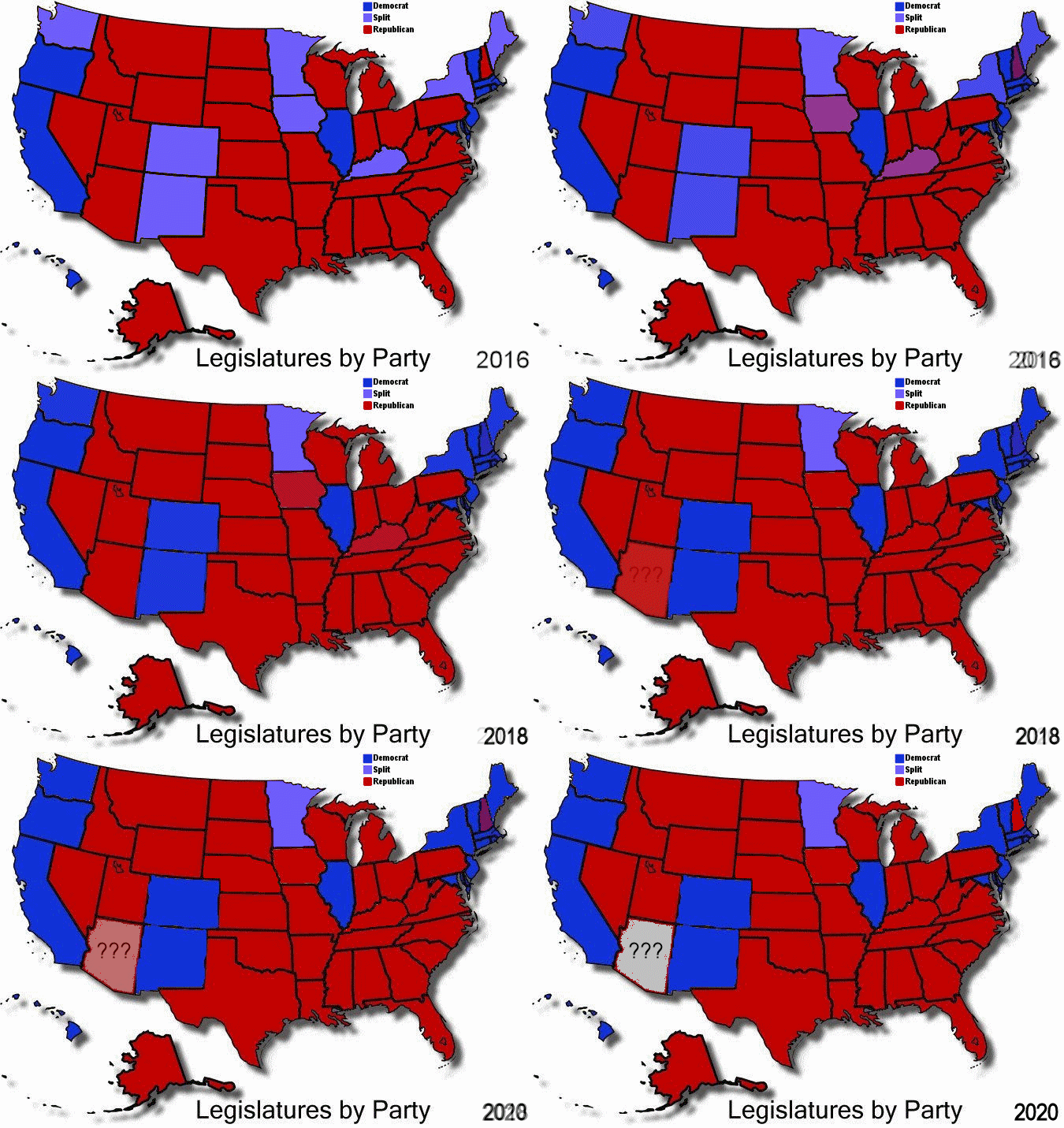
Whether you are a Democrat or a Republican, one should not let this election go by without noting its impact - or lack thereof - on the Koch Bros control of the government entities that count, the state legislatures. In 2018 the Democrats picked up some control mostly in legislatures in which the control of the houses were split, as you can see in the graphic above. The Dems did pick up control of both houses of the New Hampshire legislature.

So long as votes are being counted, one could say there's a chance for a different outcome in 2020. But it appears that the Dems returned control of both houses in New Hampshire to the Republicans. And it appears the Dems have a chance to pick either or both houses in the Arizona legislature.

Of course this means that in all those red colored states, the Republicans will control the decennial redistricting of the U.S. House of Representatives and the legislatures.

But it appears Joe Biden might move into the White House in January and presumably over the next four years will reverse all those Executive Orders and other administrative and regulatory changes the Trump Administration put in place.

But most public policy in the United States will be limited. Many posts noting the Koch political machine are offered in this blog. Perhaps it is easiest to revisit the one regarding former Kansas Congressman and current Secretary of State Mike Pompeo to see what the implications of continued Koch policy will be in the case of Climate Change:

[U.S. Secretary of State Mike]  Pompeo explained that we Americans will...
  • responsively reorganize our society, 
  • relocate as needed, and
  • rely on future technological innovation 
...instead of developing governmental policy as suggested in House Resolution 109 - Recognizing the duty of the Federal Government to create a Green New Deal and creating the bureaucracy needed to implement it.
...The core conservative Climate Change view is addressed in the following policy statement:
  1. Yes, the climate is changing;
  2. Yes, a the changing climate likely will have impacts, perhaps some significant ones;
  3. No, we do not have an accurate prediction of what those impacts will be in the years 2025, 2050, 2100 or 2200;
  4. Individuals and businesses should recognize that over the next decades a need to adapt to changing climate conditions may arise requiring geographical relocation;
  5. Nations should recognize that over the next decades a need to adapt to changing climate conditions may arise requiring a responsive, evolutionary reorganization of society;
  6. Individuals, mostly through businesses as facilitated by free nations, will create technological advances which will allow for adaptation to and reductions in impacts from Climate Change;
  7. The United States Government in response to Climate Change at this time should not create complex economic and social policies, and the bureaucracies to implement them as suggested by the Democrats in H.R. 109, instead continue to rely upon the private sector and the states to address problems as they arise.

Since it is unlikely that the Democrats can get control of the U.S. Senate in the foreseeable future, it would appear that Pompeo's conservative policy will prevail into the next decade.

Yes, Biden could the U.S. rejoin The Paris Agreement. But as explained in a September 30, 2019, post, American participation will depend upon the efforts of the U.S. Climate Alliance depending upon state pollicy plus the efforts of the America’s Pledge organization bringing together private and public sector leaders to ensure the United States remains a global leader in reducing emissions and delivers the country’s ambitious climate goals of the Paris Agreement.

That is simply the product of Democrats not being able to gain control of the state governments. It can be seen in multiple policy arenas. And nothing the Sanders and AOC's of the world do address the problem. They are too enamored with the Presidency and the federal government to divert efforts to where they are needed. And they aren't going to move to Kansas.

Monday, October 19, 2020

Will the dogma "that lives loudly within" Amy Coney Barrett enshrine Koch Brothers Economics?

In her use of the term dogma, Senator Diane Feinstein was discussing Catholic religious dogma with now U.S. Supreme Court nominee and apparent Catholic religious dogma adherent Amy Coney Barrett. Indeed, it is some concern relative to state laws on abortion rights, physician-assisted suicide, and gay marriage.

But what if none of this matters relative to what is important to American national economic and societal structure? What if, as expressed in The New York Times by Kochland author Christopher Leonard "Judge Barrett’s nomination is the latest battleground in [Charles Koch's] decades-long war to reshape American society in a way that ensures that corporations can operate with untrammeled freedom."

What if, indeed!

In a blog post here we have explored in great detail the Koch-funded Neoliberal political organization. In 1958, the father of the Koch Brothers and the Koch Network, Fred C. Koch, became a founding member of the John Birch Society, an American political advocacy group supporting limited government. Over the next 60 years, the Koch wealth has been used particularly by Charles Koch to achieve control of American government. The truth is that with Barrett's nomination Trump has cemented a Neoliberal majority view on the Court.

As noted in the blog post referenced above, the map below indicates which among the 50 U.S. states at the beginning of 2016 had

  1. a Democratic Governor and 
  2. Democrats in control of its legislature. 


In fact, the shift from 1976 to 2016 within the important governments of the United States, the state legislatures, the Koch Network worked hard to bring about the following changes (the Nebraska unicameral legislature is supposedly non-partisan):

After gaining control of most state governments over a period of six decades, in 2016 Neoliberalism gained ideological dominance in the White House with the election of Mike Pence as Vice-President.

 In 1991, Pence became the president of the Indiana Policy Review Foundation, a self-described free-market think tank and a member of the Neoliberal State Policy Network, a position he held until 1993.

More than half of SPN funding comes from DonorsTrust and its sister donor conduit Donors Capital Fund, the preferred funding vehicles of the Koch network of right-wing millionaires, billionaires, and foundations created to funnel money anonymously to network partners.

In 1992, Pence began hosting a Neoliberal ideology daily talk show on WRCR, The Mike Pence Show, in addition to a Saturday show on WNDE in Indianapolis. Beginning on April 11, 1994, Network Indiana syndicated The Mike Pence Show statewide.  From 1995 to 1999, Pence hosted a weekend public affairs TV show also titled The Mike Pence Show on Indianapolis TV station WNDY.

Pence won election to Congress then was elected as Governor. While Governor, in a televised interview appearance with Chris Matthews, Pence advocated eroding the teaching of science in public schools by putting religious dogma on a par with established science, accepting "creationist beliefs" as factual, and thus "teaching the controversy" over evolution and natural selection, and regarding the age of the earth, and letting children decide for themselves what to believe.

This, of course, brings us back to the issue of dogma in politics. In 1980 Charles Koch's brother, the late David Koch, credited the 1976 presidential campaign of Libertarian Roger MacBride as his inspiration for getting involved in politics: "Here was a great guy, advocating all the things I believed in. He wanted less government and taxes, and was talking about repealing all these victimless crime laws that accumulated on the books. I have friends who smoke pot. I know many homosexuals. It's ridiculous to treat them as criminals — and here was someone running for president, saying just that."

In other words, the Koch's are not conservative when it comes social issues. They simply want government totally out of business regulation and funding

Nonetheless, the Koch's have had to accept the dogmatic orthodoxy of Catholic fundamentalists and Christian evangelicals in order to advance their dogma in "these" United States (see maps above). If they must risk state laws on abortion rights, physician-assisted suicide, and gay marriage to "restore" unrestricted capitalism, so be it. In reality none of those laws would ever interfere with the activities of wealthy capitalists anyway.

Religion has a peculiar role in American history and politics. For instance, the Third Clause of Article VI of the Constitution states in part: "No religious Test shall ever be required as a Qualification to any Office or public Trust under the United States." Further, the First Amendment to the U.S. Constitution states: "Congress shall make no law respecting an establishment of religion, or prohibiting the free exercise thereof."

As perhaps half of 13 percent of Americans who know the year the U.S. Constitution was ratified are aware, the establishment of religion is a legal arrangement. It exists in Great Britain, Norway and other countries and existed in varying forms in many more countries in 1789, and in 10 of the original 13 colonies. One religion is designated as the official religion of the government. It is given preferential financial support by the government, which normally has a voice in the appointment of church officials. Frequently, the head of state must be an adherent of that religion.

The exclusion of non-Protestants from public office was practiced well into the 19th century. Disestablishment was not completed in Connecticut until 1818, in Massachusetts until 1833 and in New Hampshire until 1877. Keep that year in focus.

The Constitution forbids Congress to establish a national religion or even permit a religious requirement for someone to hold office. It also forbids congressional interference with religious practices. Or does it?

The year after 1877, in 1878, the U.S. Supreme Court, in Reynolds v. United States, ruled that a law against bigamy was not considered to be religiously discriminatory against members of The Church of Jesus Christ of Latter-day Saints (LDS Church), who were practicing polygamy up until 1890. The Court investigated the history of religious freedom in the United States and quoted a letter from Thomas Jefferson in which he wrote that there was a distinction between religious belief and action that flowed from religious belief. The former "lies solely between man and his God," therefore "the legislative powers of the government reach actions only, and not opinions." The Court determined that the First Amendment forbade Congress from legislating against opinion, but allowed it to legislate against action. Therefore, religious duty was not a suitable defense to a criminal indictment, religious actions could be regulated by law.

So ""Congress shall make no law...prohibiting the free exercise" of religion was interpreted to mean that the term "free exercise" was limited to holding an opinion.

In no way does the Constitution prohibit states from recognizing religions or religious practices nor from prohibiting religions or religious practices. Right? Well, not exactly.

Apparently in 1878 it was determined that Congress could regulate marriage practices. You see, the 14th Amendment only guaranteed religious civil rights by securing "the equal protection of the laws" for every person effectively prohibiting discrimination on the basis of religion.

But marriage laws, for instance, ostensibly don't discriminate on the basis of religion but rather on the "moral" preferences of the legislature. That puts gay marriage potentially back before the courts, as would the "right to life" put abortion and assisted suicide before the court.

If you find this confusing, you are not alone. It will be interesting to see what the Supreme Court will have to say about it all now that we've turned the Judicial Branch over to the American Catholic Church.

On the other hand, the Koch Network hopes it will result in enshrining their economic dogma.

Monday, August 17, 2020

Will the Democrats allow the Koch Brothers machine through Trump finally kill the Post Office


The Post Office is a key community service for rural communities. That is as it was intended to be when in the late 19th Century the United States Post Office Department began Rural Free Delivery (RFD).

Long before that, the postal system was established as explained on this History site:

    In 1753, Benjamin Franklin, who had been postmaster of Philadelphia [since 1737], became one of two joint postmasters general for the colonies. He made numerous improvements to the mail system, including setting up new, more efficient colonial routes and cutting delivery time in half between Philadelphia and New York by having the weekly mail wagon travel both day and night via relay teams. Franklin also debuted the first rate chart, which standardized delivery costs based on distance and weight.
    In 1774, the British fired Franklin from his postmaster job because of his revolutionary activities. However, the following year, he was appointed postmaster general of the United Colonies by the Continental Congress. Franklin held the job until late in 1776, when he was sent to France as a diplomat. He left a vastly improved mail system, with routes from Florida to Maine and regular service between the colonies and Britain. President George Washington appointed Samuel Osgood, a former Massachusetts congressman, as the first postmaster general of the American nation under the new U.S. constitution in 1789. At the time, there were approximately 75 post offices in the country.

Since Franklin's time, private delivery services existed frequently lobbying against the Post Office Department seeking to replace it. However, the system expanded offering parcel service and stimulating the formation of catalog companies in the late 19th Century.

In March 1970, having virtually no plan and no big picture view, union postal workers in New York City - upset over low wages and poor working conditions, and emboldened by the Civil Rights Movement - organized a strike which eventually gained support of over 210,000 United States Post Office Department workers across the nation. This resulted in the Postal Reorganization Act of August 12, 1970, replacing the historical cabinet-level Post Office Department with a new federal agency, the United States Postal Service, that looked and felt more like a private company.

From the 1970's on, conservative organizations pushed hard behind the scenes for privatization of the new Postal Service. As noted in a Christian Science Monitor 1995 article Republicans Eye US Postal Service For Privatization Push during the Clinton Administration privatization even received backhanded support from Postmaster General Marvin Runyon, a former Ford Executive.

Now we are confronted with a stronger move to dismantle the Postal Service as noted in Trump Moves to Gut the Post Office: His war on Amazon expands to include the right wing’s campaign to abolish America’s oldest - and still successful - public service.

The popular press offer stories like Exclusive: UPS, FedEx warn they cannot carry ballots like U.S. Postal Service explaining complexities of the law while only mentioning at the end that costs would skyrocket since delivery firms charge significantly more for deliveries than the price of a 55-cent stamp and international costs would be astronomical.

And therein lies the truth of privatizing the Postal Service, the third largest non-rail logistics company by value in America. It generated $71 billion in annual sales in 2019, slightly less than UPS’s $76 billion and somewhat higher than FedEx’s $69 billion. But it could generate another 20% by substantially raising rates on some classes of mail at the expense of the average American and particularly rural Americans.

Republicans, of course, back privatization while enjoying the support of much of rural America. It's a puzzle. However, the conservative CATO Institute website offers a full explanation on why a Constitutional Amendment would not be necessary to privatize the Postal Service. Founded in 1974 by Ed Crane, Murray Rothbard, and Charles Koch, the Cato Institute has multiple pages on the Postal Service and its woes which accurate reflects Republican Party thinking.

Trump, of course, has taken advantage of the left's mindless labor-oriented attacks on Amazon in order to put the Postal Service in a bad light. It is simply another lie that Amazon doesn't pay enough. The picture below did not come about because the Post Office is cheap:


The issue is relatively simple and has been for 280+ years. Benjamin Franklin and others wished to assure an affordable, timely distribution system for information and goods for all Americans. In theory since the 1930's it should have always been a top Democratic Party issue. But panic over voting is the only thing that has even brought the matter to the forefront since Third Way or New Democrats in the Clinton Administration gained influence.1

While the urban young may think the Post office an antiquated system, it has come to the attention of some that internet technology is not available to a lot of students. Sadly, what has been lost is the 1930-1970 commitment to assure all Americans access to the basic utilities needed to assure everyone a fair, basic opportunity at life.

                                                   
FOOTNOTES:

  1.  New Democrats tend to identify as fiscally conservative and socially liberal. The Post Office is a good example of why that is inherently an untrustworthy combination. There is nothing about the funding of the Post Office that deserves support by a fiscal conservative. But if you care at all about non-wealthy, the Post Office is an essential service.

Monday, June 10, 2019

As Climate Change Black Death Surrounds Us
  U.S. Secretary of State Mike Pompeo explains the
  conservative "old deal" to address Climate Change

U.S. Secretary of State Mike Pompeo, speaking on behalf of what is Republican thinking, laid out policy regarding Climate Change.

In an interview while he was in Europe, Pompeo explained that the Paris Agreement was an "aspirational" document but otherwise worthless because its "enforcement mechanisms were near-nonexistent." He argued that it represented a “real burden … on the [U.S.] and its economy and its workers and ordinary people in places like Kansas that I come from.”

Instead, Pompeo explained that we Americans will...
  • responsively reorganize our society, 
  • relocate as needed, and
  • rely on future technological innovation 
...instead of developing governmental policy as suggested in House Resolution 109 - Recognizing the duty of the Federal Government to create a Green New Deal and creating the bureaucracy needed to implement it.

Before becoming Secretary of State, Pompeo served as CIA Director for the Trump Administration leaving his seat representing Kansas House District 4 which he had held since January 2011. He was a member of the Tea Party wing of the Republican Party. In the 2010 Republican Primary when another Republican candidate began to gain on him, Koch Bros funding assured his victory.

Pompeo did not "come from" Kansas. He did not evolve from some rural experience in the Plains States. A native Californian who graduated from Los Amigos High School in Fountain Valley, Pompeo is a West Point graduate who served only 4+ years as an officer in the Army and is an attorney who received his JD degree in 1994 from Harvard.

In 1998, when he was 34, Pompeo came to Kansas with three West Point friends, Brian Bulatao (who at the time worked for Bain Capital and who was confirmed by the United States Senate as Under Secretary of State for Management on May 16, 2019), Ulrich Brechbuhl (who since May 3, 2018, has served as Counselor of the United States Department of State), and Michael Stradinger. In Wichita they acquired three aircraft-part manufacturers along with a fourth in St. Louis, Missouri. They obtain venture funding from Bain Capital (Mitt Romney was that company's first CEO), Koch Industries, and Cardinal Investment (founded by another West Point/Harvard graduate).

One other fact Pompeo offered about himself in a speech places in ideological context the importance of the statements he made about Climate Change policy.


Simply put, Pompeo is the face of an evolving American conservative activism that is blending Neoconservatism and Neoliberalism under what appears to be unfocused freewheeling President Donald Trump.

And, as mentioned by Pompeo, the core conservative Climate Change view is addressed the following policy statement:
  1. Yes, the climate is changing;
  2. Yes, a the changing climate likely will have impacts, perhaps some significant ones;
  3. No, we do not have an accurate prediction of what those impacts will be in the years 2025, 2050, 2100 or 2200;
  4. Individuals and businesses should recognize that over the next decades a need to adapt to changing climate conditions may arise requiring geographical relocation;
  5. Nations should recognize that over the next decades a need to adapt to changing climate conditions may arise requiring a responsive, evolutionary reorganization of society;
  6. Individuals, mostly through businesses as facilitated by free nations, will create technological advances which will allow for adaptation to and reductions in impacts from Climate Change;
  7. The United States Government in response to Climate Change at this time should not create complex economic and social policies, and the bureaucracies to implement them as suggested by the Democrats in H.R. 109, instead continue to rely upon the private sector and the states to address problems as they arise.
Since it is unlikely that the Democrats can get control of the U.S. Senate in the foreseeable future, it would appear that Pompeo's conservative policy will prevail into the next decade. And it would be a mistake to dismiss the policy statement.

Earlier this month, a Reuters report World's biggest firms foresee $1 trillion climate cost hit indicated that:

    More than 200 of the world’s largest listed companies forecast that climate change could cost them a combined total of almost $1 trillion, with much of the pain due in the next five years....
    The companies anticipated a total of $970 billion in extra costs due to factors including hotter temperatures, chaotic weather, and pricing of greenhouse gas emissions. About half of these costs were seen as “likely to virtually certain.”
    Many companies also saw a huge potential upside if the world can de-carbonize in time to avert the bleakest climate scenarios, which scientists see as an existential risk to industrial civilization.
    Fossil fuel companies who submitted responses to the study reported $140 billion of potential opportunities in the drive toward a low-carbon economy - more than five times the $25 billion value of the risks they identified...
    With climate action focused on limiting the burning of coal, oil and gas, CDP urged investors to question why fossil players seemed so confident of benefiting from an energy transition that would render their existing business models obsolete.

It might be tempting to minimize this news except that it is based on a study initiated by the G20 Finance Ministers and Central Bank Governors. At their request the Financial Stability Board (FSB) established the Task Force on Climate-related Financial Disclosures (TCFD) and its recommendations resulted in reporting from 6,937 companies (more information is available here).

And so as many of the Democratic candidates seeking to run for President in 2020 embrace the Green New Deal of Democratic Socialist Alexandria Ocasio-Cortez, Donald Trump has a simple answer - individual American's and their businesses using their ingenuity will deal with Climate Change when and as needed. (The unsaid corollary is: and those who can't deal ...well... we already have too many people.)

Or Americans could choose to depend on the Democrat of their choice who says "I'm from the government and I'm here to help you." The problem with that is even if Trump loses, the Senate stands in the way.

Meanwhile some of the states are taking serious action such as California as explained in Embracing Inclusive Capitalism Plus within The California Green & Gold Deal as Newsom leads.


The 21st Century Climate Change Black Death is happening now.
                                                                                                          If you're new to this blog here's the link to the listing of the 30+ previous posts in the Blog regarding Climate Change and the Environment.

This post is a part of a series:  climate change black death surrounds us 
                                                                                                         

Friday, May 17, 2019

The very-American delusion behind Trump's foreign policy
The Bold 19th Century and 21st Century Women Architect-Advocates of America's Manifest Destiny


Jane Cazneau - The 19th Century Mistress of Manifest Destiny


The first female war correspondent in American history, Jane Cazneau, is credited with coining the term "Manifest Destiny" in 1845.

The term "manifest destiny" appeared in an unsigned editorial entitled "Annexation" in the United States Magazine and Democratic Review which at the time was edited by John L. O'Sullivan who was rescued from obscurity in the twentieth century after the term was traced back to the publication and was assumed to have been written by him (after all, he was a man).

In fact Cazneau regularly wrote for the publication but it wasn't until Linda S. Hudson in her 2001 biography of Cazneau Mistress of Manifest Destiny that Cazneau was credited and then only because Hudson used computer-aided "textual analysis" to support her argument.

In the editorial, Cazneau wrote almost prophetically (emphasis added):

    Why, were other reasoning wanting, in favor of now elevating this question of the reception of Texas into the Union, out of the lower region of our past party dissensions, up to its proper level of a high and broad nationality, it surely is to be found, found abundantly, in the manner in which other nations have undertaken to intrude themselves into it, between us and the proper parties to the case, in a spirit of hostile interference against us, for the avowed object of thwarting our policy and hampering our power, limiting our greatness and checking the fulfillment of our manifest destiny to overspread the continent allotted by Providence for the free development of our yearly multiplying millions.
    Away, then, with all idle French talk of balances of power on the American Continent. There is no growth in Spanish America! Whatever progress of population there may be in the British Canadas, is only for their own early severance of their present colonial relation to the little island three thousand miles across the Atlantic; soon to be followed by Annexation, and destined to swell the still accumulating momentum of our progress. And whosoever may hold the balance, though they should cast into the opposite scale all the bayonets and cannon, not only of France and England, but of Europe entire, how would it kick the beam against the simple, solid weight of the two hundred and fifty, or three hundred millions–and American millions–destined to gather beneath the flutter of the stripes and stars, in the fast hastening year of the Lord 1945!

This was motivated by economic self-interest. In 1832, Jane's father ventured into land speculation, and was one of the founders of the Galveston Bay and Texas Land Company. Jane and her brother Robert traveled to Texas, which was then still part of Mexico, to buy land. The next year, Jane (pictured right), her father, her brother Robert and a company of German settlers set out to take possession of the land, but when the scheme failed she returned home with her father to Brunswick, NY. Her brother Robert remained in Texas and eventually became a wealthy planter. Also at this time, Eliza Jumel named her as co-respondent in her divorce suit with Aaron Burr, alleging an affair in addition to his ruinous attempt at land speculation.

Though a northerner Cazneau embraced the expansion of the South, and of slavery, its 'peculiar institution', into Central America and the Caribbean. President John Polk sent her on a secret peace mission to Mexico in 1845 which evolved into her Mexican-American War coverage, after which she began advocating Cuba's annexation and denouncing its Spanish colonial status. She did not live long enough to see the Spanish-American War. Having married William Cazneau in 1849, they moved  to the Dominican Republic in 1855. She wrote that the Civil War was a serious interruption to further prospects of American expansion in the Caribbean. In 1878, she was drowned when her ship sank in a storm on her way to Santo Domingo.

The term Manifest Destiny was used to justify the war with Mexico. One might speculate that if alive today Cazneau would be a Trump supporter on Fox News because of her political and personal opinions would fit nicely into Trump's view of life. 

As explained in the Wikipedia entry, Manifest Destiny:

    The legacy is a complex one....
    The belief in an American mission to promote and defend democracy throughout the world, as expounded by Thomas Jefferson and his "Empire of Liberty" and Abraham Lincoln, was continued by Theodore Roosevelt and Woodrow Wilson. Under Harry Truman (and Douglas MacArthur) it was implemented in practice in the American rebuilding of Japan and Germany after World War II. George W. Bush in the 21st century applied it to the Middle East, in Afghanistan and Iraq. Tyner argues that in proclaiming a mission to combat terror, Bush was continuing a long tradition of prophetic presidential action to be the beacon of freedom in the spirit of manifest destiny.
    President Woodrow Wilson continued the policy of interventionism in the Americas, and attempted to redefine both manifest destiny and America's "mission" on a broader, worldwide scale. Wilson led the United States into World War I with the argument that "The world must be made safe for democracy." In his 1920 message to Congress after the war, Wilson stated:

    ... I think we all realize that the day has come when Democracy is being put upon its final test. The Old World is just now suffering from a wanton rejection of the principle of democracy and a substitution of the principle of autocracy as asserted in the name, but without the authority and sanction, of the multitude. This is the time of all others when Democracy should prove its purity and its spiritual power to prevail. It is surely the manifest destiny of the United States to lead in the attempt to make this spirit prevail.
    This was the only time a president had used the phrase "manifest destiny" in his annual address....
    "Manifest destiny" is sometimes used by critics of U.S. foreign policy to characterize interventions in the Middle East and elsewhere. In this usage, "manifest destiny" is interpreted as the underlying cause of what is denounced by some as "American imperialism." A more positive-sounding phrase devised by scholars at the end of the twentieth century is "nation building," and State Department official Karin Von Hippel notes that the U.S. has "been involved in nation-building and promoting democracy since the middle of the nineteenth century and 'Manifest Destiny.'"

Has the reality of the 21st Century been overlain with a veneer of American 19th Century delusion clouding the eyes of many Americans, particularly those in the Trump Administration?

The correct word is "overlain", the past participle of "overlie", as it means to cover, overwhelm, or smother. That is different from "overlaid", the past participle of "overlay" which means adds something such as "he overlaid the railroad routes to the highway map."

The ideological seeds of the Trump Administration as supported by The Deplorables were planted in 19th Century America. We grew a belief in Manifest Destiny the policy effects of which are well expressed by John Gast’s painting “American Progress”.


Its images which in truth were of government subsidized railroads and homesteaders taking advantage of the various Homestead Acts (though the subsidized portion is a commonly shared denial), includes in its darkness slavery, hysterical anti-heretic religious discrimination ranging from the witch trials to anti-Catholic pogroms, the genocidal American Indian Wars, the permanent occupation resulting from the Mexican American War, and the Imperialism of the Spanish American War of 1898 which was reflected in this political cartoon of the time...


Kiron Skinner - The 21st Century Mistress of Manifest Destiny

All of this brings us to the racist history underlying the Trump Administration's approach to China. And to understand that, you need to be aware of another woman,  Kiron Skinner, who on behalf of the Trump Administration appears to have embraced a 21st Century update of Cazneau's worldview.

But first, some history review is required....

On May 6, 1882, the Chinese Exclusion Act was signed into law just 13 years after the Last Spike was driven to connect east and west portions of the Transcontinental Railroad. The Act effectively barred the Chinese from entering the country and prevented them from achieving citizenship. It was an addition to the 1875 Page Act, which banned Chinese women from immigrating to the United States. These were the first laws implemented to prevent all members of a specific racial, ethnic or national group from immigrating and/or obtaining citizenship. Thus began a period of systematic discrimination against the Chinese, hundreds of whom built the west portion of the railroad as part of the achievement of America's Manifest Destiny.

Now you might ask why I would bring up this history today? What could it possibly have to do with current government policy. Well apparently whether white or black, historically in the 19th Century or currently in the 21st Century, American foreign policy officials really do seem to have a problem with Asians, particularly the Chinese as an ethnic group.

Earlier this month, building on a story that appeared in the Washington Examiner, The Washington Post headlined its report Because China isn’t ‘Caucasian,’ the U.S. is planning for a ‘clash of civilizations.’ That could be dangerous. From another source defending the "Caucasian" reference, I learned that the Director of Policy Planning at the United States Department of State Kiron Skinner said at a security forum March 29: "So in China we have an economic competitor, we have an ideological competitor, one that really does seek a kind of global reach that many of us didn't expect a couple of decades ago, and I think it's also striking that it's the first time that we will have a great power competitor that is not Caucasian."

Kiron Kanina Skinner having been raised in California should
  1. be aware of Japan's position in Asia in the first half of the 20th Century - you know, we fought them, used the atomic bomb on them, etc. - and 
  2. understand that the Japanese are not Caucasian. 
She has a superlative education and extensive experience in government and in politics. Oh, and she's black which superficially would seem to caution her about racial references particularly because she was a student of, Condoleezza Rice, the Thomas and Barbara Stephenson Senior Fellow on Public Policy at the ideologically Neoconservative Hoover Institution.

So when I read that Skinner is the W. Glenn Campbell Research Fellow and a member of the Shultz-Stephenson Task Force on Energy Policy at Stanford University's Hoover Institution, it started to dawn on me that her likely ideological orientation is Neoconservative. Like Secretary of State Mike Pompeo and National Security Advisor John Bolton she's one of the Neocon's in the Trump foreign policy group.

She worked on the political campaigns of George W. Bush,  Newt Gingrich,  and Mitt Romney and served on Trump's transition team. Her academic life includes extensive published work on Ronald Reagan. She is a Fox News contributor.

And today she works directly for Secretary of State and former Congressman from Kansas Mike Pompeo who in a talk at the right wing, Koch Brothers funded Heritage Foundation on May 21, 2018, said: "First as a private citizen and then as a member of Congress, and even today, the Heritage Foundation has shaped my thinking on matters of the world and public policy issues".

Skinner’s office is composing what it calls “Letter X” — styled after George Kennan’s “X Article” that laid out an argument for containing the Soviet Union during the first years of the Cold War. In other words, the Trump Neocons such as Skinner are set on creating a new Cold War with China's 1.4 billion people.

Unfortunately in the long term that makes no sense in the context of Climate Change which in the late-21st Century will wipe away the veneer of American 19th Century delusion.

And unfortunately, as will be explored in the next post, by embracing in the 21st Century the American 19th Century delusion the implementation of new 5G technology for use by the average American will be significantly delayed.

But when Trump said he wanted to "Make America Great Again" he apparently meant embracing that Manifest Destiny delusion, though perhaps he is unaware that it launched the United States into its first two foreign wars of aggression.

Thursday, December 6, 2018

The Crimson Tide engulfing 32 states (77% of the United States in area) absorbs the Blue Ripple vote. What the biennially aroused Democrats don't get!


When it comes to ocean metaphors, the National Democratic Party has its head in the sand. Since the 1960's 64% of these United States experienced a consistently rising political Crimson Tide1, dispersed over 77% of the geographic area, which no electoral Blue Wave will sweep away. In the 21st Century, only California has had a significant, consistent electoral Blue Tide.


A Blue Wave versus a Rising Blue Tide

In the months leading up to the November 2018 election, we were buried in "Blue Wave" hype by Democrats and liberal media.


Of course no electoral Blue Wave materialized. As will be explored here, there have been electoral "Waves" and there have been public policy "Waves." Then there is a California "Blue Tide" pushing away the Crimson Tide sustaining currents from its electoral and public policy shores.

The kind of "Blue Wave" that might really matter - a public policy Blue Wave - we last saw in these United States in 1964-66. More on that later.

If you wonder what an electoral Blue Wave really looks like consider this. In the General Election of 1882 California voters chose to:
  • elect Democratic candidates to all of the then existing state Executive positions - Governor, Lieutenant Governor, Attorney General, Secretary of State, Treasurer, Controller, and Superintendent of Public Instruction - all previously held by Republicans
  • switch the State Board of Equalization from 3 Republicans and 1 Democrat to 3 Democrats and 1 Republican
  • replace the Republican majority in the State Senate with an 80% Democratic supermajority and the Republican majority in the State Assembly with a 75% Democratic supermajority; and
  • elect 4 Democrats as its members of the House of Representatives from California, previously 2 Republicans and 2 Democrats.
But as is typical for electoral waves, that wave broke, receded, and within eight years Republicans regained domination in California government until 1959, 68 years later, when Democrats started winning some key races and a majority in the Legislature.

Beginning in the 21st Century, California Democrats expanded, with an occasional short-term exception, control of all of California's state government. Instead of a Blue Wave, we have had a "Blue Tide" that has slowly and steadily drowned the California Republican Party in its own Crimson Tide currents.

In the 2018 General Election our Blue Tide did rise to an unusual high. As the new Legislature was sworn in on December 3rd, at the last count:
  • the new Assembly was Democrats 60 (75% supermajority), Republicans 20 (25%), with a chance one seat could end up with a Democrat instead of a Republican;
  • the new Senate was Democrats 29 (72.5% supermajority), Republicans 11 (27.5%);
  • Democrats control every statewide office; and
  • Representatives from California in the House of Representatives included 46 Democrats to 7 Republicans, versus the previous count of 38 Democrats and 14 Republicans.
At this given moment no meaningful Republican Party exists in California, a state where previous Republican Governors included Earl Warren and Ronald Reagan.


About that current sustaining the electoral Crimson Tide

I am a native Californian, I'm old, but until this November I held a foolish hope that the National Democratic Party was going to attempt to create a party structure that would consistently win outside California. But then this appeared less than a month before the election:

"The first line of resistance against Republicans’ extremist policies starts in the states." - from an October 8, 2018 memo signed by Democratic National Committee CEO Seema Nanda and Democratic Legislative Campaign Committee Executive Director Jessica Post

Really? This had to be stated in a memo to the Democratic Party less than a month before the midterms?

Apparently so. Because this week a special election to fill the most important position in Georgia state government - the one that will determine election administrative policy such as whose names to strike off the voter rolls in 2020 - was abandoned by the starry-eyed, celebrity-oriented Democrats who seemingly can only get aroused biennially and then only enough to focus on positions that have celebrity status - like the Governor's position in Georgia that they lost in November (though we must recognize that special arousal that resulted in tens of millions of dollars spent on losing one Georgia Congressional seat special election in 2017, correctly called "a bad and expensive bet"). And so we have this story...


...which tells us...

    Georgia, the site of one of the year's most closely watched races for governor — and before that, its most expensive special House election in history — will hold Tuesday runoffs in a smattering of local races and for two major statewide offices. The duties of one, secretary of state, drew an unusual amount of attention before and just after the Nov. 6 election. Then, the job was held by Abrams's Republican opponent, Brian Kemp, whom Democrats accused of making it more difficult for people of color to vote by purging voter rolls of people who had not voted in recent elections and not supplying enough voting machines at some polling places.
    While Kemp defends his actions, Abrams pointedly did not offer a formal concession when she acknowledged Kemp's win. She is telling voters that their election is not over and is prominently featured in a mailer for John Barrow, the Democrat hoping to replace Kemp.
    "Voter suppression works when people decide their individual voices are too weak or too fragile to bring about change,” Abrams said in a recent interview with The Washington Post. "John Barrow is part of the solution."
    But even with Abrams's urging and the controversy around the Nov. 6 vote, formerly bustling campaign offices are seeing notably less traffic. The celebrities who flew in to endorse Abrams have stayed home. The airwaves have largely been reconquered by local businesses, with only occasional election spots. The relatively low-key election worries Democrats.
    Yet days before the year's final competitive elections, the turnout machine was dramatically smaller than the one that had changed the state's electorate in an unsuccessful attempt to elect Stacey Abrams to the governor's office. "I had 120 canvassers for the November 6 election," said Latrice Benton, the NGP's lead organizer for Gwinnett County, in the Atlanta suburbs. "I had 20 yesterday, but I had to cut them." The reason? "Not enough funding."

The Republican won, of course. Instead, Democrats seem to embrace the following really, really stupid thinking...


Fresh from patting themselves on the back for winning the governor (and attorney general) races in Michigan and Wisconsin, followers of national Democratic "leaders" like Sanders are discovering just how unimportant it is to elect a candidate to a "D-List celebrity" position like governor (or President).

During the lame-duck period before the new Democratic governor-elect takes office in 2019, the Republican legislators - folks who hold the most powerful positions in the United States - are adopting laws which will limit the power of the incoming Democratic governors.

Those legislatures will, of course, remain Republican after the new year begins because the Democrats failed miserably to win the important positions in those states. But those legislatures will not be veto-proof. They needed to act now while a Republican is still governor.

Democrats are grumbling but here's the truth....

There are 132 people in Wisconsin and 148 in Michigan serving as state senators and state representatives. That's 280 legislators, mostly bland, frequently policy-oriented folks not of celebrity status material. They get to decide many details about Obamacare and abortion in those two states, not Donald Trump or any U.S. President, not Congress, and not a Governor. Finding a way to win a simple majority in each state senate and house would have been meaningful.

It's not "fun" to effectively organize a campaign for candidates for those 280 seats. And there are 7,103 other state legislators in these United States, each seat needing the focused attention from the Democratic side, focus comparable to that given by the Koch Bros Neoliberal organization - the current sustaining the American 21st Century Republican Crimson Tide.

In the last quarter of the 20th Century Democrats really didn't seem to want to divert attention away from their Presidential candidates. Thus Democrats lost each election in most of the states whether their Presidential candidate won or not.

During that period the Neoliberals moved the Republicans to victory through the states. That's because they are not confused, as explained here in April 2017:

...Over a period of 70 years, between 1947 and 2016, one group of ideologues - the Neoliberals - achieved effective control of most state government$ in the United States and, at this time somewhat less effectively, taken control of the U.S. House of Representatives. And to some degree their view is strongly represented on the Supreme Court.

In fact, the shift from 1976 to 2016 within the important government$ of the United States, the state legislatures, looks like this (focus on Nebraska which has a unicameral legislature that is supposedly non-partisan).


Yes, in November 2018 Democrats did win a majority in the House of Representatives - thereby winning control of half of one of the three branches of the U.S. government. Yes, control of half of one of the three branches of the U.S. government. That's not a Blue Wave, just a Blue Ripple. At the same time, there was an election that looked like this from the standpoint of political control of the states:


In this context, the "Blue Wave" enthusiasm in the end apparently meant that a few purple states (split control of the legislature) turned totally blue (Democratic control of both houses). And some turned red (Republican control of both houses). As explained by the New York Times:

    In a stark display of the nation’s divide, the lower and upper chamber of every legislature but one — Minnesota — will be controlled by the same party following Tuesday’s midterm elections. It will be the first time in 104 years that only one state will have a divided legislature.
    That emerging political dynamic has potentially serious policy implications. Without a divided government, these single-party state houses are in a position to enact legislation at a time when Washington faces a new round of gridlock after Democrats captured the House and Republicans expanded their control of the Senate.
    The political lineup of the legislatures came into focus as the Democrats captured control of seven statehouse chambers on Tuesday, a relatively weak showing that left Republicans dominant in an overwhelming majority of state governments. By contrast, Republicans seized more than 20 statehouse chambers from Democrats in the critical 2010 midterm elections, according to the National Conference of State Legislatures.
    The district maps drawn by Republicans who took power in state legislatures in 2010 — a midterm election under President Barack Obama that saw steep losses for his party across the board — was one of the reasons for the modest Democratic gains, analysts said.
    With the election results, the Republican Party will control both houses in 30 states, while Democrats will hold complete control in 18 states.
    Republicans dismissed the Democratic gains in the statehouses, noting how modest they were and that Republicans held onto legislative majorities in crucial states like Florida, Michigan and Wisconsin.
    “We see this as a significantly fumbled opportunity by the Democrats to make gains,” said Matt Walter, the president of the Republican State Leadership Committee, adding that the states where Democrats flipped chambers on Tuesday were all states Ms. Clinton won in 2016. For Democrats, he said, it was a “disappointing night given all the spending and hype.”
    Democrats did not succeed in flipping statehouse chambers in key Midwestern states where Mr. Trump triumphed in 2016. Indeed, Republicans held or extended their majorities in some of those states, including in the Wisconsin Senate and the Iowa Senate.
    In Ohio, where Mr. Trump won by eight points, Democrats fell short of winning the governor seat. While Democrats picked up a handful of seats in the House chamber, they appeared to have lost a seat in the Senate. And even though Republicans lost seats in the state House, the party will retain a three-fifths supermajority in both legislative chambers, giving them the ability to override gubernatorial vetoes.
    In New Hampshire, Democrats flipped both chambers and took control of the Executive Council, which effectively functions as an additional branch of government. Although Gov. Chris Sununu, a Republican, was re-elected, the fact that he will have to deal with a Democratic legislature and Executive Council could make it difficult for him to implement policy.
    The vote on Tuesday represented the first stage of elections that will set the parameters for reapportionment after the 2020 census is conducted. About 800 of the lawmakers elected Tuesday will have a voice in that realignment — for the most part, state senators whose terms are longer than two years. Another 5,000 will be elected in 2020.

When liberals go hat-in-hand to beg the U.S. Supreme Court to overturn state laws on subjects like gay marriage or abortion, they are going there because those liberals failed to do the hard work and spend the money to win their state legislatures. Unless or until the National Democratic Party starts explaining this to their members, it will fail as a political party in the Union known as these United States.

As I've noted here numerous times, it is those who are elected to state legislatures that are in the most important political positions. I know this is difficult for many Democrats to accept. And that is exactly why the Democrats have so little clout over domestic policy within a significant majority of states.


The 1964 Civil Rights Act

Keep within your vision the state-level directional change from 1978 to 2016 when you consider this:


The U.S. Constitution, designed to create a Union of internally independent states, was structured to retain the broadest government power within the state governments.

Or to put it another way, the 10th Amendment emphasizes that the United States Union was created to smooth out commerce across state and international boundaries, provide for a common defense of all states in the case of an attack by an outside foreign government, and a few other minor related items.

Not included in the list were things like inter-personal relationships, health care, education, etc. These were things state legislatures were supposed to take care of. And if you haven't noticed, whether it's Obamacare or land use, it is the legislatures that create the regulatory framework for those issues, and in a majority of cases not in a way we Democrats like because we don't do the work and spend the money on winning all those legislative seats.

Yes, one exception exists to the powers of the state legislatures which was a somewhat confusing result of the Civil War. That is the 14th Amendment, not put in place by our Founding Fathers, which specifically provides that: "No State shall make or enforce any law which shall abridge the privileges or immunities of citizens of the United States; nor shall any State deprive any person of life, liberty, or property, without due process of law; nor deny to any person within its jurisdiction the equal protection of the laws." Note that it does not give Congress any specific additional powers. But it does give the federal court system a standard by which state laws can be reviewed.

Now reconsider the graphic above containing the images of Presidents Lyndon Johnson and Donald Trump.

The Civil Rights Act of 1964 based on the 14th Amendment was a law of the United States government making unlawful segregation in public places and banning employment discrimination on the basis of race, color, religion, sex or national origin. The legislation had been proposed by Democratic President John F. Kennedy in June 1963, but opposed by filibuster in the Senate. It is considered one of the crowning legislative achievements of the Democratic President Lyndon Johnson. But was it a the death knell of the Democratic Party within the Union (let's be clear, the Union is not a Union of people, but a Union of states). Consider these two graphics:

Notice the block of states in the south that were Democratic or Mostly Democratic in 1964. Then notice that most of the "No" votes on the 1964 Civil Rights Act came from the solidly Democratic states.

Now reconsider this...


...graphic showing the changes in partisan control resulting from the Democratic leadership sponsored 1964 Civil Rights Act as you consider the following from Wikipedia:

Note: "Southern", as used in this section, refers to members of Congress from the eleven states that made up the Confederate States of America in the American Civil War. "Northern" refers to members from the other 39 states, regardless of the geographic location of those states.

The original House version:
  • Southern Democrats: 7–87   (7–93%)
  • Southern Republicans: 0–10   (0–100%)
  • Northern Democrats: 145–9   (94–6%)
  • Northern Republicans: 138–24   (85–15%)
The Senate version:
  • Southern Democrats: 1–20   (5–95%) (only Ralph Yarborough of Texas voted in favor)
  • Southern Republicans: 0–1   (0–100%) (John Tower of Texas)
  • Northern Democrats: 45–1   (98–2%) (only Robert Byrd of West Virginia voted against)
  • Northern Republicans: 27–5   (84–16%)


The 1965-66 Public Policy Blue Wave

Give some thought to those economic/environmental programs of Johnson's Great Society outlined in the graphic with images of Presidents Johnson and Trump above in the context of how the Koch Bros Neoliberals generally must have reacted. The Great Society explains why they settled in to plan, and then carry out, a long term strategy to take control of the state governments through a Crimson Tide.

In that time, not only have significant elements the 1964-66 policy Blue Wave legislation been rolled back, there is little likelihood of reconciling the political divide among the states. This was reflected in the struggle to implement the Obamacare Medicaid provisions designed to help provide medical care to all U.S. families with income up to an effective 138% of the poverty line who would qualify for coverage in any state that participated in the Medicaid program. The federal government paid 100% of the cost of Medicaid eligibility expansion in participating states in 2014-16, 95% in 2017, 94% in 2018, 93% in 2019, and 90% thereafter. In case it is unclear, the goal was to assure that routine medical care is available to children and larges sums of money were available - but that wasn't enough for the non-green states.

We residents of these not-so-United States seem to have at the personal level slowly evolving questions in the political divide context - who are we and whose pain should we not care about?

A parallel political divide can be found in Britain which has been explained as follows:

    The public are divided down the middle. One of the reasons they’re divided down the middle — and this is not dissimilar to the US — is because Brexit has activated a values divide.
    This isn’t a traditional left-right thing. This is almost our equivalent to a culture war. If you want to predict how people voted, it’s their views on diversity, on gay rights, on gender equality, on the death penalty. It’s those values issues that people are coalescing around.
    What we know about those issues is once they’ve been ignited in political debate, they’re very hard to put out again. People hold those beliefs very deeply and find it hard to change them. That’s one of the reasons why people aren’t changing their minds. It’s one of the reasons why the Brexit division is proving to be a very deep division indeed. A majority of British people now identify themselves as Leaver or Remainer rather than Labour or Tory.
    At the same time, no one has a huge amount of faith in any of our political leaders because the perception is that both Theresa May and [Labour Party leader] Jeremy Corbyn just aren’t very competent at their jobs.
    Finally, one of the reasons this is messy is because we have a series of crises going on at the same time, all of which, except Brexit, were brewing before the referendum, and all of which have been made worse by the referendum.
    We’ve got a crisis of economics because of high levels of inequality and an enormous amount of economic pain being placed upon those least able to deal with it....

Here in the U.S., the election of Donald Trump served as a referendum on the old messy, amorphous 20th Century post-Civil Rights Act political party structures of Lyndon Johnson and George H.W. Bush.

That structure was the losing side in 2016 as we found ourselves in an election in which our economic Neoliberal ideologues and cultural religious traditionalists coalesced, taking over the Republican Party name. These should be "strange bedfellows" but for the time being they appear to make up about a reliable 30% of the voting public, or even 40% with a celebrity like Trump leading this Crimson Tide.


California's Blue Tide policy agenda

The Democratic Blue Tide supermajority in California has some ideas about what ought to be done as explained by long-time observer George Skelton:

    [Governor-elect Gavin] Newsom will target early childhood education, focusing on what he calls the “readiness gap” — kids not being adequately prepared to start school. The governor-elect says he has a “sense of urgency” for “universal access to preschool.”
    That’s also the [Assembly Speaker Anthony] Rendon’s top priority.
    Rendon says he and Newsom are “definitely on the same page. Get the kids early and break the cycle of poverty.” He wants to expand access and also modernize programs.
    But how poor will a family need to be to qualify for a state-funded program? That may upset many people.
    “The consensus in the Legislature is that it’s not our goal to serve kids whose parents have the means to afford their own” early childhood education, Rendon says
    Newsom also will take a stab at universal healthcare, although not necessarily the single-payer, all-government system many of his supporters adamantly advocate.
    “I’m going to push the envelope, lean in on this and see how far we can take it,” Newsom told me in October. “I’ve got over 30 people working on it as we speak.”
    This also is a top priority for Senate leader Toni Atkins (D-San Diego). Last year she coauthored a colossally expensive single-payer plan that passed the Senate and was quickly killed in the Assembly by Rendon because it lacked details and funding.
    Rendon points out that only roughly 7 percent of Californians aren’t covered by medical insurance, thanks largely to the federal Affordable Care Act.
    “Closing that final gap,” he says, “makes more sense” than trying to create a costly single-payer system.
    Another pressing problem Democrats have promised to keep working on is homelessness. Newsom says it’s a priority. So does Atkins. California has by far the largest homeless population of any state, with an estimated 23,000 living on L.A. streets.
    Voters last month approved $5 billion in bonds for various homeless and low-income housing programs, but that’s just a start.

No, it's not "just a start" which is why as an old California Democrat I can be both enthused and a bit depressed. Consider the discussion above in the context of the bottom portion of the graphic that includes Johnson and Trump - here's what I'm talking about:


What we will be creating in California will look much like a "Project Head Start (1965)" and a "Medicaid (1965) and a "Housing and Urban Development Act (1965)". Today we must create  programs to assure the availability of preschool, medical care, and housing for all children. Of course, we're doing it at the state level, where it might not be undone by other states.

I am a native Californian, I'm old, and I remember 1965, which was 53 years ago. At the current time, I feel as politically alienated from 77% of the area of these United States as Jeff Sessions would likely feel in Coastal California.

I keep using that 77% number because - as many learned in 2000 and 2016 Presidents are elected by geography not necessarily number of votes, and as we see every day in votes in the U.S. Senate which is based on geography not population - each state must be considered separately.

In my humble opinion it's time for the National Democratic Party and its supporters to quit looking for a popular Blue Wave in some biennial election and start working to roll back the electoral Crimson Tide state-by-state in 32 states. It will be difficult as it means struggling for victory within that 77% of the geographic area of these United States.

In the meantime,  dealing at the personal level with those slowly evolving questions in the political divide context, all I can answer is "I'm a Californian" who believes the current Democratic Party state-by-state must counter the Koch Bros Neoliberal organization using their own organizational model. To get a more complete picture of the history and organization of the Neoliberal organization  click here.

                                                   
FOOTNOTES:

  1. "Crimson Tide" is a metaphor used here to reflect both the poisonous effects of a Red Tide, a phenomenon associated with wildlife mortalities and harmful human exposure caused by the bloom of an algal species, as well as the name by the University of Alabama sports teams; see Red tide found on Alabama coast; health officials urge caution.