Showing posts with label Extended Economic Distortion. Show all posts

Friday, October 7, 2022

It appears the world is going to overreact and mishandle the Extended Economic Distortion

 In a newsletter this afternoon, the folks at Bloomberg observed, in part:

    Nonfarm payrolls increased 263,000 in September while the unemployment rate dropped to 3.5%, matching a five-decade low. Average hourly earnings also rose firmly.
    The figures are the latest illustration of the worrisome strength of the US job market, at a time when the Fed wants to see just the opposite—cooling wage growth and inflation.

They go on to note that the stock market "cratered" today, Federal Reserve officials blabbed about the need to raise interest rates because of inflation, with only President Biden offering what used to be the normal positive reaction to continuing full employment and higher earnings.

A lot more working and retired folks are worried about the stock market than used to be worried because they have money invested in stocks, mostly in retirement accounts of one kind or another.

As noted in numerous posts on Extended Economic Distortion, the problem is no one understands what is going on nor what is the likely path and outcome. One thing seemingly is becoming obvious - the Federal Reserve raising interest rates has not suppressed full employment or reduced wage growth. Based on the limited evidence to date, it may not have that impact. It could lead to a full blown depression because the experts are over-focused on inflation. The problem is inflation isn't a cause, it is an effect. Interest rates are, at best, only one cause of the Extended Economic Distortion.

Since the beginning of the 21st Century we have seen a significant change in retail sales symbolized by Amazon but, in fact, created by thousands of online retailers. They couldn't have made that change without there being an "online" which really on came into being at the beginning of the century and which has altered behavior in ways unexpected. Most significantly because of the pandemic it has brought about the "working from home" trend which has, of course, brought about empty office buildings, among other things. It also has reduced the time people spend away from home, people who then need to retail shop more online.

Also changed during this period was the reductions in inventory maintained by retailers and wholesalers and manufacturers which required the establishment of a supply chain system which barely avoided a full collapse during the pandemic because folks staying at home were bored and needed to buy stuff. The problem was the related workforce - truck drivers, ship crews, etc., couldn't be increased in such a short period of time while other workers in the supply chain were ...you guessed it... staying at home.

These are just a few more obvious examples of distortions in the traditional economy which the Federal Reserve has no way to address. Also in the midst of the pandemic folks now working from home decided they should buy new homes, particularly since interest rates were so low. Home sales skyrocketed. Now that the Fed is raising interest rates, those homes cannot be easily sold and sale prices are declining leaving huge numbers of folks with recently acquired overvalued homes.

We don't understand the math of the current economy. It is in an Extended Economic Distortion and the Fed needs to pause for at least six months to let the distortion effects provide some information.

But that isn't likely to  happen because of the stressed online hand wringing - people just can communicate too much. We're seeing the impact of this over-communication in a predictable outcome - the world-wide growth of support for right wing populist politics. In the extreme this is reflected in Putin's war in the Ukraine.

And we still have no understanding of the likely path and outcome of the Extended Economic Distortion. But we do seem to want to, so badly that we will overreact and mishandle it. And just as Climate Change impacts are becoming more obvious.

Tuesday, July 26, 2022

Extended Economic Distortion: It's Year 3 of ???

In a May 2, 2020, post here the term "Extended Economic Distortion" was introduced:

    In this writer's opinion, too many pundits talk about the economic situation in terms of a recession or even a depression. The problem is mankind has never before seen an economy like the economy of the first two decades of the 21st Century. So we have never seen a reaction to a radical pandemic-based shift during such an economy.
    The reaction is likely to lead to an Extended Economic Distortion, not a "great" recession or depression. Mistrust, a general sense of unease, is likely to be felt by most people. And the real meaning of "people" in this context is "consumers" whose spending drives the worldwide "consumer economy" which in the United States represents about 70% of economic activity.

On a May 7, 2020, I followed up with additional observations:

    Prognostications from some sources indicate that an economic recovery will begin by the second half of the year. More likely the Coronavirus Crisis will lead to an Extended Economic Distortion.
    ...By "distortion" it is meant that the entire political economy will be twisted out of shape, away from the expected direction.

In truth this writer, among hundreds of writers and commentators, failed to anticipate how the Extended Economic Distortion would flow because I like the others had "never seen a reaction to a radical pandemic-based shift during such an economy" in a multiyear pandemic with a rapidly evolving virus which had not been in the prognostications of 2020.

Nor was the U.S. consumer behavioral reaction to the lockdown anticipated.

In other words we didn't know anything useful for forecasting and we still don't.

We do think that someday the coronavirus will be able to be reclassified as endemic rather than pandemic. We also think that someday the hugely inflationary pandemic economy probably will reverse potentially leading to a recession or depression.

The difficulty is that medical science which quite rapidly created vaccines can follow closely the evolution of the virus. But it cannot exactly predict what evolutionary changes will come next.

And, of course, economists once again have proven that economics is not a "big picture" science but rather an art painted by informed guesses. In a June 20, 2020, post, renegade economist Kate Raworth was quoted from a pre-pandemic piece as follows:

     No one can deny it: economics matters. Its theories are the mother tongue of public policy, the rationale for multi-billion-dollar investments, and the tools used to tackle global poverty and manage our planetary home. Pity then that its fundamental ideas are centuries out of date yet still dominate decision-making for the future.
    Today’s economics students will be among the influential citizens and policymakers shaping human societies in 2050. But the economic mindset that they are being taught is rooted in the textbooks of 1950 which, in turn, are grounded in the theories of 1850. Given the challenges of the 21st century—from climate change and extreme inequalities to recurring financial crises—this is shaping up to be a disaster. We stand little chance of writing a new economic story that is fit for our times if we keep falling back on last-century’s economic storybooks.
    When I studied economics at university 25 years ago I believed it would empower me to help tackle humanity’s social and environmental challenges. But like many of today’s disillusioned students its disconnect from relevance and reality left me deeply frustrated. So I walked away from its theories and immersed myself in real-world economic challenges, from the villages of Zanzibar to the headquarters of the United Nations, and on to the campaign frontlines of Oxfam
    In the process I realized the obvious: that you can’t walk away from economics because it frames the world we inhabit, so I decided to walk back towards it and flip it on its head. What if we started economics with humanity’s goals for the 21st century, and then asked what economic mindset would give us half a chance of achieving them?

Of course, Raworth has continued to advocate her views within this current turmoil. In addition Climate Change factors came together this year to provide "in your face" evidence that it is already too late to avoid major weather impacts and extreme inequalities returning mass starvation in the third world.

It is not predictable what the turmoil within the Extended Economic Distortion will paint as a "big picture" but humans tend to become hopeless, then angry when they lose their new overpriced homes and/or cannot feed their families. This can lead to conflict and violence, and to the Mussolini's and Hitler's.

I don't know if it can lead to starting an "economics with humanity’s goals for the 21st century" then creating an economic mindset that "would give us half a chance of achieving them." It would require abandoning the economic theories of 1850 which prop up our current class and corporate structures and are protected by our governments - national, state and local. Along with dealing with Climate Change, that's a lot to dump on those born after 1980.

Thursday, April 21, 2022

The Extended Economic Distortion and a review of what it was like living in America during WWII

In a May 2, 2020, post here the term "" was first introduced:

    In this writer's opinion, too many pundits talk about the economic situation in terms of a recession or even a depression. The problem is mankind has never before seen an economy like the economy of the first two decades of the 21st Century. So we have never seen a reaction to a radical pandemic-based shift during such an economy.
    “It is impossible to overstate the pain that people are feeling now and will continue to feel for years to come,” [Bill] Gates warns us.
    The reaction is likely to lead to an Extended Economic Distortion, not a "great" recession or depression. Mistrust, a general sense of unease, is likely to be felt by most people. And the real meaning of "people" in this context is "consumers" whose spending drives the worldwide "consumer economy" which in the United States represents about 70% of economic activity.

Beginning with that post two years ago, 14 posts here have included some discussion of the Extended Economic Distortion.  Now in its second month, the Russia-Ukraine war has added a different twist. While American fuel costs rise, the headline at CNBC on April 1 was Millions of Brits plunged into fuel poverty on Friday as household energy bills surge and the April 21 Guardian offers People are struggling to pay their energy bills – here’s a simple idea that could help. Simply European nations are being clobbered because of the ties to Russian oil.

The folks at Bloomberg have already told us:

    A barrage of shocks is building that’s unlike anything emerging markets have had to confront since the 1990s, when a series of rolling crises sank economies and toppled governments.
    Turmoil triggered by rising food and energy prices is already gripping countries like Sri Lanka, Egypt, Tunisia and Peru. It risks turning into a broader debt debacle and yet another threat to the world economy’s fragile recovery from the pandemic.

The difficulty in dealing with the situation of Ukraine ties back to the Orange Revolution of November 2004 to January 2005 in Ukraine and was followed in the next decade by Euromaidan, Revolution of Dignity, and the War in Donbas. But Americans know all about this, so no links are needed. (Yeah, right.)

At the beginning of the 2022 Russia-Ukraine war, the head of the World Bank David Malpass said the economic impact of the war stretches beyond Ukraine's borders, and the rises in global energy prices in particular "hit the poor the most, as does inflation". He noted food prices have also been pushed up by the war, and "are a very real consideration and problem for people in poor countries".

Many Americans are eager to aid the Ukraine people even to the point of joining the war against Russia. The fact is black folks have been killing each other for decades in places like Sudan and Ethiopia and all the efforts of George Clooney in the Sudan haven't stirred the American people and their government anything like the Ukraine situation where white folks have been killing white folks for less than two months.

So before we go to war - perhaps against Russia and China - let's pretend that a nuclear war wouldn't be a likely outcome and instead we'd just have to prepare for a war similar to WWII. Here are just a few of the things that were required of Americans then:

  1. Over a year before the Japanese bombed Pearl Harbor, on September 16, 1940, the United States instituted the Selective Training and Service Act of 1940 and thereafter inducted 10.1 million men into an armed force of approximately 15 million who fought WWII, of whom 405,399 were killed.
  2. Unlike in WWII, where 27 million Russians died and 10.2 million Chinese died, both civilian and military, the United States experienced no warfare on its mainland.
  3. The U.S government ended all civilian automobile sales on January 1, 1942,  typewriters in March, and bicycles in May. In addition  gasoline, shoes, rubber footwear, silk, nylon, fuel oil, stoves, meat, lard, shortening, food oils, cheese, butter, margarine, processed foods (canned, bottled, and frozen), dried fruits, canned milk, firewood, coal, jams, jellies, and fruit butter were rationed, among other things.
  4. Civilian hospitals received only small amounts of penicillin during the war, because it was not mass-produced for civilian use until after the war. A triage panel at each hospital decided which patients would receive the penicillin.
  5. Officials in American coastal cities were well aware of their vulnerability to air attacks and began ordering practice blackouts long before the Dec. 7, 1941, bombing of Pearl Harbor. On March 8, 1941, Seattle became the first major American city to test its blackout procedures. This expanded across America. There were blackout drills that forced people to practice their response to the air-raid alarm signal—a series of intermittent siren blasts. Air-raid wardens supervised the blackout drills, cruising up and down neighborhood streets to make sure no light escaped the houses. By early 1943, there were about 6 million volunteers in public protection roles such as air-raid warden.

Of course, if a nuclear war with both Russia and China occurs, few, if any, Americans would be alive to put up with these inconveniences.

In the meantime, the U.S. is already running out of resources to bail out our economy from the Extended Economic Distortion. So let's calm things down a bit and quit pretending that we have the military capability to beat Russia on their own turf. The last idiots who thought that were the Germans in WWII. Ukrainians are hoping for a stalemate.

Thursday, October 7, 2021

The Covid-created Extended Economic Distortion has morphed into a shortage consumer economy

 In the March 6 post here Will the American economy be "at anchor" with nowhere to go? An Extended Economic Distortion? it was noted a record of 40 container ships were at anchor at the ports in Los Angeles and Long Beach on February 1. That's now up to 70+ as the number of full containers languishing in expanded storage areas have multiplied over the months.

Perhaps the most comprehensive article to date on this problem is the Washington Post article Inside America's Broken Supply Chain. But the number of factors impacting the supply chain are myriad, for instance Explainer: why is a drought contributing to the silicon chip shortage? which explains that a drought in Taiwan has made it harder to manufacture chips.

The Covid variants causing labor shortages still limit economic activity; retail prices are surging, including food prices and fuel and energy costs; sourcing of key components such as semiconductors, chemicals and glass has become problematic for many manufacturers; the drought is negatively impacting food production in the American Southwest and around the world as well as the production of silicon chips; the Chinese economy is struggling with a power crunch and a regulatory crackdown, further impacting the supply of key components; the U.S. Congress is stalled over spending and the debt limit, key economic policy issues which could impact the money supply; fearful in inflation central banks are seriously considering ending stimulus measures. The list of problems is becoming endless and multiplying.

The term Extended Economic Distortion was introduced in these posts on May 2, 2020, with an expanded discussion on May7, 2020. As repeatedly noted since then, we cannot predict the course of the Extended Economic Distortion. It will end either through slow adjustments over the next decade or a worldwide economic collapse.

Unfortunately for the world, the American political system offers no consensus on how to address the problem

Thursday, August 5, 2021

For the record the "new" Covid variants are Delta Plus, Epsilon, Lamda; like Delta they are spreading

Seven months ago, on January 5, in Welcome to the second year of Covid-19 in which new, more dangerous variants are already here we noted that new Covid-19 variants were on their way to your community.

Since then, the Delta variant has become the dominant infection. That's what "variants" do - compete to become the new, more infections dominant. 

As an example the Santa Clara County California case rate — the total number of cases on a given day per 100,000 people — is 25.3 for unvaccinated residents and 6.8 for vaccinated residents. Last month the case rate for unvaccinated people was hovering around 3. The figures also show a spike in cases among the county’s vaccinated residents, up from a case rate of around 1 at the start of July.

If you are vaccinated you probably won't get the Delta variant. But don't feel left out. At this point in time, one or more of the following variants will likely be broadly spreading in the next 12 months - Delta Plus, Lambda, and Epsilon variants (the latter was initially discovered in California in 2020 is spreading in Pakistan and is proving to be resistant to vaccines). In fact, all three are spreading.

It has turned out that the Delta variant is not only more infectious than the original pandemic, it is infecting more young people.

Finally, research scientists are now including in their writings that Covid infections within the decade will become frequent epidemics to the extent vaccines are ineffective or not used.  It will probably be helpful in the future if we all understand these words:

  • AN EPIDEMIC is a disease that affects a large number of people within a community, population, or region.
  • A PANDEMIC is an epidemic that’s spread over multiple countries or continents.
  • ENDEMIC is something that belongs to a particular people or country.
  • AN OUTBREAK is a greater-than-anticipated increase in the number of endemic cases. It can also be a single case in a new area. If it’s not quickly controlled, an outbreak can become an epidemic.

Not surprisingly, the Extended Economic Distortion, the economic downturn resulting from the Pandemic, also appears to be worsening as the infections rise. Many states have, of course, eliminated unemployment benefits related to the pandemic reducing the number of claims. So new statistics are basically lies. But in California, which hasn't moved into economic pretend mode, jobless claims have risen to their highest level since June 12, which was just a few days before the state reopenings occurred.

And, coincidentally, the impacts of Climate Change have become evident in an extensive, obvious way at the beginning of the third decade of the 21st Century.

By the way, many folks are angry....

Saturday, March 6, 2021

Will the American economy be "at anchor" with nowhere to go? An Extended Economic Distortion?

Chaos! It's the word used to describe the supply chain problem reflected in the U.S. Coast Guard video above. Watch the video. Taken last month in the height of the shipping containers waiting...and waiting...and waiting to get a slot at the Port of Los Angeles.

The latest data from the Port of Los Angeles and from the Marine Exchange of Southern California confirms that there has been no real let-up in the historic container-ship traffic jam off California’s coast. Since the beginning of this year 25 container ships were at berth in Los Angeles and Long Beach, 30+ container ships were at anchorage with a record of 40 container ships at anchor on February 1.

The term Extended Economic Distortion was introduced in these posts on May 2, 2020. Perhaps no situation illustrates what that means more than the shipping chaos. And we'll explore that further after noting the confusing (chaotic?) continuing reports on employment in the press flooding the headlines because...you guessed it...those reporting it are sitting on their behinds simply rewriting news releases instead of reporting.

Anyway...

The U.S. has an available workforce of 160± million, 83± million of whom are male, and 77 million of whom are female. Of those, 18± million people are receiving some sort of jobless aid - they are termed "the underutilized."

That doesn't count the folks who aren't getting jobless aid. Do we call them "the unutilized?"

The news Thursday told us in the week ended February 27, 745,000± people not currently on the roles of the underutilized filed claims for Unemployment, up 9,000 from the previous week. Some stories even tell us that about 437,000 others who filed claims for Pandemic Unemployment Assistance, a program for business owners, self-employed workers, independent contractors, and those with a limited work history who are out of business or have significantly reduced their services as a direct result of the pandemic.

If you skim the articles you might get the impression that the 745,000± newly unemployed are up (or down) a little from the norm. Actually that is three times the "normal" claimants. And that's after the pandemic settled down a bit.

What's fascinating is the graphics. Compare these two charts:


 It is quite obvious that the graph used to show initial claims has been "adjusted" to reflect the 7 million claims filed in March of 2020. That makes it possible to minimize the difference between early 2020 and early 2021. Again, the number of claims is three times those of early 2020.

Because it was the beginning of this month, Friday we did get information on the monthly employment statistics including in-depth numbers which can be compared as follows:

Looking at the first line, we should be getting a hint about the problem - three times as many folks find themselves unemployed 15 weeks or longer. At the bottom line, we learn we have have about 11.6 million in employment "labor underutilization"

Not on this chart, we now know we have at least another 6.4 million in contract "labor underutilization."

Or, to put it another way, at least 11% of the labor force is effectively out-of-work as we generally understand the term.

All of which brings us back to the Port of Los Angeles which initially saw a decline in imports noted here previously, but now we must have a chart that can help us visualize the chaos in our supply chain:

There is no question that the large Covid finanicial relief packages previously approved by Congress contributed to this retail "buying spree." Now it appears another large package will be on its way.

As we move towards 70% vaccination, how is this going to play out? We noted here on May 7, 2020, Expect a consumer-based Extended Economic Distortion after the Great Economic Lockdown. What will an Extended Economic Distortion look like? We don't know. Maybe it will be an economy "at anchor" with nowhere to go.

Wednesday, December 9, 2020

Why must competitors be considered enemies? Changing the rules in the 21st Century is a must.

Americans need to find language that doesn't encourage a rise in enmity when a competitor succeeds. That is a 20th Century attitude that resulted in wars.

This year's annual 2020 Asia Summit sponsored by the Milken Institute is being held in partnership with the Monetary Authority of Singapore and run alongside the Singapore FinTech Festival. It is a unique opportunity to embrace the possibilities of a Pacific-Southeast Asian partnership in the world.

It shouldn't have come as a surprise that at the beginning 83-year-old wealthy investor and Donald Trump's Secretary of Commerce Wilbur Ross would at the beginning set up a negative theme by saying “China continues to be both the largest potential market and the principal military and economic threat in the region,” noting that the Regional Comprehensive Economic Partnership (RCEP) signed last month by China and 14 other Asia-Pacific countries will not tackle what the U.S. has declared to be the “most sensitive issues” in trade - subsidies to state-owned companies, protection of intellectual property and equal market access.

Over two hours later in a session titled The United States in 2021 and Beyond Bob Corker, former Republican United States Senator from Tennessee from 2007 to 2019, noted that the Trans-Pacific Partnership (TPP) was a “missed opportunity. Obviously politics got a hold of the issue in 2016 and it was a missed opportunity for our country to really put a lot of pressure against some of the things that China was doing, and to have an alliance that would have made a significant difference."

The relevant portion of a longer post is offered below to explain what is happening.


China's Crucial Win in World Trade

China clearly has has offered a 21st Century non-military challenge to U.S. economic strength with a crucial win in world trade, along with a manufacturing focus shift inward.

This must be viewed in the context of China's relative success at suppressing Covid-19 outbreaks. China's one-party unitary national government can impose mandatory lockdowns, testing, and vaccination more effectively than in an undisciplined multiparty federation such as the United States.

China's one-party unitary national government can, and has, turned inward to promote its own consumer economy with the context of the 14th Five-Year Plan and the 2035 Vision to be taken up by the Party Congress next year. Consider this news story:

    President Xi Jinping called on the nation in May to rely more on domestic demand for future growth – dubbing it a dual circulation strategy – and his directive requires significant changes in both internal supply and demand.
    “The pandemic has made it difficult for us to sell abroad, but we do feel as though Chinese customers are less … enthusiastic for foreign brands, especially mid-level products,” said a sales manager at a fashion jewellery brand with shops all over the country.
    “Frankly, it may be becoming fashionable and more politically correct to make and consume good-quality Chinese goods,” he added, asking not to be identified.
    That sentiment seems to be felt by a growing number of Chinese export manufacturers, some of whom say they have started shifting investments to the domestic market even as their exports have seen a huge resurgence recently.
    Orders have been returning to China as other producing countries are still being ravaged by the pandemic, but manufacturers know the trend is most likely unsustainable.

However, China's one-party unitary national government can, and has, turned toward the Pacific-Southeast Asia to join with Australia, Brunei, Cambodia, Indonesia, Japan, Laos, Malaysia, Myanmar, New Zealand, Philippines, Singapore, South Korea, Thailand, and Vietnam to create the Regional Comprehensive Economic Partnership (RCEP). The RCEP, signed November 15, includes almost one-third of the world’s population and about one-third of its gross domestic product. It is the first ever free trade agreement between China, Japan and South Korea – Asia’s largest, second-largest and fourth-largest economies. It's goal is to progressively lower tariffs and aims to counter protectionism, increase investment and allow more free movement of goods.

Brunei, Vietnam, Laos, Cambodia, Thailand, Myanmar, Malaysia, Singapore, Indonesia and the Philippines are members of the Association of Southeast Asian Nations (ASEAN) trade group. It was announced December 1 that the European Union has joined with the ASEAN group in a strategic partnership to "stand up for safe and open trade routes and a free and fair trade" according to German Foreign Minister Heiko Maas after a virtual meeting with his EU and ASEAN counterparts. "Together, we represent more than a billion people and almost 25 per cent of global economic power," noted Maas.

Then, to the surprise of many, President Xi Jinping announced that China “will actively consider” joining the Comprehensive and Progressive Agreement for Trans-Pacific Partnership (CPTPP). Chinese Premier Li Keqiang’s in May noted that “China has a positive and open attitude toward joining the CPTPP”. Were this to be accomplished it would add Canada, Chile, Mexico, and Peru to China's trade group partners.

For Americans who don't remember as far back as four years ago (most Americans), the CPTPP evolved from the Trans-Pacific Partnership (TPP), which failed due to the withdrawal of the United States after Trump took office. Twenty-two TPP provisions that were priorities of the U.S., but not other negotiating partners, were suspended or modified in the CPTPP.

President Barack Obama's push to pass the TPP in 2016 was resisted by the 2016 presidential candidates in both major parties. Clinton and Trump opposed the deal, arguing that it would hurt American workers.

The problem for Clinton was former 2016 presidential candidate socialist U.S. Sen. Bernie Sanders rallied his supporters to urge the Democratic National Committee (DNC) to include language in their platform rejecting the TPP. CNN reporter Eric Bradner wrote, "By keeping specific opposition to the Trans-Pacific Partnership out of the platform, Democrats avoided embarrassing President Barack Obama." Although the DNC's decision was a disappointment to Sanders, he, along with U.S. Sen. Elizabeth Warren, continued to spearhead efforts in the Senate to get their colleagues to vote against Obama's trade deal.

This year, President-elect Joe Biden stated: "When it comes to trade, either we're going to write the rules of the road for the world or China is – and not in a way that advances our values. That's what happened when we backed out of TPP – we put China in the driver's seat. That's not good for our national security or for our workers. TPP wasn’t perfect but the idea behind it was a good one: to unite countries around high standards for workers, the environment, intellectual property, and transparency, and use our collective weight to curb China’s excesses."

What Biden did not foresee was the RCEP, the EU-ASEAN agreement, and China's positive outward reach to the CPTPP.

The problem for the U.S. is that while two-thirds of the original chapters remain in the CPTPP,, among the 22 provisions set aside include such things as investors’ ability to litigate disputes under investment agreements and investment authorizations - which are used mostly for mining and oil investments - are more limited.

Further regarding intellectual property the length of patent protection for innovative medicines has been shortened, technology and information protections have been narrowed, and copyright periods for written materials have also been shortened. Particularly, the stringent requirements that the United States pursued in technological protection measures, rights management information, encrypted satellite and cable signals, and safe harbors for internet service providers have all been removed.

Effectively, the American-East-Coast oriented ignoramuses handed a massive international trade win to China. They didn't protect any American interests or American workers. As Biden said: "We put China in the driver's seat."

The 46 nations within the CPTPP, RCEP, and EU-ASEAN are home to 38% of the world's population and control 50% of the world's Gross Domestic Product (GDP) - 51.64% of the 2019 Nominal GDP, 50.03% of the 2019 Purchasing Power Parity GDP.

The map below with the countries in white (most importantly the United States, India, and Russia) representing non-participants will shape our future Extended Economic Distortion:

The fact that the EU has chosen to get its foot in the door should be a clear warning that the United States no longer has the "collective weight" (to use the term Biden used) it had in the 20th Century. Americans made significant choices at the beginning of the Millenium, choices which will continue to hang over the U.S. economy in complex ways for decades.

Wednesday, December 2, 2020

Covid-19, unemployment, & realigned world trade: Extended Economic Distortion begins to take shape

We are nearing the end of a year of pandemic after four years of the Trump Administration. It is not surprising that Covid-19, unemployment associated with changes in consumer habits, and a realignment of world trade towards the Pacific-Southeast Asian nations are creating a picture of a probable Extended Economic Distortion within the U.S.


The Pandemic

The Covid-19 pandemic has worsened severely. As of November 30, here in California's hospitalizations exceeded the previous high as can be seen in this chart...

...while the 7-day death rate climb has just begun - 133 days after the hospitalization rise exactly as last time. These charts do not reflect Thanksgiving infections and, with Christmas and New Years coming up, hospitalizations will continue to skyrocket probably through February. (It has become clear that Californians are no better than any others waiting for the vaccine while protecting the vulnerable among them.)


Unemployment

Expanded unemployment has, and will continue to, create difficult economic pressures. Obviously, a runaway pandemic is going to put pressure on businesses directly serving the public. Many restaurants and retailers have closed. But that isn't the major issue.

The most immediate issue is the impact of expiring expanded unemployment related benefits enacted to reduce economic losses from the Covid-19 pandemic. By the end of December the last of the aid will be paid out that Congress provided through a series of emergency measures in the spring.

Direct checks of $1,200 per person to most U.S. households, $600 a week in supplemental unemployment benefits and hundreds of billions of dollars in support for small businesses reduced the effects through the summer. But according to U.S. employment data the number of people out of work for more than six months (the indicator of long-term unemployment) rose 1.2 million in October, to 3.6 million - a ⅓ rise - and is likely to continue to increase well into 2021. In addition, workers are facing these realities:

  • Nearly four million Americans are receiving benefits under the pandemic compensation program, a number that doubled in the past month and which will keep rising as more people reach the end of their 26-week state benefits.
  • There are 9.3 million people receiving Pandemic Unemployment Assistance, a program to cover people left out of the normal unemployment system, such as freelancers and self-employed workers, as well as those unable to work because of pandemic-related child care issues and similar obstacles.
  • Tens of millions of workers will lose access to federally mandated paid sick and family leave from the Families First emergency program which required many employers to provide workers with two weeks of coronavirus-related sick leave at full pay and up to 12 weeks of family and medical leave to care for family members at two-thirds pay.

All this must be viewed in the context of an October 2020 report titled Household Financial Fragility during COVID-19: Rising Inequality and Unemployment Insurance Benefit Reductions which makes us acutely aware that even in January 2020 when our economy was thought to be booming a large majority of American households were dependent upon that next paycheck to cover their cost of housing and food.

In theory Congress could extend, modify-and-extend, or create new programs. Recent headlines indicate a compromise bill proposed by nine Senators has some support. But the divided national political scene as reflected by the Republican Senate versus Democratic House - Senate Majority Leader Mitch McConnell (R-KY) versus Speaker of the House Nancy Pelosi (D-CA) - will not make that easy.

We will know by the end of January 2021 the level of success of McConnell's election 2024 goal to make Joe Biden seem responsible for an economic disaster by minimizing benefits to unemployed workers.


21st Century Economic Restructuring

As noted here in a September 1 post, the first 20 years of the 20th Century and the first 20 years of the 21st Century solidified major transitions in the economy.

The most significant of the changes was brought about by the embracing of the internet for communications, entertainment, and sales of goods and services. Consider this story:

    US ecommerce sales will reach $794.50 billion this year, up 32.4% year-over-year....
    “We’ve seen ecommerce accelerate in ways that didn’t seem possible last spring, given the extent of the economic crisis,” said Andrew Lipsman, eMarketer principal analyst at Insider Intelligence. “While much of the shift has been led by essential categories like grocery, there has been surprising strength in discretionary categories like consumer electronics and home furnishings that benefited from pandemic-driven lifestyle needs.”
    “There will be some lasting impacts from the pandemic that will fundamentally change how people shop,” said Cindy Liu, eMarketer senior forecasting analyst at Insider Intelligence. “For one, many stores, particularly department stores, may close permanently. Secondly, we believe consumer shopping behaviors will permanently change. Many consumers have either shopped online for the first time or shopped in new categories (i.e., groceries). Both the increase in new users and frequency of purchasing will have a lasting impact on retail.”

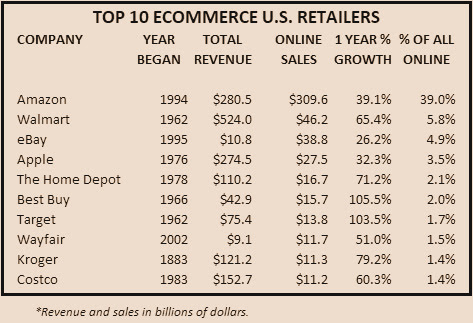
The numbers in the table below reflect that changing market when comparing the 2019 financial statement total revenue to the most recently reported current esales:

The likelihood that gains in internet sales after Covid-19 will revert to in-store sales is not great. And expected holiday sales will shift further to online. The impact on local retail sales cannot be overstated.

Further, as mentioned in the article above, the real surprise is that online grocery sales have skyrocketed as noted in this Atlanta Constitution article:

    Recent numbers show the pandemic pushed online grocery sales in the U.S. to extraordinary heights. In August 2019, sales were $1.2 billion, according to data gathered by the companies Brick Meets Click and Mercatus. In June 2020, they were $7.2 billion.
    Meanwhile, online sales grew from 3.4% of the grocery buying market in 2019 to 10.2% a year later, according to Mercatus and consumer data firm Incisiv.
    The change is creating thousands of new jobs in Atlanta, from high-tech positions to warehouse and delivery workers.
    Online shoppers will see improved delivery services and a better online user experience as companies compete for their share of the $1 trillion annual U.S. grocery market, industry analyst David J. Livingston said. But some smaller grocers likely won’t be able to keep up and could end up closing as behemoths like Walmart and Amazon continue to take bigger chunks of the online grocery business.
    Grocery store chains are staying competitive by throwing more resources into the fight. Kroger, for instance, has hired the British company Ocado to build a $55 million warehouse in Forest Park where robots will help sort online grocery orders. The chain will begin delivering in the metro area in 2021.
    “We’ll all look back on this year as being possibly the most significant inflection point for online grocery shopping,” said David Hardiman-Evans, Ocado’s senior vice president for North America.

One must also note that the "shoppers" are gig workers reflecting another shift in our economy.


China's Crucial Win in World Trade

China clearly has has offered a 21st Century non-military challenge to U.S. economic strength with a crucial win in world trade, along with a manufacturing focus shift inward.

This must be viewed in the context of China's relative success at suppressing Covid-19 outbreaks. China's one-party unitary national government can impose mandatory lockdowns, testing, and vaccination more effectively than in an undisciplined multiparty federation such as the United States.

China's one-party unitary national government can, and has, turned inward to promote its own consumer economy with the context of the 14th Five-Year Plan and the 2035 Vision to be taken up by the Party Congress next year. Consider this news story:

    President Xi Jinping called on the nation in May to rely more on domestic demand for future growth – dubbing it a dual circulation strategy – and his directive requires significant changes in both internal supply and demand.
    “The pandemic has made it difficult for us to sell abroad, but we do feel as though Chinese customers are less … enthusiastic for foreign brands, especially mid-level products,” said a sales manager at a fashion jewellery brand with shops all over the country.
    “Frankly, it may be becoming fashionable and more politically correct to make and consume good-quality Chinese goods,” he added, asking not to be identified.
    That sentiment seems to be felt by a growing number of Chinese export manufacturers, some of whom say they have started shifting investments to the domestic market even as their exports have seen a huge resurgence recently.
    Orders have been returning to China as other producing countries are still being ravaged by the pandemic, but manufacturers know the trend is most likely unsustainable.

However, China's one-party unitary national government can, and has, turned toward the Pacific-Southeast Asia to join with Australia, Brunei, Cambodia, Indonesia, Japan, Laos, Malaysia, Myanmar, New Zealand, Philippines, Singapore, South Korea, Thailand, and Vietnam to create the Regional Comprehensive Economic Partnership (RCEP). The RCEP, signed November 15, includes almost one-third of the world’s population and about one-third of its gross domestic product. It is the first ever free trade agreement between China, Japan and South Korea – Asia’s largest, second-largest and fourth-largest economies. It's goal is to progressively lower tariffs and aims to counter protectionism, increase investment and allow more free movement of goods.

Brunei, Vietnam, Laos, Cambodia, Thailand, Myanmar, Malaysia, Singapore, Indonesia and the Philippines are members of the Association of Southeast Asian Nations (ASEAN) trade group. It was announced December 1 that the European Union has joined with the ASEAN group in a strategic partnership to "stand up for safe and open trade routes and a free and fair trade" according to German Foreign Minister Heiko Maas after a virtual meeting with his EU and ASEAN counterparts. "Together, we represent more than a billion people and almost 25 per cent of global economic power," noted Maas.

Then, to the surprise of many, President Xi Jinping announced that China “will actively consider” joining the Comprehensive and Progressive Agreement for Trans-Pacific Partnership (CPTPP). Chinese Premier Li Keqiang’s in May noted that “China has a positive and open attitude toward joining the CPTPP”. Were this to be accomplished it would add Canada, Chile, Mexico, and Peru to China's trade group partners.

For Americans who don't remember as far back as four years ago (most Americans), the CPTPP evolved from the Trans-Pacific Partnership (TPP), which failed due to the withdrawal of the United States after Trump took office. Twenty-two TPP provisions that were priorities of the U.S., but not other negotiating partners, were suspended or modified in the CPTPP.

President Barack Obama's push to pass the TPP in 2016 was resisted by the 2016 presidential candidates in both major parties. Clinton and Trump opposed the deal, arguing that it would hurt American workers.

The problem for Clinton was former 2016 presidential candidate socialist U.S. Sen. Bernie Sanders rallied his supporters to urge the Democratic National Committee (DNC) to include language in their platform rejecting the TPP. CNN reporter Eric Bradner wrote, "By keeping specific opposition to the Trans-Pacific Partnership out of the platform, Democrats avoided embarrassing President Barack Obama." Although the DNC's decision was a disappointment to Sanders, he, along with U.S. Sen. Elizabeth Warren, continued to spearhead efforts in the Senate to get their colleagues to vote against Obama's trade deal.

This year, President-elect Joe Biden stated: "When it comes to trade, either we're going to write the rules of the road for the world or China is – and not in a way that advances our values. That's what happened when we backed out of TPP – we put China in the driver's seat. That's not good for our national security or for our workers. TPP wasn’t perfect but the idea behind it was a good one: to unite countries around high standards for workers, the environment, intellectual property, and transparency, and use our collective weight to curb China’s excesses."

What Biden did not foresee was the RCEP, the EU-ASEAN agreement, and China's positive outward reach to the CPTPP.

The problem for the U.S. is that while two-thirds of the original chapters remain in the CPTPP,, among the 22 provisions set aside include such things as investors’ ability to litigate disputes under investment agreements and investment authorizations - which are used mostly for mining and oil investments - are more limited.

Further regarding intellectual property the length of patent protection for innovative medicines has been shortened, technology and information protections have been narrowed, and copyright periods for written materials have also been shortened. Particularly, the stringent requirements that the United States pursued in technological protection measures, rights management information, encrypted satellite and cable signals, and safe harbors for internet service providers have all been removed.

Effectively, the American-East-Coast oriented ignoramuses handed a massive international trade win to China. They didn't protect any American interests or American workers. As Biden said: "We put China in the driver's seat."

The 46 nations within the CPTPP, RCEP, and EU-ASEAN are home to 38% of the world's population and control 50% of the world's Gross Domestic Product (GDP) - 51.64% of the 2019 Nominal GDP, 50.03% of the 2019 Purchasing Power Parity GDP.

The map below with the countries in white (most importantly the United States, India, and Russia) representing non-participants will shape our future Extended Economic Distortion:

The fact that the EU has chosen to get its foot in the door should be a clear warning that the United States no longer has the "collective weight" (to use the term Biden used) it had in the 20th Century. Americans made significant choices at the beginning of the Millenium, choices which will continue to hang over the U.S. economy in complex ways for decades.


The Undercurrent in U.S. Politics Enters the Limelight

The future of the United States is currently bound up in a (almost) fanatical dispute between three points of view. Most certainly the socialists versus the libertarians (recently in the persons of Bernie Sanders versus the Koch Brothers) have chiseled their ideological way into the electorate as reflected in Congress and the state capitols.

But added to that is a formerly "silent" significant minority.

Speaking in Madison, Wisconsin on April 15, 2011, Sarah Palin said everything that needs to be said about that significant minority: "And speaking of President Obama, I think we ought to pay tribute to him today at this Tax Day Tea Party because really he's the inspiration for why we're here today. That's right. The Tea Party Movement wouldn't exist without Barack Obama."

Palin epitomizes what appeals to the significant minority:

  • Of English, Irish, and German ancestry, she was born February 11, 1964 in Sandpoint, Idaho, to "Chuck" Heath (a taxpayer supported science teacher and track-and-field coach) and "Sally" Sheeran (a taxpayer supported school secretary), the third of four children.
  • When she was a few months old, the family moved to Alaska where her father had been hired to teach,  settling in Wasilla, Alaska in 1972.
  • She attended Wasilla High School, where she was head of the Fellowship of Christian Athletes and a member of the 1982 Alaska state champion girls' basketball team and cross-country running team.
  • In 1984, Palin won the Miss Wasilla beauty pageant and she finished second runner-up in the Miss Alaska pageant, where she won the title of "Miss Congeniality".
  • In 1987 she received her bachelor's degree in communications with an emphasis in journalism from the University of Idaho, and then worked as a sportscaster for Anchorage TV stations and a newspaper sports reporter.
  • In August 1988, she eloped with Todd Palin, her high school sweetheart, and they have five children, the youngest of who born in 2008 was prenatally diagnosed with Down syndrome.
  • Todd worked for the oil company BP as an oil-field production operator, retiring in 2009, and owns a commercial fishing business.
  • They are now divorced.

Simply, Palin is a celebrity who foreshadowed the successful candidacy of Donald Trump. It is unclear what would have happened in 2008 had her fame and experience not been limited to Alaska, the third least populous state ahead of only Wyoming and Vermont. Of course, social media such as Twitter and Facebook had not yet completely replaced traditional news sources in 2008 when she ran for Vice-President.

In today's political reality, political candidacy favors celebrity contestants and the significant minority accepts its beliefs from the likes of sportscasters and reality show hosts. The Regional Comprehensive Economic Partnership (RCEP) signed in November 2020 was introduced as a concept in 2011 during the 19th ASEAN Summit. The original proposal for the Trans-Pacific Partnership was made in 2008 with the final agreement stalled by the U.S. disinformation machine in 2016. Sportscasters and reality show hosts cannot compete on a world stage that depends upon 8+ years of informed participation in detailed economic negotiations.

Whatever else you may think, Barack Obama was a well-educated, experienced politician who also was young and black. Future elections will tell us if the U.S. is destined to be a bystander in the world.

Saturday, November 7, 2020

The Extended Economic Distortion appears to be settling in as the pandemic continues unabated

The Extended Economic Distortion has settled in nine months after the Covid-19 pandemic became a reality in the United States.

As indicated in the chart above, the official unemployment rate (U-3) is at 6.9% which is a 92% increase over the October 2019 rate. On top of that, 12.1% of all Americans who have been identified in some way previously attached to the labor force are out of a job, which is a 75.4% increase over the October 2019 rate.

Those numbers are just indicators that the economy is ill. It's no surprise. As explained here in a post on May 7:

The only goal of the Great Economic Lockdown of 2020 was to slow the spread of Covid-19 cases during the first months of the Coronavirus Crisis. That allowed time to organize enough hospital beds to handle both Covid-19 cases and the normal flow of cases due to other illnesses (you know, cancer, strokes, heart attacks, auto accidents, etc.).

As the Lockdown restrictions are lifted, Covid-19 will continue to spread.The underlying reality for the next "x" number of months (or forever) is that while we struggle to create a new economic and social normal, each day hundreds of people from infants to centenarians will die or become disabled from a Covid-19 infection.

Prognostications from some sources indicate that an economic recovery will begin by the second half of the year. More likely the Coronavirus Crisis will lead to an Extended Economic Distortion.

As with any newly evolved disease, what we know about Covid-19 is limited through what science is learning. We do know it makes folks sick, killing some, worse for older folks.

Wearing a mask reduces your likely impact on others as does social distancing. Logically then, you want to be around people who do those things to protect yourself...if you must be around other people. If you can avoid others you can reduce your chance of infection.

Some of what science has learned to date is well described in How the Coronavirus Hacks the Immune System in this week's New Yorker. (You can download a PDF here.) It isn't straightforward yet, but it is clearly a remarkable advance in the disease world from the diseases' point of view. That used to happen more frequently. But since the 1950's in the U.S. we last confronted such a thing in the HIV pandemic. So far we've essentially contained Ebola outside our country.

It's new. It's not the flu. This happens. Seeking to place blame is a foolish waste of time.

The number of new cases is rising again with all the attendant impacts and choices regarding socializing and business closures.

The headlines in the past two weeks typical for this fall include From Exxon to Charles Schwab, white-collar job cuts are mounting, Mass layoffs in the US as states face unprecedented budget crisis, Nike to layoff 700 people at HQ by January. As businesses realize that mounting cases meaning mounting unemployment, the layoffs will expand as we are a consumer economy.

And as it appears, Joe Biden will take office with news media having told him that "in the month before the election China’s trade surplus with the United States was 46.5 per cent higher than the day Donald Trump took office."

Fasten your seatbelts America, it's going to be a rough couple of years.

Tuesday, September 1, 2020

A trade war, gig economy, and lack of immigrant workers will be the key factors in prolonging the post-pandemic Extended Economic Distortion

Because the differences between the 20th Century and 21st Century economies are significant, though not commonly identified, they will become significant elements in the post-pandemic Extended Economic Distortion.

Like most centuries, what is significantly different from the last century is confusing because the source of changes seem to escape clarity. For instance, as late as April 2009 international finance guru Randy Charles Epping's book The 21st Century Economy--A Beginner's Guide was released to acclaim and was regarded Bookauthority.or as among the "40 Best New Economy Books".

In that book according to one description: "Epping defines key ideas and commonly used words and phrases like carbon footprint, WTO, economy of scale, NAFTA, and outsourcing [and] illustrates how central banks help navigate global crises and drive the global economy, discusses the benefits of Green Economics, shows how trade wars can be avoided...."

Uh, shows how trade wars can be avoided?

One thing 2016 and 1916 have in common is that the economics of the previous century was about to come to an end. In 1916 we had WWI followed by The Great Depression and WWII.  In 2016 when Donald Trump took control of the Republican Party and won the U.S. Presidency, he began a nationalist trade war with the rest of the world completely disrupting the norms of the global economy, a trade war that appears to be expanding into hostilities when it comes to China.

Then came 2020's pandemic shutting down travel and commerce for many months - we don't know how many, because it's still going on and does not appear to be on a course towards full recovery. Except for China which, as explained in The New York Times:

    This was supposed to be the year that China’s export machine began to stall. President Trump had imposed broad tariffs on Chinese goods. Countries like Japan and France pushed companies to shift production from China. The pandemic had crippled China’s factories by the end of January.
    Instead, China Inc. has come roaring back.
    After reopening in late February and early March, China’s factories began an export blitz that is still gaining steam. Exports soared in July to their second-highest level ever, nearly matching the record-setting Christmas rush last December. The country has grabbed a much larger share of global markets this summer from other manufacturing nations, entrenching a dominance in trade that could last long after the world begins to recover from the pandemic.
    China is showing its export machine cannot be stopped — not by the coronavirus and not by the Trump administration. Its resilience lies not only in the country’s low-cost, skilled labor and efficient infrastructure but also in a state-controlled banking system that has been offering small and large businesses extra loans to cope with the pandemic.
    The pandemic has also found China better placed than other exporting nations. It is making what the world’s hospitals and housebound families need right now: personal protection gear, home improvement products and lots of consumer electronics.

The irony of this is important to California. As explained here in the lengthy November 24, 2016 post #Calexit. Perhaps 170 years of invidious doubtful scorn is enough California's early European influence was Spanish trade with Asia:

    Effectively the Pacific Coast (and more) of the Americas was left to the Spaniards, good Roman Catholics all, to colonize and they did so from Northern California to Cape Horn.
    The first European contact in California was a Spanish sailing expedition, led by Portuguese (?) captain Juan Rodríguez Cabrillo, in 1542, which traveled up the Pacific Coast as far north as the Russian River. Subsequent Spanish expeditions, followed....
    In 1565 the Spanish developed a trading route where they took gold and silver from the Americas and traded it for goods and spices from China and other Asian areas. The Spanish set up their main base in the Philippines. The trade with Mexico involved using an annual passage of Manila galleons, which would traverse somewhere near Cape Mendocino, then could turn south down the California coast towards their home port in Mexico.
    When the value of California for trade routes became obvious to several other European interests, particularly the Russians whose fur traders were traveling from Alaska down the coast, the Spanish sent the Portola Expedition both over land and sailing up the coast in 1769.
    The Portola Expedition's original assignment was to travel to the "port of Monterey" described by the Vizcaino expedition and establish a settlement there. After that, the explorers were to continue north to locate Cermeño's "Bay of San Francisco" (the northern end of which is now called Drake's Bay), chase away any Russians encountered, plant the Spanish flag and determine whether the bay would make a good port.
    After the Portolà expedition of 1769-70, Spanish Catholic missionaries began setting up 21 California Missions on or near the coast of Alta (Upper) California, beginning in San Diego. During the same period, Spanish military forces built several forts (presidios) and three small towns (pueblos). Two of the pueblos grew into the cities of Los Angeles and San Jose. And so California became a part of Viceroyalty of New Spain.

Except in the midst of WWII, trade with Asia has been critical for California's economy since the 17th Century. In the past four decades, trade with Asia has been integral to the U.S. economy as a whole. In 2018 Asian trade for the U.S. totaled $1.6+ trillion. In the first six months of 2020 it was $115 billion less.

A new 21st Century economy integral element is the so-called "Gig Economy." For many it is hard to understand the significance of the Gig Economy. Apparently the federal government has no lack of understanding.

There was no hesitation on the part of the federal government as reflected in the red in the chart to the right. Those red bars are the people on Unemployment Insurance (UI) under federal programs established by the CARES Act and some other programs

Under the CARES Act states are permitted to provide Pandemic Unemployment Assistance (PUA) to individuals who are self-employed, seeking part-time employment, or who otherwise would not qualify for regular unemployment compensation.

The important thing to recognize is that news stories such as in today's New York Times begin with "just over one million Americans filed new claims for state jobless benefits last week" before noting further down on the page "another 608,000 people filed for benefits under the federal Pandemic Unemployment Assistance program."

The truth is last week 1.43 million new unemployment claims were filed, and 42.5% were under the PUA many of whom, if not most, fall under the vague definition of gig workers who were working in the Gig Economy. And it is this subject that also relates to California's history.

If you know about the film industry you know that today actors, writers, and almost all other production folks are effectively gig workers, meaning they don't have jobs until they are hired for specific productions then laid off. Many work enough to get UI for a period, but then must do jobs like wait tables. It wasn't always this way as a 1984 New York Times article noted:

    In 1938, Metro-Goldwyn-Mayer had 120 actors and actresses under contract, including Clark Gable, Greta Garbo, Robert Benchley, Dame May Whitty, Judy Garland, and Freddie Bartholomew. Nearly a hundred writers and directors were under contract to M-G-M that year, too. And 1938 was hardly a peak year during the golden era of the Hollywood studio system.
    Although the movie industry has often yearned publicly for the old days - Francis Coppola, for example, bought a nine-acre studio in the heart of Hollywood a few years ago in order to re-create the old system, and every decade Universal has announced a ''new talent'' contract program - the studio system, with its old authoritarianism, has stubbornly remained as dead as the dodo bird and passenger pigeon that it followed into oblivion. Mr. Coppola's Zoetrope, which put four promising actors under long-term contract, is bankrupt; and somehow the new talent programs, which tried to do the same thing with beginning actors, never worked.

In the film industry there is some evolved benefits programs through unions for some of the quarter of a million California film industry UI applicants. But that isn't true for the bulk of the Gig Economy that began in the past two decades. Investopedia lays the subject out straightforwardly:

    In a gig economy, temporary, flexible jobs are commonplace and companies tend toward hiring independent contractors and freelancers instead of full-time employees. A gig economy undermines the traditional economy of full-time workers who rarely change positions and instead focus on a lifetime career.

Wikipedia offers considerably more discussion but gives this piece of critical information:

    In the 2000s, the digitalization of the economy and industry was carried out rapidly due to the development of information and communication technologies such as the Internet and the popularization of smartphones. As a result, on-demand platform based on digital technology has created jobs and employment forms that are differentiated from existing offline transactions based on accessibility, convenience and price competitiveness, the so-called Gig economy has become a focus.

Within the overall economy, the Gig Economy has complicated things because as noted in Wikipedia "36% of U.S. workers join in the gig economy through either their primary or secondary jobs." And they are likely the bulk of the 42.5% of new filings for unemployment.

Complicating the matter further, California is in the middle of a policy battle over whether gig workers are should be employees, not independent contractors. It's complicated and the outcome could impact the future of the national economy.

Foreign trade and the Gig Economy are two integral elements of the 21st Century American economy facing significant change. A third is the role of immigrant workers.

We are generally familiar with the nearly-century-old policy debate - perhaps battle - over immigrants, both legal and illegal, who work in agriculture. The Trump Administration has instituted policies that reduce the number of available workers, implying that the goal is zero. That would have a significant impact on the cost of food.

Then there is the complicated issue of the H-1B visa, on which U.S. technology companies have become dependent for workers. The issue is complicated because some companies use those visas to tie workers to a job and pay less than the market wage. But the United States and China are in a growing competition for technological leadership in areas such as artificial intelligence, biotechnology, quantum computing, and other sectors vital to future economic and military prowess. The Trump Administration's has acted to restrict both student and H-1B visas.

In the pandemic with its travel restrictions many actual and potential technology workers have gone home and others have not been able to come to the United States. In effect the pandemic has implemented Trump policies. This is going to disrupt American technology leadership already being effectively challenged by China. It is not clear that this will change in the next few years.

The post-pandemic Extended Economic Distortion is going to result from, among other factors, reduced world trade, reevaluation and potential reorganization of the Gig Economy, and a loss of immigrant worker efficiency and expertise.

A reason for the surprising ease that the early $500 billion in direct intervention for American families passed both houses of Congress. Without it, 17 million people would have dropped below the poverty line. That's why Trump bypassed a stalled Congress with the $300 per week second round add-on to UI.

Getting restaurant and personal care workers back to work is a goal to avoid some potential deep poverty. But post-pandemic economic issues go well beyond the service industry and well beyond the time when a vaccine will push Covid-19 onto the same shelf in people's minds as "the flu."

No historical period exists that is identical to this time. But the sharp deflationary recession across Europe and in the United States known as the Depression of 1920–1921 was stimulated by the return to the civilian economy of troops after the end of World War I.

But it created an economic distortion further twisted by the Spanish Flu and the rise of labor unions. Each country responded differently. Italy's response to the social unrest offers a cautionary lesson for dealing with an Extended Economic Distortion in 2020. We will explore the Mussolini-effect here in the future.

Monday, August 10, 2020

Last week's multitude of confusing statistics help mystify The Great Economic Distortion's impact

Having said innumerable times over the decades "figures don't lie but lairs sure can figure" it seems like reading, seeing, and hearing inane reporting on statistics in the news media should not be bothersome.

After all, clearly embedded in the term is the truth of its history - stat istics - as the term is intimately connected with the development of the modern sovereign state, specifically within European states following the peace of Westphalia (1648).

If you didn't know it, scholars have recognized the Peace of Westphalia as the origin of principles crucial to the concept of the modern self-governing independent nation, including the inviolability of borders and non-interference from outside the borders in the domestic affairs states.

It shouldn't surprise anyone that statistics, a mathematical science grounded in probability theory, became a tool for elected politicians. Statistics can be confusing for we non-statisticians, even those of us who took a statistics course in college.

For instance, last Thursday the U.S. Department of Labor reported 1.186 million new initial unemployment insurance claims for the preceding week. While that is a number that needs no interpretation, we can learn that the normal weekly initial unemployment insurance claims in 2019 was 200,000-250,000. That range extended into early March as can be seen on the chart below (numbers are in thousands, so the first number is 211,000 and themost recent is  1,186,000):

Again, these are just numbers. If you total the numbers shown on the graph, the reported weekly initial unemployment insurance claims during this period is 55,814,000 - yes, 55.8 million!

Again, these are just numbers. But the news media can't just report the numbers - that's just boring news. So on July 16 CNBC reported that the continuing claims as of July 4 were 17.3 million as asserted by the Federal Reserve Bank of St. Louis. Then on July 24 The New York Times headline was About 30 Million Workers Are Collecting Jobless Benefits explaining that "the Labor Department reported that the total number of people claiming unemployment insurance for the week ending July 4 — without any seasonal adjustments — equaled 31.8 million."

Yeah, ah, there is quite a difference between 17.3 million and 31.8 million continuing claims. If you total the weekly initial unemployment insurance claims on the chart above only through the July 4 period, there were 50.5 million. If the CNBC 17.3 million number were correct it would seem that 65.7% of those that filed between March and July went back to work. If The New York Times 31.8 million number were correct it would seem that 34.3% of those that filed between March and July went back to work.

For this writer, this kind of crap reporting is unacceptable albeit it has been the new normal for decades. Those continuing claims numbers don't seem to be included in news stories about real people nor by this writer's personal knowledge, albeit both are anecdotal. IF we join in these speculative games, even if 20% of those initial claims numbers include errors, false claims, and people who have returned to work, the continuing claims today would be 44.7 million. But I certainly wouldn't pretend to report that to the public as news.

A paranoid political junkie might even suspect that the stat istics might be being used for purposes of the state. And the headline news last Friday would reinforce that view. We were told that the U.S. Bureau of Labor Statistics (BLS) reported that 16.3 million people were unemployed in mid-July making the official unemployment rate for mid-July 10.2% down from its peak in mid-April. The implication is that 68.5% of those that filed between March and July went back to work!

Wow! Things are really looking up! But wait! What is the U.S. Bureau of Labor Statistics (BLS). It even has stat istics in its name.

If one digs down ever so slightly one learns that the headline BLS unemployment rate is the "U-3 rate." It turns out that the BLS has a broader "U-6" measure of unemployment, which includes such people as those working part-time but not of their volition and people who have given up, is at 16.5%. In fact, there are rates labeled U-1 through U-6, all of which are reported in a table (but not in headline news) as follows:

In the 12 months before the pandemic, the BLS household employment survey had a response rate of 83%. The July survey had a response rate of 67% which should make one wonder if they didn't get an adequate response for statistical probability analysis. But these folks are statisticians whose data could be useful for government planning. Unfortunately, it is useful for politicians who over the years have made sure the news media get the statistics.

As noted earlier, the anecdotal information available indicates a whole lot of families (aka households) have seen their wage-earner members lose their jobs. Lo and behold, another federal agency, the Census Bureau, in a Household Pulse Survey found last week that found that 50.8% of adults live in households that "experienced loss of employment income since March 13, 2020 (for self or household member)" and 26.5% of surveyed adults either missed their last rent or mortgage payment or have either slight or no confidence they can pay the next one.

According to the Census Bureau, in collaboration with five federal agencies the Household Pulse Survey was designed to deploy quickly and efficiently, collecting data on a range of ways in which people’s lives have been impacted by the pandemic. Data will be disseminated in near real-time to inform federal and state response and recovery planning. But keep in mind that it is a "survey" which like other "polls" has a limited number of responses (typically 80,000±).

Many news articles now assert we're in a depression. The problem with that is there is no definition of a depression based on statistics. Other articles and government agencies say we are in a recession based on statistics. Unfortunately, they are really asserting that the data indicates a probability of an event something like the recessions since WWII for which they have data. As asserted here in prior posts, that is incorrect. We don't know what's going on and have chosen to call it The Great Economic Distortion of 2020.

So what seems likely about The Great Economic Distortion of 2020? It appears a large number of households have seen a drop in income during the pandemic. That is because since the since April at any one time a significant percentage of Americans of working age who wish to be participating in the work force are unemployed or significantly under-employed.

Keep in mind that the economic impacts of the pandemic began in mid-March and the data is for mid-July, a mere 4 months. At the beginning of The Great Depression, the stock market crash was in October 1929 but unemployment did not hit double digits until the end of 1930.

As noted in a previous post, the effects of a crippling world-wide pandemic have not been experienced since modern economic statistical data, such as unemployment and GDP, began to be systematically compiled on a regular, standardized, though on occasion revised, basis after World War II.

Given that the United States was considered the world's economic leader from 1946 through 2016, it is clear that life for people around the world is about to begin a significant long-term change with no model to emulate.

China's 4000+ years history of empires created its peculiar civil perspective. The traditional Chinese form of national government has been an oligarchy with a touch (sometimes a heavy hand) of autocracy led by an emperor or, since the middle of the 20th Century, a paramount leader. It's culture is built around one ethnic group. Fundamentally the autocratic state controls the economy. It does not offer others an appealing road to follow.

In contrast the United States is a country that has existed less than 250 years. It claims to be a democracy. Two of the last three Presidents lost the popular vote but were appointed to office. The U.S. Senate majority was elected by less than 8% of eligible American voters. Together they have secured control of the Supreme Court. The truth of the matter is the U.S. form of national government has been an oligarchy with a touch of autocracy. Fundamentally, state-favored organized greed controls the economy. Because it's population is ethnically diverse, it has no stable culture. It does not offer others an appealing road to follow.

The most significant challenge facing humanity over the 21st Century is Climate Change. International action is needed to address the multitude of problems. The Great Economic Distortion of 2020 will make it more difficult. It appears that no single influential or powerful leader is likely to step forward.

The future looks...interesting?