Showing posts with label wildfires. Show all posts

Monday, July 18, 2022

"Hot Helen" and "Scorching Sam" - naming and categorizing heat waves should be coming soon

Like hurricanes, heatwaves will soon be named.

Humans have been a bit slow to acknowledge the real threats of Climate Change. But we see today headlines in British newspapers like ‘Heat apocalypse’ warning in western France as thousands flee wildfire. 

In June we read In world's first, Spain's Seville to name and classify heatwaves. While here at home, if you read the article Heat waves could soon have names in June you would have learned

    Five other cities — Los Angeles; Miami; Milwaukee; Kansas City, Missouri; and Athens — have also started piloting a similar initiative, using weather data and public health criteria to categorize heat waves.
    They'll use a three-category system that organizers want to standardize. Each city's system will be tailored to its particular climate.
    A "category three" heat wave in L.A., for example, will look and feel quite different from the same designation in Milwaukee.

In California Assembly Bill 2238 was introduced in February to create and put a heat wave ranking system in place by Jan. 1, 2024. Recently amended in the Senate, there is a chance this bill will be adopted.

It's a fact that this comes quite late in California's attempt to deal with Climate Change and associated heatwaves and wildfires. But it is a reality that everyone seems to be behind. It was necessary for The Guardian to publish today the article Why is the UK so unprepared for extreme heat and what can be done? which had to include the following explanations:

    The stifling current heat is certainly attracting attention. But Bob Ward at the London School of Economics said: “More action is needed to inform the public about the dangers created by heatwave conditions. One part of the solution could be to name heatwaves in the same way that winter storms are now given names to gain the attention of the public.”
    [The University of Reading Prof Hannah] Cloke said: “We also need to have more sophisticated forecast-based warnings that are more focused on people. It shouldn’t just be about peak afternoon temperatures, even though these really are very high indeed.” They should also take into account other factors, such as humidity, and spell out the risk to people, she said: “Heatwaves are silent killers.”

"Heatwaves are silent killers." The PR problem is they tend to kill the poor, the infirm, and the old while solutions tend to negatively impact the Consumer Economy which benefits most everyone else and particularly corporate interests.

But apparently we will soon see a warning system evolve. Unfortunately, as I posted here in 2018: "Regarding Al Gore's campaign on climate policy beginning 40 years ago, he..., well, kids..., my generation failed him and you. But then I said that before...."

Wednesday, July 7, 2021

Fact - 35 years ago Californians were warned of a 9° climate temperature increase within this Century

In Christopher Nolan’s science fiction film, Interstellar, set in the year 2067, the first few minutes of the film consists of interviews by survivors of an apocalyptic dust bowl. Those scenes are in fact are from a Ken Burn's documentary, real interview clips of actual survivors from the Dust Bowl which nearly destroyed the middle "Red States" of the United States in the 1930s. The Dust Bowl was the result of decades of individuals acting with full encouragement of the government in a time when we had no "climate scientists." Today Americans, particularly those living in the same "Dust Bowl" states, continue to behave in a similar fashion ignoring climate science, even to the point of assuring their government abandons their grandchildren to a disastrous future.

Beginning in posts here in 2011, the impacts on our grandchildren of governmental policy failures became the term used to create context about our failures as a people.

If you follow climate news you know the a heat dome impacted California and the Pacific Northwest last month. Firefighters battled 44 large wildfires that have burned nearly 700,000 acres. One of the coldest inhabited places on the planet, Verkhoyansk, Siberia, the land surface temperature was 118 degrees. And these are not isolated events:

Katharine Hayhoe, a 49-year-old climate scientist at Texas Tech University and chief scientist for the Nature Conservancy, noted “These extremes are something we knew were coming, the suffering that is here and now is because we have not heeded the warnings sufficiently.”

Hayhoe was only 14 when Congressional leaders first began reciting, repeating, warnings of impending climate change.

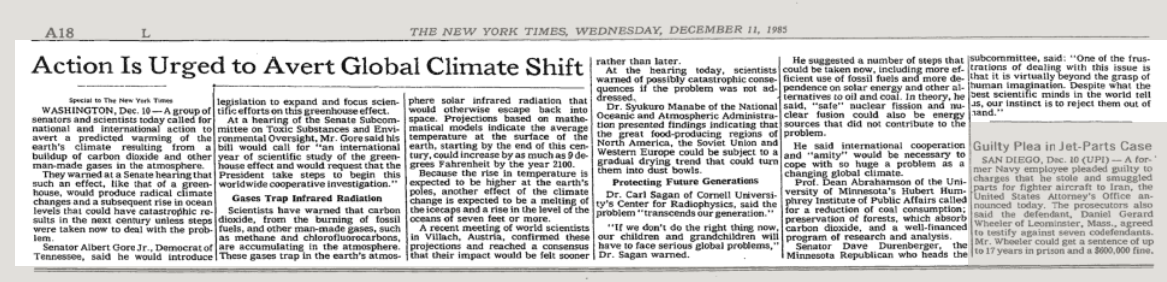
Indeed, the "alarmist" headline read "ACTION IS URGED TO AVERT GLOBAL CLIMATE SHIFT." Of course that was 35 years ago in a December 1985 New York Times article that told us:

    "Scientists have warned that carbon dioxide, from the burning of fossil fuels, and other man-made gases, such as methane and chlorofluorocarbons, are accumulating in the atmosphere. These gases trap in the earth's atmosphere solar infrared radiation that would otherwise escape back into space. Projections based on mathematical models indicate the average temperature at the surface of the earth, starting by the end of this century, could increase by as much as 9 degrees Fahrenheit by the year 2100."

Elements of the post that follows appeared here previously, but given the recent climate "warming" impacts we need to be certain that readers be given the opportunity to consider its message.

Because agencies of the United States government and the Chinese government recently have accepted as inevitable a near-maximum catastrophic impact from Climate Change, the subject must be taken up again. The May 2018 Chinese study, which corresponds to the July official projections accepted and published by the Trump Administration, is unequivocal.

Of course, almost no living person in the Baby Boom generation (or older) will be alive to experience the full catastrophic impact even in the earliest year of the Chinese models - 2064. And at least half of the Gen X generation will be gone before the Chinese model's "most likely" full catastrophic impact year - 2084.

That means Climate Change is still a somewhat abstract concept to the generations of people who voted in the greatest percentages in the latest elections - excluding those who died from the recent heat. And too many of them keep telling themselves it is a lie as they try to figure out how to stay in their home until they die, in many cases despite regular flooding or wildfires or both.

And by "them" I must include "me" because as I wrote in 2016 Al Gore's campaign on climate policy beginning "40 years ago, he..., well, kids..., my generation failed him and you." 


We have already changed the world catastrophically

As explained in a previous post here, Elizabeth Kolbert is a Pulitzer Prize winning author who has won many awards for her extensive writings on Climate Change. In that post a quote from the 2015 update to her 2006 Field Notes from a Catastrophe: Man, Nature, and Climate Change summed up the situation (emphasis added):

     In the years since I wrote this book I’ve been asked hundreds of variations on the question: “What should I do?” What people seem to be looking for is both advice on concrete actions they can take and the assurance that what they do will make a difference. Given the paralysis of the political system, the time lag built into the climate system, and the high likelihood that the threshold of DAI [dangerous anthropogenic interference] has now been crossed, it’s difficult to offer such assurances. We have already changed the world dramatically, indeed quite probably catastrophically. But even when it comes to catastrophe, distinctions can be made. What we choose to do—or not to do—in the coming decades will determine the future both for our own kind and for the millions of other species with whom we share this planet. It is possible that we could still limit warming to around two degrees Celsius, and it is also possible that we could lock in warming of six degrees Celsius or more. These two possibilities represent radically different worlds.

In her 2014 Pulitzer Prize winning book The Sixth Extinction: An Unnatural History she explains that the Earth is in the midst of a man-made sixth extinction, chronicling previous mass extinction events, and comparing them to the accelerated, widespread extinctions of our present time. In a July 2014 interview on The Daily Show with John Stewart promoting the book at the end they both acknowledge a kind of despair:

Unfortunately, in 2018 in both the U.S. and China formal findings have been made that we have "locked in warming" of 4°± Celsius most likely within 60 years.

Under the direction of the Trump Administration the National Highway Traffic Safety Administration (NHTSA) with the cooperation of the U.S. Environmental Protection Agency (EPA) and the U.S. Department of Energy (DOE) issued aDraft Environmental Impact Statement (DEIS) for the Safer Affordable Fuel-Efficient (SAFE) Vehicles Rule for Model Year 2021–2026 Passenger Cars and Light Trucks proposing reduced average fuel economy standards for those vehicles.

The DEIS has determined that the draft official policy of the United States government will be acceptance of a near worst case scenario, a 4.387°C (7.876°F) global temperature rise since 1880 by 2100. That is because any lesser scenario would require deep cuts in carbon emissions to avoid this drastic warming. A lesser scenario “would require substantial increases in technology innovation and adoption compared to today’s levels...which is not currently technologically feasible or economically feasible.”

In May 2018 a collaborative research team from China published a new analysis that shows the Earth's climate would increase by 4 °C, compared to pre-industrial levels, most likely by 2084. They found that most of the models projected an increase of 4°C as early as 2064 and as late as 2095, with 2084 appearing as the median year.

"Our ultimate goal is to provide a comprehensive picture of the mean and extreme climate changes associated with higher levels of global warming based on state-of-the art climate models, which is of high interest to the decision-makers and the public," said Dabang Jiang, a senior researcher at the Institute of Atmospheric Physics of the Chinese Academy of Sciences.

Perhaps some would want to dismiss both government agencies as being too pessimistic. The problem is in 1995, now 26 years ago, then Vice-President Gore reflected on his experienced reality in a 1995 New York Times article:

    "We are in an unusual predicament as a global civilization," Al Gore said when I interviewed him early in his Vice Presidency. "The maximum that is politically feasible, even the maximum that is politically imaginable right now, still falls short of the minimum that is scientifically and ecologically necessary."

In other words, as Kobert outlined in The Sixth Extinction: An Unnatural History various species have already gone extinct. Others are adapting, doing things like moving to higher elevations. But they haven't experienced anything close to the impacts of an increase of 4°C which will strain every species including humans.

All of which should lead us back 90 years to the Dust Bowl Era pictured at the beginning of this post.

In his 1933 novel To A God Unknown, John Steinbeck tells an allegorical tale of the California experience. The protagonist, Joseph, comes to California to create his future. He discovers a place of apparent wealth and promise. And indeed he appears to be achieving all that he dreams. But over time, tragedies strike and a drought undoes his life work.

Late 19th and early 20th Century immigrants to Californian hadn't read To A God Unknown. Instead they believed that water was an endless resource of wealth for future Californians. Unfortunately that wasn't true. It was Johnny Carson who observed that California has four seasons: Fire, Earthquake, Flood, and Drought. But mid-20th Century Californians didn't hear that.

Lands that once were orchards in Southern California. the San Francisco Peninsula, and Santa Clara County, and farms in the Central Valley became subdivisions of housing for large populations, urban/suburban populations that were now dependent upon that water for human consumption competing with the remaining agricultural interests. In 2009 the Southern San Joaquin Valley became the first area in the State to suffer significantly from the return of centuries of drought that received intermittent decades of relief.

No one can say we weren't warned.

Saturday, July 4, 2020

Living "self-cloistered without self-sufficingness" on the Fourth of July in the year of COVID-19. About a new context for old Californians and others


The Fourth of July in the year of Covid-19 certainly offers a new context for an old Californian.

Four months ago, March 4, 2020, our Mendocino County Health Officer declared a local health emergency due to the COVID-19 pandemic. On that day monitoring the expanding pandemic became a fierce focus in our household.

We are among Californians over the age of 75, among the group identified as having the highest health risk in the pandemic. We are among those who remember Polio epidemics. We are among those who remember parents and grandparents who lived through, but rarely discussed, other disease epidemics. Fortunately through the efforts of public health programs those diseases were eradicated or effectively suppressed.

Subsequent to the availability of a Polio vaccine, we saw and felt the impact of annual flu epidemics, though they were and are limited by imperfect vaccines. We lived through the HIV tragedy feeling the sorrow of death among acquaintances. We read with concern the stories of Ebola.

Truthfully, those of us who have lived most of our lives in the post-1958 "Western world" have simply been lucky.


Why and how to live self-cloistered without self-sufficingness

On the July 4, 2020, aka The Fourth of July, it will have been 160 days or 5⅓ months since the first confirmed Covid-19 case arrived in California, 166 days or 5½ months since the first confirmed U.S case, 230 days or 7⅔ months since the World's first confirmed case occurred. (Click on the timeline to right to see relevant dates.)

It has also been 109 days or 3⅔ months since March 16 when public health officials in seven counties around the Bay Area introduced approximately 7 million residents to the concept of mandated "protective sequestration."

"Protective sequestration, in public health," according to Wikipedia, refers to "social distancing measures taken to protect a small, defined, and still-healthy population from an epidemic (or pandemic) before the infection reaches that population."

It must be truly baffling for Americans who remember living through the four years of rationing and fighting of WWII to watch the widespread lack of patriotism in the current generations. People today have been asked to give up some of the life they led prior to 2020 for less than four months to protect the lives of other Americans and they have balked at the idea.

California's "shelter-in-place" protective sequestration efforts were for the purpose of "flattening the curve" for a sufficient time period to expand hospital capacity to deal with the inevitable infection surge. Based on the charts below reflecting data through June 30, California succeeded in keeping infections down. Now that we are "opening up" it is obvious what's going to happen, what is happening.


By Fathers Day, June 21, the expected Covid-19 infection "First Wave" surge had begun using those hospital beds. In some California hospitals the ICU beds are full.

We do have widespread testing for infections which are very useful for slowing the infection surge. Finding the infected persons allows officials to place them in quarantine. But the data is not yet useful for defining the extent and impact of the surge.

Yes, today more people have been infected compared to yesterday. But those statistics also show that more people have been tested. And what they show is a very small percentage of Californians are infected (see table at right).

Since we know that 10% of the population has been tested, it might be reasonable to assume one could multiply those percentages in the table by 10. But we also know that prior to mid-June most of the testing subjects were people with symptoms. Further, the testing only indicates who is currently infected, not who was infected a month ago or will be infected a week from now.

It also appears from the chart below that death statistics are not good indicators of surge levels.


In fact from the February 6 when the first Californian died, through the end of June, Covid-19 has killed 6,000+ Californians, which is 0.017% of the population. That is over a period of 21 weeks. On average every five weeks an equivalent number of Californians die of heart disease. Of the deaths in California to date, 94.0% are persons 50 years of age and older, indeed 75.4% are 65+.

Today no protective sequestration stay-at-home order is in effect. But with or without an order, a choice exists.

On March 13 we chose to become "self-cloistered without self-sufficingness" The goal is simple. Avoid being hospitalized because of a Covid-19 infection.

The death data suggests that for those of us over 65 being "self-cloistered without self-sufficingness" is prudent. We are "self-cloistered" meaning we are staying at home. Being "without self-sufficingness" simply means acknowledging that we are not self-sufficient, we do not grow all our own food, we do not create our own soap. So to safely sustain the basics of our manner of living within the time of the current pandemic, we choose to interact with people only from a distance mostly through 21st Century technology.

In practice that means ordering food and other necessities online which results in deliveries via the U.S. Postal Service, UPS, FedEx, Instacart, and others.

We have not left our home, our property, since March 13, 2020. That was three days in advance of those first "shelter in place" orders covering the Bay Area, five days in advance of the first Mendocino County order, and one week in advance of the first California state order. On the Fourth of July we will have been "self-cloistered without self-sufficingness" for 3¾ months, or 16 weeks, or 113 days.

But while Californians like us who live in the forest can limit our risk from Covid-19 by staying home, the risk from wildfire is another story. This past Sunday 40 homes were lost to a wildfire in rural Niland. One resident died. For us Covid-19 is an add-on risk

Unfortunately it is one which has seriously damaged the economy.


Labor Day and the Extended Economic Distortion

News reports on Thursday announced that the unemployment rate in mid-June fell to 11.1%. The headlines offered feelings ranging from "great news" to "hopeful." What the headlines didn't say is:
  • unemployment levels remained higher than any time since The Great Depression;
  • there were still nearly 15 million fewer jobs in June than in February;
  • data was collected in mid-June, before coronavirus cases began to surge causing many cities, counties, and states to roll back the phased reopenings that brought many jobless workers back into the labor force;
  • because those unemployed do not include anyone who works only one hour or more a week, the headlines did not indicate that full-time employment remains 12 percent lower than it was in February while part-time employee numbers are above pre-pandemic levels with twice as many working part-time involuntarily; and,
  • on the same day those mid-June unemployment numbers were reported the same news sources reported  that 1.4 million filed new claims for state unemployment benefits last week, the 15th straight week that the figure exceeded 1 million, and another 840,000 filed for benefits under the federal Pandemic Unemployment Assistance program.
Nor did the headlines mention the probable continuing reporting error affecting the level of unemployment:


Finally, with regard to unemployment there is the matter of rising numbers of layoffs becoming permanent:


The number of permanent layoffs has doubled since April reflecting a growing awareness by employers that the "great" economy ended sometime in February replaced by an Extended Economic Distortion discussed here on May 7 in Expect a consumer-based Extended Economic Distortion after the Great Economic Lockdown. In terms of employment we likely will have a clear indication of the level of the problem in the private sector by Thanksgiving. We will not get a clear picture of the impact on the 3 million jobs in California state and local government including school districts until next Spring.

By Labor Day we likely will begin to see from the Covid-19 Hospital Patients graph how extended and how distorted the economy will become prior to a Second Wave which likely will happen if we are unable to produce a reliable vaccine.


This too shall pass, though it may take entire decade

As noted at the beginning of this post, the Fourth of July in the year of Covid-19 certainly offers a new context for old Californians like us.

What we don't know about the cause of the immediate crisis, a virus, after these few months leaves us ignorant of long-term impact on many, many people ages 14-50 who become infected but survive.

What we don't know about the short- and long-term impacts of the crisis on California's economy, the world's 5th largest, is significant. The Trump Administration's trade war and disdain for other economic powers now being reflected in international travel bans imposed against Americans will magnify the damage to California's economy. All this triggered by the pandemic Trump supporters denied was happening while their grandparents were prematurely dying.

As noted in the above-referenced May 5 post, in the 20th Century, beginning intensively in 1929 and lasting 50± years,  massive changes in the legal, economic, political, social, cultural, environmental, and technological subsystems were implemented. This created not only the established reality of two "seniors" ordering goods and receiving entertainment over the internet, but the possibility of a significant percentage of workers effectively working from home.

Covid-19 forced the expanded working-from-home trial which could be indicative of more massive changes in the legal, economic, political, social, cultural, environmental, and technological subsystems. It is not surprising that the pandemic enabled younger generations to push more visibly for major revisions to the legal, economic, political, social, cultural, and environmental subsystems to assure some greater semblance of equity by the mid-21st Century.

Yep, the Fourth of July in the year of Covid-19 certainly offers a new context for an old Californian.

Monday, January 27, 2020

It's hard not to endorse Michael Bloomberg if you believe the climate crisis - without the fog of asperational socialism - is the issue that matters.


If you weren't aware of it, Michael Bloomberg has secured the endorsements of the mayors of three major cities in California – Stockton, San Francisco, and San Jose.

Stockton Mayor Michael Tubbs stated: ""I am excited to endorse Mayor Bloomberg for President as he has the record, the relationships, and the resources to defeat Donald Trump and reclaim our democracy." Following his endorsement, Mayor Tubbs was also named a national co-chair of the Bloomberg presidential campaign.

San Francisco Mayor London Breed said on Facebook that she is backing Bloomberg because he “is the only candidate for president with a real plan for African Americans”, touting his Greenwood Initiative to increase black home ownership and the number of black-owned businesses.

San Jose Mayor Sam Liccardo said in a statement "Mayors don't have the luxury of hyperpartisan tongue-wagging, they have to solve problems and get things done."

And in Bloomberg snags fifth congressional endorsement in Politico Monday, we learned that Rep. Scott Peters of California's 52nd Congressional District endorsed Mike Bloomberg citing Bloomberg's plans to fight climate change and spiraling gun deaths.

Given the importance of the climate crisis, this writer could not simply ignore these endorsements simply cannot be ignored. Bloomberg has been a big player in climate policy.

In 2015 Michael Bloomberg, as the U.N. Secretary-General's Special Envoy for Cities and Climate Change along with Mayor Anne Hidalgo of Paris hosted the Climate Summit for Local Leaders a gathering of Mayors and others as part of the meeting that resulted in the Paris Accord. At that gathering, Bloomberg told the attendees: “You were not elected to ask the public where they want to go, you were elected to have a vision about what is right for the people you serve, and then to convince them to follow you to a better life.”

Prior to that meeting, on October 8 Bloomberg and Vancouver Mayor Gregor Robertson were interviewed by WBUR's Here & Now host Jeremy Hobson. You can listen to that interview using this link.

In response to President Trump's announced withdrawal of the U.S. from that Paris Accord, in July 2017 Bloomberg and California Governor Jerry Brown launched The America's Pledge initiative which (funded by Bloomberg Philanthropies Support LLC,) aggregates, quantifies and publicizesthe actions of states, cities and businesses and other non-national actors in the United States to achieve the Paris climate accord goals.

In 2019 a Los Angeles Times article explained:


    Despite President Trump‘s decision to withdraw from the Paris climate accord, the United States hasn’t completely abandoned the landmark international agreement.
    More than 400 city leaders have joined the Climate Mayors association, and 25 states and territories have joined the U.S. Climate Alliance. Both organizations have vowed to uphold the country’s Paris pledge.
    Many city, county, state and tribal governments have also signed the We’re Still In declaration, which reiterates support for the accord. So have 2,200 businesses and investors, 350 universities and 200 faith groups.
    Together, these players account for almost 60% of the U.S. economy, half the country’s population, and 37% of its greenhouse gas emissions, according to an assessment by America’s Pledge, an initiative focused on sub-national climate actions led by former California Gov. Jerry Brown and ex-New York City Mayor Michael Bloomberg.
    If this collection of governments and organizations were their own country, they would be the world’s third-largest emitter.
    In a 2018 analysis, Frisch and her colleagues found that existing commitments by sub-national actors could achieve two-thirds of the emissions reductions called for in the U.S.’s Paris pledge. Broader participation and additional measures, like rapid retirement of coal-fired power plants, could bring that number close to 90%.
    Under Obama, the U.S. had promised to get emissions 26% to 28% below 2005 levels by 2025. The country is already almost halfway there, although emissions rose in 2018 for the first time in three years.
    To tackle the other half, all eyes are now on cities, states and businesses.

The The America's Pledge website offers a lot of information, some of which is summarized by the graphics below:

We are confronted with a lineup of candidates running in the Democratic Presidential primaries. Unfortunately, early on many have signed on to the "Green New Deal" proposal of self-declared socialists Senator Bernie Sanders and first-term Representative Alexandria Ocasio-Cortez which entwines socialist asperational goals into climate crisis policy. Senator Elizabeth Warren, has offered proposed complex economic policies designed to reduce carbon pollution.

I'm not quite sure what this all has to do with the Presidency. No one who understands American government can believe that complex economic goals, particularly socialist ideas, can be easily achieved by a President. Any policy to implement the goals must be approved by the United States House of Representatives and the United States Senate - you know, Congress. Just ask Obama how limited Presidential powers are when trying to get, say, a health care agenda passed in Congress with a Democratic majority in both houses.

For this writer, there is only one problem facing the people of the world, including Americans. That problem is the climate crisis.

As outlined above, only one candidate in the Democratic Presidential primaries has provided leadership to help American states, local governments, and private companies and citizens successfully act to reduce climate change. That candidate is Michael Bloomberg.

Of course Bloomberg is a billionaire. And as Mayor of New York, he was not the most socially sensitive of government officials. And he is most certainly not a socialist.

But when it comes to federal policy, at some point we might want to consider some things. For instance, what are the likely cost increases for health care going to be from climate change? Considerable evidence has already been gathered. One study examined 10 climate-sensitive events during 2012 that led to 917 deaths, 20,568 hospitalizations, and 17,785 emergency department visits, along with other health-related expenses, totaling nearly $10 billion (in 2018 dollars) in health-related costs.

Many types of health problems linked to 2012 climate-sensitive events that extended way beyond what typically comes to mind including pregnancy complications, carbon monoxide poisonings, and kidney disease complications, all linked to the aftermath of Hurricane Sandy in New Jersey and New York.

Wildfire-driven air pollution in Colorado and Washington caused hundreds of premature deaths. Harmful algal blooms in Florida resulted in a large number hospital admissions and emergency room visits.

In other words, while there’s growing scientific evidence on the health impacts of climate change across the country, regarding your children's health apparently some of the candidates are committed to bogging Congress down in arguing over whether to abandoned Obamacare for a single-payer system. What was that story about a government leader fiddling while Rome burned?

All this leaves this writer wondering if Bloomberg might not be the best choice, not just because he has a lot of money to use to challenge Trump, but because he might be the best leader to get the U.S. government back on track to fight the climate crisis.

Tuesday, January 7, 2020

A depressing climate crisis update to all. Victoria Police Facebook post: "You are in danger and need to act immediately to survive. It is too late to leave."

The 2019–20 Australian bushfire season is of cataclysmic proportions as it has burned an estimated 21 million acres (32,000 square miles), destroyed over 2,500 buildings (including over 1,900 houses) and killed 25 people as of 5 January 2020. Much of the burned land is bushland, forests and national parks, home to the country's beloved and unique wildlife. This event is due to the climate crisis created by 20th Century human civilization. But the victims here are koalas, kangaroos, and other wildlife.

For some perspective we should note that the 2018 California wildfires consumed 2 million acres and the 2019 Amazon rainforest wildfires burnt 2.2 million acres - each just 10%± of this year's Aussie bushfires. And, of course, the Australian fires are still burning.

In What Will Another Decade of Climate Crisis Bring? in this week's The New Yorker Elizabeth Kolbert, whose multiple award-winning (including a Pulitzer Prize) climate writings have been quoted here extensively, expressed frustration:

    ...If in the past year (or the past decade) the world began to understand how dangerous climate change is, it certainly didn’t act like it. In the past ten years, more CO2 was emitted than in all of human history up to the election of J.F.K.
    In 2015, in Paris, world leaders, including President Barack Obama, committed to holding the average global temperature increase to “well below 2°C.” They never committed to how they were going to do this, however, and last month, in Madrid, the creaky machinery of climate diplomacy came very close to breaking down altogether. The Trump Administration, which has filed to withdraw the United States from the Paris agreement, and the [Australian Prime Minister Scott] Morrison government, which wanted to use an accounting trick to fulfill its Paris commitments, were explicitly blamed for the stalemate. Many commentators noted the irony of the situation. A headline in the Guardian put it this way: “AUSTRALIA TOOK A MATCH TO UN CLIMATE TALKS WHILE BACK HOME THE COUNTRY BURNED.”
    Every decade is consequential in its own way, but the twenty-twenties will be consequential in a more or less permanent way. Global CO2 emissions are now so high—in 2019, they hit a new record of forty-three billion metric tons—that ten more years of the same will be nothing short of cataclysmic. Unless emissions are reduced, and radically, a rise of two degrees Celsius (3.6 degrees Fahrenheit) will be pretty much unavoidable by 2030. This will make the demise of the world’s coral reefs, the inundation of most low-lying island nations, incessant heat waves and fires and misery for millions—perhaps billions—of people equally unavoidable.

The climate crisis - Climate Change, Global Warming - is an ongoing worldwide cataclysm which in geological time is extremely fast- moving. It is an unprecedented speed, albeit not quite as fast as that ultimate bad day for the dinosaurs sixty-six million years ago when a devastating asteroid impact occurred near the Mexican town of Chicxulub. In geological time there is little difference between that event and the current climate crisis.

Unfortunately the common human perception of time considers a generation (20 to 30 years loosely defined) as a significant period of time. In that context, for the general population of the first world there can never be a generally accepted climate "crisis."

The term "crisis" means the "turning point." In the context of Climate Change it is a stage in a sequence of events at which the trend of all future experiences will be worse.

As noted by Kolbert, it is true that "in the past ten years, more CO2 was emitted than in all of human history up to the election of J.F.K." But in the case of Climate Change, for the past 60 years every day has been, and every day hence will be, a "turning point" as pollutants have accumulate in the atmosphere making all future experiences worse.

In this context, the first knowledge of such turning points occurred decades ago for Al Gore's generation. In 2009 in an appearance on the NBC sitcom "30 Rock", using the term climate crisis Gore summarized what he had been saying for three decades:

    If we're going solve the climate crisis, we've got to change more than the lightbulbs and the windows. We've got to change the laws and the policies through collective political action on a large scale.

Another term is evolving in the legal community.  "Climatic Conditions" refers to the frequency and severity of hurricanes, tornadoes, fifty (50) year or greater floods as defined prior to the year 2000 by the U.S. Geological Survey (USGS), ecological drought as defined by the USGS,  heat waves, and other weather events such as temperature, wind, precipitation (rain, snow, ice, hail), lightning, etc. To the extent such events are similar, reoccurring, unusually severe events, and increasing in frequency, it can be said that Climatic Conditions have changed or were previously misrepresented.

The important thing to understand about the evolving legal term is that it is occurring within the American legal community. Along with the U.S. military acting to adapt to Climate Change, this should tell Americans that the climate crisis is real within the important institutions which sustain the structure of our lives despite politics and democracy.

Three responses to the climate crisis are possible:
  1. let individuals, families, and corporations adapt their lives to both weather events and economic disruption by making changes in where they live and changes in standard of living and by accepting the statistics and reality of poorer health and reduced lifespans;
  2. have society and government attempt to provide relief to those experiencing the impacts of the catastrophe; and/or
  3. have society, primarily through government, collectively attempt to reduce the scope and/or depth of the catastrophe.
In the past decade the first response has been the experience for millions of people and in the future will be the experience of millions of more people.

In the past decade the second response has resulted in limited relief and an increasing struggle to deal with an ever-greater number of events and the costs thereof.

In the past decade attempts at the third response have proved futile. Greta Thunberg notwithstanding, there is no indication that situation will change as new generations assume power and responsibility.

The overwhelming difficulty is that collective action would require a significant reduction in the standard of living for the first world population. And for first world people that would only happen if a clearly defined "crisis" or 'turning point" could be seen - a Germany invades Poland or Japan bombs Pearl Harbor type of event.

In geological time, it is becoming clear that an irreversible turning point occurred sometime around the beginning of this new millennium. There is no hour or day, or week, or month, year, or decade in which that happened. Scientists dealing with geological time frequently define beginnings and ends in terms of more than 1,000 years. It is nearly impossible for most people to shift their perception framework from months and days to millenniums and centuries. We do not live for or plan for a time in excess of 100 years from now. So we cannot adjust downward our current standard of living for someone who will be living in the year 2150.

Unfortunately, despite leadership efforts to deal with the climate crisis, much of the population of California lives in areas that already have exceeded the threshold set in the 2015 Paris climate accord provision to keep average warming “well below” 2 degrees Celsius:


The truth is best expressed in the article referenced above by Santa Barbara County farmer Guner Tautrim while describing a weather event: “I call what’s happening here ‘global weirding,” His farm was deeded to his family as a Spanish land grant more than two centuries ago. No one believes that his family back then should have taken action to prevent the world from becoming what it is today.

The article also noted that offshore the warming ocean has depleted kelp forests and the shelled creatures that lived in them which are food for numerous larger species which relates to the fact that 13 dead whales washed ashore in San Francisco Bay in 2019, many of which had completely empty stomachs.

The difference between humans and the dinosaurs is that the dinosaurs did not knowingly cause their catastrophic event. Humans in the first world both individually and in groups are knowingly causing their event tweet-by-tweet. Those tweets symbolize something called "a lifestyle" which for thousands of people around the world each year results in "a deathstyle." The fact is "the internet" is the source of massive amounts of carbon.

As noted in last year in The Guardian, if every adult in the UK sent one less email each day it "would save more than 16,433 tonnes of carbon a year – equivalent to 81,152 flights to Madrid or taking 3,334 diesel cars off the road."

You see, Greta Thunberg's choice to sail rather than fly was truly symbolic. Yes, it was symbolic about the subject of transportation and the related carbon footprint.

Unfortunately, it was also symbolic of how just one person can stimulate millions of people to use electronic technology infrastructure to communicate about her thereby making the result of Thunberg's trip across the Atlantic the equivalent of hundreds-of-thousands of flights from London to New York.

"In the past ten years, more CO2 was emitted than in all of human history up to the election of J.F.K." Do you really think that is because of foolish people driving diesel vehicles? Or could it be because of smart phones and other devices? Who is to blame?

The inconvenient truth is that humanity will be unable to stop its inevitable ongoing progress towards a worldwide climate cataclysm which will leave not only whales but most larger mammal species extinct because of empty stomachs...well...only those that haven't been incinerated in wildfires.

Saturday, October 26, 2019

Power to be shutoff from Golden Gate Bridge to North Humboldt County; Cities of Windsor and Healdsburg residents and others being evacuated


For our friends and relatives who may be unaware, because of expected unprecedented wind gusts PG&E intends to shut down power from the Golden Gate Bridge to the north end of Humboldt County with a few exceptions (see map at The Press Democrat). That power outage will include friends and relatives in Marin and Humboldt Counties as well as at our home in Mendocino County. And it could be for several days.

We have a generator, but it is likely we will lose our Comcast internet and, at some point, our phone service (cellular companies usually can keep service on for a day or so). We do not have a land line, which we stopped a few years ago as in a similar situation it also went down. We will have Dish satellite TV for Bay Area news though the winds blow the redwoods across the view of the satellites making reception spotty.

(It must be noted that there is a very small likelihood that power in some areas might not be turned off.)

As indicated in The Press Democrat headline above (click on picture to see continuing full coverage of the Kincade Fire), tens of thousands of people are being evacuated from parts of Sonoma and Lake Counties. From Healdsburg south, Highway 101 southbound is packed with cars.

Wednesday, October 23, 2019

The evolving 21st Century Promethean Calamity: "Implicatory" Climate Crisis Denial and Thunberg's GenZ demand to halt Climate Change Black Death

In Greek mythology, Prometheus is a Titan, culture hero, and trickster figure who is credited with the creation of man from clay, and who defies the gods by stealing fire and giving it to humanity as civilization.


Zeus, king of the Olympian gods, sentenced Prometheus to eternal torment for his transgression of giving fire to humans. The Theft of Fire Myth appears in numerous world mythologies.Why human cultures thought that fire was stolen, an evil act committed essentially to empower mankind, is unclear.

What is clear is that Climate Change would not be happening without combustion - without fire albeit contained, controlled, and enhanced through technological advances over a relatively few centuries.

In the Western classical tradition, Prometheus became a figure who represented human striving, particularly the quest for scientific knowledge, and the risk of overreaching or unintended consequences. In particular, he was regarded in the Romantic era as embodying the lone genius whose efforts to improve human existence could also result in tragedy.

At the beginning of the 21st Century in the Western World the theft of fire clearly is associated with overreaching, unintended consequences, and tragedy. Perhaps it offers the quintessential example of "nature" when we speak of "man against nature." And perhaps the "theft of fire" reflects a belief that the gods knew fire was a malevolent demon in attractive disguise offering power and riches to some men, a demon that would destroy man.

What? Do you think that is so much silliness??? Consider this from an opinion piece:


Of course, that is not true of all men in Western Civilization. We can point to Al Gore. Al Gore's presentation, movie, and book about Global Warming is entitled rather ironically "An Inconvenient Truth" precisely because as noted above "at a deep level, the language of climate denialism is tied up with a form of masculine identity predicated on modern industrial capitalism." The basic truth of the situation is economically very inconvenient and therefore politically very inconvenient.


We need to acknowledge a problem with words.

Al Gore's original words were "Global Warming." The Globe (aka the Earth) has a surface of 196.9 million square miles,  or 790,453,002,240,000,000 square inches.  A year has 1,182,600 minutes. What Gore was referring to is that on average all those square inches in all those minutes of each year consistently have become warmer over many decades beginning in the 20th Century.

He was also explaining that this warming is occurring much faster than in prior warming periods that have occurred in the last few hundred million years, periods in which no human lived.

And he told us that for the most part the cause of the warming is fire (combustion) as contained, controlled, and enhanced by men and their capitalist organizations through industrial and technological advances over a relatively few centuries.

With few exceptions the entire advancement of tWestern Civilization was powered by that contained, controlled, and enhanced fire (combustion). Fire is at the core of our economy. It is at the center of our lives. You are able to read this on a "device" because of 'stored" fire.

To keep the Earth habitable for millions of species endangered by the climate crisis including Homo sapiens, the proposal is to undo all those fire-based industrial and technological advances, replacing them where possible, ending them otherwise, all in a couple of decades.

Very inconvenient indeed!

But here's another inconvenient truth. Al Gore started telling us about this 43 years ago at age 28, after being elected to the United States House of Representatives. By 1989, 30 years ago, then U.S. Senator Al Gore, in frustration published an editorial in The Washington Post, in which he argued:

    Humankind has suddenly entered into a brand new relationship with the planet Earth. The world's forests are being destroyed; an enormous hole is opening in the ozone layer. Living species are dying at an unprecedented rate. Chemical wastes, in growing volumes, are seeping downward to poison groundwater while huge quantities of carbon dioxide, methane and chlorofluo-rocarbons are trapping heat in the atmosphere and raising global temperatures.
    How much information is needed by the human mind to recognize a pattern? How much more is needed by the body politic to justify action in response?
    If an individual or a nation is accustomed to looking at the future one year at a time, and the past in terms of a single lifetime, then many large patterns are concealed. But seen in historical perspective, it is clear that dozens of destructive effects have followed the same pattern of unprecedented acceleration in the latter half of the 20th century. It took 10,000 human lifetimes for the population to reach 2 billion. Now in the course of one lifetime, yours and mine, it is rocketing from 2 billion to 10 billion, and is already halfway there.
    Yet, the pattern of our politics remains remarkably unchanged. That indifference must end. As a nation and a government, we must see that America's future is inextricably tied to the fate of the globe. In effect, the environment is becoming a matter of national security -- an issue that directly and imminently menaces the interests of the state or the welfare of the people.

Just 11 years later, a minority of Americans elected George W. Bush President, despite the fact that Al Gore won the popular vote nationwide. The American political system rejected his call that the indifference to Global Warming must end because of the menace to the interests of the state and the welfare of the people.

Of course as Gore said the people see their future welfare, their future well-being, one year at a time which effectively assures the sacrifice of the well-being of future generations when it comes to Climate Change. Fighting Climate Change means we must act in ways well beyond our abilities, ways totally unacceptable to vast numbers of people around the world.

Major generations of the Western world
Greta Thunberg's accusation is that with regard to preventing a climate catastrophe everyone alive is at best only paying lip service (meaning "an avowal of advocacy expressed in words but not backed by deeds") to what must be done to save her Generation Z and those generations that follow. Except ominously nothing follows "Z"in the alphabet. One must wonder what spell was cast to assure GenX was so named (see chart to the right).

Thunberg's words were rather straightforward:

    You have stolen my dreams and my childhood with your empty words. And yet I'm one of the lucky ones. People are suffering. People are dying. Entire ecosystems are collapsing. We are in the beginning of a mass extinction, and all you can talk about is money and fairy tales of eternal economic growth. How dare you!
    For more than 30 years, the science has been crystal clear. How dare you continue to look away and come here saying that you're doing enough, when the politics and solutions needed are still nowhere in sight.
    You say you hear us and that you understand the urgency. But no matter how sad and angry I am, I do not want to believe that. Because if you really understood the situation and still kept on failing to act, then you would be evil. And that I refuse to believe.

Regarding the angry-men response to Thunberg, environmentalist and author Bill McKibben observed:

    Greta has said from the start that people attack her because they can’t attack the science; that seems undeniable.
    The attacks reveal the hollowness — intellectual and moral — of the climate-denying right.

McKibben was referencing another term - "Climate Change Denial" - which appeared  in the United States and other parts of the Western World to describe a basic adult human reaction when confronted with the choice between the corporate explanations and those of Al Gore.

Ironically, the use of the word "climate" came into being because "Global Warming" had to be replaced with the term "Climate Change" because people thought "Global Warming" referred to the daily weather at their house, weather that included snow, sleet, and cold days. It was confusing. So in their minds "Global Warming" didn't make sense, particularly as a supporting argument for undermining their lifestyle and the economy that sustains it.

Of course, "climate" in the context of the whole Earth is not a uniformly understood concept. For the average person, in the winter one might travel from, let's say, icy Chicago to balmy Miami. That travel is because, as we all know, in the Winter the climate in Chicago is cold and in Miami its warm ...well, the weather is warm.

Scientists can try to communicate with the general public and you get the Wikipedia entry on "climate" (feel free to skip on when your eyes glaze over reading this):

    On Earth, interactions between the five parts of the climate system that produce daily weather and long-term averages of weather are called "climate". Some of the meteorological variables that are commonly measured are temperature, humidity, atmospheric pressure, wind, and precipitation. The climate of a location is affected by its latitude, terrain, and altitude, as well as nearby water bodies and their currents.
    In a broader sense, the "climate" of a region is the general state of the climate system at that location at the current time.
    Climates can be classified according to the average and the typical ranges of different variables, most commonly temperature and precipitation. The most commonly used classification scheme was the Köppen climate classification. The Thornthwaite system, in use since 1948, incorporates evapotranspiration along with temperature and precipitation information and is used in studying biological diversity and how climate change affects it. The Bergeron and Spatial Synoptic Classification systems focus on the origin of air masses that define the climate of a region.

So in the end we have something called "Climate Change Denial." There are different forms of "Climate Change Denial" and most every adult is a "Climate Change Denier". Very few are in "literal denial" - the rejection of the science. Some of us are "interpretive deniers" - meaning those who say yes the facts are true but Climate Change is a natural fluctuation or greenhouse gas accumulation is a consequence of Global Warming, not a cause - but they are not really the problem.

Unfortunately at some level most of us are engaged in the far more dangerous "implicatory denial." In consciously or subconsciously engaging in implicatory denial we minimize the psychological, political and moral implications of the facts as they apply to us. We disassociate the causes from the "I" or "me" (or even the "you" for those who wish to be consistent, so long as "you" aren't some soulless corporate bigwig).

The truth is "we" avoid taking action on the scale required even though the information is clear. "We" refuse to accept responsibility for not responding.

Implicatory denial allows us to use a reusable coffee cup at the airport just before we climb on an airplane.

We feel even somewhat better when we read How Guilty Should You Feel About Flying? in The New York Times because all the rationales are in there for us. The weirdest part of the article is that it talks about "global civil aviation" and passenger miles. Nowhere does it even mention military aviation which is the largest component of aircraft CO2 emission which would give us one more way to rationalize. All of which requires repeating the paragraph from above...

With few exceptions the entire advancement of the United States and Western Civilizations was powered by that contained, controlled, and enhanced fire (combustion). Fire is at the core of our economy. To save the Earth, the proposal is to undo all those fire-based industrial and technological advances, replacing them where possible, ending them otherwise, all in a couple of decades.

What that really says to our civilization is to have all airline corporations ground most aircraft permanently. We know that won't happen that way. We also do know that to effectively achieve that "we" must never again get on an airplane...and never again drive a car with an internal combustion engine...and never again....

"We" are not even thinking like that.

Even when three massive hurricanes in a five-year period displace our retired in-laws living on the Gulf Coast, "we" will not be thinking like that. Even if our sister and family lose their home in the third major wildfire of the year in Southern California, "we" will not be thinking like that. Even when the low-paid janitor in our office loses his grandmother to heat stroke in one of the now annual extreme heat waves, "we" will not be thinking like that

"We" choose to refuse to acknowledge our implicatory climate crisis denial  "We" minimize the psychological, political and moral implications of the facts as they apply to us - a disassociation. "We" refuse to accept responsibility for not responding. "We" avoid taking action on the scale required even though the information is clear.

Greta Thunberg's generation does have a reason to be angry. The members of the international movement Extinction Rebellion explain it: "We are facing an unprecedented global emergency. Life on Earth is in crisis: scientists agree we have entered a period of abrupt climate breakdown, and we are in the midst of a mass extinction of our own making."

What do we do in response? Two celebrities of my generation, Jane Fonda, 81, and Sam Waterston, 78, got themselves arrested in a Washington, D.C., march advocating action on the Green New Deal. That's  nice. But they didn't walk to D.C. And nothing in the Green New Deal rises to the level of immediately grounding most aircraft permanently or immediately prohibiting the use of non-electric cars.

The Green New Deal as crafted by the Democratic Socialists - you know, AOC and Bernie Sanders - is far more about people having jobs and good pay next year than about immediately grounding all aircraft to save GenZ members from death in 2065. Implicatory denial anyone?

We must begin to use words that reflect the truth. It is a climate emergency, climate crisis or climate breakdown to be discussed in terms of the impacts of environmental collapse and global heating which in inevitably lead to inequality, migration and wars over scarce resources.

Because there was no significant responsive affirmative action from his fellow wealthy American men to Al Gore's plea in 1989, it is too late to prevent many impacts of environmental collapse and global heating, impacts which in the next decade will kill people and create economic stress, impacts that cannot be avoided by action taken in the next 10 months or 10 years.

Young people are facing the 21st Century Promethean Calamity. Action taken in the next 10 months or 10 years will reduce impacts on generations living in the year 2100. That doesn't include members of the generations listed in the chart above, except a few (by then) very old Millennials and Thunberg's GenZ, and their offspring.

Thunberg is telling the rest of us to at least try to wrap our heads around the truth about our choices. It is surprisingly hard for those of us in Jane Fonda's and Sam Waterston's Silent Generation. Given the technological advances that occurred in our lifetimes, it is easy to believe that clever people will invent ways to directly alter factors like the CO2 levels. Of course, that is just an extension of the implicatory climate crisis denial we've engaged in since Gore began holding hearings in 1976....


  The 21st Century Climate Change Black Death is happening now.
                                                                                                          If you're new to this blog here's the link to the listing of the 30+ previous posts in the Blog regarding Climate Change and the Environment.

This post is a part of a series:  climate change black death surrounds us 

Sunday, November 11, 2018

California's devastating wildfires are a slow moving yearly rehearsal for our future with Climate Change


One of the saddest facts related to the recent disastrous wildfires in Democratic California is the lack of any state and local planning effort to significantly reduce the risk.

I don't want to confuse anyone. I'm not talking about reducing Climate Change which underlies that current increase wildfire disaster-loading. California's extra effort in implementing anti-Climate Change policy notwithstanding, Climate Change is going to happen, at near-maximum catastrophic impact.

Official agencies of both the United States and China determined that this year (yes, the U.S. government under Donald Trump). See the post in this blog As the midterm election approaches we should be in great fear of Climate Change. Why aren't we?

As indicated in the article linked from the image above:

    “It’s like a tragic replay of last year, with strong winds in both Northern California and Southern California blowing fire,” said Max Moritz, a wildfire specialist at the Bren School at UC Santa Barbara, recalling the devastating Wine Country fires in October 2017 and the Thomas Fire, which burned through Ventura and Santa Barbara counties in December.
    There is a common denominator between all the fires — bone dry vegetation and hot, dry winds out of the northeast that many scientists believe were exacerbated by climate change. But the remarkable thing, Moritz said, is that nothing has been done to prepare communities like Paradise, or Santa Rosa, for the kind of devastation they were destined to face.
    “We had a lot of discussion after the fires last year about the liability issue with utilities, but it’s interesting to see what didn't happen,” Moritz said. “Nobody has talked about mapping neighborhoods and homes in fire-prone areas like they do in flood plain hazard zones, engineering resilience into communities or building a little smarter.”

Simply put, California liberal environmentalism has no playbook for addressing the social and economic details of problem, details which are also explained:

    It is important given that more than 2 million homes throughout California — about 15 percent of the state’s housing — are at high risk for wildfire, according to the Center for Insurance Policy and Research. That’s more than any other state.
    The stakes are high, said Tom Bonnicksen, a retired forestry and wildfire expert who spent years researching fires in California.
    “There are millions and millions and millions of dollars going into fighting fires,” Bonnicksen said, “but there are not millions and millions and millions of dollars going into preventing the fires.”
    The situation is especially bad in and around Paradise, an incorporated town of 27,000 where dozens of homes, businesses and ranches were incinerated, prompting a state of emergency to be declared. Bonnicksen said the forests around Paradise contained some 2,000 trees per acre — including many small, shrub-like saplings that can serve as fuel ladders — when he studied the area about a decade ago. A healthy forest should have between 60 and 80 trees per acre. The densities have only gotten worse since then, he said.

If you do the quick math using the numbers offered by Tom Bonnicksen, a decade ago officials governing the area around Paradise, California, in the Sierra Foothills, needed to eliminate about 95% of the shrub and tree growth within the region's forested lands, both public and private.

Professor Bonnicksen is the author of numerous articles. His 2000 book America's Ancient Forests: From the Ice Age to the Age of Discovery is both...
  1. the definitive work on impact of the Paleo-Indians and their descendants on North American forest development and
     
  2. the basis for subsequent attacks on Bonnicksen by extreme environmentalist misusing the normal peer review process
...such as the balancing comments reflected in this typical review. The underlying problem, of course, is that the computerized data assembled 8000 years ago by the Paleo-Indians was lost in a wildfire. If you didn't understand that last sentence as sarcasm you probably should stop reading now. Otherwise, here is discussion from that review:

    ...The drastic effects of European settlement on North American ecosystems have caused many ecologists to overlook the role that Native Americans once played in shaping the landscape prior to European arrival. For this reason, the presettlement forests of North America are often assumed to have been primeval wildernesses, whose structure and composition were determined solely by physical and biotic forces.
    In the first part of America’s Ancient Forests: From the Ice Age to the Age of Discovery, Bonnicksen (2000) attempts to correct this overly simple perspective by describing the climatic events and cultural practices that shaped the development of North American forests from the last glacial maximum (21,000 years ago) to the moment prior to European settlement. An explicit theme running through the book is that American forests prior to European settlement were not pristine wildernesses, but rather the product of millennia of usage and management by Native Americans. Or, as Bonnicksen states on page 142, “... there can be no doubt that North America would have been a different place when Europeans arrived if American Indians had not lived here.” In the second part, Bonnicksen describes the state of the presettlement forests, combining eyewitness accounts from early European explorers, trappers, soldiers, and missionaries with a review of the ecological, paleoecological, and archaeological literature.
    Because Bonnicksen, a professor in the Department of Forest Science at Texas A&M University, places such emphasis on the role played by the Paleoindians and their descendants in shaping North American forests, his book is, despite its title, as much a cultural history as an account of forest development. Although Bonnicksen briefly summarizes the main climatic events that took place during the Pleistocene and Holocene and assesses the vegetational responses, the bulk of the first part of the book is devoted to a description of Native American cultural practices and a discussion of their impact on North American ecosystems. These effects included hunting, small-scale logging, agriculture, and, above all else, fire....
    America’s Ancient Forests provides persuasive evidence that Native American activities had at least some consequences for North American ecosystems. Perhaps the most dramatic example is the extinction of most large mammal species in North America between 10,800 and 10,000 years ago, which was probably a result of the effective (and perhaps wasteful) hunting practices of Paleoindians, coupled with rapid environmental changes. Fire is another clear example of how Native Americans may have significantly changed forest composition and openness....
    However, the crucial question for ecologists is not whether Native Americans modified their environment (they undoubtedly did), but how significant these effects were relative to natural agents such as lightning-induced fires, disease, storms, or climate change. Were these anthropogenic disturbances confined primarily to local areas next to streams, for example, or did the accumulated impact of small disturbances transform a continent? Despite the detailed picture of Native American practices, Bonnicksen never explicitly evaluates their ecological significance within a larger context....
    The debate over the influence of Native Americans upon the structure of presettlement North American forests has implications for resource managers and conservation ecologists. After all, an implicit goal of many current conservation efforts is to preserve or restore ecosystems to their "natural" presettlement condition, after which active human management should be minimized. This view is expressed in our management decision to set aside some portions of national forests as wildernesses. However, if Bonnicksen is correct in his assertion that Native Americans fundamentally transformed North American ecosystems, then maintaining them in their presettlement appearance will, on the contrary, require continued and active management.
    America’s Ancient Forests does well to call attention to this debate, but it is too strongly tilted in favor of anthropogenic effects to be read uncritically. The most compelling feature of the book is the numerous and well-integrated eyewitness accounts of the American forests and Native American land-use practices. However, the writing is choppy at times, and the book suffers from a lack of accompanying figures....

Bonnicksen's biggest problem has been his long-term advocacy for "continued and active management." He has been the subject of unrestrained attacks as noted in 2006:

    Ten distinguished professors from across the United States have issued an open letter to the media supporting Texas A&M University Professor Emeritus Thomas Bonnicksen and criticizing three professors with differing views for trying to stifle the debate over forest management.
    "Their attack is a violation of professional standards of conduct in science: the free exchange of ideas and collegiality among scholars," the professors say in an open letter to the media. "We adamantly oppose any effort to stifle his contribution to the debate on proper management of our nation's forests."
    The professors are from Yale University, University of California, Berkeley, Humboldt State University, Clemson University and the universities of Minnesota, Tennessee and the University of Washington. They say they are appalled at an open letter to the media published recently by three professors and an adjunct faculty member that attacked Dr. Bonnicksen.

The reality facing Californians (and other Americans) is a costly one consisting of a need to fund
  • adaptation through land use planning leading to the engineering of resilience into high-fire risk communities or not build such communities by building alternative desirable and affordable housing elsewhere, and
  • rescuing our forests, at least as much as possible in the face inevitable Climate Change, through what  Bonnicksen terms "Restoration Forestry." 
What Bonnicksen describes as "Restoration Forestry" is theoretically the policy of professional foresters. But Bonnicksen knows they have a problem. He doesn't think Californians (or anyothers) are going to go without a new iPhone every year and instead shell out that $800-$1,000 annually to fund through taxes "Restoration Forestry." In truth, he just doesn't believe that our liberalism extends very deeply into our wallets. He's correct, of course.

So he has a plan that would prevent the situation like Paradise where the 2000 trees per acre have been reduced by fire to the point that his 60-80 trees per acre to be maintained also are gone. It's one of those plans that neither political side in the forest management political argument will embrace because they don't trust each other. It is available online in the form of a booklet in PDF format created ten years ago in 2008 Protecting Communities and Saving Forests:


Until something like his proposal is put into effect, neighborhoods and even whole communities will regularly disappear in flames and people will die.

All of this has given Donald Trump just enough space in which to tweet again on the subject of Democrats failing to manage the forests. Ironically, it is a failure only in the context of the impacts of Climate Change which Trump won't acknowledge.

But when it comes to action he needs his National Highway Traffic Safety Administration (NHTSA) with the cooperation of his U.S. Environmental Protection Agency (EPA) and his U.S. Department of Energy (DOE) issued a Draft Environmental Impact Statement (DEIS) for the Safer Affordable Fuel-Efficient (SAFE) Vehicles Rule for Model Year 2021–2026 Passenger Cars and Light Trucks acknowledges a 4.387°C (7.876°F) global temperature rise by 2100, a near worst case scenario.

It is a failure across both parties, really a generational failure. As I've noted here before, Al Gore's campaign on climate policy began 40 years ago.  He..., well, kids....  My generation failed him and you.

And it appears that we haven't done any better with regard to California's forests which are dying as can be seen in this photo from an April 2017 piece on the Pacific Crest Trail Association's website:


As explained in that post:

    Our forests are dying. ...Notice how the vast conifer ocean that we live within for so many miles is rapidly changing. Look closely and you’ll see.
    A decade ago, I saw it on my PCT thru-hike. Two decades ago, as a tenderfoot scout, a naturalist had me touch the trees so that I could see what was already happening....
    Ozone from our cars and industries, lingering low to the ground, is one of the most toxic pollutants affecting our forests.... This pollution causes ozone mottling in which needles drop from the trees.
    ...With our changing forests, we’re all in this together....
    Experts based in the Vallejo, Calif., Forest Service office that manages that Pacific Crest Trail fly small planes across California to survey the extent of the damage. The agency estimates that 102 million trees have died across all ownership boundaries in California since 2010. In 2016 alone, 62 million trees died.


    In 2015, California Gov. Jerry Brown called a state of emergency, saying this was “the worst epidemic of tree mortality” the state has ever seen. More funds flow in, state laws are passed, actions explored. It’s all hands on deck. Gov. Brown issued an executive order and established the Tree Mortality Task Force. The task force was the nexus for the U.S. Forest Service, local governments, public utility providers and other stakeholders to combine efforts and work collaboratively for the greater good.
    “These dead and dying trees continue to elevate the risk of wildfire, complicate our efforts to respond safely and effectively to fires when they do occur, and pose a host of threats to life and property across California,” said Tom Vilsack, U.S. Department of Agriculture secretary under President Barack Obama in a November 2016 press release.
    Public safety is a top priority. State and federal land managers must cope with increasingly massive wildfires that sweep through dead or weakened forests, especially in the urban-wildland interface where so many have recently built homes. Their job is to ensure that roads and other crucial infrastructure remain safe. Recreation sites – trails such as the PCT – are often closed after a fire because of safety concerns.

This "we're all in this together" effort has seen some success as the Tree Mortality Task Force has removed more than 1.2 million dead or dying trees from the state’s forests since 2015. In May after the release of an alarming 350-page report by the California Environmental Protection Agency that documents the ruinous domino effect of climate change Governor Brown issued executive order will launch a slate of projects to improve forest conditions and increase fire protection, including a doubling of the amount of land managed by controlled burns, tree thinning and other forest-management tactics.

Still, there was this (click on it to go the website where you can download numerous documents and meeting agendas):


The draft document lays out goals to address the myriad of forest health/wildfire issues with programs to be in place within five years. The October 29, 2018, date with a five-year timeline certainly is frustrating when one considers it in the context of the quote above: "Two decades ago, as a tenderfoot scout, a naturalist had me touch the trees so that I could see what was already happening...." And Bonnicksen's pamphlet was printed 10 years ago!

It is, however, among the many California government programs for adaptation to Climate Change which the Trump Administration says doesn't exist (except to put in place policy acknowledging it will have reached a near worst case scenario by 2100).

Except that draft document will now face political scrutiny in California and Washington. So as our communities burn up and people die, we'll be deciding how to fund the programs, if we are going to fund them.