For humans who can read, the press today is letting us know the "news" that we have successfully put the Earth's climate on track for a devastating 2.5 degrees Celsius rise in temperatures by 2100, a future world of death and destruction.
It is very clear that the people of the United States and China will assure that the anticipated world of death and destruction will be achieved by the year 2100.
But wait. Haven't we in California made some significant gains towards reducing Climate Change? Uh, yeah...about that....
Our analysis suggests several notable bit findings. First, wildfires in California have become a major and growing source of GHG emissions. Over the long to very long term, regrowth could alleviate some of the emissions, but this is unlikely to occur on the time scale necessary to meet near and medium-term emission targets needed to avert passing the 1.5 degree C threshold.
Second, the magnitude of the emissions makes wildfires the second most important source of emissions in 2020 behind transportation emissions, and one that appears likely to grow with future climate change. Average wildfire emissions from the past five years (~46 mmt CO2e from 2016 to 2020) ranks above the most recent individual contributions from the Commercial & Residential, Agriculture, Recycling & Waste, and High Global Warming Potential sectors. The latter includes fluorine-containing gases that destroy stratospheric ozone; sources include electricity transmission and distribution and semiconductor manufacturing.
Third, wildfire emissions in 2020 essentially negate 18 years of reductions in GHG emissions from other sectors by a factor of two.
Fourth, the additional global damages due only to the contribution of these emissions to climate change can be valued at $7.09 billion.
Simply put, California policies to replace most gas and diesel fueled motor vehicles - specifically cars and trucks - with carbon-free power sources sometime in the next two decades could possibly help limit Climate Change to a devastating 2.5 degrees Celsius rise in temperatures by 2100.
At some point in time, language regarding Climate Change needs to shift from phrases like "our analysis suggests" to reflect that reliable information shows an actual, nearly irreversible threat to lives and property around the globe.
In a July 2014 interview on The Daily Show with John Stewart promoting her book, at the end they both acknowledge a kind of despair. Hopefully, she sees something better today. You may want to watch that interview again. Or not.
The opponents view lithium extraction as the latest gold rush, and fear that the desperation to abate the climate crisis is driving a race into avoidable environmental degradation. The flawed assumption behind the “clean energy transition,” they argue, is that it can maintain levels of consumption that are inherently unsustainable.
“We want people to understand that ‘clean energy’ is not clean,” Max Wilbert, of the Protect Thacker Pass campaign, said. “We’re here because our allegiance is to the land. It’s not to cars. It’s not to high-energy, modern lifestyle. It’s to this place.”
The first thing we need to do is gain some perspective. The article notes:
...Despite the reduction in emissions that the widespread adoption of EVs would bring, the Center for Interdisciplinary Environmental Justice at the University of San Diego, an organization of concerned scientists who monitor harms to communities from mining, opposes the electrification of transportation. Their analysis shows that in order to stabilize atmospheric carbon dioxide at 450 ppm by 2050—parts of gas per million parts of air—industrialized countries’ greenhouse gas emissions would have to decrease by 80 percent. Electric cars, the center’s researchers concluded, would achieve just 6 percent of that target, leading them to argue that driving electric vehicles is not a radical enough behavioral change to significantly slow climate change.
The Democratic Party leadership are assuming a panicky demeanor regarding Climate Change. They should. It is literally not possible to avoid significant climate change impacts. And in what can only considered disturbing everyone - including scientists, politicians, and business leaders - only discuss impacts in terms of before the year 2100.
In the Covid Crisis we learned that at least a third of our population see only their own household's future economic well-being, and even that at best one day at a time. That has effectively assured the sacrifice of the well-being of future generations.
As noted here in a previous post, in Elizabeth Kolbert's 2014 Pulitzer Prize winning book The Sixth Extinction: An Unnatural History she explains that the Earth is in the midst of a man-made sixth extinction, chronicling previous mass extinction events, and comparing them to the accelerated, widespread extinctions of our present time. In a July 2014 interview on The Daily Show with John Stewart promoting the book at the end they both acknowledge a kind of despair:
Perhaps we need to ask a question. Is it likely that the nation of humans that perfected world war will sacrifice any significant economic advantage to take on the climate problem?
In Christopher Nolan’s science fiction film, Interstellar, set in the year 2067, the first few minutes of the film consists of interviews by survivors of an apocalyptic dust bowl. Those scenes are in fact are from a Ken Burn's documentary, real interview clips of actual survivors from the Dust Bowl which nearly destroyed the middle "Red States" of the United States in the 1930s. The Dust Bowl was the result of decades of individuals acting with full encouragement of the government in a time when we had no "climate scientists." Today Americans, particularly those living in the same "Dust Bowl" states, continue to behave in a similar fashion ignoring climate science, even to the point of assuring their government abandons their grandchildren to a disastrous future.
Beginning in posts here in 2011, the impacts on our grandchildren of governmental policy failures became the term used to create context about our failures as a people.
If you follow climate news you know the a heat dome impacted California and the Pacific Northwest last month. Firefighters battled 44 large wildfires that have burned nearly 700,000 acres. One of the coldest inhabited places on the planet, Verkhoyansk, Siberia, the land surface temperature was 118 degrees. And these are not isolated events:
Katharine Hayhoe, a 49-year-old climate scientist at Texas Tech University and chief scientist for the Nature Conservancy, noted “These extremes are something we knew were coming, the suffering that is here and now is because we have not heeded the warnings sufficiently.”
Hayhoe was only 14 when Congressional leaders first began reciting, repeating, warnings of impending climate change.
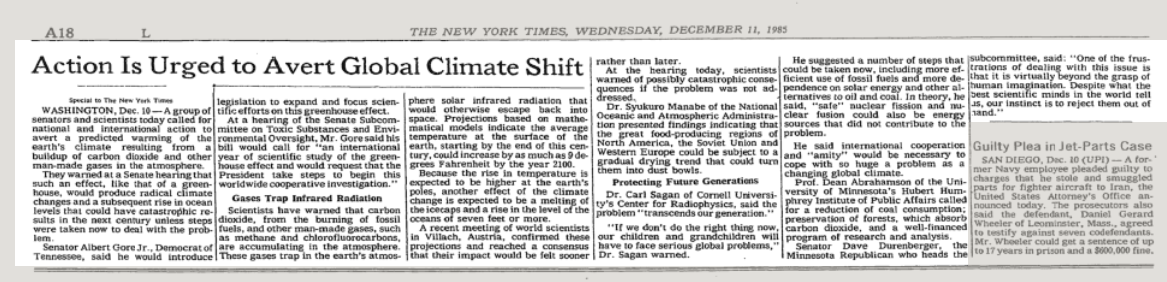
"Scientists have warned that carbon dioxide, from the burning of fossil fuels, and other man-made gases, such as methane and chlorofluorocarbons, are accumulating in the atmosphere. These gases trap in the earth's atmosphere solar infrared radiation that would otherwise escape back into space. Projections based on mathematical models indicate the average temperature at the surface of the earth, starting by the end of this century, could increase by as much as 9 degrees Fahrenheit by the year 2100."
Elements of the post that follows appeared here previously, but given the recent climate "warming" impacts we need to be certain that readers be given the opportunity to consider its message.
Because agencies of the United States government and the Chinese government recently have accepted as inevitable a near-maximum catastrophic impact from Climate Change, the subject must be taken up again. The May 2018 Chinese study, which corresponds to the July official projections accepted and published by the Trump Administration, is unequivocal.
Of course, almost no living person in the Baby Boom generation (or older) will be alive to experience the full catastrophic impact even in the earliest year of the Chinese models - 2064. And at least half of the Gen X generation will be gone before the Chinese model's "most likely" full catastrophic impact year - 2084.
That means Climate Change is still a somewhat abstract concept to the generations of people who voted in the greatest percentages in the latest elections - excluding those who died from the recent heat. And too many of them keep telling themselves it is a lie as they try to figure out how to stay in their home until they die, in many cases despite regular flooding or wildfires or both.
And by "them" I must include "me" because as I wrote in 2016 Al Gore's campaign on climate policy beginning "40 years ago, he..., well, kids..., my generation failed him and you."
We have already changed the world catastrophically
In the years since I wrote this book I’ve been asked hundreds of variations on the question: “What should I do?” What people seem to be looking for is both advice on concrete actions they can take and the assurance that what they do will make a difference. Given the paralysis of the political system, the time lag built into the climate system, and the high likelihood that the threshold of DAI [dangerous anthropogenic interference] has now been crossed, it’s difficult to offer such assurances. We have already changed the world dramatically, indeed quite probably catastrophically. But even when it comes to catastrophe, distinctions can be made. What we choose to do—or not to do—in the coming decades will determine the future both for our own kind and for the millions of other species with whom we share this planet. It is possible that we could still limit warming to around two degrees Celsius, and it is also possible that we could lock in warming of six degrees Celsius or more. These two possibilities represent radically different worlds.
In her 2014 Pulitzer Prize winning book The Sixth Extinction: An Unnatural History she explains that the Earth is in the midst of a man-made sixth extinction, chronicling previous mass extinction events, and comparing them to the accelerated, widespread extinctions of our present time. In a July 2014 interview on The Daily Show with John Stewart promoting the book at the end they both acknowledge a kind of despair:
Unfortunately, in 2018 in both the U.S. and China formal findings have been made that we have "locked in warming" of 4°± Celsius most likely within 60 years.
The DEIS has determined that the draft official policy of the United States government will be acceptance of a near worst case scenario, a 4.387°C (7.876°F) global temperature rise since 1880 by 2100. That is because any lesser scenario would require deep cuts in carbon emissions to avoid this drastic warming. A lesser scenario “would require substantial increases in technology innovation and adoption compared to today’s levels...which is not currently technologically feasible or economically feasible.”
In May 2018 a collaborative research team from China published a new analysis that shows the Earth's climate would increase by 4 °C, compared to pre-industrial levels, most likely by 2084. They found that most of the models projected an increase of 4°C as early as 2064 and as late as 2095, with 2084 appearing as the median year.
"Our ultimate goal is to provide a comprehensive picture of the mean and extreme climate changes associated with higher levels of global warming based on state-of-the art climate models, which is of high interest to the decision-makers and the public," said Dabang Jiang, a senior researcher at the Institute of Atmospheric Physics of the Chinese Academy of Sciences.
Perhaps some would want to dismiss both government agencies as being too
pessimistic. The problem is in 1995, now 26 years ago, then
Vice-President Gore reflected on his experienced reality in a 1995 New York Times article:
"We are in an unusual predicament as a global civilization," Al Gore said when I interviewed him early in his Vice Presidency. "The maximum that is politically feasible, even the maximum that is politically imaginable right now, still falls short of the minimum that is scientifically and ecologically necessary."
In other words, as Kobert outlined in The Sixth Extinction: An Unnatural History various species have already gone extinct. Others are adapting, doing things like moving to higher elevations. But they haven't experienced anything close to the impacts of an increase of 4°C which will strain every species including humans.
All of which should lead us back 90 years to the Dust Bowl Era pictured at the beginning of this post.
In his 1933 novel To A God Unknown, John Steinbeck tells an allegorical tale of the California experience. The protagonist, Joseph, comes to California to create his future. He discovers a place of apparent wealth and promise. And indeed he appears to be achieving all that he dreams. But over time, tragedies strike and a drought undoes his life work.
Late 19th and early 20th Century immigrants to Californian hadn't read To A God Unknown. Instead they believed that water was an endless resource of wealth for future Californians. Unfortunately that wasn't true. It was Johnny Carson who observed that California has four seasons: Fire, Earthquake, Flood, and Drought. But mid-20th Century Californians didn't hear that.
Lands that once were orchards in Southern California. the San Francisco Peninsula, and Santa Clara County, and farms in the Central Valley became subdivisions of housing for large populations, urban/suburban populations that were now dependent upon that water for human consumption competing with the remaining agricultural interests. In 2009 the Southern San Joaquin Valley became the first area in the State to suffer significantly from the return of centuries of drought that received intermittent decades of relief.
The 2019–20 Australian bushfire season is of cataclysmic proportions as it has burned an estimated 21 million acres (32,000 square miles), destroyed over 2,500 buildings (including over 1,900 houses) and killed 25 people as of 5 January 2020. Much of the burned land is bushland, forests and national parks, home to the country's beloved and unique wildlife. This event is due to the climate crisis created by 20th Century human civilization. But the victims here are koalas, kangaroos, and other wildlife.
For some perspective we should note that the 2018 California wildfires consumed 2 million acres and the 2019 Amazon rainforest wildfires burnt 2.2 million acres - each just 10%± of this year's Aussie bushfires. And, of course, the Australian fires are still burning.
In What Will Another Decade of Climate Crisis Bring? in this week's The New Yorker Elizabeth Kolbert, whose multiple award-winning (including a Pulitzer Prize) climate writings have been quoted here extensively, expressed frustration:
...If in the past year (or the past decade) the world began to understand how dangerous climate change is, it certainly didn’t act like it. In the past ten years, more CO2 was emitted than in all of human history up to the election of J.F.K.
In 2015, in Paris, world leaders, including President Barack Obama, committed to holding the average global temperature increase to “well below 2°C.” They never committed to how they were going to do this, however, and last month, in Madrid, the creaky machinery of climate diplomacy came very close to breaking down altogether. The Trump Administration, which has filed to withdraw the United States from the Paris agreement, and the [Australian Prime Minister Scott] Morrison government, which wanted to use an accounting trick to fulfill its Paris commitments, were explicitly blamed for the stalemate. Many commentators noted the irony of the situation. A headline in the Guardian put it this way: “AUSTRALIA TOOK A MATCH TO UN CLIMATE TALKS WHILE BACK HOME THE COUNTRY BURNED.”
Every decade is consequential in its own way, but the twenty-twenties will be consequential in a more or less permanent way. Global CO2 emissions are now so high—in 2019, they hit a new record of forty-three billion metric tons—that ten more years of the same will be nothing short of cataclysmic. Unless emissions are reduced, and radically, a rise of two degrees Celsius (3.6 degrees Fahrenheit) will be pretty much unavoidable by 2030. This will make the demise of the world’s coral reefs, the inundation of most low-lying island nations, incessant heat waves and fires and misery for millions—perhaps billions—of people equally unavoidable.
The climate crisis - Climate Change, Global Warming - is an ongoing worldwide cataclysm which in geological time is extremely fast- moving. It is an unprecedented speed, albeit not quite as fast as that ultimate bad day for the dinosaurs sixty-six million years ago when a devastating asteroid impact occurred near the Mexican town of Chicxulub. In geological time there is little difference between that event and the current climate crisis.
Unfortunately the common human perception of time considers a generation (20 to 30 years loosely defined) as a significant period of time. In that context, for the general population of the first world there can never be a generally accepted climate "crisis."
The term "crisis" means the "turning point." In the context of Climate Change it is a stage in a sequence of events at which the trend of all future experiences will be worse.
As noted by Kolbert, it is true that "in the past ten years, more CO2 was emitted than in all of human history up to the election of J.F.K." But in the case of Climate Change, for the past 60 years every day has been, and every day hence will be, a "turning point" as pollutants have accumulate in the atmosphere making all future experiences worse.
In this context, the first knowledge of such turning points occurred decades ago for Al Gore's generation. In 2009 in an appearance on the NBC sitcom "30 Rock", using the term climate crisis Gore summarized what he had been saying for three decades:
If we're going solve the climate crisis, we've got to change more than the lightbulbs and the windows. We've got to change the laws and the policies through collective political action on a large scale.
Another term is evolving in the legal community. "Climatic Conditions" refers to the frequency and severity of hurricanes, tornadoes, fifty (50) year or greater floods as defined prior to the year 2000 by the U.S. Geological Survey (USGS), ecological drought as defined by the USGS, heat waves, and other weather events such as temperature, wind, precipitation (rain, snow, ice, hail), lightning, etc. To the extent such events are similar, reoccurring, unusually severe events, and increasing in frequency, it can be said that Climatic Conditions have changed or were previously misrepresented.
The important thing to understand about the evolving legal term is that it is occurring within the American legal community. Along with the U.S. military acting to adapt to Climate Change, this should tell Americans that the climate crisis is real within the important institutions which sustain the structure of our lives despite politics and democracy.
Three responses to the climate crisis are possible:
let individuals, families, and corporations adapt their lives to both weather events and economic disruption by making changes in where they live and changes in standard of living and by accepting the statistics and reality of poorer health and reduced lifespans;
have society and government attempt to provide relief to those experiencing the impacts of the catastrophe; and/or
have society, primarily through government, collectively attempt to reduce the scope and/or depth of the catastrophe.
In the past decade the first response has been the experience for millions of people and in the future will be the experience of millions of more people.
In the past decade the second response has resulted in limited relief and an increasing struggle to deal with an ever-greater number of events and the costs thereof.
In the past decade attempts at the third response have proved futile. Greta Thunberg notwithstanding, there is no indication that situation will change as new generations assume power and responsibility.
The overwhelming difficulty is that collective action would require a significant reduction in the standard of living for the first world population. And for first world people that would only happen if a clearly defined "crisis" or 'turning point" could be seen - a Germany invades Poland or Japan bombs Pearl Harbor type of event.
In geological time, it is becoming clear that an irreversible turning point occurred sometime around the beginning of this new millennium. There is no hour or day, or week, or month, year, or decade in which that happened. Scientists dealing with geological time frequently define beginnings and ends in terms of more than 1,000 years. It is nearly impossible for most people to shift their perception framework from months and days to millenniums and centuries. We do not live for or plan for a time in excess of 100 years from now. So we cannot adjust downward our current standard of living for someone who will be living in the year 2150.
Unfortunately, despite leadership efforts to deal with the climate crisis, much of the population of California lives in areas that already have exceeded the threshold set in the 2015 Paris climate accord provision to keep average warming “well below” 2 degrees Celsius:
The truth is best expressed in the article referenced above by Santa Barbara County farmer Guner Tautrim while describing a weather event: “I call what’s happening here ‘global weirding,” His farm was deeded to his family as a Spanish land grant more than two centuries ago. No one believes that his family back then should have taken action to prevent the world from becoming what it is today.
The article also noted that offshore the warming ocean has depleted kelp forests and the shelled creatures that lived in them which are food for numerous larger species which relates to the fact that 13 dead whales washed ashore in San Francisco Bay in 2019, many of which had completely empty stomachs.
The difference between humans and the dinosaurs is that the dinosaurs did not knowingly cause their catastrophic event. Humans in the first world both individually and in groups are knowingly causing their event tweet-by-tweet. Those tweets symbolize something called "a lifestyle" which for thousands of people around the world each year results in "a deathstyle." The fact is "the internet" is the source of massive amounts of carbon.
As noted in last year in The Guardian, if every adult in the UK sent one less email each day it "would save more than 16,433 tonnes of carbon a year – equivalent to 81,152 flights to Madrid or taking 3,334 diesel cars off the road."
You see, Greta Thunberg's choice to sail rather than fly was truly symbolic. Yes, it was symbolic about the subject of transportation and the related carbon footprint.
Unfortunately, it was also symbolic of how just one person can stimulate millions of people to use electronic technology infrastructure to communicate about her thereby making the result of Thunberg's trip across the Atlantic the equivalent of hundreds-of-thousands of flights from London to New York.
"In the past ten years, more CO2 was emitted than in all of human history up to the election of J.F.K." Do you really think that is because of foolish people driving diesel vehicles? Or could it be because of smart phones and other devices? Who is to blame?
The inconvenient truth is that humanity will be unable to stop its inevitable ongoing progress towards a worldwide climate cataclysm which will leave not only whales but most larger mammal species extinct because of empty stomachs...well...only those that haven't been incinerated in wildfires.
In a series of posts here grouped under
climate change black death surrounds us both news and context regarding Climate Change have been offered. We continue now with new reports from March.
This is the reality of climate change. We need to mention two articles in the April 1 edition of The New Yorker, one representing new reporting by Elizabeth Kolbert on Lousiana's sinking lands and the other a review of a new book providing some context “Nature’s Mutiny: How the Little Ice Age of the Long Seventeenth Century Transformed the West and Shaped the Present”
by German-born, Vienna-based historian Philipp Blom who discusses the
complex relationship between the social, economic, and intellectual
disruption caused by the changed climate in the period from 1570 to 1710
known as the Little Ice Age. Both articles are worth reading and perhaps the book would give solid perspective on the future.
In her recent update to Field Notes she told us all (emphasis added):
In the years since I wrote this book I’ve been asked hundreds of variations on the question: “What should I do?” What people seem to be looking for is both advice on concrete actions they can take and the assurance that what they do will make a difference. Given the paralysis of the political system, the time lag built into the climate system, and the high likelihood that the threshold of DAI [dangerous anthropogenic interference] has now been crossed, it’s difficult to offer such assurances. We have already changed the world dramatically, indeed quite probably catastrophically. But even when it comes to catastrophe, distinctions can be made. What we choose to do—or not to do—in the coming decades will determine the future both for our own kind and for the millions of other species with whom we share this planet. It is possible that we could still limit warming to around two degrees Celsius, and it is also possible that we could lock in warming of six degrees Celsius or more. These two possibilities represent radically different worlds.
For clarity, "dangerous anthropogenic interference" means that within a period of less than a 100 years we humans screwed up the self-regulating mechanisms of the biosphere to an irremediable level.
Perhaps it is because she has hung around scientists too long, but in this case Kolbert, who is a master wordsmith and whose two books are the best reporting available on the subjects of regional climate change impacts, still used probability wording - "the high likelihood that the threshold of DAI has now been crossed." A more accurate way of saying it is "the threshold of DAI was crossed sometime early in this Millennium." To put it in perspective, looking back from the year 2116 folks will be correct when they say that on one date in the 20 years between 1995 and 2015 the threshold of DAI was crossed.
And that's what most too many Americans still don't get - by 2066 the number of natural disasters - massive hurricanes, flooding, drought-caused water shortages, and wildfires - will have reached significantly disruptive proportions for many. "Significantly disruptive" in many cases will mean catastrophic locally in some areas by 1950's standards.
Kolbert's new article is excellent reporting on what's happening along the Louisiana coastline. But the book reviewed provides a feeling for what happens to human civilization when the climate changes as significantly as it did in the period 1570-1710 - though perhaps not as radically as it likely will in the period of 1970-2110.
Back then, as now, the effects were world world-wide. Europe saw the collapse of the Middle Ages. In China, already the most populous country in the world, such events such as erratic harvests caused the Ming dynasty to collapse in 1644.
And back then the temperature change was a 2ºC decrease. This time it will be a 4ºC± increase. Let us quote from that same prior post:
The DEIS has determined that the draft official policy of the United States government will be acceptance of a near worst case scenario, a 4.387°C (7.876°F) global temperature rise since 1880 by 2100. That is because any lesser scenario would require deep cuts in carbon emissions to avoid this drastic warming. A lesser scenario “would require substantial increases in technology innovation and adoption compared to today’s levels...which is not currently technologically feasible or economically feasible.”
Take it from someone who has prepared similar such documents - that DEIS is a thorough document.
One might wish to claim that if the Trump Administration would just get on board, things might be different. But in China, home to the world's second largest (and sooner or later, largest) economy, the same conclusion was reached.
In May a collaborative research team from China published a new analysis that shows the Earth's climate would increase by 4 °C, compared to pre-industrial levels, most likely by 2084. They found that most of the models projected an increase of 4°C as early as 2064 and as late as 2095, with 2084 appearing as the median year.
"Our ultimate goal is to provide a comprehensive picture of the mean and extreme climate changes associated with higher levels of global warming based on state-of-the art climate models, which is of high interest to the decision-makers and the public," said Dabang Jiang, a senior researcher at the Institute of Atmospheric Physics of the Chinese Academy of Sciences.
Perhaps some would want to dismiss both government agencies as being too pessimistic. The problem is in 1995, now 23 years ago, then Vice-President Gore reflected on his experienced reality in a 1995 New York Times article:
"We are in an unusual predicament as a global civilization," Al Gore said when I interviewed him early in his Vice Presidency. "The maximum that is politically feasible, even the maximum that is politically imaginable right now, still falls short of the minimum that is scientifically and ecologically necessary."
For the generations after the Baby Boomers, there is no other issue of political importance. This is difficult for many to accept because of what will appear to be slowly evolving social and economic impacts that will create disruption even more significant than what happened between 1570 and 1710. (Note: That was before there was a United States of America...or maybe that is why there is a United States of America.
One cannot discuss the Climate Change period of 1970-2110 without saying it "will appear to be slowly evolving social and economic impacts." The impacts will occur over a much longer period than the 3 minute attention span of the average person and the two day attention span of investment analysts, will require comprehending many thousands more words than found in a tweet, and really will not at all vw as cool as the new Apple stuff.
If you think otherwise, remember that then Congressman Al Gore held hearings on Climate Change in the mid-1970's.
Finally, one has to note, as we have before, that scientists are often forced to create the basis for Climate Change denial by simply reporting observations. We see it again this month.
That's how the generations after the Baby Boomers will be denied by corporate interests the necessary action to reduce the impact of Climate Change. And while some are making plans to adapt, most are fuming about the silly, distracting politics surrounding the Trump Administration which it appears the Trump people will win because they are better at "common man" politics. The climate clock is ticking folks.
The 21st Century Climate Change Black Death is happening now.
"What I want to make French people understand – notably those who say ‘we hear the president, the government, they talk about the end of the world and we are talking about the end of the month’ – is that we are going to treat both, that we must treat both." - French President Emmanuel Macron of France in a November 27 speech addressing the open revolt of the “yellow vest” protesters objecting to costs of measures to reduce Climate Change.
Macron is the last of the "Third Way" politicians to gain office as the head of state in a Western Democracy, in the Tony Blair (Labour Party) - Bill Clinton (Democratic Party) tradition. The Third Way was created as a pro-capitalism intellectual re-evaluation of political policies within various center-left progressive movements in response to doubt regarding the economic viability of the state and the overuse of economic intervention policies.
Those economic intervention policies had previously been popularized by Keynesian Economics but in the latter quarter of the 20th Century contrasted with the rise of popularity the Neoliberal right that captured the Republican Party during that period.
Like many Third Way politicians, Macron is intellectually involved in issues such as Climate Change while totally uninvolved in determining how to address those issues in ways that won't create a psychologically depressed working class that would see in the world coming to an end a better outcome.
Depending on how you look at things, a coal-stuffed climate summit is either completely absurd—“beyond parody,” as one commentator put it—or merely appropriate. With each passing month, the threat posed by global warming grows clearer.
Last week, just as the [Conference of the Parties] session in Katowice was getting under way, the French President, Emmanuel Macron, suspended plans to raise that nation’s gasoline and diesel-fuel taxes. The increase had been intended to speed the transition to cleaner cars; the postponement came in response to violent protests by the so-called “yellow vest” movement. Demonstrators complained that Macron was worried about the end of the world, while they were worried about the end of the month. - Elizabeth Kolbert in "Coal for Christmas at the U.N. Climate Conference"
And that summarizes the problem for urbane (note - that is not "urban") in the Western World including the United States - they worry about abstractions like the end of the world as we know it probably coming sometime in the next century or two while struggling workers worry about being unable to pay the electric bill as the very real utility employee is now at the front door ready to turn off the power.
Meanwhile, Donald Trump offers lumps of coal which can be used to heat the house.
And so among all the various environmental climate change headlines came What France’s ‘Yellow Vest’ Protests Can Teach California. The young writer with much insight addresses the November election failure of Proposition 6 which would have repealed a recent gas tax increase adopted by the Legislature. As she explains:
As the “yellow vest” protests erupt in France, Californians should recognize that many of the policies provoking outrage across the Atlantic are also stoking divisions in our own cities and suburbs.
Here in California, the gas tax that ignited the French protests brings to mind the most contentious proposition on last month’s midterm election ballot: Proposition 6, which would have repealed a gas tax implemented in 2017. The gas tax is a polarizing issue in the state and cost an Orange County senator his job. Although Prop 6 failed, a substantial 43 percent of Californians—most of them living outside urbanized coastal regions—did vote to get rid of the added cost at the pump.
On the surface, the gas tax seems fair: If people choose to drive rather than get around using more planet-friendly modes like public transportation, they should pay the price for contributing to climate change and pollution. And those who make more ecologically responsible choices—whether that’s walking, riding a bike, or using transit—should be rewarded.
But this way of thinking is stuck in an outdated notion of who lives—and drives—in California’s suburbs. ...Many Californians still imagine suburbs as “garden cities” where well-to-do white families enjoy peaceful living while eschewing the ethnic and socioeconomic diversity of the city. But the fact is, as wealthy millennial children of the suburbs increasingly migrate to urban hubs, many minority and low-income residents are being squeezed out.
The Bay Area is infamous for its extreme wealth inequality and an acute housing crisis that is driving many long-term residents—particularly low-income people and people of color—to outlying areas that have fewer job opportunities and are disconnected from the region’s public transportation network.... ...In the Bay Area, low-income households’ third largest category of expenses is transportation, after housing and food. The rise of the gig economy means that more so-called super commuters (those who travel more than 90 minutes to work each day) are working multiple precarious jobs, often far from home, rather than commuting to and from one steady job during normal business hours.
...We are unfairly burdening the state’s already disadvantaged communities
with the costs of our transition to a greener society, while excluding
them from the benefits.....
As noted in this blog previously, the irony is that, California's extra effort in implementing anti-Climate Change policy notwithstanding, Climate Change is going to happen, at near-maximum catastrophic impact. The loss of housing and businesses in recent California wildfires and in earlier hurricanes represents the beginning of a century-long period of environmental changes resulting in new migration within the United States whenever and wherever state and local governments fail to adapt.
"It's the economy, stupid" is a cautionary expression that should be applied to all anti-Climate Change policy development. And the corollary is that the negative economic impacts of that policy must necessarily fall on the rich and successful, or there will be no anti-Climate Change policy.
Beginning in posts here in 2011, the impacts on our grandchildren of governmental policy failures became the term used to create context about our failures as a people.
This grandchildren reference most pointedly has been used with regard to Climate Change.
Because agencies of the United States government and the Chinese government recently have accepted as inevitable a near-maximum catastrophic impact from Climate Change, the subject must be taken up again. The May 2018 Chinese study, which corresponds to the
July official projections accepted and published by the Trump Administration, is unequivocal.
Of course, almost no living person in the Baby Boom generation (or older) will be alive to experience the full catastrophic impact even in the earliest year of the Chinese models - 2064. And at least half of the Gen X generation will be gone before the Chinese model "most likely" full catastrophic impact year - 2084.
That means Climate Change is still a somewhat abstract concept to the generations of people who will turnout in the greatest percentages in the upcoming Midterm Election. And too many of them keep telling themselves it is a lie as they try to figure out how to stay in their home until they die, in many cases despite regular flooding or wildfires or both.
And by "them" I must include "me" because as I wrote in 2016 Al Gore's campaign on climate policy beginning "40 years ago, he..., well, kids..., my generation failed him and you."
We have already changed the world catastrophically
In the years since I wrote this book I’ve been asked hundreds of variations on the question: “What should I do?” What people seem to be looking for is both advice on concrete actions they can take and the assurance that what they do will make a difference. Given the paralysis of the political system, the time lag built into the climate system, and the high likelihood that the threshold of DAI [dangerous anthropogenic interference] has now been crossed, it’s difficult to offer such assurances. We have already changed the world dramatically, indeed quite probably catastrophically. But even when it comes to catastrophe, distinctions can be made. What we choose to do—or not to do—in the coming decades will determine the future both for our own kind and for the millions of other species with whom we share this planet. It is possible that we could still limit warming to around two degrees Celsius, and it is also possible that we could lock in warming of six degrees Celsius or more. These two possibilities represent radically different worlds.
In her 2014 Pulitzer Prize winning book The Sixth Extinction: An Unnatural History she explains that the Earth is in the midst of a man-made sixth extinction, chronicling previous mass extinction events, and comparing them to the accelerated, widespread extinctions of our present time. In a July 2014 interview on The Daily Show with John Stewart promoting the book at the end they both acknowledge a kind of despair:
Even by 2015 she still said: "But even when it comes to catastrophe, distinctions can be made." In this week's The New Yorker Kolbert expressed her frustrated outrage (emphasis added):
Last week, the United Nations’ scientific advisory board delivered its assessment of those numbers. The findings of the group, the Intergovernmental Panel on Climate Change, were almost universally—and justifiably—described as “dire.” Even 1.5 degrees’ worth of warming, the I.P.C.C. warned, is likely to be disastrous, with consequences that include, but are not limited to, the loss of most of the world’s coral reefs, the displacement of millions of people by sea-level rise, and a decline in global crop yields. Meanwhile, at the current rate of emissions, the world will have run through the so-called carbon budget for 1.5 degrees within the next decade or so. “It’s like a deafening, piercing smoke alarm going off in the kitchen,” Erik Solheim, the executive director of the U.N. Environment Program, told the Washington Post.
But, if a smoke alarm rings in the kitchen and everyone’s watching “Fox & Friends” in the den, does it make a sound? Asked about the report last week, Donald Trump said, “I want to look at who drew it—you know, which group drew it.” The answer seemed to indicate that the President had never heard of the I.P.C.C., a level of cluelessness that, while hardly a surprise, was nevertheless dismaying. The next day, as a devastating hurricane hit Florida—one made that much more destructive by the warming that’s already occurred—the President flew to Pennsylvania to campaign for Lou Barletta, a climate-change-denying Republican congressman running for the Senate.
Though the Administration often seems incapable of systematic action, it has spent the past eighteen months systematically targeting rules aimed at curbing greenhouse-gas emissions. One of these rules, which required greater fuel efficiency for cars and trucks, would have reduced CO2 emissions by an estimated six billion tons over the lifetime of the affected vehicles. In a recent filing intended to justify the rollback, the Administration predicted that, by the end of this century, global temperatures will have risen by almost four degrees Celsius (nearly seven degrees Fahrenheit). In this context, the Administration argued, why would anyone care about a mere six billion tons? Come the apocalypse, it seems, we’ll all want to be driving S.U.V.s.
...Meanwhile, two and a half degrees, three degrees, or even, per the Trump Administration, four degrees of warming are all realistic possibilities. Indeed, based on recent trends, the last figure seems the most likely. Globally, emissions rose last year, and they’re expected to rise still further this year. This disaster is going to be as bad—as very, very bad—as we make it.
Yes. "This disaster is going to be as bad—as very, very bad—as we make it." Unfortunately, in 2018 in both the U.S. and China formal findings have been made that we have "locked in warming" of 4°± Celsius most likely within 60 years.
The DEIS has determined that the draft official policy of the United States government will be acceptance of a near worst case scenario, a 4.387°C (7.876°F) global temperature rise since 1880 by 2100. That is because any lesser scenario would require deep cuts in carbon emissions to avoid this drastic warming. A lesser scenario “would require substantial increases in technology innovation and adoption compared to today’s levels...which is not currently technologically feasible or economically feasible.”
Take it from someone who has prepared similar such documents - that DEIS is a thorough document.
One might wish to claim that if the Trump Administration would just get on board, things might be different. But in China, home to the world's second largest (and sooner or later, largest) economy, the same conclusion was reached.
In May a collaborative research team from China published a new analysis that shows the Earth's climate would increase by 4 °C, compared to pre-industrial levels, most likely by 2084. They found that most of the models projected an increase of 4°C as early as 2064 and as late as 2095, with 2084 appearing as the median year.
"Our ultimate goal is to provide a comprehensive picture of the mean and extreme climate changes associated with higher levels of global warming based on state-of-the art climate models, which is of high interest to the decision-makers and the public," said Dabang Jiang, a senior researcher at the Institute of Atmospheric Physics of the Chinese Academy of Sciences.
Perhaps some would want to dismiss both government agencies as being too pessimistic. The problem is in 1995, now 23 years ago, then Vice-President Gore reflected on his experienced reality in a 1995 New York Times article:
"We are in an unusual predicament as a global civilization," Al Gore said when I interviewed him early in his Vice Presidency. "The maximum that is politically feasible, even the maximum that is politically imaginable right now, still falls short of the minimum that is scientifically and ecologically necessary."
In other words, as Kobert outlined in The Sixth Extinction: An Unnatural History various species have already gone extinct. Others are adapting, doing things like moving to higher elevations. But they haven't experienced anything close to the impacts of an increase of 4°C which will strain every species including humans.
The species that all living human beings on this planet belong to is Homo sapiens. During a time of dramatic climate change 200,000 years ago, Homo sapiens (modern humans) evolved in Africa. We evolved out of a time of dramatic climate change and we could go extinct in a time dramatic climate change.
Unless, of course, we successfully adapt. But that would require a broad acceptance of what's coming - the impacts of an increase of 4°C, perhaps as early as 2064 but certainly no later than then end of the 21st Century.
The impacts in most presentations include discussions of sea water depths and temperature rises. In terms of human populations, in the popular American press usually we only read about people on some Pacific island or populations living in Trump's "shithole" countries.
In 2010 scientists noted that higher resolution modelling studies project substantial increases in the frequency of the most intense cyclones, and increases of the order of 20% in the precipitation rate within 100 km (60 mi) of the storm centre. But it wasn't until this month, eight years later, we see the following headlines:
And yet no politician is adequately creating in the U.S. population fear of the coming impacts of Climate Change, unless you mistakenly consider migration from Central America an impact. The one American truth about Climate Change impacts as a subject is the complete lack of
presentation focused on the geographic centers of Progressive populations compared to the Deplorables populations.
(And most certainly no one is mentioning the many, many American billionaires quietly investing in expensive homes on hundreds or thousands of acres of ranch land in the area of the Eastern Slope of the Continental divide. But that's another subject.)
Awareness has only begun with sea rise and a wildfire-mudslide cycle
To begin to understand the reality, watch this news feature video done by Australians limited to sea rise impacts, recognizing that it was done in 2017 before the new numbers:
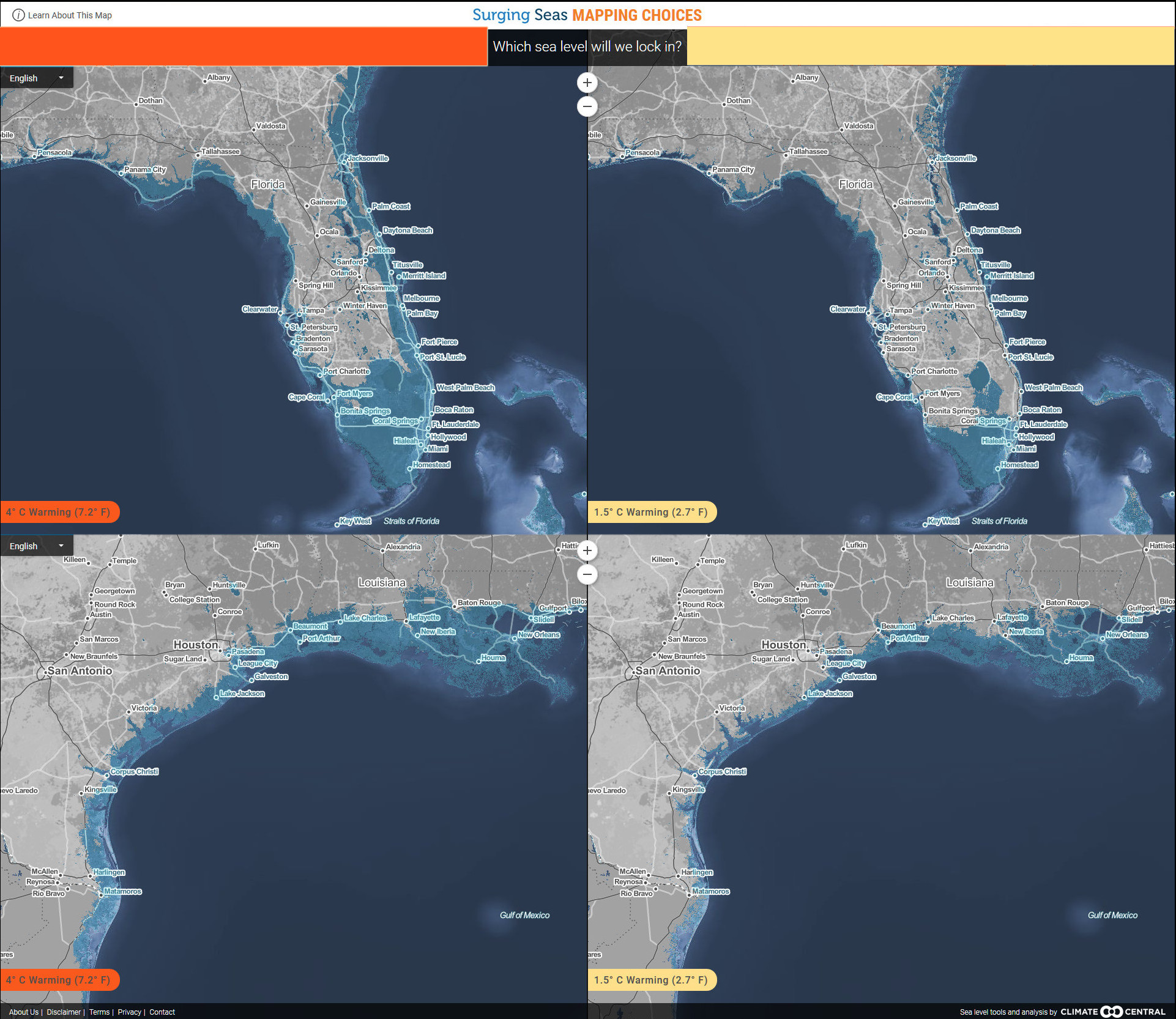
Since two of the featured locales are on the Gulf of Mexico, take a look at these comparative maps - the right side is what not too long ago many thought would be the maximum impact, the left side is what we now project will happen in 60± years while the right side is maybe 20 years out (click on the image for a larger version):
Do look at the larger version particularly if you think you might want to invest now in what will be beach front real estate in Tallahassee, Florida, or Houston, Texas, or Baton Rouge, Louisiana. It will be valuable property you can bequest to your descendants.
Not featured in the video are two U.S. West Coast locales that haven't experienced any visible sea rise impact because they aren't ocean front communities - Sacramento, California, and Portland Oregon. With the 4°± Celsius sea rise most likely within 60 years, folks there might want to consider these maps (click on the image for a larger version):
As can be seen on the left, with a rise of 4°C all of Sacramento and much of its surrounds will be inundated. This is because the Sacramento and San Joaquin River confluence areas will be impacted by the rising waters in the San Francisco Bay. (What we know as "The Delta" will no longer exist except as a bay.)
And all of downtown Portland and large swaths of areas adjacent to the Columbia River will be inundated. This is because the waters in the Columbia River will discharge into a much higher ocean outlet, causing the water to rise inland as far as the Bonneville Dam.
Rising seas along with the recent wildfire-mudslide cycles provide strong visual presentations. In the video above we even see the beginnings of the "migration from" patterns within the United States due to sea rise.
Then comes agricultural production losses with eco-system changes
But this doesn't even begin to expore the impacts of eco-system changes and resulting changes in agricultural production.
With a 4°C of global warming the likelihood "substantial species extinctions" and "large risks to global and regional food security" is "extremely high" according to the Intergovernmental Panel on Climate Change. In other words, the ecosystem transformation will be unavoidable. And while you may not be concerned about that frog or cricket in the field down the road, you may want to eat.
Food production is a huge concern. Now here's where communications skills were, and still are, lacking in Democrats. Consider this.
"A growing number of studies suggest it would become significantly more difficult for the world to grow food with 3°C or 4°C of global warming."
It's unfortunate. Scientific truths are saddled with terms like "extremely high", "growing number", "suggest" and "more difficult." Nonethless, climate science studies when tied to economic information indicate that not only will your grandchildren's diet look radically different they may not have enough to eat. What we know as the American middle-class and poorer families will struggle to fund three meals a day. Parents will have to join their kids for lunch using the school lunch program.
Ignoring all of the rest of the world, graphics like the one at the left are used to tell us that radical shifts in agricultural production will be required in the areas within the circles. This is how the threat to our grandchildren is communicated! Large broad strokes are offered which cause eyes to glaze over. It doesn't say to folks in Red States "your descendants will go hungry!"
That means substantial changes in production in the United States - as a nation the U.S. will become far less self-sufficient when it comes to obtaining food. But the average Trump supporter can't get that from the narrative offered at the right.
And that is what ultimately allowed people to ignore the Climate Change problem. Scientists don't assert a truth, they describe what might be the case, if.... In a case like this they do this because there is no exact experience, no mathematical absolute. There are data variations, chances, unknowns.
And if we all wait to see what will actually happen, we'll know all the frogs and crickets are dead just before we all starve, or die of heat, or flooding. Because like frogs, we need time to adapt, so unless we start now.....
U.S. production of corn, much of which is used to feed livestock could be cut in half by a 4˚C increase in global temperatures. A study by Purdue University note that warmer overnight temperatures in Indiana have contributed to reduced corn yields over the last decade. Elevated overnight temperatures increase plant respiration, reducing sugar availability for grain production, and it can affect the timing and success of pollination—resulting in lower crop yield. Observations show that Indiana corn yields are reduced by about 2 percent for every 1°F increase in overnight temperatures during July.
The study suggests such things as breeding corn for traits that improve factors contributing to yield in warmer conditions, may also help offset the effect of warming overnight temperatures. But we need to know that this takes time and money.
More than half of California's Central Valley is projected to be no longer suitable for growing crops like apricots, peaches, plums and walnuts sometime around the middle of the century. By the end of the century, that’s projected to grow to 90 percent or more of the valley!
Tapan Pathak, a scientist and climate adaptation extension specialist at the University of California, Merced, who was the lead author of a 2018 study Climate Change Trends and Impacts on California Agriculture: A Detailed Review explained: “There is a clear need and urgency for adaptation research to make California agriculture resilient to future climate risks,” In that localized research, he said, “priority should be given to crops and commodities that are most vulnerable to climate impacts."
Other studies of the U.S. indicate that some crop production can be shift northward, much like the animals and plants moving to higher elevations, though volume will be reduced without other adaptation breakthroughs.
Hopefully, the Climate Change hoax bluster of the Republicans will not keep agricultural research unfunded.
Regarding Al Gore's campaign on climate policy beginning 40 years ago, he..., well, kids..., my generation failed him and you. But then I said that before....


 In Christopher Nolan’s science fiction film,



 website.
