Showing posts with label 2020 Election. Show all posts

Saturday, February 13, 2021

The Declaration of Independence allows for revolt against "a long train of abuses and usurpations"

The single most disturbing thing about living in the United States is knowing how little Americans know about their government and founding documents.

For instance, there is no mention of people being "created equal" in the Constitution. The closest one can come is Section 1 of the 14th Amendment which states:

    All persons born or naturalized in the United States, and subject to the jurisdiction thereof, are citizens of the United States and of the State wherein they reside. No State shall make or enforce any law which shall abridge the privileges or immunities of citizens of the United States; nor shall any State deprive any person of life, liberty, or property, without due process of law; nor deny to any person within its jurisdiction the equal protection of the laws.

On the other hand the Declaration of Independence has legal standing. Consider this:

    The Declaration has been recognized as the founding act of law establishing the United States as a sovereign and independent nation, and Congress has placed it at the beginning of the U.S. Code, under the heading "The Organic Laws of the United States of America." The Supreme Court, however, has generally not considered it a part of the organic law of the country. For example, although the Declaration mentions a right to rebellion, this right, particularly with regard to violent rebellion, has not been recognized by the Supreme Court and other branches of the federal government. The most notable failure to uphold this right occurred when the Union put down the rebellion by the Southern Confederacy in the Civil War.

We are fortunate that Donald Trump's attorneys did not offer the text of the Declaration in their defense beginning with the discussing "The Organic Laws of the United States of America" as contained in the U.S. Code.

"Prudence, indeed, will dictate that Governments long established should not be changed for light and transient causes; and accordingly all experience hath shewn, that mankind are more disposed to suffer, while evils are sufferable, than to right themselves by abolishing the forms to which they are accustomed." But what if a third of the current American population believes "it is their right, it is their duty, to throw off" the current U.S. government?

Back "when the Union put down the rebellion by the Southern Confederacy in the Civil War" just 50 years after the War of 1812 finally gave the former British Colonies some stable independence, people were different. Right? No?

Exactly when does "a long train of abuses and usurpations" become long enough to say "no more?"

Perhaps the reality is that when, as was the case at the beginning of the Civil War, the military leadership was divided and, to a significant degree, the rank and file was state-oriented, a revolt against the national government was possible. But today the military is significantly national and we now have police who support stability over instability.

Of course that could change. There is the Declaration of Independence, an official part of the U.S. Code, an organic law that is part of the foundation of U.S. government,that authorizes a revolution:

It's all about what we (and Trump's attorneys?) don't know.

Wednesday, January 20, 2021

What happens when the much vaunted "center" of a "new world order" withdraws creating a vacuum


In human history all dominate cultures have fallen. In the past decade many have been writing that the world leadership by the U.S. has declined or even collapsed. It's complicated, but also true in the sense that the United States is no longer the "center" of a "new world order."


New World Order

As historically used, the term "new world order" refers to a leadership transition in collective efforts to identify, understand, and/or address global problems that go beyond the capacity of the peoples of individual nation-states to solve. The term was used at the end of both World War I and II with the United States appearing to be the hope for the world. 

European culture, with an emphasis on Great Britain's empire, was the center of a new world order as the United States evolved. The U.S. in the second half of the 20th Century assumed that "center" mantle. At the very time that the U.S. seemed to have assured its place with the fall of the Soviet Union, in fact it turns out it was the end of the Eurocentric world.

The term "new world order" was most recently used at the end of the Cold War.

After the election March 11, 1985, of Mikhail Gorbachev to the position of General Secretary of the Communist Party of the Soviet Union, the process of dissolution of the Soviet Union was begun. Prior to that time, the United States and the Soviet Union dominated the world order. In five years, the change was clear as noted by U.S. President George H. W. Bush:

We stand today at a unique and extraordinary moment. The crisis in the Persian Gulf, as grave as it is, also offers a rare opportunity to move toward an historic period of cooperation. Out of these troubled times, our fifth objective—a new world order—can emerge: a new era—freer from the threat of terror, stronger in the pursuit of justice, and more secure in the quest for peace. An era in which the nations of the world, East and West, North and South, can prosper and live in harmony. A hundred generations have searched for this elusive path to peace, while a thousand wars raged across the span of human endeavor. Today that new world is struggling to be born, a world quite different from the one we've known. A world where the rule of law supplants the rule of the jungle. A world in which nations recognize the shared responsibility for freedom and justice. A world where the strong respect the rights of the weak.

    - President George H.W. Bush, September 11, 1990, Address Before a Joint Session of Congress

Unfortunately, Bush was a bit ahead of the curve thinking there would be a future of peace, freedom and justice as he did not recognize the shadow cast by the self-centered arrogance endemic to the American people. The historical period of 1918-1922 should have represented a warning that just as the U.S. effectively abandoned the League of Nations ultimately causing WWII, there was little chance the the American political scene would shift to support a unanimous unselfish group leadership role.

The irony should not be lost that Bush's speech was given 11 years to the day before his son as President would face what we know as 9/11 leading to a another two decades of war initiated by the United States.

In fact, beginning in 1980 the U.S. electorate shifted politically back to the post-WWI Republican capitalist greed era by electing Ronald Reagan. Reagan clearly stated his philosophy in 1964 while campaigning for Barry Goldwater in  his famous speech, "A Time for Choosing":

The Founding Fathers knew a government can't control the economy without controlling people. And they knew when a government sets out to do that, it must use force and coercion to achieve its purpose. So we have come to a time for choosing ... You and I are told we must choose between a left or right, but I suggest there is no such thing as a left or right. There is only an up or down. Up to man's age-old dream—the maximum of individual freedom consistent with order—or down to the ant heap of totalitarianism.

The Clinton and Obama Presidencies remained focused on maintaining the wealth of the American 1% through corporate support in the international arena.

The high risk factor ignored was that most of the world's population was located outside the U.S. and half the U.S. population was becoming uneasy with the decline in their share, small as it was, in the growing wealth.

That led to the election of Donald Trump, a millionaire who touted a populist-image aimed at the gullible half of the U.S. population that had grown uneasy with the decline in their share. Trump pulled the U.S. out of international financial and other agreements which pretty much ended the world's love for American democracy.

The truth is that world power was centered on European economic power in the 19th Century and on U.S. economic power in the 20th Century.

Today in terms of economic power, the focus is rapidly shifting away from the 20th Century inherited European-American North Atlantic focus bequested to the U.S. by Britain. 

Recent events have assured an Asian-Pacific focus with expanding African and European participation, all through international agreements. This is no accident. The world's population is roughly 7.8 billion with 4.6 billion living in Asia,  2.82 billion of whom live in China and India. Africa has another 1.4 billion. So far, another 250 million folks in Pacific Rim nations Australia, Canada, Chile, Mexico, New Zealand, and Peru have signed on.

While the United States coped with Trumpist shifts away from internationalism, Great Britain withdrew from the European Union and is now just beginning to discover the negative economic effects of Brexit.

Are we prepared for this? To date the only President born in a Pacific Coast state, Richard Nixon, is also the only President to have made any significant positive move in our history to recognize the importance of Asia.

Yes, Donald Trump left office creating internal turmoil in his wake. The electorate did anoint Joe Biden to replace him. But in terms of creating a role for the U.S. in a new world order, Biden faces major problems as (1) a significant bloc of the U.S. electorate opposes economic participation in world organizations and (2) most of the world's nations, in reaction to Trump, effectively have moved on leaving the U.S. as just one more player in world affairs, and not a very reliable one at that.

Those two facts alone represent major hurdles for the U.S. But they aren't even where the focus must be right now.


The Pandemic, Climate Change, and Cyberspace Vulnerability

President Joe Biden assumes office at the beginning of the third decade of the Second Millennium A.D. facing a world that easily can be distinguished from the 20th Century world.

Biden and humanity are confronting the immediate problems of...

  • a pandemic from a new disease, 
  • climate change, and 
  • sophisticated cyberattacks within a new theater of war called cyberspace, 

...all of which involve a leadership failure of the United States as a political entity during the first two decades of the Millennium.

Regarding the Covid-19 Pandemic, in the U.S. we have had 24,000,000+ cases and 400,000+ deaths in a year. 

Is this a real problem? For comparison in 2020, an estimated 1,806,590 new cases of cancer will have been diagnosed and 606,520 people will die from cancer. Regarding the flu, for which we have vaccines, annually in the last decade we have had between 9 million - 45 million illnesses, between 140,000 - 810,000 hospitalizations and between 12,000 - 61,000 deaths.

In terms of behavioral deaths, there were 36,096 fatalities in motor vehicle accidents and 15,292 people were fatally shot in 2019.

We should have been on top of the Covid-19 pandemic in January 2020 basically isolating the United States from the world and recommending everyone else do it also. But that is just not our way, ultimately letting us know that some day we will suffer major losses setting us back economically a century or more. But as we all know that will happen to someone else.

Based on available data, it is reasonable to expect recurrent Covid-19 epidemics as strains mutate. Other than the obvious impact on individuals, this has significantly altered our economy. But as seen from the statistics above, we've decided to coexist with disease and related economic impacts.

Regarding the second major U.S. policy failure impacting the economy, Climate Change, by 1960 research was telling us we had a problem as explained in Wikipedia:

By the late 1950s, more scientists were arguing that carbon dioxide emissions could be a problem, with some projecting in 1959 that CO2 would rise 25% by the year 2000, with potentially "radical" effects on climate. In the centennial of the American oil industry in 1959, organized by the American Petroleum Institute and the Columbia Graduate School of Business, Edward Teller said "It has been calculated that a temperature rise corresponding to a 10 per cent increase in carbon dioxide will be sufficient to melt the icecap and submerge New York. [....] At present the carbon dioxide in the atmosphere has risen by 2 per cent over normal. By 1970, it will be perhaps 4 per cent, by 1980, 8 per cent, by 1990, 16 per cent if we keep on with our exponential rise in the use of purely conventional fuels.". In 1960 Charles David Keeling demonstrated that the level of CO2 in the atmosphere was in fact rising. Concern mounted year by year along with the rise of the "Keeling Curve" of atmospheric CO2.

In terms of political awareness, we can point to Al Gore. In 1976, after joining the United States House of Representatives, Al Gore held the first congressional hearings on the climate change, and co-sponsored hearings on toxic waste and global warming. 

As explained in a previous post, Gore's subsequent presentation, movie, and book about Global Warming is entitled rather ironically "An Inconvenient Truth" precisely because as explained by Greta Thunberg "at a deep level, the language of climate denialism is tied up with a form of masculine identity predicated on modern industrial capitalism." The basic truth of the situation is economically very inconvenient and therefore politically very inconvenient. The American electoral system, not the majority of voters, defeated Al Gore for President in 2000 partly, or mostly, for that reason.

Simply, 1960 was 60 years ago. It is too late to avoid many climate catastrophes. As explained in a recent article:

    “The scale of the threats to the biosphere and all its lifeforms – including humanity – is in fact so great that it is difficult to grasp for even well-informed experts,” they write in a report in Frontiers in Conservation Science which references more than 150 studies detailing the world’s major environmental challenges.
    The delay between destruction of the natural world and the impacts of these actions means people do not recognise how vast the problem is, the paper argues. “[The] mainstream is having difficulty grasping the magnitude of this loss, despite the steady erosion of the fabric of human civilisation.”

Nonetheless, Joe Biden has indicated a significant shift towards addressing climate change which offers some hope.

The third major U.S. economic policy failure is Cyberspace Vulnerability. Several facts need to be understood:

  • "Cyberspace" has numerous meanings within the world of the arts, but ultimately came to reference a widespread, interconnected digital technology associated with the internet which has no single centralized governance in either technological implementation or policies for access and usage that began in the 1960s with the Advanced Research Projects Agency (ARPA) of the United States Department of Defense funded research into time-sharing of computers; in other words, it was created by the United States DOD.
  • In 2013 Edward Snowden released a bunch of information about what the NSA was doing as noted in an extensive article in The Guardian (if you haven't read it you should); simply the U.S. was engaging in far reaching clandestine cyber espionage the disclosure of which resulted in a furor among U.S. allies, but did not actually restrict NSA activities, leaving the United States government as the largest single organization on Earth invading the privacy of individual human beings, individual businesses, and foreign governments, both within an international scope and within the United States.
  • Because in the 1980's internet development was turned over to the private sector, clandestine spying is rampant; specific to politics you might remember the name Cambridge Analytica in relationship to both privacy invasion and Russian interference issues related to the election of Donald Trump because the company was paid at least $650,000 for voter data analysis and digital video; however, American corporate cyberspace spying has led to the establishment of  similar clandestine programs which have allowed both public and private sector interference in American affairs.

In summary American Cyberspace Vulnerability is entirely the fault of American worship of greed and power. Unlike nuclear weapons, no effective international restrictions exist today to protect cyberspace nor can they be instituted. 

Instead, the incoming Biden Administration must determine what, if any, data should be sealed from outside access and then figure out how to make that happen given the widespread existence within "the cloud" of elements of critical data.

In the meantime, we know that the ability to mess with elections is out there. But we also know that the ability of nations to shut down and damage utilities such as electricity, gas, and communications in other nations is a reality.

It is no small irony that most "smart" phones, including all critical components, are manufactured in Asia. This is also true of most electronics. It is the world a greedy United States created thumbing its nose at government. It will not be easy to undo.


The Next Eight Decades

Consider the following very recent observation:

    Most great empires, Arnold Toynbee once argued, end by committing suicide rather than being murdered.
    But with their exceptionalism and profound myopia, Americans think they are exempt from history’s merciless fate. They won’t be. There are four areas in which Americans have reigned supreme from the second half of the last century: the military, the capitalist financial system, medicine and disease control, and democratic institutions.
    In every one of them, signs of decay and decline abound.

The article the above quote is from should be read by all Americans. Unfortunately, it will be read by nearly none.

It is highly unlikely that the United States will be the "center" of a "new world order." It may turn out that George H.W. Bush was right when he said 30 years ago:

Today that new world is struggling to be born, a world quite different from the one we've known. A world where the rule of law supplants the rule of the jungle. A world in which nations recognize the shared responsibility for freedom and justice. A world where the strong respect the rights of the weak.

It could be humans will make the necessary decisions creating such a world. But the nature of that world will rest in the heads and hearts of those who over the next 80 years consider is the nature of freedom and justice and what should be the focus of attention. In that context the U.S. ended up with 80±-year-old political leaders. Aren't we the generation who created the mess we're in? Well, not exactly!

The only appointed high official to serve a full four years in the Trump years, 57-year-old Mike Pompeo, was appointed by Trump as Director of the Central Intelligence Agency in January 2017 and promoted to secretary of state in March 2018 after Trump fired Rex Tillerson who reportedly called Trump a moron.  

Pompeo appears to have successfully completed the early 21st Century redefining of China as an enemy of American capitalism. As noted here in 2019 Pompeo is a Koch Brothers believer (as is Mike Pence):

There is no question that the Koch conservative right sees China as the one serious threat to unfettered capitalism and Pompeo has worked diligently to focus American military and foreign policy on that enemy. It's relatively simple equation - capitalism and communism are arch enemies. 

Confronted with Pompeo's Koch viewpoint, China's President Xi has refocused China's military on the very real U.S. threat while continuing to move forward with China's long term economic plans.

Make no mistake about it, freedom and justice are not defined by the Chinese in any way similar to American definitions. On the other hand, China is preparing its 14th Five Year Plan and 2035 Vision, a key marker of Xi’s national rejuvenation project to build a "prosperous, strong, democratic, culturally advanced, harmonious, and beautiful" modern socialist country by 2049. The core goal is to give the nation's people freedom from economic worry.

The Koch oil company empire notwithstanding, what do 340 million Americans living in a politically divided country that has a 250 year history really think about 1.44 billion Chinese living in a country that has a 4000 year history of centralized rule? Are there any thoughts about China planning an economy for it's children and grandchildren?

And, of course, what exactly is the national plan for mediating the impact of climate change on the American people?

This is the beginning of Joe Biden's term. It's quite a challenge.

Wednesday, December 2, 2020

Covid-19, unemployment, & realigned world trade: Extended Economic Distortion begins to take shape

We are nearing the end of a year of pandemic after four years of the Trump Administration. It is not surprising that Covid-19, unemployment associated with changes in consumer habits, and a realignment of world trade towards the Pacific-Southeast Asian nations are creating a picture of a probable Extended Economic Distortion within the U.S.


The Pandemic

The Covid-19 pandemic has worsened severely. As of November 30, here in California's hospitalizations exceeded the previous high as can be seen in this chart...

...while the 7-day death rate climb has just begun - 133 days after the hospitalization rise exactly as last time. These charts do not reflect Thanksgiving infections and, with Christmas and New Years coming up, hospitalizations will continue to skyrocket probably through February. (It has become clear that Californians are no better than any others waiting for the vaccine while protecting the vulnerable among them.)


Unemployment

Expanded unemployment has, and will continue to, create difficult economic pressures. Obviously, a runaway pandemic is going to put pressure on businesses directly serving the public. Many restaurants and retailers have closed. But that isn't the major issue.

The most immediate issue is the impact of expiring expanded unemployment related benefits enacted to reduce economic losses from the Covid-19 pandemic. By the end of December the last of the aid will be paid out that Congress provided through a series of emergency measures in the spring.

Direct checks of $1,200 per person to most U.S. households, $600 a week in supplemental unemployment benefits and hundreds of billions of dollars in support for small businesses reduced the effects through the summer. But according to U.S. employment data the number of people out of work for more than six months (the indicator of long-term unemployment) rose 1.2 million in October, to 3.6 million - a rise - and is likely to continue to increase well into 2021. In addition, workers are facing these realities:

  • Nearly four million Americans are receiving benefits under the pandemic compensation program, a number that doubled in the past month and which will keep rising as more people reach the end of their 26-week state benefits.
  • There are 9.3 million people receiving Pandemic Unemployment Assistance, a program to cover people left out of the normal unemployment system, such as freelancers and self-employed workers, as well as those unable to work because of pandemic-related child care issues and similar obstacles.
  • Tens of millions of workers will lose access to federally mandated paid sick and family leave from the Families First emergency program which required many employers to provide workers with two weeks of coronavirus-related sick leave at full pay and up to 12 weeks of family and medical leave to care for family members at two-thirds pay.

All this must be viewed in the context of an October 2020 report titled Household Financial Fragility during COVID-19: Rising Inequality and Unemployment Insurance Benefit Reductions which makes us acutely aware that even in January 2020 when our economy was thought to be booming a large majority of American households were dependent upon that next paycheck to cover their cost of housing and food.

In theory Congress could extend, modify-and-extend, or create new programs. Recent headlines indicate a compromise bill proposed by nine Senators has some support. But the divided national political scene as reflected by the Republican Senate versus Democratic House - Senate Majority Leader Mitch McConnell (R-KY) versus Speaker of the House Nancy Pelosi (D-CA) - will not make that easy.

We will know by the end of January 2021 the level of success of McConnell's election 2024 goal to make Joe Biden seem responsible for an economic disaster by minimizing benefits to unemployed workers.


21st Century Economic Restructuring

As noted here in a September 1 post, the first 20 years of the 20th Century and the first 20 years of the 21st Century solidified major transitions in the economy.

The most significant of the changes was brought about by the embracing of the internet for communications, entertainment, and sales of goods and services. Consider this story:

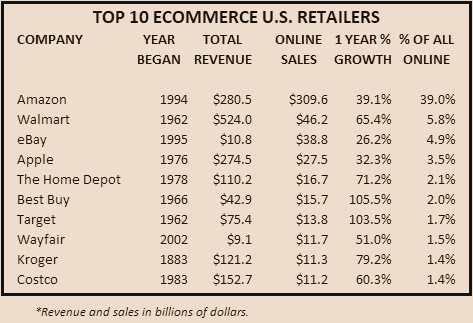
    US ecommerce sales will reach $794.50 billion this year, up 32.4% year-over-year....
    “We’ve seen ecommerce accelerate in ways that didn’t seem possible last spring, given the extent of the economic crisis,” said Andrew Lipsman, eMarketer principal analyst at Insider Intelligence. “While much of the shift has been led by essential categories like grocery, there has been surprising strength in discretionary categories like consumer electronics and home furnishings that benefited from pandemic-driven lifestyle needs.”
    “There will be some lasting impacts from the pandemic that will fundamentally change how people shop,” said Cindy Liu, eMarketer senior forecasting analyst at Insider Intelligence. “For one, many stores, particularly department stores, may close permanently. Secondly, we believe consumer shopping behaviors will permanently change. Many consumers have either shopped online for the first time or shopped in new categories (i.e., groceries). Both the increase in new users and frequency of purchasing will have a lasting impact on retail.”

The numbers in the table below reflect that changing market when comparing the 2019 financial statement total revenue to the most recently reported current esales:

The likelihood that gains in internet sales after Covid-19 will revert to in-store sales is not great. And expected holiday sales will shift further to online. The impact on local retail sales cannot be overstated.

Further, as mentioned in the article above, the real surprise is that online grocery sales have skyrocketed as noted in this Atlanta Constitution article:

    Recent numbers show the pandemic pushed online grocery sales in the U.S. to extraordinary heights. In August 2019, sales were $1.2 billion, according to data gathered by the companies Brick Meets Click and Mercatus. In June 2020, they were $7.2 billion.
    Meanwhile, online sales grew from 3.4% of the grocery buying market in 2019 to 10.2% a year later, according to Mercatus and consumer data firm Incisiv.
    The change is creating thousands of new jobs in Atlanta, from high-tech positions to warehouse and delivery workers.
    Online shoppers will see improved delivery services and a better online user experience as companies compete for their share of the $1 trillion annual U.S. grocery market, industry analyst David J. Livingston said. But some smaller grocers likely won’t be able to keep up and could end up closing as behemoths like Walmart and Amazon continue to take bigger chunks of the online grocery business.
    Grocery store chains are staying competitive by throwing more resources into the fight. Kroger, for instance, has hired the British company Ocado to build a $55 million warehouse in Forest Park where robots will help sort online grocery orders. The chain will begin delivering in the metro area in 2021.
    “We’ll all look back on this year as being possibly the most significant inflection point for online grocery shopping,” said David Hardiman-Evans, Ocado’s senior vice president for North America.

One must also note that the "shoppers" are gig workers reflecting another shift in our economy.


China's Crucial Win in World Trade

China clearly has has offered a 21st Century non-military challenge to U.S. economic strength with a crucial win in world trade, along with a manufacturing focus shift inward.

This must be viewed in the context of China's relative success at suppressing Covid-19 outbreaks. China's one-party unitary national government can impose mandatory lockdowns, testing, and vaccination more effectively than in an undisciplined multiparty federation such as the United States.

China's one-party unitary national government can, and has, turned inward to promote its own consumer economy with the context of the 14th Five-Year Plan and the 2035 Vision to be taken up by the Party Congress next year. Consider this news story:

    President Xi Jinping called on the nation in May to rely more on domestic demand for future growth – dubbing it a dual circulation strategy – and his directive requires significant changes in both internal supply and demand.
    “The pandemic has made it difficult for us to sell abroad, but we do feel as though Chinese customers are less … enthusiastic for foreign brands, especially mid-level products,” said a sales manager at a fashion jewellery brand with shops all over the country.
    “Frankly, it may be becoming fashionable and more politically correct to make and consume good-quality Chinese goods,” he added, asking not to be identified.
    That sentiment seems to be felt by a growing number of Chinese export manufacturers, some of whom say they have started shifting investments to the domestic market even as their exports have seen a huge resurgence recently.
    Orders have been returning to China as other producing countries are still being ravaged by the pandemic, but manufacturers know the trend is most likely unsustainable.

However, China's one-party unitary national government can, and has, turned toward the Pacific-Southeast Asia to join with Australia, Brunei, Cambodia, Indonesia, Japan, Laos, Malaysia, Myanmar, New Zealand, Philippines, Singapore, South Korea, Thailand, and Vietnam to create the Regional Comprehensive Economic Partnership (RCEP). The RCEP, signed November 15, includes almost one-third of the world’s population and about one-third of its gross domestic product. It is the first ever free trade agreement between China, Japan and South Korea – Asia’s largest, second-largest and fourth-largest economies. It's goal is to progressively lower tariffs and aims to counter protectionism, increase investment and allow more free movement of goods.

Brunei, Vietnam, Laos, Cambodia, Thailand, Myanmar, Malaysia, Singapore, Indonesia and the Philippines are members of the Association of Southeast Asian Nations (ASEAN) trade group. It was announced December 1 that the European Union has joined with the ASEAN group in a strategic partnership to "stand up for safe and open trade routes and a free and fair trade" according to German Foreign Minister Heiko Maas after a virtual meeting with his EU and ASEAN counterparts. "Together, we represent more than a billion people and almost 25 per cent of global economic power," noted Maas.

Then, to the surprise of many, President Xi Jinping announced that China “will actively consider” joining the Comprehensive and Progressive Agreement for Trans-Pacific Partnership (CPTPP). Chinese Premier Li Keqiang’s in May noted that “China has a positive and open attitude toward joining the CPTPP”. Were this to be accomplished it would add Canada, Chile, Mexico, and Peru to China's trade group partners.

For Americans who don't remember as far back as four years ago (most Americans), the CPTPP evolved from the Trans-Pacific Partnership (TPP), which failed due to the withdrawal of the United States after Trump took office. Twenty-two TPP provisions that were priorities of the U.S., but not other negotiating partners, were suspended or modified in the CPTPP.

President Barack Obama's push to pass the TPP in 2016 was resisted by the 2016 presidential candidates in both major parties. Clinton and Trump opposed the deal, arguing that it would hurt American workers.

The problem for Clinton was former 2016 presidential candidate socialist U.S. Sen. Bernie Sanders rallied his supporters to urge the Democratic National Committee (DNC) to include language in their platform rejecting the TPP. CNN reporter Eric Bradner wrote, "By keeping specific opposition to the Trans-Pacific Partnership out of the platform, Democrats avoided embarrassing President Barack Obama." Although the DNC's decision was a disappointment to Sanders, he, along with U.S. Sen. Elizabeth Warren, continued to spearhead efforts in the Senate to get their colleagues to vote against Obama's trade deal.

This year, President-elect Joe Biden stated: "When it comes to trade, either we're going to write the rules of the road for the world or China is – and not in a way that advances our values. That's what happened when we backed out of TPP – we put China in the driver's seat. That's not good for our national security or for our workers. TPP wasn’t perfect but the idea behind it was a good one: to unite countries around high standards for workers, the environment, intellectual property, and transparency, and use our collective weight to curb China’s excesses."

What Biden did not foresee was the RCEP, the EU-ASEAN agreement, and China's positive outward reach to the CPTPP.

The problem for the U.S. is that while two-thirds of the original chapters remain in the CPTPP,, among the 22 provisions set aside include such things as investors’ ability to litigate disputes under investment agreements and investment authorizations - which are used mostly for mining and oil investments - are more limited.

Further regarding intellectual property the length of patent protection for innovative medicines has been shortened, technology and information protections have been narrowed, and copyright periods for written materials have also been shortened. Particularly, the stringent requirements that the United States pursued in technological protection measures, rights management information, encrypted satellite and cable signals, and safe harbors for internet service providers have all been removed.

Effectively, the American-East-Coast oriented ignoramuses handed a massive international trade win to China. They didn't protect any American interests or American workers. As Biden said: "We put China in the driver's seat."

The 46 nations within the CPTPP, RCEP, and EU-ASEAN are home to 38% of the world's population and control 50% of the world's Gross Domestic Product (GDP) - 51.64% of the 2019 Nominal GDP, 50.03% of the 2019 Purchasing Power Parity GDP.

The map below with the countries in white (most importantly the United States, India, and Russia) representing non-participants will shape our future Extended Economic Distortion:

The fact that the EU has chosen to get its foot in the door should be a clear warning that the United States no longer has the "collective weight" (to use the term Biden used) it had in the 20th Century. Americans made significant choices at the beginning of the Millenium, choices which will continue to hang over the U.S. economy in complex ways for decades.


The Undercurrent in U.S. Politics Enters the Limelight

The future of the United States is currently bound up in a (almost) fanatical dispute between three points of view. Most certainly the socialists versus the libertarians (recently in the persons of Bernie Sanders versus the Koch Brothers) have chiseled their ideological way into the electorate as reflected in Congress and the state capitols.

But added to that is a formerly "silent" significant minority.

Speaking in Madison, Wisconsin on April 15, 2011, Sarah Palin said everything that needs to be said about that significant minority: "And speaking of President Obama, I think we ought to pay tribute to him today at this Tax Day Tea Party because really he's the inspiration for why we're here today. That's right. The Tea Party Movement wouldn't exist without Barack Obama."

Palin epitomizes what appeals to the significant minority:

  • Of English, Irish, and German ancestry, she was born February 11, 1964 in Sandpoint, Idaho, to "Chuck" Heath (a taxpayer supported science teacher and track-and-field coach) and "Sally" Sheeran (a taxpayer supported school secretary), the third of four children.
  • When she was a few months old, the family moved to Alaska where her father had been hired to teach,  settling in Wasilla, Alaska in 1972.
  • She attended Wasilla High School, where she was head of the Fellowship of Christian Athletes and a member of the 1982 Alaska state champion girls' basketball team and cross-country running team.
  • In 1984, Palin won the Miss Wasilla beauty pageant and she finished second runner-up in the Miss Alaska pageant, where she won the title of "Miss Congeniality".
  • In 1987 she received her bachelor's degree in communications with an emphasis in journalism from the University of Idaho, and then worked as a sportscaster for Anchorage TV stations and a newspaper sports reporter.
  • In August 1988, she eloped with Todd Palin, her high school sweetheart, and they have five children, the youngest of who born in 2008 was prenatally diagnosed with Down syndrome.
  • Todd worked for the oil company BP as an oil-field production operator, retiring in 2009, and owns a commercial fishing business.
  • They are now divorced.

Simply, Palin is a celebrity who foreshadowed the successful candidacy of Donald Trump. It is unclear what would have happened in 2008 had her fame and experience not been limited to Alaska, the third least populous state ahead of only Wyoming and Vermont. Of course, social media such as Twitter and Facebook had not yet completely replaced traditional news sources in 2008 when she ran for Vice-President.

In today's political reality, political candidacy favors celebrity contestants and the significant minority accepts its beliefs from the likes of sportscasters and reality show hosts. The Regional Comprehensive Economic Partnership (RCEP) signed in November 2020 was introduced as a concept in 2011 during the 19th ASEAN Summit. The original proposal for the Trans-Pacific Partnership was made in 2008 with the final agreement stalled by the U.S. disinformation machine in 2016. Sportscasters and reality show hosts cannot compete on a world stage that depends upon 8+ years of informed participation in detailed economic negotiations.

Whatever else you may think, Barack Obama was a well-educated, experienced politician who also was young and black. Future elections will tell us if the U.S. is destined to be a bystander in the world.

Friday, November 6, 2020

And yet another election won by the Koch Machine, this time locking up redistricting and climate policy


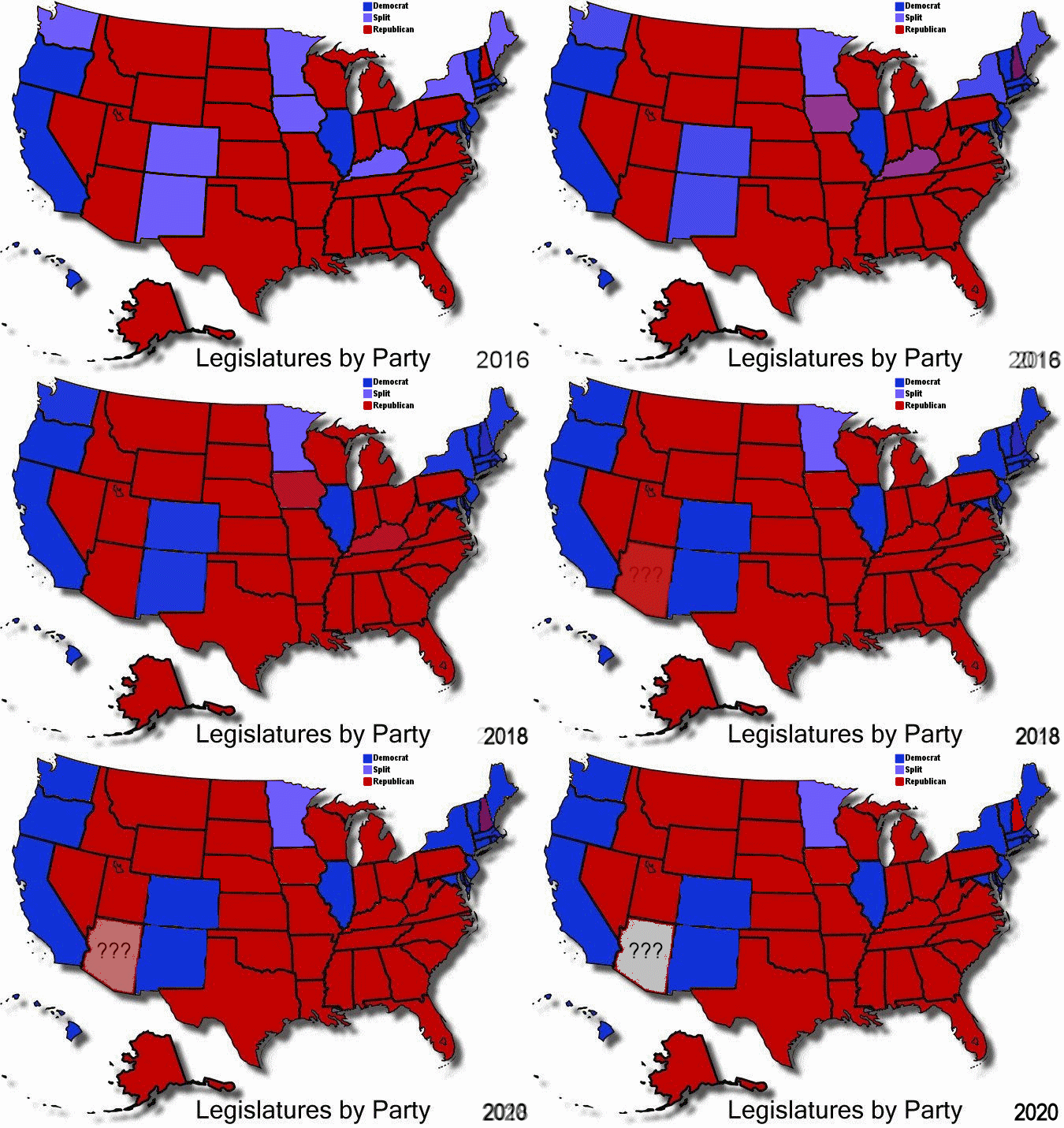
Whether you are a Democrat or a Republican, one should not let this election go by without noting its impact - or lack thereof - on the Koch Bros control of the government entities that count, the state legislatures. In 2018 the Democrats picked up some control mostly in legislatures in which the control of the houses were split, as you can see in the graphic above. The Dems did pick up control of both houses of the New Hampshire legislature.

So long as votes are being counted, one could say there's a chance for a different outcome in 2020. But it appears that the Dems returned control of both houses in New Hampshire to the Republicans. And it appears the Dems have a chance to pick either or both houses in the Arizona legislature.

Of course this means that in all those red colored states, the Republicans will control the decennial redistricting of the U.S. House of Representatives and the legislatures.

But it appears Joe Biden might move into the White House in January and presumably over the next four years will reverse all those Executive Orders and other administrative and regulatory changes the Trump Administration put in place.

But most public policy in the United States will be limited. Many posts noting the Koch political machine are offered in this blog. Perhaps it is easiest to revisit the one regarding former Kansas Congressman and current Secretary of State Mike Pompeo to see what the implications of continued Koch policy will be in the case of Climate Change:

[U.S. Secretary of State Mike]  Pompeo explained that we Americans will...
  • responsively reorganize our society, 
  • relocate as needed, and
  • rely on future technological innovation 
...instead of developing governmental policy as suggested in House Resolution 109 - Recognizing the duty of the Federal Government to create a Green New Deal and creating the bureaucracy needed to implement it.
...The core conservative Climate Change view is addressed in the following policy statement:
  1. Yes, the climate is changing;
  2. Yes, a the changing climate likely will have impacts, perhaps some significant ones;
  3. No, we do not have an accurate prediction of what those impacts will be in the years 2025, 2050, 2100 or 2200;
  4. Individuals and businesses should recognize that over the next decades a need to adapt to changing climate conditions may arise requiring geographical relocation;
  5. Nations should recognize that over the next decades a need to adapt to changing climate conditions may arise requiring a responsive, evolutionary reorganization of society;
  6. Individuals, mostly through businesses as facilitated by free nations, will create technological advances which will allow for adaptation to and reductions in impacts from Climate Change;
  7. The United States Government in response to Climate Change at this time should not create complex economic and social policies, and the bureaucracies to implement them as suggested by the Democrats in H.R. 109, instead continue to rely upon the private sector and the states to address problems as they arise.

Since it is unlikely that the Democrats can get control of the U.S. Senate in the foreseeable future, it would appear that Pompeo's conservative policy will prevail into the next decade.

Yes, Biden could the U.S. rejoin The Paris Agreement. But as explained in a September 30, 2019, post, American participation will depend upon the efforts of the U.S. Climate Alliance depending upon state pollicy plus the efforts of the America’s Pledge organization bringing together private and public sector leaders to ensure the United States remains a global leader in reducing emissions and delivers the country’s ambitious climate goals of the Paris Agreement.

That is simply the product of Democrats not being able to gain control of the state governments. It can be seen in multiple policy arenas. And nothing the Sanders and AOC's of the world do address the problem. They are too enamored with the Presidency and the federal government to divert efforts to where they are needed. And they aren't going to move to Kansas.

Tuesday, September 1, 2020

A trade war, gig economy, and lack of immigrant workers will be the key factors in prolonging the post-pandemic Extended Economic Distortion

Because the differences between the 20th Century and 21st Century economies are significant, though not commonly identified, they will become significant elements in the post-pandemic Extended Economic Distortion.

Like most centuries, what is significantly different from the last century is confusing because the source of changes seem to escape clarity. For instance, as late as April 2009 international finance guru Randy Charles Epping's book The 21st Century Economy--A Beginner's Guide was released to acclaim and was regarded Bookauthority.or as among the "40 Best New Economy Books".

In that book according to one description: "Epping defines key ideas and commonly used words and phrases like carbon footprint, WTO, economy of scale, NAFTA, and outsourcing [and] illustrates how central banks help navigate global crises and drive the global economy, discusses the benefits of Green Economics, shows how trade wars can be avoided...."

Uh, shows how trade wars can be avoided?

One thing 2016 and 1916 have in common is that the economics of the previous century was about to come to an end. In 1916 we had WWI followed by The Great Depression and WWII.  In 2016 when Donald Trump took control of the Republican Party and won the U.S. Presidency, he began a nationalist trade war with the rest of the world completely disrupting the norms of the global economy, a trade war that appears to be expanding into hostilities when it comes to China.

Then came 2020's pandemic shutting down travel and commerce for many months - we don't know how many, because it's still going on and does not appear to be on a course towards full recovery. Except for China which, as explained in The New York Times:

    This was supposed to be the year that China’s export machine began to stall. President Trump had imposed broad tariffs on Chinese goods. Countries like Japan and France pushed companies to shift production from China. The pandemic had crippled China’s factories by the end of January.
    Instead, China Inc. has come roaring back.
    After reopening in late February and early March, China’s factories began an export blitz that is still gaining steam. Exports soared in July to their second-highest level ever, nearly matching the record-setting Christmas rush last December. The country has grabbed a much larger share of global markets this summer from other manufacturing nations, entrenching a dominance in trade that could last long after the world begins to recover from the pandemic.
    China is showing its export machine cannot be stopped — not by the coronavirus and not by the Trump administration. Its resilience lies not only in the country’s low-cost, skilled labor and efficient infrastructure but also in a state-controlled banking system that has been offering small and large businesses extra loans to cope with the pandemic.
    The pandemic has also found China better placed than other exporting nations. It is making what the world’s hospitals and housebound families need right now: personal protection gear, home improvement products and lots of consumer electronics.

The irony of this is important to California. As explained here in the lengthy November 24, 2016 post #Calexit. Perhaps 170 years of invidious doubtful scorn is enough California's early European influence was Spanish trade with Asia:

    Effectively the Pacific Coast (and more) of the Americas was left to the Spaniards, good Roman Catholics all, to colonize and they did so from Northern California to Cape Horn.
    The first European contact in California was a Spanish sailing expedition, led by Portuguese (?) captain Juan Rodríguez Cabrillo, in 1542, which traveled up the Pacific Coast as far north as the Russian River. Subsequent Spanish expeditions, followed....
    In 1565 the Spanish developed a trading route where they took gold and silver from the Americas and traded it for goods and spices from China and other Asian areas. The Spanish set up their main base in the Philippines. The trade with Mexico involved using an annual passage of Manila galleons, which would traverse somewhere near Cape Mendocino, then could turn south down the California coast towards their home port in Mexico.
    When the value of California for trade routes became obvious to several other European interests, particularly the Russians whose fur traders were traveling from Alaska down the coast, the Spanish sent the Portola Expedition both over land and sailing up the coast in 1769.
    The Portola Expedition's original assignment was to travel to the "port of Monterey" described by the Vizcaino expedition and establish a settlement there. After that, the explorers were to continue north to locate Cermeño's "Bay of San Francisco" (the northern end of which is now called Drake's Bay), chase away any Russians encountered, plant the Spanish flag and determine whether the bay would make a good port.
    After the Portolà expedition of 1769-70, Spanish Catholic missionaries began setting up 21 California Missions on or near the coast of Alta (Upper) California, beginning in San Diego. During the same period, Spanish military forces built several forts (presidios) and three small towns (pueblos). Two of the pueblos grew into the cities of Los Angeles and San Jose. And so California became a part of Viceroyalty of New Spain.

Except in the midst of WWII, trade with Asia has been critical for California's economy since the 17th Century. In the past four decades, trade with Asia has been integral to the U.S. economy as a whole. In 2018 Asian trade for the U.S. totaled $1.6+ trillion. In the first six months of 2020 it was $115 billion less.

A new 21st Century economy integral element is the so-called "Gig Economy." For many it is hard to understand the significance of the Gig Economy. Apparently the federal government has no lack of understanding.

There was no hesitation on the part of the federal government as reflected in the red in the chart to the right. Those red bars are the people on Unemployment Insurance (UI) under federal programs established by the CARES Act and some other programs

Under the CARES Act states are permitted to provide Pandemic Unemployment Assistance (PUA) to individuals who are self-employed, seeking part-time employment, or who otherwise would not qualify for regular unemployment compensation.

The important thing to recognize is that news stories such as in today's New York Times begin with "just over one million Americans filed new claims for state jobless benefits last week" before noting further down on the page "another 608,000 people filed for benefits under the federal Pandemic Unemployment Assistance program."

The truth is last week 1.43 million new unemployment claims were filed, and 42.5% were under the PUA many of whom, if not most, fall under the vague definition of gig workers who were working in the Gig Economy. And it is this subject that also relates to California's history.

If you know about the film industry you know that today actors, writers, and almost all other production folks are effectively gig workers, meaning they don't have jobs until they are hired for specific productions then laid off. Many work enough to get UI for a period, but then must do jobs like wait tables. It wasn't always this way as a 1984 New York Times article noted:

    In 1938, Metro-Goldwyn-Mayer had 120 actors and actresses under contract, including Clark Gable, Greta Garbo, Robert Benchley, Dame May Whitty, Judy Garland, and Freddie Bartholomew. Nearly a hundred writers and directors were under contract to M-G-M that year, too. And 1938 was hardly a peak year during the golden era of the Hollywood studio system.
    Although the movie industry has often yearned publicly for the old days - Francis Coppola, for example, bought a nine-acre studio in the heart of Hollywood a few years ago in order to re-create the old system, and every decade Universal has announced a ''new talent'' contract program - the studio system, with its old authoritarianism, has stubbornly remained as dead as the dodo bird and passenger pigeon that it followed into oblivion. Mr. Coppola's Zoetrope, which put four promising actors under long-term contract, is bankrupt; and somehow the new talent programs, which tried to do the same thing with beginning actors, never worked.

In the film industry there is some evolved benefits programs through unions for some of the quarter of a million California film industry UI applicants. But that isn't true for the bulk of the Gig Economy that began in the past two decades. Investopedia lays the subject out straightforwardly:

    In a gig economy, temporary, flexible jobs are commonplace and companies tend toward hiring independent contractors and freelancers instead of full-time employees. A gig economy undermines the traditional economy of full-time workers who rarely change positions and instead focus on a lifetime career.

Wikipedia offers considerably more discussion but gives this piece of critical information:

    In the 2000s, the digitalization of the economy and industry was carried out rapidly due to the development of information and communication technologies such as the Internet and the popularization of smartphones. As a result, on-demand platform based on digital technology has created jobs and employment forms that are differentiated from existing offline transactions based on accessibility, convenience and price competitiveness, the so-called Gig economy has become a focus.

Within the overall economy, the Gig Economy has complicated things because as noted in Wikipedia "36% of U.S. workers join in the gig economy through either their primary or secondary jobs." And they are likely the bulk of the 42.5% of new filings for unemployment.

Complicating the matter further, California is in the middle of a policy battle over whether gig workers are should be employees, not independent contractors. It's complicated and the outcome could impact the future of the national economy.

Foreign trade and the Gig Economy are two integral elements of the 21st Century American economy facing significant change. A third is the role of immigrant workers.

We are generally familiar with the nearly-century-old policy debate - perhaps battle - over immigrants, both legal and illegal, who work in agriculture. The Trump Administration has instituted policies that reduce the number of available workers, implying that the goal is zero. That would have a significant impact on the cost of food.

Then there is the complicated issue of the H-1B visa, on which U.S. technology companies have become dependent for workers. The issue is complicated because some companies use those visas to tie workers to a job and pay less than the market wage. But the United States and China are in a growing competition for technological leadership in areas such as artificial intelligence, biotechnology, quantum computing, and other sectors vital to future economic and military prowess. The Trump Administration's has acted to restrict both student and H-1B visas.

In the pandemic with its travel restrictions many actual and potential technology workers have gone home and others have not been able to come to the United States. In effect the pandemic has implemented Trump policies. This is going to disrupt American technology leadership already being effectively challenged by China. It is not clear that this will change in the next few years.

The post-pandemic Extended Economic Distortion is going to result from, among other factors, reduced world trade, reevaluation and potential reorganization of the Gig Economy, and a loss of immigrant worker efficiency and expertise.

A reason for the surprising ease that the early $500 billion in direct intervention for American families passed both houses of Congress. Without it, 17 million people would have dropped below the poverty line. That's why Trump bypassed a stalled Congress with the $300 per week second round add-on to UI.

Getting restaurant and personal care workers back to work is a goal to avoid some potential deep poverty. But post-pandemic economic issues go well beyond the service industry and well beyond the time when a vaccine will push Covid-19 onto the same shelf in people's minds as "the flu."

No historical period exists that is identical to this time. But the sharp deflationary recession across Europe and in the United States known as the Depression of 1920–1921 was stimulated by the return to the civilian economy of troops after the end of World War I.

But it created an economic distortion further twisted by the Spanish Flu and the rise of labor unions. Each country responded differently. Italy's response to the social unrest offers a cautionary lesson for dealing with an Extended Economic Distortion in 2020. We will explore the Mussolini-effect here in the future.

Tuesday, April 21, 2020

The Coronavirus Crisis dilemma: Immunizing the herd without a vaccine to end the Great Economic Lockdown of 2020 could kill 7 million Americans

In the face of the Coronavirus Crisis of 2020, responsible local and state governments initiated the Great Economic Lockdown of 2020 to minimize deaths and hospitalizations from Covid-19.

Today two sources of political pressure to "open" the Great Economic Lockdown of 2020 are rising.

One is the obvious group of "you can't do that to me" folks who are outwardly seeming to advocate a "give me liberty or give me death" philosophy while ignoring what they are really advocating - "give me liberty to spread disease and kill you." Ironically, most are the folks that claim to be "Pro-Life" who are advocating "Pro-Choice" as their right. Donald Trump is cheering them on because he needs them to win reelection.

President George Washington would be turning over in his grave, of course. As he made clear during the Whiskey Rebellion personally leading troops to squash the protest, nothing in the Constitution or American history guarantees freedom from government regulation. We are a government of laws, not men.

But the sign-waving, out-on-the-streets-with-guns protesters are not alone.Not quite as obvious are those criticizing the lack of progress on badly needed testing that's holding up ending the Lockdown, the other folks questioning whether we can wait.

A good example is Dear Governor Newsom: Where Is Our Coronavirus Testing? subtitled A letter to the much-lauded California governor — because we know very little, and it’s frustrating. It was written by Sharon Waxman, the founder, CEO and Editor in Chief of TheWrap. She is an award-winning journalist and best-selling author, and was a Hollywood correspondent for The New York Times.

I have to believe that Waxman may have done well in college - she graduated from Barnard College in 1985 and from St. Antony's College, Oxford University in 1987 with a Masters of Philosophy in Modern Middle East Studies. But she must have avoided math classes. And her criticism reflects others who can't do math.

You see, there are about 340,000,000 people (that's 340 million) in the United States. If we tested 1,000,000 (that's 1 million) a day, it would take 340 days to test everyone.  And based on California's share of the population Californians would be testing 117,000 people a day.

Fortunately, however, we don't need to test everyone to know if we've achieved "herd immunity."

In the midst of this Covid-19 pandemic officials or public health specialists refer to "herd immunity." Herd immunity is a form of indirect protection from infectious disease that occurs when a large percentage of a population has become immune to an infection, whether through previous infections or vaccination. This provides a measure of protection for individuals who are not immune.

It sounds simple enough. But it takes a substantial percentage of the population to become immune to protect those who are not immune. If enough people are vaccinated, we have herd immunity.

If there is no vaccine for a disease, enough people have to get the disease and survive to achieve herd immunity. Another way to explain it is that a population reaches herd immunity when enough people have survived to achieve the herd immunity threshold (HIT). Oh, and inevitably and unavoidably that means enough people have died!

Consider the chart at the right. Smallpox is a good example of a disease. If smallpox appears in a localized population of 1,000 people and  980 fall ill and 80 survive, those 80 are immune offering "herd immunity" resistance against a future epidemic developing thereby protecting the 20 who were not infected of the original population of 1,000.

Harvard University experts say to reopen the United States by mid-May, the number of daily tests performed between now and then should be 500,000 to 700,000. So if population size is the factor California's share would be 7,200 tests a day.  While mid-May is perhaps overly optimistic, it actually appears California is getting there:


But we need to understand the goal for this level of testing. It is to measure our gains towards "herd immunity" through the spreading of the infection. This will be accomplished by letting people go back to doing their thing thereby contracting the disease. But not too many at a time. And while still trying to protect those most vulnerable to death.

Regarding Covid-19, California Governor Gavin Newsom has used the term to explain the levels of achieving a new normal. One reporter wrote:

    What does “herd immunity” look like in the age of COVID-19? Without a vaccine, about 28 million infected Californians.
    Based on current estimates, about 5 percent of infected people — or roughly 1.4 million Californians — would get severely ill. Of these, 840,000 could die, although there’s hope of holding that number down.
    This bleak strategy may be the only way through a pandemic that is causing profound economic, social and education paralysis. A vaccine, which also could provide herd immunity, is 12 to 18 months away, with likely additional months needed to scale up manufacturing and distribution.
    It’s also very scary. The governor’s promised “light at the end of the tunnel” could instead be the glaring halogens over an ICU bed.

The reporter is using a 70% HIT which if you look at the chart seems reasonable. If you extend those numbers to the entire US., it would mean 231 million Americans will have to get Covid-19 to create a national herd immunity. That would mean 11.6 million would get severely ill with as many as 7 million deaths.

But we don't even know if that will work.

Though people who recover from Covid-19 likely will have some degree of immunity for some period of time, the specifics are unknown. For instance, we don’t yet know why some who’ve been diagnosed as “fully recovered” from the virus have tested positive a second time after leaving quarantine. For instance, we don’t know why some recovered patients have low levels of antibodies.

 In fact there is much we don't know.

We don’t know today  how many people have been infected with Covid-19 and we have no way to estimate that number based on many years of experience like we do the flu. We don’t know the full range of symptoms. We don’t always know why some infections develop into fatal severe disease.

We don’t know what percentage of adults or what percentage of children are asymptomatic and don't know if we will ever be able to know. That is because we don’t know if the United States will ever be able to deploy the 22-million-people-per-day mass testing needed to develop reliable data before next outbreak of Covid-19. Heck, we don’t know when states will be able to test everyone who has symptoms.

We don't know how many virus particles it takes to launch an infection, how far the virus travels in outdoor spaces or in indoor settings (though experts now are saying 4 meters or 13 feet, not 6 feet), or if airborne movements affected the course of the pandemic.

We don’t know for certain if the virus will subside as the Northern Hemisphere enters the warmer months of spring and summer, as many other viruses do. And we don't know that whether it will return perhaps mutated in the fall or winter if it does subside, as many other viruses do.

Assuming a best case scenario we are at least 24 months away from achieving herd immunity with a vaccine. But we don’t know if or when researchers will develop a successful vaccine or whether the coronavirus will or already has mutated thwarting the future effectiveness of vaccines.

In order to give us time to gear up to treat victims, we have instituted the Great Economic Lockdown of 2020 which among other things includes insuring social distancing, also called “physical distancing,” which means keeping space between yourself and other people outside of your home. To practice social or physical distancing as prescribed:
  • Stay at least 6 feet (2 meters) from other people
  • Do not gather in groups
  • Stay out of crowded places and avoid mass gatherings
Note the words "at least" relative to the 6 feet (2 meters) measurement and again note that experts have discovered that the airborne movements of the virus seems to be 4 meters or 13 feet. So people are also being asked to wear masks.

Members of the pro-Trump right are opposing the Lockdown essentially saying that they have the right to choose how to protect their own safety while retaining all freedom of movement and association. As pictures appear of unmasked folks with guns standing next to each other demonstrating against the Great Economic Lockdown of 2020, one has to puzzle how they relate the Coronavirus Crisis to the common understanding of public safety - are they planning on shooting the virus if it doesn't turn itself in at a the police station?

There is a reason we frequently say "health and safety." They are not the same thing.

A difference exist between laws protecting public safety and regulations protecting public health. The protesters are confused as they don't understand the concept of a local or state government "Public Health Department" which is a government department authorized by law to use the science and art of preventing disease, prolonging life, and promoting health through organized efforts based on informed choices.

This is different from the concept of "Public Safety" departments like police departments which are the government departments authorized by law to use guns to enforce laws regarding criminal behavior. In general there is little commonality between the skills and expertise needed to handle public safety issues versus public health issues. It is police officers who use guns, not health officers.

The fact is that the ability to use a gun is a skill that in no way will protect you or your family from Covid-19. There are a growing number of families that include or included a police officer that will testify to that.

The one fact we know about the disease is that it is personal interaction between people, just socializing or engaging in business, is the human behavior that ultimately kills people. To not be free to interact with people for business or social purposes is contrary to everything Americans believe, except when the obvious result of the interaction will be to unintentionally kill human life.

The real problem is Americans under the age of 100 years old have never seen a worldwide pandemic from a virulent disease that seemingly randomly kills humans and against which no one has any immunity nor can obtain immunity from a vaccine. In fact only those of us older than age 65 can remember in the United States an epidemic such as polio. Fear of epidemics (a widespread occurrence of an infectious disease in a community at a particular time) and pandemics (an occurrence of an infectious disease over a whole country or the world) was once a part of human life.

Yes, annual influenza pandemics still kill people. In countries such as the United States vaccines though imperfect are available. Because the HIT for influenza is 33-44%, people frequently have some degree of immunity sometimes from prior year similar strains, Yes, deaths from the flu are normally limited to those who have prior unrelated health conditions which makes it seem similar to Covid-19 deaths. But one thing we do know is that a severe Covid-19 coronavirus infection looks nothing like influenza, not even the 1918 Spanish Flu. We do know that Covid-19 attacks the lungs and blood vessels in ways unlike the flu.

Just exactly how much risk are we willing to take to reopen our economy and society to personal interaction? Having had no similar experience, we don’t know how to open things up again, What if the actual safe social distance is 13 feet, not six?

We could, of course, create herd immunity by just ending all restrictions. But we in California quite literally have set a goal to reduce restrictions in order to infect the most people possible while avoiding high hospitalization and death rates.

Last Tuesday Governor Newsom said at his  news briefing: "There's no light switch here. It's more like a dimmer. That dimmer is this toggling back and forth between more restrictive and less restrictive measures."

Make no mistake about it. Ending the Great Economic Lockdown of 2020 will not end the Coronavirus Crisis of 2020. We will discover when we've ended a specific restriction too soon by the level of jumps in hospitalizations and deaths.

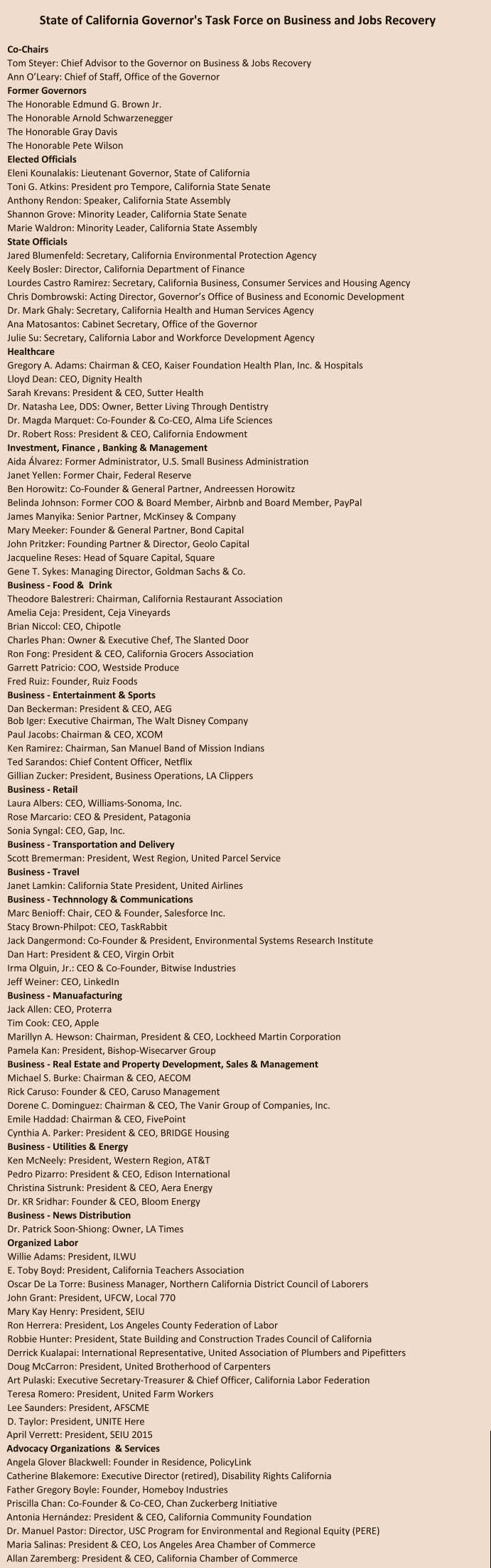
With that said, I trust Newsom's approach. And because I know most of them know how to do math, I also trust the group of people he has appointed to his Task Force on Business and Jobs Recovery (see below) to help California thread the needle required to stitch our economy back together while minimizing deaths.

Saturday, April 11, 2020

No precedent exists to guide us after the Great Economic Lockdown and Coronavirus Crisis

On January 1, 2020, a formal international economic structure and an informal global economic structure existed. Both were unlike anything that existed in the 19th Century when the economic theories of Adam Smith, Karl Marx, and friends became popular. We have significantly interrupted the normal functioning of those structures because of a pandemic threatening the lives of many, many people.

Ignorance still pervades what has become the Coronavirus Crisis though you would not know that from the news relating to the Trump Administration exploring ending shutdown orders.

Covid-19 infections began in China in November 2019 or earlier and as noted in an article in the LA Times may have arrived in the U.S. in December.

In the past, several members of the coronavirus family called "human coronavirus" have infected us annually causing mild respiratory ailments we regard as the common cold. These "colds" are not distinguished clinically from other annual colds. Those infections provide no lasting immunity. The same type of human coronavirus may return after several years, but a different one may cause an infection in intervening years. Incidents peak in the winter, taking the form of local epidemics lasting a few weeks or months. We also don't shut our economy down during these "common cold" epidemics. From this we know that strains of coronavirus behave differently from influenza virus strains.

We don't know if the Coronavirus Crisis will be seasonal like other coronavirus strains. We don't know if the Covid-19 coronavirus will provide any lasting immunity like influenza virus strains. And unlike in cold and flue epidemics, we have instituted worldwide the Great Economic Lockdown of 2020 to limit deaths and major disabilities from the Covid-19 pandemic.

No precedent exists to guide us through to January 2021. Still key elected officials are under tremendous pressure from constituents only slightly more ignorant than they are who are pushing to end the Great Economic Lockdown of 2020. Or perhaps they all are crassly merciless believing that humans are just nameless machines feeding labor into the all-important economy. If you think they are not that ignorant or crass, consider this.

In fact a pandemich such as the Coronavirus Crisis was predicted as we can see below in Bill Gates' TED2015 talk explaining what our pandemic would be like. (with transcript).


It is fair to say that almost all the populist voters who supported the Trump movement were and are unaware of what Gates explained. And it is likely that those few who were aware dismissed it as a lie from the political left.

Because of the populist rhetoric reawakening 19th Century attitudes on race, culture, economics, and relative wealth, issues of public health and safety in the reality of the One Earth 21st Century did not come up in election campaign discussions. In the past decade within the western economies deliberate populist political choices were made to accelerate the reversal the 30-year economic globalization pattern that preceded the 2008-09 Great Recession.

The  Coronavirus Crisis and subsequent Great Economic Lockdown of 2020 is an unexpected outcome of those choices.

In the Post-WWII half-century leading up to the Great Recession the global economy expanded, with trade and cross-border financial flows growing and nations working together, albeit haltingly, resisting at times.

Since the Great Recession and prior to the Covid-19 pandemic cross-border financial flows were down more than 60 per cent by value indicative of the success of the populist choice and indicative of opposition to nations working together.

In the past decade overt government intervention and state-against-state economic clashes became the norm. Most obvious are Trump's trade wars which, along with Climate Change denial, blinded the American political debate to any broader "One Earth" reality. And Trump's most antagonistic trade war was with China.

That truth is that the health of the public in Wuhan, China, in December 2019 should have been the primary concern of the U.S. government resulting in a major effort to address the pandemic potential by mid-January 2020. But that was impossible in the political climate controlling American democracy within which money is the only issue, who has it and who can get it.

Government mobilization of the public and corporations to mitigate the Coronavirus Crisis has been compared to the mobilization of civilians and the economy at the beginning of WWII. Yet few, if any, have noted the parallels of American pro-isolationist policies of the Roaring 20's that led to the Great Depression and WWII. And in truth there has been no U.S. government effort to mobilize the public and corporations approaching the scale of WWII mobilization.

The Great Economic Lockdown of 2020 ordered by states and local governments in response to the Coronavirus Crisis has no parallels in history. In the 21st Century humanity exists in a rapidly moving "One Earth" reality created by the colonialism of the 19th Century, the wars and medical advances (including birth control) of the 20th Century, and the technology of the 21st Century. Consider:
  1. Since the end of WWI we have been in an extended period of struggle over globalization between the forces of nationalism against the idealism embedded in a One Earth movement that resulted in the 20th Century nations creating international organizations such as
    • the League of Nations and the United Nations,
    • the International Monetary Fund (IMF),
    • the World Health Organization (WHO),
    • the World Trade Organization (WTO),
    • the ASEAN Free Trade Area (AFTA),
    • the North American Free Trade Agreement (NAFTA) and its probable successor the U.S.-Mexico-Canada Agreement (USMCA), and
    • the Paris Agreement,
    all of which facilitate a world economy dependent upon trade and cross-border financial flows, but which have been opposed since The Great Recession of 2008-09.
     
  2. In the 21st Century a globalized, connected public has come into being outside those organizations as a result of popular, easily accessible technology which is associated with pervasive data production, collection.  analysis, and cross-border sharing; that public is made up of "informed" labor which is also the consumer swimming in a deluge of "infotaiment" in an economy where consumer spending is the major element (for instance 71% of the U.S. Gross Domestic Product).
     
  3. In the 21st Century the world is supporting an aging population; in 1960 persons age 65 and older made up only 5 percent of the world's population while today they make up nearly double that percentage with Europe and North America at 16%. and in 1960 persons under the age of 14 made up 37%,while today they make up 26% which is an 11% drop.
     
  4. In the Great Economic Lockdown of 2020 well over 20% of labor (including thousands of small business owners) across every developed country has ceased working which means that a comparable percentage of consumers have had their normal income stop as they are the same people; at some point the more fortunate in many nations may receive government funded replacement income created through unprecedented national debt increases which no one has discussed in the context of repayment.
     
  5. In January before the Coronavirus Crisis was acknowledged in the United States, The Wall Street Journal, MarketWatch, and other new media noted with seeming concern that the Congressional Budget Office projected that by 2030 federal government debt would rise to $31.4 trillion, 98% of the Gross Domestic Product; but on top of an expected $1 trillion current fiscal year deficit, the Great Economic Lockdown of 2020
    • has caused unemployment to surged dramatically, reducing government income flows from payroll taxes;
    • forced Congress to approved three rescue packages, the most recent of which came with a $2 trillion price tag with more packages being discussed;
    • stimulated the Federal Reserve, after injecting $1.5 trillion into short-term money markets and cutting interest rates to about 0 percent, to implementing plans to boost the economy by buying up mortgage-backed securities and government bonds and creating further plans offering up to $2.3 trillion in economic aid to businesses and state and local governments, including extending $600 billion in loans through its Main Street Lending Program to small and medium-sized businesses, offering $500 billion to state and local governments to avoid budget shortfalls and maintain spending on critical relief programs, and collectively offering up to $850 billion to households, employers, and companies through its corporate credit facilities and Term Asset-Backed Securities Loan Facility, much of which is considered potentially unrecoverable unlike the Troubled Asset Relief Program (TARP) of the Great Recession era;
    all of which is expected to push the U.S. national debt, which was was around $22 trillion last year to, beyond $25 billion this year to be considered in the context of even greater debt expansion by other nations around the world.
Again no precedent exists to guide us through to January 2021. In addition to what we don't know about the Covid-19 coronavirus, we do not know how the interplay of the five factors listed above will influence government action attempting a return to economic "normal" and what reactions from labor/consumers will result.

After this pandemic the data will be crunched and costs of preparing for future pandemics, including the costs of creating structures to limit the impacts of those pandemics, will be considered for inclusion into a recovering economy.

The problem is many nation-states are controlled by glib semi-competent politicians served by the "infotaiment" media. And too many are committed to broad free-market policies constraining the possible consideration of government options to intervene in the economy even in a stressful pandemic situation.

Perhaps it is just a well we Americans have an experienced reality TV host as our President as a lack of precedent to guide him through to January 20th, 2021, will not be of concern - his writers can just make things up to suit him. What happens after that is another story....