Showing posts with label California. Show all posts

Monday, July 18, 2022

"Hot Helen" and "Scorching Sam" - naming and categorizing heat waves should be coming soon

Like hurricanes, heatwaves will soon be named.

Humans have been a bit slow to acknowledge the real threats of Climate Change. But we see today headlines in British newspapers like ‘Heat apocalypse’ warning in western France as thousands flee wildfire

In June we read In world's first, Spain's Seville to name and classify heatwaves. While here at home, if you read the article Heat waves could soon have names in June you would have learned

    Five other cities — Los Angeles; Miami; Milwaukee; Kansas City, Missouri; and Athens — have also started piloting a similar initiative, using weather data and public health criteria to categorize heat waves.
    They'll use a three-category system that organizers want to standardize. Each city's system will be tailored to its particular climate.
    A "category three" heat wave in L.A., for example, will look and feel quite different from the same designation in Milwaukee.

In California Assembly Bill 2238 was introduced in February to create and put a heat wave ranking system in place by Jan. 1, 2024. Recently amended in the Senate, there is a chance this bill will be adopted.

It's a fact that this comes quite late in California's attempt to deal with Climate Change and associated heatwaves and wildfires. But it is a reality that everyone seems to be behind. It was necessary for The Guardian to publish today the article Why is the UK so unprepared for extreme heat and what can be done? which had to include the following explanations:

    The stifling current heat is certainly attracting attention. But Bob Ward at the London School of Economics said: “More action is needed to inform the public about the dangers created by heatwave conditions. One part of the solution could be to name heatwaves in the same way that winter storms are now given names to gain the attention of the public.”
    [The University of Reading Prof Hannah] Cloke said: “We also need to have more sophisticated forecast-based warnings that are more focused on people. It shouldn’t just be about peak afternoon temperatures, even though these really are very high indeed.” They should also take into account other factors, such as humidity, and spell out the risk to people, she said: “Heatwaves are silent killers.”

"Heatwaves are silent killers." The PR problem is they tend to kill the poor, the infirm, and the old while solutions tend to negatively impact the Consumer Economy which benefits most everyone else and particularly corporate interests.

But apparently we will soon see a warning system evolve. Unfortunately, as I posted here in 2018: "Regarding Al Gore's campaign on climate policy beginning 40 years ago, he..., well, kids..., my generation failed him and you. But then I said that before...."

Wednesday, July 6, 2022

For Californians it is time to initiate a process to leave the "Union" to become a separate republic


It is not a surprise that the San Francisco Chronicle this week published a piece California has two choices in these dark times: lead or secede

Because the U.S. Supreme Court's embracing theonomy is the immediate cause of this discussion (see California must protect itself from the rise of "A Handmaid's Tale" theonomist judiciary as more is at risk than abortion and gay marriage), this writer does not see two choices.

Rather, it is time to review and move forward on the California Republic idea long supported in these posts.

The idea is not complicated. California should be as independent as Switzerland or Chile, its people free to create a 21st Cemtiry government of policies not hindered by lingering commitments to racial, economic, or religious bigotry nor by fear of not being the alpha country in a world of sovereign countries.

The proposal is to have the California Legislature petition the Congress of the United States to permit California's independence through a negotiated agreement. This is not a proposal to unilaterally secede potentially causing a second Civil War. Nor is it a "Nationalist" movement based upon some ethnic or extended tribal differences.

Instead, the idea is based upon the assumption that if Californians through their Legislature petition Congress for permission to withdraw from the Union and Congress approves, (perhaps after a referendum on the matter) California simply returns to being the California Republic. No civil war, no terrorist movement, no riots - just an agreement between rational, democratic people.

Why, you might ask, would anyone seriously propose this? (It is a fact that a growing chorus of Texans joined the long-existing large choir in California to advocate for nationhood for their state, but that's a different discussion.)

It is not a new idea that California should return to republic status. A serious proposal gained some headway in the late 1930's but was sidelined because of WWII. At the beginning of the 21st Century, in 2002, the Sacramento Bee Columnist Peter Schrag had the following to say about the idea of California becoming a separate nation:

California secedes -- A midwinter night's dream
           By Peter Schrag -- Bee Columnist - (Published December 23, 2002)
    It began as no more than a gesture of protest, when a group of California Democrats, led by U.S. Sen. Barbara Boxer and House Minority Leader Nancy Pelosi, put on the November 2004 ballot the California Dignity Initiative, a measure calling on the state's congressional delegation to renegotiate California's relationship to the Union.
    The precipitating event was the Interior Department decision to authorize exploratory oil drilling in Yosemite National Park: The intent of the initiative was just to draw Washington's attention to its mistreatment of the Golden State.
    But by fall 2006, California, the world's sixth-largest economy, was an independent nation, Pelosi was running for president and Boxer was slated to become California's ambassador to the United Nations.
    In the Bay Area, the Boxer-Pelosi measure had won by a margin of 80 percentage points to 20 percentage points. But a lot of conservatives, drawn by the campaign slogan "No More IRS," also voted for it, and so it passed overwhelmingly. By then, congressional Republicans, led by House Majority Leader Tom DeLay of Texas, had told California to go fly a kite, and the gesture began to gather irresistible momentum. "They burn the damn gas out there," DeLay said. "Why the hell shouldn't they help produce it?"
    What became known as the "Rape of Yosemite," of course, was only the latest of the insults. By the time of the vote, the Public Policy Institute of California had issued a half-dozen studies showing that California was sending between $17 billion and $40 billion a year more to Washington in taxes than it was getting back in federal contracts, grants and services.
    The feds weren't even willing to pay for the anti-terrorism costs of California's law enforcement agencies.
    The difference in what Californians pay and what they get would be more than enough to close the state's yawning budget deficit, provide for California's national defense -- mostly through tighter protection of key California facilities and landmarks -- and still promise an overall tax cut for most Californians.
    Meanwhile, the most conservative anti-tax states in the Union -- Alabama, Mississippi, Louisiana, South Carolina, Georgia, Idaho, Wyoming, Colorado, Utah and Texas -- were getting far more than their share from Washington. It was also their votes that carried the Productive Americans Act, abolishing all federal taxes on those making more than $10 million a year.
    As expected, the California Dignity Initiative campaign was written off by national pundits as another crazy California stunt and by GOP spokesmen as a re-election ploy by a couple of beyond-the-fringe San Francisco Democrats.
    But Pelosi had no opposition in her 2004 congressional campaign and, in what amounted to the same thing, Boxer's opponent was Shawn Steel, the former chairman of the state GOP, who had threatened recall campaigns against any Republican who voted for a tax increase to close the state's budget deficit.
    Continuing a long California GOP tradition, the conservative Steel had easily beaten moderate Tom Campbell, whom he dubbed "California's Harold Stassen," in the March primary, before being obliterated himself.
    The fall campaign, however, did focus Californians' attention on their grievances: the government's campaign to override the state's auto emission laws; the Justice Department's crackdown on medicinal pot smokers and their suppliers, who of course were operating legally under Proposition 215; the renewed federal oil leases off the Santa Barbara coast; and the Federal Energy Regulatory Commission's contemptuous disregard of the state's pleas for refunds from price-gouging gas and electricity suppliers.
    The surprise was how willing Congress and the administration were to let California go.
     In his successful re-election campaign in 2004, President Bush, quoting Lincoln, had promised to preserve the Union. But once he won, White House political affairs director Karl Rove and other Republican strategists realized that without California's votes and the money from Hollywood liberals, the GOP could dominate national affairs indefinitely. By then, of course, it was clear that the most likely candidate in 2008 would be the president's brother, Gov. Jeb Bush of Florida.
    California's departure would almost certainly lead to a Supreme Court that would overturn Roe vs. Wade and the decisions restricting school prayer, and to a new reading of the Second Amendment barring any state law restricting the right to carry guns.
    Congressional liberals such as Sen. Hillary Rodham Clinton and Sen. Ted Kennedy objected vehemently. They understood that California's secession would leave them even more powerless than they had been in 2002-2004.
     But representatives from the Southern and Mountain states, who didn't know or didn't care how much they lived off the Golden State's wealth, were happy to be rid of tree-hugging California, where they banned automatic weapons, the schools taught homosexuality and the courts erased God from the Pledge of Allegiance.
    Of course, it took a lot of negotiating -- about water rights, about what the feds claimed was California's share of the national debt, about continental security and jurisdiction over the state's remaining military bases. But once Washington realized there was no way California could be kept out of Asia-Pacific Economic Cooperation group or NAFTA, the Bear Flag nation was born.

Notice that the article mentions potential issues such as Roe v Wade, separation of church and state, gun restrictions, etc., in the context of policy changes because California would no longer be in the Union. Uh...

California is still in the Union. During this time, a Californian has been the Speaker of the House and California has a very large share of House members. A former California U.S. Senator is the Vice-President.

"Lead or secede" is not a real choice in a Union again divided as badly as it was in 1860. 

And it is a simple fact that "protests" in California against Supreme Court actions are futile for two reasons. 

  • The Supreme Court with members holding lifetime terms and a majority holding theonomist views is the one Constitutional body that is not responsible to the people. 
  • Supreme Court appointees can be confirmed by a vote of 51 Senators who represent the least populous of the 26 states containing only 17.6% of the U.S. population and who were put into office by less than 8% of eligible American voters; California has 12% of the U.S. population and cast 11% of the vote in the 2020 Presidential election
  • California public policy on issues such as abortion are consistent with 21st Century views of the vast majority of Californians. 

That is why at this point in time we must take up the separation of the California Republic issue.

Why a "failed Union" - instead of a country, nation or state

On June 17, 2018, in an extensive post here Why factually these United States is a more perfect Union, not a country, nation, or state.  The following quote from that post summarizes the facts:

For purposes of clarity and simplicity, as used here from this point on the following words have specific meanings based upon pre-17th Century concepts:
  • "Country" means "any considerable territory demarcated by topographical conditions."
  • "Nation" means "any distinctive population with a common language, culture, and considerable history."
  • "State" means "a central civil government or authority that exercises the legitimate use of force within defined geographical boundaries."
  • "Union" means "a number of states or nations joined together for defined purposes to be accomplished by a separately created autonomous authority."
Using those definitions, the Cherokee Nation is a nation. Italy is a country and a state. Japan is a country, a state, and a nation. The United States of America is none of these. It is a union of states.

...We need to understand "these United States" is a union created solely for purposes of a common military defense and assuring economic success of the numerous and separate states, not regulate mundane issues such as who can have sex with whom. That's one reason why in 1792 Americans insisted on leaving establishing government churches to the real states.

You can follow the link to read the entire post. A year later in 2019 preeminent historian Jill Lapore wrote A New Americanism: Why a Nation Needs a National Story discussing the same issues and offering this observation:

    But in the 1970s, studying the nation fell out of favor in the American historical profession. Most historians started looking at either smaller or bigger things, investigating the experiences and cultures of social groups or taking the broad vantage promised by global history. This turn produced excellent scholarship. But meanwhile, who was doing the work of providing a legible past and a plausible future—a nation—to the people who lived in the United States? Charlatans, stooges, and tyrants. The endurance of nationalism proves that there’s never any shortage of blackguards willing to prop up people’s sense of themselves and their destiny with a tissue of myths and prophecies, prejudices and hatreds, or to empty out old rubbish bags full of festering resentments and calls to violence. When historians abandon the study of the nation, when scholars stop trying to write a common history for a people, nationalism doesn’t die. Instead, it eats liberalism.

Lapore's article explores the issues in depth but at the end offers this warning:

    At the close of the Cold War, some commentators concluded that the American experiment had ended in triumph, that the United States had become all the world. But the American experiment had not in fact ended. A nation founded on revolution and universal rights will forever struggle against chaos and the forces of particularism. A nation born in contradiction will forever fight over the meaning of its history. But that doesn’t mean history is meaningless, or that anyone can afford to sit out the fight.
    “The history of the United States at the present time does not seek to answer any significant questions,” [the Pulitzer Prize–winning, bowtie-wearing Stanford historian Carl] Degler told his audience some three decades ago. If American historians don’t start asking and answering those sorts of questions, other people will, he warned. They’ll echo Calhoun and Douglas and Father Coughlin. They’ll lament “American carnage.” They’ll call immigrants “animals” and other states “shithole countries.” They’ll adopt the slogan “America first.” They’ll say they can “make America great again.” They’ll call themselves “nationalists.” Their history will be a fiction. They will say that they alone love this country. They will be wrong.


We are now two full decades into the 21st Century there can be no doubt that we must acknowledge Degler's warning. But Lapore's hope that some historian will save the day is foolish. We literally no longer teach history. In fact, those Amazon Echo's mostly named Alexa offer a question "How many stars are there on the American flag?" In generations past everyone had that kind of information drilled into them by second grade. But at some point in the past three decades, in grades K-12 we replaced history with sociology, and the U.S. has always been and could never otherwise be a sociological mess.

To unify Swedish, Hungarian, and Italian immigrants Americans don't need to know more about their cultural differences. If we can't learn to simply ignore culture, ethnic, and racial differences then the United States must cease as the Union that once attempted to serve as a model for unifying the world.

After only 70 years the United States descended into what was, at that point in time, the worst war in history. As Lapore notes: "The American Civil War was a struggle over two competing ideas of the nation-state. This struggle has never ended; it has just moved around."

As explained in a History.com article: "The struggle between pro- and anti-slave forces in Kansas was a major factor in the eruption of the Civil War."

Sure there was (and is) the Deep South. But Border-State Kansas-like struggles now exists in the southwestern states, states which were once part of Mexico until, a decade before the Civil War the Union started and won a war with Mexico.

The fact is that California and Texas were part of Mexico but then both became republics before joining the United States. Perhaps that stimulates the significant popular movements advocating for the withdrawal of the two states from the Union.


How to move forward towards a new California Republic

Many argue that the Civil War settled the issue about a state having the right to secede from the Union.  Secession is  unilateral act and it does seem that the Civil War did establish clearly that no state can unilaterally withdraw itself from the United States. However....

Article IV,  Section 3,  Clause 1 of the Constitution provides as follows:  "New States may be admitted by the Congress into this Union; but no new State shall be formed or erected within the Jurisdiction of any other State; nor any State be formed by the Junction of two or more States, or Parts of States, without the Consent of the Legislatures of the States concerned as well as of the Congress."

"Implied powers" is an accepted legal concept.  One could reasonably argue that if Congress has the power to admit states to the Union and, further, has the power to create a state from an existing state or states with the permission of the state or states involved, then it is implied that Congress has the power to remove a state from the Union with the permission of the state involved.

Additionally, the 10th Amendment provides as follows: "The powers not delegated to the United States by the Constitution, nor prohibited by it to the States, are reserved to the States respectively, or to the people."  This would seem to imply that where clarity in the Constitution is lacking, when a state is involved in something such as removal from the Union, if it has approved the idea of being out of the Union that ought to be sufficient.

In other words, if the Legislature of California were to request that the state be permitted to withdraw from the United States and Congress approves, then the separation of California from the Union would be pursuant to a bilateral agreement between the parties and legally sufficient.

Obviously, such an agreement would come about through the negotiation of an "Agreement Document" which presumably would cover the complex issues involved and would ultimately have the legal status of a treaty.  And, just to assure the democratic nature of the action, it should only be effective if approved by California voters in a referendum.  This would lay to rest the question of the existence of the implied power since the State and its people would have approved the action.

Secession is a hostile act involving insurrection and rebellion.  Separation could be accomplished in a process of mutual respect, understanding, and agreement.

So, the steps would seem fairly straightforward:

  1. The Legislature would initially adopt a resolution requesting that Congress consider removing California from the Union.
  2. A resolution then would be adopted by Congress providing for a process for developing an Agreement for the Separation of California from the Union.
  3. Upon completion of the proposed agreement, Congress would approve the Agreement and forward it to the Legislature.
  4. The Legislature would submit to the voters an amendment to the State Constitution approving the Agreement and calling for a constitutional convention to develop a new California Constitution.
  5. If the voters approve the amendment, then California would become a separate nation pursuant to the agreement and would establish its own national constitution.

It seem as though such a legal process is fairly straightforward, albeit difficult to get accomplished. But it would be a process preferable to a four-year civil war.

Saturday, July 31, 2021

Bemoaning the loss of the Mythic California Dream: How can so many not know what Steinbeck knew?

    The California Dream is the psychological motivation to gain fast wealth or fame in a new land. As a result of the California Gold Rush after 1849, California's name became indelibly connected with the Gold Rush, and fast success in a new world became known as the "California Dream". California was perceived as a place of new beginnings, where great wealth could reward hard work and good luck. ...Overnight, California gained the international reputation as the "golden state"—with gold and lawlessness the main themes. - from Wikipedia

A curious narrative is being reported and repeated in news stories such as The California Dream Is Dying offered in The Atlantic. No, the "California Dream" is not dying. It is a 170-year-old myth sold to gullible people. As further explained in that Wikipedia entry:

    Generations of immigrants have been attracted by the California Dream. California farmers, oil drillers, movie makers, aerospace corporations and "dot-com" entrepreneurs have each had their boom times in the decades after the Gold Rush.
    Part of the "California Dream" was "that every family could have its own private home."
    As historian Kevin Starr has pointed out, for many if not most migrants to the golden state, "the dream outran the reality." The Okies of the 1930s "found their California dream transformed into a nightmare,' notes Walter Stein. As a result, "the California Dream is a love affair with an idea, a marriage to a myth."

If you read John Steinbeck's The Grapes of Wrath you get a good picture of the disappointment experienced by The Okies of the 1930's. But his other writings make clear that the current climate "change" called a drought is a good example of the myth as explained in 2017 here in Foolish planning and the inevitable wildfires: What could have been learned from John Steinbeck about California's true climate. That post expanded on a 2014 post To A God Unknown: Steinbeck, Stine, and Medieval California. Both those were based on what Steinbeck wrote in his 1933 novel To A God Unknown. But the following from East of Eden offers a direct view of California's climate:

Now the problem is exacerbated with something we have labeled "Climate Change" which for California means even drier made more disastrous fires because too many people live in California.

And a significant part of California's wealth is large agriculture dependent entirely on a water supply propped up by federal and state facilities, all of which is collapsing around us as the reservoirs go dry.

The drought is just one piece of the myth gone wrong. There is the the 20th Century housing myth.

Yes, we did have a huge housing boom after WWII. But it wasn't something that just happened. Compounding the California Dream myth, the federal government established funding mechanisms for building thousands of new homes to be purchased by people who would not have otherwise been able to afford them at the time. This was done through loan guarantees from the Federal Housing Administration and the Veterans Administration. From Wikipedia:

    During the Great Depression many banks failed, causing a drastic decrease in home loans and ownership. At that time, most home mortgages were short-term (three to five years), with no amortization, and balloon instruments at loan-to-value (LTV) ratios below sixty percent.[4] This prevented many working and middle-class families from being able to afford home ownership. The banking crisis of the 1930s forced all lenders to retrieve due mortgages; refinancing was not available, and many borrowers, now unemployed, were unable to make mortgage payments. Consequently, many homes were foreclosed, causing the housing market to plummet. Banks collected the loan collateral (foreclosed homes) but the low property values resulted in a relative lack of assets.
    In 1934 the federal banking system was restructured. The National Housing Act of 1934 created the Federal Housing Administration. Its intention was to regulate the rate of interest and the terms of mortgages that it insured; however, the new practices were restricted only to white Americans. These new lending practices increased the number of white Americans who could afford a down payment on a house and monthly debt service payments on a mortgage, thereby also increasing the size of the market for single-family homes.
    Since 1934, the FHA and HUD have insured almost 50 million home mortgages. Currently, the FHA has approximately 8.5 million insured single family mortgage, more than 11,000 insured multifamily mortgages, and over 3,900 mortgages for hospitals and residential care facilities in its portfolio.

This is what many think is the California Dream - housing funded by a federal program. Much like the Gold Rush, it was a myth-expanding reality though the federal government action did make far more new Californians "richer" than the Gold Rush did. And then those Californians adopted Proposition 13 putting a fence around their federally created wealth.

If you reread the first quote in this post you will note that "gold and lawlessness" were the main themes of the California Dream. Gold has been replaced, apparently by bitcoin, but lawlessness (defined as "being without law; uncontrolled by a law; unbridled; unruly; unrestrained") continues in the technology boom.

Probably more of the critical narrative appearing in print today is that folks migrating into California are not finding the economic promise of the Mythic California Dream. Housing? If you do a little research you will learn that in the 20th Century a multitude of cities were incorporated in California within which thousands of those federally funded homes were built. That incorporation of new cities stopped in 2000. The reason is simple - new cities must be allocated natural resources that are not available because there aren't enough to support even the existing economic structure.

Wednesday, July 7, 2021

Fact - 35 years ago Californians were warned of a 9° climate temperature increase within this Century

In Christopher Nolan’s science fiction film, Interstellar, set in the year 2067, the first few minutes of the film consists of interviews by survivors of an apocalyptic dust bowl. Those scenes are in fact are from a Ken Burn's documentary, real interview clips of actual survivors from the Dust Bowl which nearly destroyed the middle "Red States" of the United States in the 1930s. The Dust Bowl was the result of decades of individuals acting with full encouragement of the government in a time when we had no "climate scientists." Today Americans, particularly those living in the same "Dust Bowl" states, continue to behave in a similar fashion ignoring climate science, even to the point of assuring their government abandons their grandchildren to a disastrous future.

Beginning in posts here in 2011, the impacts on our grandchildren of governmental policy failures became the term used to create context about our failures as a people.

If you follow climate news you know the a heat dome impacted California and the Pacific Northwest last month. Firefighters battled 44 large wildfires that have burned nearly 700,000 acres. One of the coldest inhabited places on the planet, Verkhoyansk, Siberia, the land surface temperature was 118 degrees. And these are not isolated events:

Katharine Hayhoe, a 49-year-old climate scientist at Texas Tech University and chief scientist for the Nature Conservancy, noted “These extremes are something we knew were coming, the suffering that is here and now is because we have not heeded the warnings sufficiently.”

Hayhoe was only 14 when Congressional leaders first began reciting, repeating, warnings of impending climate change.

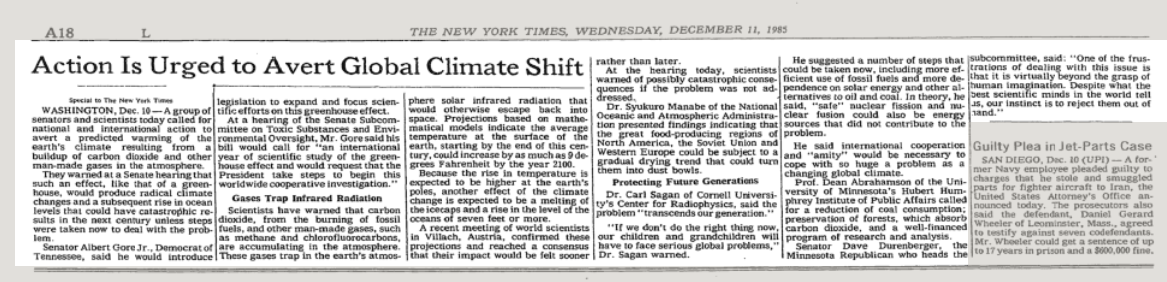
Indeed, the "alarmist" headline read "ACTION IS URGED TO AVERT GLOBAL CLIMATE SHIFT." Of course that was 35 years ago in a December 1985 New York Times article that told us:

    "Scientists have warned that carbon dioxide, from the burning of fossil fuels, and other man-made gases, such as methane and chlorofluorocarbons, are accumulating in the atmosphere. These gases trap in the earth's atmosphere solar infrared radiation that would otherwise escape back into space. Projections based on mathematical models indicate the average temperature at the surface of the earth, starting by the end of this century, could increase by as much as 9 degrees Fahrenheit by the year 2100."

Elements of the post that follows appeared here previously, but given the recent climate "warming" impacts we need to be certain that readers be given the opportunity to consider its message.

Because agencies of the United States government and the Chinese government recently have accepted as inevitable a near-maximum catastrophic impact from Climate Change, the subject must be taken up again. The May 2018 Chinese study, which corresponds to the July official projections accepted and published by the Trump Administration, is unequivocal.

Of course, almost no living person in the Baby Boom generation (or older) will be alive to experience the full catastrophic impact even in the earliest year of the Chinese models - 2064. And at least half of the Gen X generation will be gone before the Chinese model's "most likely" full catastrophic impact year - 2084.

That means Climate Change is still a somewhat abstract concept to the generations of people who voted in the greatest percentages in the latest elections - excluding those who died from the recent heat. And too many of them keep telling themselves it is a lie as they try to figure out how to stay in their home until they die, in many cases despite regular flooding or wildfires or both.

And by "them" I must include "me" because as I wrote in 2016 Al Gore's campaign on climate policy beginning "40 years ago, he..., well, kids..., my generation failed him and you." 


We have already changed the world catastrophically

As explained in a previous post here, Elizabeth Kolbert is a Pulitzer Prize winning author who has won many awards for her extensive writings on Climate Change. In that post a quote from the 2015 update to her 2006 Field Notes from a Catastrophe: Man, Nature, and Climate Change summed up the situation (emphasis added):

     In the years since I wrote this book I’ve been asked hundreds of variations on the question: “What should I do?” What people seem to be looking for is both advice on concrete actions they can take and the assurance that what they do will make a difference. Given the paralysis of the political system, the time lag built into the climate system, and the high likelihood that the threshold of DAI [dangerous anthropogenic interference] has now been crossed, it’s difficult to offer such assurances. We have already changed the world dramatically, indeed quite probably catastrophically. But even when it comes to catastrophe, distinctions can be made. What we choose to do—or not to do—in the coming decades will determine the future both for our own kind and for the millions of other species with whom we share this planet. It is possible that we could still limit warming to around two degrees Celsius, and it is also possible that we could lock in warming of six degrees Celsius or more. These two possibilities represent radically different worlds.

In her 2014 Pulitzer Prize winning book The Sixth Extinction: An Unnatural History she explains that the Earth is in the midst of a man-made sixth extinction, chronicling previous mass extinction events, and comparing them to the accelerated, widespread extinctions of our present time. In a July 2014 interview on The Daily Show with John Stewart promoting the book at the end they both acknowledge a kind of despair:

Unfortunately, in 2018 in both the U.S. and China formal findings have been made that we have "locked in warming" of 4°± Celsius most likely within 60 years.

Under the direction of the Trump Administration the National Highway Traffic Safety Administration (NHTSA) with the cooperation of the U.S. Environmental Protection Agency (EPA) and the U.S. Department of Energy (DOE) issued aDraft Environmental Impact Statement (DEIS) for the Safer Affordable Fuel-Efficient (SAFE) Vehicles Rule for Model Year 2021–2026 Passenger Cars and Light Trucks proposing reduced average fuel economy standards for those vehicles.

The DEIS has determined that the draft official policy of the United States government will be acceptance of a near worst case scenario, a 4.387°C (7.876°F) global temperature rise since 1880 by 2100. That is because any lesser scenario would require deep cuts in carbon emissions to avoid this drastic warming. A lesser scenario “would require substantial increases in technology innovation and adoption compared to today’s levels...which is not currently technologically feasible or economically feasible.”

In May 2018 a collaborative research team from China published a new analysis that shows the Earth's climate would increase by 4 °C, compared to pre-industrial levels, most likely by 2084. They found that most of the models projected an increase of 4°C as early as 2064 and as late as 2095, with 2084 appearing as the median year.

"Our ultimate goal is to provide a comprehensive picture of the mean and extreme climate changes associated with higher levels of global warming based on state-of-the art climate models, which is of high interest to the decision-makers and the public," said Dabang Jiang, a senior researcher at the Institute of Atmospheric Physics of the Chinese Academy of Sciences.

Perhaps some would want to dismiss both government agencies as being too pessimistic. The problem is in 1995, now 26 years ago, then Vice-President Gore reflected on his experienced reality in a 1995 New York Times article:

    "We are in an unusual predicament as a global civilization," Al Gore said when I interviewed him early in his Vice Presidency. "The maximum that is politically feasible, even the maximum that is politically imaginable right now, still falls short of the minimum that is scientifically and ecologically necessary."

In other words, as Kobert outlined in The Sixth Extinction: An Unnatural History various species have already gone extinct. Others are adapting, doing things like moving to higher elevations. But they haven't experienced anything close to the impacts of an increase of 4°C which will strain every species including humans.

All of which should lead us back 90 years to the Dust Bowl Era pictured at the beginning of this post.

In his 1933 novel To A God Unknown, John Steinbeck tells an allegorical tale of the California experience. The protagonist, Joseph, comes to California to create his future. He discovers a place of apparent wealth and promise. And indeed he appears to be achieving all that he dreams. But over time, tragedies strike and a drought undoes his life work.

Late 19th and early 20th Century immigrants to Californian hadn't read To A God Unknown. Instead they believed that water was an endless resource of wealth for future Californians. Unfortunately that wasn't true. It was Johnny Carson who observed that California has four seasons: Fire, Earthquake, Flood, and Drought. But mid-20th Century Californians didn't hear that.

Lands that once were orchards in Southern California. the San Francisco Peninsula, and Santa Clara County, and farms in the Central Valley became subdivisions of housing for large populations, urban/suburban populations that were now dependent upon that water for human consumption competing with the remaining agricultural interests. In 2009 the Southern San Joaquin Valley became the first area in the State to suffer significantly from the return of centuries of drought that received intermittent decades of relief.

No one can say we weren't warned.

Friday, May 7, 2021

The 2020 Census resulted in California losing a House seat. Yes, it is still the nation's largest state.

One in eight US residents lives in California. Nonetheless, reading the news recently one might believe California lost its status.

The 2020 Census Data was released and California still had the largest population - by 35.61%. Our official population for April 2020 was 39,576,757.

California's population growth was 2,322,238 - more than the total population in each of the 15 smallest states and more than the total population of the three smallest states.

California had 10,393,467 more people than Texas, the second most populous state. That 10,393,467 was more than the total population of the 10 least populous states.

Texas is the largest state by area in the lower 48. California is second. As of April 2020 Texas had 108.65 people per square mile. California had 241.77 people per square mile, roughly 2¼ times the population density of Texas.

California does have significant problems.

We have housing cost problems because around the year 2000 we effectively put a freeze on incorporating new cities. Hence we now regularly read of folks bidding $1 million more than the asking price for homes in the East Bay.

We have a drought that isn't likely to go away soon. That's because it isn't a drought, but a shift in long term climate to hotter and dryer. So we have wildfire problems because we permitted new construction in areas that have wildfires. We have water supply problems which were evident before the year 2000.

But we have the world's 5th largest economy sustained in no small way by technology companies. We have the largest imports value in the nation. Our exports include 100 percent of the almonds, artichokes, dates, dried plums, figs, garlic, kiwifruit, olives, pistachios, raisins and walnuts, plus 60 other agricultural products. California accounts for roughly 13.5% of agricultural cash receipts in the United States, at $50.1 billion of $370.6 billion.

While it's not something to brag about, in terms of our economy in 2019 we did have the third highest ranking of housing starts in market value. And the problem for local contractors after Covid is the shortage of wood which combines to exacerbate our housing shortage.

The headline issue was the result of the Census in California. In 2022 California will have one less seat in the House of Representatives. In 1990 California's population grew by 25.7% giving it 52 representatives in the 1992 election. It gained one more as the result of the 2000 Census which it retained as a result the 2010 Census, but lost in 2020.


Wednesday, December 2, 2020

Covid-19, unemployment, & realigned world trade: Extended Economic Distortion begins to take shape

We are nearing the end of a year of pandemic after four years of the Trump Administration. It is not surprising that Covid-19, unemployment associated with changes in consumer habits, and a realignment of world trade towards the Pacific-Southeast Asian nations are creating a picture of a probable Extended Economic Distortion within the U.S.


The Pandemic

The Covid-19 pandemic has worsened severely. As of November 30, here in California's hospitalizations exceeded the previous high as can be seen in this chart...

...while the 7-day death rate climb has just begun - 133 days after the hospitalization rise exactly as last time. These charts do not reflect Thanksgiving infections and, with Christmas and New Years coming up, hospitalizations will continue to skyrocket probably through February. (It has become clear that Californians are no better than any others waiting for the vaccine while protecting the vulnerable among them.)


Unemployment

Expanded unemployment has, and will continue to, create difficult economic pressures. Obviously, a runaway pandemic is going to put pressure on businesses directly serving the public. Many restaurants and retailers have closed. But that isn't the major issue.

The most immediate issue is the impact of expiring expanded unemployment related benefits enacted to reduce economic losses from the Covid-19 pandemic. By the end of December the last of the aid will be paid out that Congress provided through a series of emergency measures in the spring.

Direct checks of $1,200 per person to most U.S. households, $600 a week in supplemental unemployment benefits and hundreds of billions of dollars in support for small businesses reduced the effects through the summer. But according to U.S. employment data the number of people out of work for more than six months (the indicator of long-term unemployment) rose 1.2 million in October, to 3.6 million - a rise - and is likely to continue to increase well into 2021. In addition, workers are facing these realities:

  • Nearly four million Americans are receiving benefits under the pandemic compensation program, a number that doubled in the past month and which will keep rising as more people reach the end of their 26-week state benefits.
  • There are 9.3 million people receiving Pandemic Unemployment Assistance, a program to cover people left out of the normal unemployment system, such as freelancers and self-employed workers, as well as those unable to work because of pandemic-related child care issues and similar obstacles.
  • Tens of millions of workers will lose access to federally mandated paid sick and family leave from the Families First emergency program which required many employers to provide workers with two weeks of coronavirus-related sick leave at full pay and up to 12 weeks of family and medical leave to care for family members at two-thirds pay.

All this must be viewed in the context of an October 2020 report titled Household Financial Fragility during COVID-19: Rising Inequality and Unemployment Insurance Benefit Reductions which makes us acutely aware that even in January 2020 when our economy was thought to be booming a large majority of American households were dependent upon that next paycheck to cover their cost of housing and food.

In theory Congress could extend, modify-and-extend, or create new programs. Recent headlines indicate a compromise bill proposed by nine Senators has some support. But the divided national political scene as reflected by the Republican Senate versus Democratic House - Senate Majority Leader Mitch McConnell (R-KY) versus Speaker of the House Nancy Pelosi (D-CA) - will not make that easy.

We will know by the end of January 2021 the level of success of McConnell's election 2024 goal to make Joe Biden seem responsible for an economic disaster by minimizing benefits to unemployed workers.


21st Century Economic Restructuring

As noted here in a September 1 post, the first 20 years of the 20th Century and the first 20 years of the 21st Century solidified major transitions in the economy.

The most significant of the changes was brought about by the embracing of the internet for communications, entertainment, and sales of goods and services. Consider this story:

    US ecommerce sales will reach $794.50 billion this year, up 32.4% year-over-year....
    “We’ve seen ecommerce accelerate in ways that didn’t seem possible last spring, given the extent of the economic crisis,” said Andrew Lipsman, eMarketer principal analyst at Insider Intelligence. “While much of the shift has been led by essential categories like grocery, there has been surprising strength in discretionary categories like consumer electronics and home furnishings that benefited from pandemic-driven lifestyle needs.”
    “There will be some lasting impacts from the pandemic that will fundamentally change how people shop,” said Cindy Liu, eMarketer senior forecasting analyst at Insider Intelligence. “For one, many stores, particularly department stores, may close permanently. Secondly, we believe consumer shopping behaviors will permanently change. Many consumers have either shopped online for the first time or shopped in new categories (i.e., groceries). Both the increase in new users and frequency of purchasing will have a lasting impact on retail.”

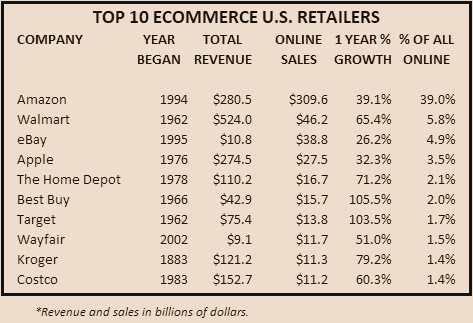
The numbers in the table below reflect that changing market when comparing the 2019 financial statement total revenue to the most recently reported current esales:

The likelihood that gains in internet sales after Covid-19 will revert to in-store sales is not great. And expected holiday sales will shift further to online. The impact on local retail sales cannot be overstated.

Further, as mentioned in the article above, the real surprise is that online grocery sales have skyrocketed as noted in this Atlanta Constitution article:

    Recent numbers show the pandemic pushed online grocery sales in the U.S. to extraordinary heights. In August 2019, sales were $1.2 billion, according to data gathered by the companies Brick Meets Click and Mercatus. In June 2020, they were $7.2 billion.
    Meanwhile, online sales grew from 3.4% of the grocery buying market in 2019 to 10.2% a year later, according to Mercatus and consumer data firm Incisiv.
    The change is creating thousands of new jobs in Atlanta, from high-tech positions to warehouse and delivery workers.
    Online shoppers will see improved delivery services and a better online user experience as companies compete for their share of the $1 trillion annual U.S. grocery market, industry analyst David J. Livingston said. But some smaller grocers likely won’t be able to keep up and could end up closing as behemoths like Walmart and Amazon continue to take bigger chunks of the online grocery business.
    Grocery store chains are staying competitive by throwing more resources into the fight. Kroger, for instance, has hired the British company Ocado to build a $55 million warehouse in Forest Park where robots will help sort online grocery orders. The chain will begin delivering in the metro area in 2021.
    “We’ll all look back on this year as being possibly the most significant inflection point for online grocery shopping,” said David Hardiman-Evans, Ocado’s senior vice president for North America.

One must also note that the "shoppers" are gig workers reflecting another shift in our economy.


China's Crucial Win in World Trade

China clearly has has offered a 21st Century non-military challenge to U.S. economic strength with a crucial win in world trade, along with a manufacturing focus shift inward.

This must be viewed in the context of China's relative success at suppressing Covid-19 outbreaks. China's one-party unitary national government can impose mandatory lockdowns, testing, and vaccination more effectively than in an undisciplined multiparty federation such as the United States.

China's one-party unitary national government can, and has, turned inward to promote its own consumer economy with the context of the 14th Five-Year Plan and the 2035 Vision to be taken up by the Party Congress next year. Consider this news story:

    President Xi Jinping called on the nation in May to rely more on domestic demand for future growth – dubbing it a dual circulation strategy – and his directive requires significant changes in both internal supply and demand.
    “The pandemic has made it difficult for us to sell abroad, but we do feel as though Chinese customers are less … enthusiastic for foreign brands, especially mid-level products,” said a sales manager at a fashion jewellery brand with shops all over the country.
    “Frankly, it may be becoming fashionable and more politically correct to make and consume good-quality Chinese goods,” he added, asking not to be identified.
    That sentiment seems to be felt by a growing number of Chinese export manufacturers, some of whom say they have started shifting investments to the domestic market even as their exports have seen a huge resurgence recently.
    Orders have been returning to China as other producing countries are still being ravaged by the pandemic, but manufacturers know the trend is most likely unsustainable.

However, China's one-party unitary national government can, and has, turned toward the Pacific-Southeast Asia to join with Australia, Brunei, Cambodia, Indonesia, Japan, Laos, Malaysia, Myanmar, New Zealand, Philippines, Singapore, South Korea, Thailand, and Vietnam to create the Regional Comprehensive Economic Partnership (RCEP). The RCEP, signed November 15, includes almost one-third of the world’s population and about one-third of its gross domestic product. It is the first ever free trade agreement between China, Japan and South Korea – Asia’s largest, second-largest and fourth-largest economies. It's goal is to progressively lower tariffs and aims to counter protectionism, increase investment and allow more free movement of goods.

Brunei, Vietnam, Laos, Cambodia, Thailand, Myanmar, Malaysia, Singapore, Indonesia and the Philippines are members of the Association of Southeast Asian Nations (ASEAN) trade group. It was announced December 1 that the European Union has joined with the ASEAN group in a strategic partnership to "stand up for safe and open trade routes and a free and fair trade" according to German Foreign Minister Heiko Maas after a virtual meeting with his EU and ASEAN counterparts. "Together, we represent more than a billion people and almost 25 per cent of global economic power," noted Maas.

Then, to the surprise of many, President Xi Jinping announced that China “will actively consider” joining the Comprehensive and Progressive Agreement for Trans-Pacific Partnership (CPTPP). Chinese Premier Li Keqiang’s in May noted that “China has a positive and open attitude toward joining the CPTPP”. Were this to be accomplished it would add Canada, Chile, Mexico, and Peru to China's trade group partners.

For Americans who don't remember as far back as four years ago (most Americans), the CPTPP evolved from the Trans-Pacific Partnership (TPP), which failed due to the withdrawal of the United States after Trump took office. Twenty-two TPP provisions that were priorities of the U.S., but not other negotiating partners, were suspended or modified in the CPTPP.

President Barack Obama's push to pass the TPP in 2016 was resisted by the 2016 presidential candidates in both major parties. Clinton and Trump opposed the deal, arguing that it would hurt American workers.

The problem for Clinton was former 2016 presidential candidate socialist U.S. Sen. Bernie Sanders rallied his supporters to urge the Democratic National Committee (DNC) to include language in their platform rejecting the TPP. CNN reporter Eric Bradner wrote, "By keeping specific opposition to the Trans-Pacific Partnership out of the platform, Democrats avoided embarrassing President Barack Obama." Although the DNC's decision was a disappointment to Sanders, he, along with U.S. Sen. Elizabeth Warren, continued to spearhead efforts in the Senate to get their colleagues to vote against Obama's trade deal.

This year, President-elect Joe Biden stated: "When it comes to trade, either we're going to write the rules of the road for the world or China is – and not in a way that advances our values. That's what happened when we backed out of TPP – we put China in the driver's seat. That's not good for our national security or for our workers. TPP wasn’t perfect but the idea behind it was a good one: to unite countries around high standards for workers, the environment, intellectual property, and transparency, and use our collective weight to curb China’s excesses."

What Biden did not foresee was the RCEP, the EU-ASEAN agreement, and China's positive outward reach to the CPTPP.

The problem for the U.S. is that while two-thirds of the original chapters remain in the CPTPP,, among the 22 provisions set aside include such things as investors’ ability to litigate disputes under investment agreements and investment authorizations - which are used mostly for mining and oil investments - are more limited.

Further regarding intellectual property the length of patent protection for innovative medicines has been shortened, technology and information protections have been narrowed, and copyright periods for written materials have also been shortened. Particularly, the stringent requirements that the United States pursued in technological protection measures, rights management information, encrypted satellite and cable signals, and safe harbors for internet service providers have all been removed.

Effectively, the American-East-Coast oriented ignoramuses handed a massive international trade win to China. They didn't protect any American interests or American workers. As Biden said: "We put China in the driver's seat."

The 46 nations within the CPTPP, RCEP, and EU-ASEAN are home to 38% of the world's population and control 50% of the world's Gross Domestic Product (GDP) - 51.64% of the 2019 Nominal GDP, 50.03% of the 2019 Purchasing Power Parity GDP.

The map below with the countries in white (most importantly the United States, India, and Russia) representing non-participants will shape our future Extended Economic Distortion:

The fact that the EU has chosen to get its foot in the door should be a clear warning that the United States no longer has the "collective weight" (to use the term Biden used) it had in the 20th Century. Americans made significant choices at the beginning of the Millenium, choices which will continue to hang over the U.S. economy in complex ways for decades.


The Undercurrent in U.S. Politics Enters the Limelight

The future of the United States is currently bound up in a (almost) fanatical dispute between three points of view. Most certainly the socialists versus the libertarians (recently in the persons of Bernie Sanders versus the Koch Brothers) have chiseled their ideological way into the electorate as reflected in Congress and the state capitols.

But added to that is a formerly "silent" significant minority.

Speaking in Madison, Wisconsin on April 15, 2011, Sarah Palin said everything that needs to be said about that significant minority: "And speaking of President Obama, I think we ought to pay tribute to him today at this Tax Day Tea Party because really he's the inspiration for why we're here today. That's right. The Tea Party Movement wouldn't exist without Barack Obama."

Palin epitomizes what appeals to the significant minority:

  • Of English, Irish, and German ancestry, she was born February 11, 1964 in Sandpoint, Idaho, to "Chuck" Heath (a taxpayer supported science teacher and track-and-field coach) and "Sally" Sheeran (a taxpayer supported school secretary), the third of four children.
  • When she was a few months old, the family moved to Alaska where her father had been hired to teach,  settling in Wasilla, Alaska in 1972.
  • She attended Wasilla High School, where she was head of the Fellowship of Christian Athletes and a member of the 1982 Alaska state champion girls' basketball team and cross-country running team.
  • In 1984, Palin won the Miss Wasilla beauty pageant and she finished second runner-up in the Miss Alaska pageant, where she won the title of "Miss Congeniality".
  • In 1987 she received her bachelor's degree in communications with an emphasis in journalism from the University of Idaho, and then worked as a sportscaster for Anchorage TV stations and a newspaper sports reporter.
  • In August 1988, she eloped with Todd Palin, her high school sweetheart, and they have five children, the youngest of who born in 2008 was prenatally diagnosed with Down syndrome.
  • Todd worked for the oil company BP as an oil-field production operator, retiring in 2009, and owns a commercial fishing business.
  • They are now divorced.

Simply, Palin is a celebrity who foreshadowed the successful candidacy of Donald Trump. It is unclear what would have happened in 2008 had her fame and experience not been limited to Alaska, the third least populous state ahead of only Wyoming and Vermont. Of course, social media such as Twitter and Facebook had not yet completely replaced traditional news sources in 2008 when she ran for Vice-President.

In today's political reality, political candidacy favors celebrity contestants and the significant minority accepts its beliefs from the likes of sportscasters and reality show hosts. The Regional Comprehensive Economic Partnership (RCEP) signed in November 2020 was introduced as a concept in 2011 during the 19th ASEAN Summit. The original proposal for the Trans-Pacific Partnership was made in 2008 with the final agreement stalled by the U.S. disinformation machine in 2016. Sportscasters and reality show hosts cannot compete on a world stage that depends upon 8+ years of informed participation in detailed economic negotiations.

Whatever else you may think, Barack Obama was a well-educated, experienced politician who also was young and black. Future elections will tell us if the U.S. is destined to be a bystander in the world.

Wednesday, November 11, 2020

With Covid-19, it's the behavoir of individual Californians that matters. We aren't doing as well.

California's success in limiting the impact of the Covid-19 pandemic - will we continue to behave? was title of a post here on October 6.

Looking at the graph above (click on it to see a larger version), apparently the answer to that question about continued behavior is "no". This is confirmed by news stories such as 11 California counties fall back to more restrictive tiers as COVID-19 surges and California counties return to restrictive Covid rules amid hospitalization surge.

The state instituted for counties a four-tier performance rating system based primarily upon the 7-day Covid-19 positivity rate (percentage of county residents who test positive for the virus of all individuals who are tested) for the week ending 7 days prior. 

Yesterday we learned that residents in Amador, Contra Costa, El Dorado, Modoc, Placer, Sacramento, San Diego, Santa Cruz, Siskiyou, Stanislaus, and Trinity counties failed to protect each other resulting in them falling into less favorable tiers. It appears that other counties will see this next week and that no county improved.

Over the last 14 days hospitalizations have increased 31.6% and the number of patients admitted to intensive care units with infections has increased 29.6%.

Indications are that a significant cause is gatherings of family and friends which not only result in spreading within the gathering participants but subsequently also to others. People say they haven't experienced symptoms nor have they tested positively "recently", but that offers little or no protection for getting together with people outside your well-established pod.

How Californians will behave over the holidays - from Thanksgiving through New Year's Day - will determine how many counties will find themselves in the purple at the beginning of the year:


All businesses and schools can do is hope that people will behave. While you might look at the tiers and say the objective is to limit cases, the deeper objective is to limit hospitalizations...and deaths. That is the outcome of bad behavior.

Tuesday, September 1, 2020

A trade war, gig economy, and lack of immigrant workers will be the key factors in prolonging the post-pandemic Extended Economic Distortion

Because the differences between the 20th Century and 21st Century economies are significant, though not commonly identified, they will become significant elements in the post-pandemic Extended Economic Distortion.

Like most centuries, what is significantly different from the last century is confusing because the source of changes seem to escape clarity. For instance, as late as April 2009 international finance guru Randy Charles Epping's book The 21st Century Economy--A Beginner's Guide was released to acclaim and was regarded Bookauthority.or as among the "40 Best New Economy Books".

In that book according to one description: "Epping defines key ideas and commonly used words and phrases like carbon footprint, WTO, economy of scale, NAFTA, and outsourcing [and] illustrates how central banks help navigate global crises and drive the global economy, discusses the benefits of Green Economics, shows how trade wars can be avoided...."

Uh, shows how trade wars can be avoided?

One thing 2016 and 1916 have in common is that the economics of the previous century was about to come to an end. In 1916 we had WWI followed by The Great Depression and WWII.  In 2016 when Donald Trump took control of the Republican Party and won the U.S. Presidency, he began a nationalist trade war with the rest of the world completely disrupting the norms of the global economy, a trade war that appears to be expanding into hostilities when it comes to China.

Then came 2020's pandemic shutting down travel and commerce for many months - we don't know how many, because it's still going on and does not appear to be on a course towards full recovery. Except for China which, as explained in The New York Times:

    This was supposed to be the year that China’s export machine began to stall. President Trump had imposed broad tariffs on Chinese goods. Countries like Japan and France pushed companies to shift production from China. The pandemic had crippled China’s factories by the end of January.
    Instead, China Inc. has come roaring back.
    After reopening in late February and early March, China’s factories began an export blitz that is still gaining steam. Exports soared in July to their second-highest level ever, nearly matching the record-setting Christmas rush last December. The country has grabbed a much larger share of global markets this summer from other manufacturing nations, entrenching a dominance in trade that could last long after the world begins to recover from the pandemic.
    China is showing its export machine cannot be stopped — not by the coronavirus and not by the Trump administration. Its resilience lies not only in the country’s low-cost, skilled labor and efficient infrastructure but also in a state-controlled banking system that has been offering small and large businesses extra loans to cope with the pandemic.
    The pandemic has also found China better placed than other exporting nations. It is making what the world’s hospitals and housebound families need right now: personal protection gear, home improvement products and lots of consumer electronics.

The irony of this is important to California. As explained here in the lengthy November 24, 2016 post #Calexit. Perhaps 170 years of invidious doubtful scorn is enough California's early European influence was Spanish trade with Asia:

    Effectively the Pacific Coast (and more) of the Americas was left to the Spaniards, good Roman Catholics all, to colonize and they did so from Northern California to Cape Horn.
    The first European contact in California was a Spanish sailing expedition, led by Portuguese (?) captain Juan Rodríguez Cabrillo, in 1542, which traveled up the Pacific Coast as far north as the Russian River. Subsequent Spanish expeditions, followed....
    In 1565 the Spanish developed a trading route where they took gold and silver from the Americas and traded it for goods and spices from China and other Asian areas. The Spanish set up their main base in the Philippines. The trade with Mexico involved using an annual passage of Manila galleons, which would traverse somewhere near Cape Mendocino, then could turn south down the California coast towards their home port in Mexico.
    When the value of California for trade routes became obvious to several other European interests, particularly the Russians whose fur traders were traveling from Alaska down the coast, the Spanish sent the Portola Expedition both over land and sailing up the coast in 1769.
    The Portola Expedition's original assignment was to travel to the "port of Monterey" described by the Vizcaino expedition and establish a settlement there. After that, the explorers were to continue north to locate Cermeño's "Bay of San Francisco" (the northern end of which is now called Drake's Bay), chase away any Russians encountered, plant the Spanish flag and determine whether the bay would make a good port.
    After the Portolà expedition of 1769-70, Spanish Catholic missionaries began setting up 21 California Missions on or near the coast of Alta (Upper) California, beginning in San Diego. During the same period, Spanish military forces built several forts (presidios) and three small towns (pueblos). Two of the pueblos grew into the cities of Los Angeles and San Jose. And so California became a part of Viceroyalty of New Spain.

Except in the midst of WWII, trade with Asia has been critical for California's economy since the 17th Century. In the past four decades, trade with Asia has been integral to the U.S. economy as a whole. In 2018 Asian trade for the U.S. totaled $1.6+ trillion. In the first six months of 2020 it was $115 billion less.

A new 21st Century economy integral element is the so-called "Gig Economy." For many it is hard to understand the significance of the Gig Economy. Apparently the federal government has no lack of understanding.

There was no hesitation on the part of the federal government as reflected in the red in the chart to the right. Those red bars are the people on Unemployment Insurance (UI) under federal programs established by the CARES Act and some other programs

Under the CARES Act states are permitted to provide Pandemic Unemployment Assistance (PUA) to individuals who are self-employed, seeking part-time employment, or who otherwise would not qualify for regular unemployment compensation.

The important thing to recognize is that news stories such as in today's New York Times begin with "just over one million Americans filed new claims for state jobless benefits last week" before noting further down on the page "another 608,000 people filed for benefits under the federal Pandemic Unemployment Assistance program."

The truth is last week 1.43 million new unemployment claims were filed, and 42.5% were under the PUA many of whom, if not most, fall under the vague definition of gig workers who were working in the Gig Economy. And it is this subject that also relates to California's history.

If you know about the film industry you know that today actors, writers, and almost all other production folks are effectively gig workers, meaning they don't have jobs until they are hired for specific productions then laid off. Many work enough to get UI for a period, but then must do jobs like wait tables. It wasn't always this way as a 1984 New York Times article noted:

    In 1938, Metro-Goldwyn-Mayer had 120 actors and actresses under contract, including Clark Gable, Greta Garbo, Robert Benchley, Dame May Whitty, Judy Garland, and Freddie Bartholomew. Nearly a hundred writers and directors were under contract to M-G-M that year, too. And 1938 was hardly a peak year during the golden era of the Hollywood studio system.
    Although the movie industry has often yearned publicly for the old days - Francis Coppola, for example, bought a nine-acre studio in the heart of Hollywood a few years ago in order to re-create the old system, and every decade Universal has announced a ''new talent'' contract program - the studio system, with its old authoritarianism, has stubbornly remained as dead as the dodo bird and passenger pigeon that it followed into oblivion. Mr. Coppola's Zoetrope, which put four promising actors under long-term contract, is bankrupt; and somehow the new talent programs, which tried to do the same thing with beginning actors, never worked.

In the film industry there is some evolved benefits programs through unions for some of the quarter of a million California film industry UI applicants. But that isn't true for the bulk of the Gig Economy that began in the past two decades. Investopedia lays the subject out straightforwardly:

    In a gig economy, temporary, flexible jobs are commonplace and companies tend toward hiring independent contractors and freelancers instead of full-time employees. A gig economy undermines the traditional economy of full-time workers who rarely change positions and instead focus on a lifetime career.

Wikipedia offers considerably more discussion but gives this piece of critical information:

    In the 2000s, the digitalization of the economy and industry was carried out rapidly due to the development of information and communication technologies such as the Internet and the popularization of smartphones. As a result, on-demand platform based on digital technology has created jobs and employment forms that are differentiated from existing offline transactions based on accessibility, convenience and price competitiveness, the so-called Gig economy has become a focus.

Within the overall economy, the Gig Economy has complicated things because as noted in Wikipedia "36% of U.S. workers join in the gig economy through either their primary or secondary jobs." And they are likely the bulk of the 42.5% of new filings for unemployment.

Complicating the matter further, California is in the middle of a policy battle over whether gig workers are should be employees, not independent contractors. It's complicated and the outcome could impact the future of the national economy.

Foreign trade and the Gig Economy are two integral elements of the 21st Century American economy facing significant change. A third is the role of immigrant workers.

We are generally familiar with the nearly-century-old policy debate - perhaps battle - over immigrants, both legal and illegal, who work in agriculture. The Trump Administration has instituted policies that reduce the number of available workers, implying that the goal is zero. That would have a significant impact on the cost of food.

Then there is the complicated issue of the H-1B visa, on which U.S. technology companies have become dependent for workers. The issue is complicated because some companies use those visas to tie workers to a job and pay less than the market wage. But the United States and China are in a growing competition for technological leadership in areas such as artificial intelligence, biotechnology, quantum computing, and other sectors vital to future economic and military prowess. The Trump Administration's has acted to restrict both student and H-1B visas.

In the pandemic with its travel restrictions many actual and potential technology workers have gone home and others have not been able to come to the United States. In effect the pandemic has implemented Trump policies. This is going to disrupt American technology leadership already being effectively challenged by China. It is not clear that this will change in the next few years.

The post-pandemic Extended Economic Distortion is going to result from, among other factors, reduced world trade, reevaluation and potential reorganization of the Gig Economy, and a loss of immigrant worker efficiency and expertise.

A reason for the surprising ease that the early $500 billion in direct intervention for American families passed both houses of Congress. Without it, 17 million people would have dropped below the poverty line. That's why Trump bypassed a stalled Congress with the $300 per week second round add-on to UI.

Getting restaurant and personal care workers back to work is a goal to avoid some potential deep poverty. But post-pandemic economic issues go well beyond the service industry and well beyond the time when a vaccine will push Covid-19 onto the same shelf in people's minds as "the flu."

No historical period exists that is identical to this time. But the sharp deflationary recession across Europe and in the United States known as the Depression of 1920–1921 was stimulated by the return to the civilian economy of troops after the end of World War I.

But it created an economic distortion further twisted by the Spanish Flu and the rise of labor unions. Each country responded differently. Italy's response to the social unrest offers a cautionary lesson for dealing with an Extended Economic Distortion in 2020. We will explore the Mussolini-effect here in the future.