Showing posts sorted by date for query What's an Economy. Sort by relevance Show all posts

Tuesday, March 1, 2022

As with the complexities of Climate Change and The Covid Economy, European History Complicates (The) Ukraine More Than Americans Understand

If you didn't notice, we have been again informed by experts who completed a new study that Climate Change has started and cannot be stopped.

Also the Covid-created Extended Economic Distortion continues unabated as the cost-of-living skyrockets.

And then there is the Russian invasion of Ukraine...

...or The Ukraine as it was called in the millennium when it was part of Russia before the Soviet Union came into being. Of course, there is no justification for starting a war which is the systematic killing of people for a political objective. With that said....

Lest you believe everything reporters born after 1959, and particularly those born after 1989, are telling you about (The) Ukraine, here is something you need to know from Wikipedia:

    Leonid Brezhnev was born on 19 December 1906 in Kamenskoye (now Kamianske, Ukraine) within the Yekaterinoslav Governorate of the Russian Empire, to metalworker Ilya Yakovlevich Brezhnev (1874–1934) and his wife, Natalia Denisovna Mazalova (1886–1975). Brezhnev's ethnicity was given as Ukrainian in some documents, including his passport, and Russian in others.
    His 18-year term as general secretary was second only to Joseph Stalin's in duration. While Brezhnev's rule was characterised by political stability and significant foreign policy successes....

In other words, the man who ran the Soviet Union for the longest period time was a Ukrainian except for Stalin who was a Georgian. You also might find the article How Ukrainian-origin leaders dominated the Soviet Union interesting as it covers the Ukrainian backgrounds of Nikita Khrushchev, Konstantin Chernenko, and Mikhail Gorbachev.

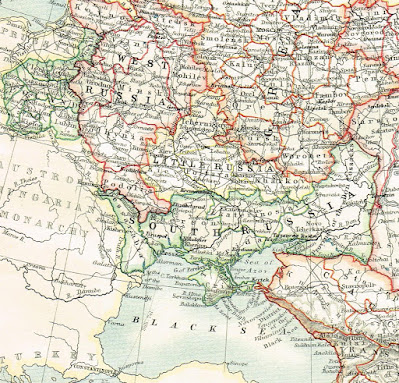
The difficulty for Americans is just how far removed we are from Europe, and more particularly European history. Without wading back through distant history, one needs to understand that in 1903 the map of the area of the Russian Empire now known as Ukraine looked like this:

Good luck finding the word "Ukraine." And that was at the beginning of the 20th Century.

Ah, but many say, the Ukrainians have their own language as a people.

If you ignore what are considered migrant, extinct (or nearly extinct), and foreign languages, the following are languages used in Russia other than Russian: Abaza, Adyghe, Altai, Avar, Bashkir, Buryat, Chechen, Chukchi, Chuvash, Crimean Tatar, Dolgan, Even, Evenki, Erzya, Finnish, Ingush, Kabardianucasian, Kalmyk, Karachay-Balkar, Karelian, Khakas, Kazakh, Khanty, Komi-Permyak, Komi-Zyrian, Mansi, Hill Mari, Meadow Mari, Moksha, Nenets, Nogai, Ossetian, Selkup, Tatar, Tuvan, Udmurt, Ukrainian, Veps, Yukaghir, and Yakut. Of these peoples, which would you be willing to risk a nuclear war to protect their right to self-government, democratic or otherwise.

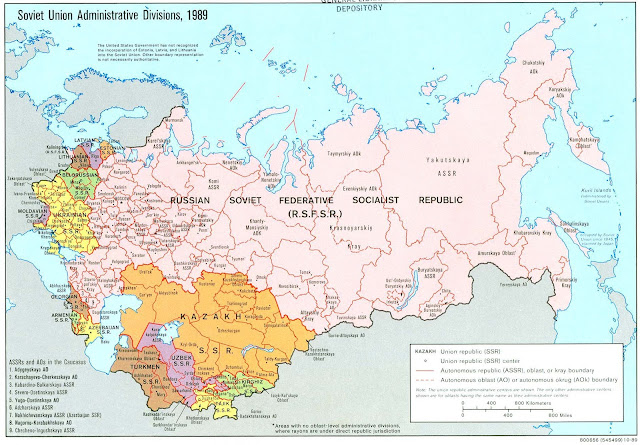
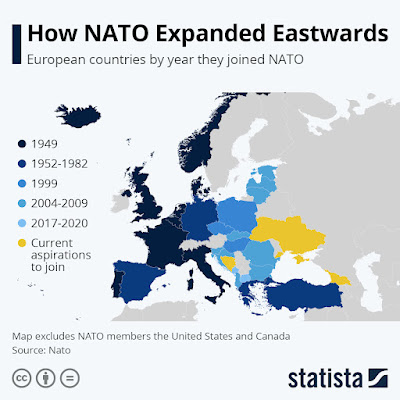
And just in case you haven't noticed, NATO has expanded into the Russian (Warsaw Pact) sphere since the Soviet system fell apart. Would you consider this aggressive if you were a Russian leader:

Over the course of the 1990s and early 2000s, NATO expanded three times: first to add the Czech Republic, Hungary and Poland; then seven more countries even farther east, including the former Soviet republics of Estonia, Latvia and Lithuania; and finally with Albania and Croatia in 2009.

Despite concerns expressed by some Americans and others, as noted by Reuters in December 2021 NATO and the U.S. rejected a statement from the Russian foreign ministry saying "NATO was on a path to draw in Ukraine, leading to the deployment of missile systems there that would target Russia. Such irresponsible behaviour creates unacceptable threats to our security and provokes serious military risks for all parties involved, right up to the point of a large-scale conflict in Europe. Ukraine and Georgia are former republics of the Soviet Union."

This came after Putin on July 12, 2021, actually published his views on the subject in a lengthy essay entitled On the Historical Unity of Russians and Ukrainians. If you know what's true and right about the Ukraine situation, of course you have already read it. But if you haven't you should, partly because it was written by Putin, but also because it isn't an inaccurate history though tinged with a particular point of view.

That point of view was clearly described in a February 28 interview of Fiona Hill in Politico:

    Reynolds: So Putin is being driven by emotion right now, not by some kind of logical plan?
    Hill: I think there’s been a logical, methodical plan that goes back a very long way, at least to 2007 when he put the world, and certainly Europe, on notice that Moscow would not accept the further expansion of NATO. And then within a year in 2008 NATO gave an open door to Georgia and Ukraine. It absolutely goes back to that juncture.
   Back then I was a national intelligence officer, and the National Intelligence Council was analyzing what Russia was likely to do in response to the NATO Open Door declaration. One of our assessments was that there was a real, genuine risk of some kind of preemptive Russian military action, not just confined to the annexation of Crimea, but some much larger action taken against Ukraine along with Georgia. And of course, four months after NATO’s Bucharest Summit, there was the invasion of Georgia. There wasn’t an invasion of Ukraine then because the Ukrainian government pulled back from seeking NATO membership. But we should have seriously addressed how we were going to deal with this potential outcome and our relations with Russia.

In other words, knowledgeable U.S. experts have known for a decade and a half that this situation was evolving. But the email titled Russia-Ukraine Conflict Shocks World, Brings Cybersecurity Worries says it all. It is complicated. It is dangerous. And we never once thought it was important. That's not Joe Biden's fault.

Saturday, March 6, 2021

Will the American economy be "at anchor" with nowhere to go? An Extended Economic Distortion?

Chaos! It's the word used to describe the supply chain problem reflected in the U.S. Coast Guard video above. Watch the video. Taken last month in the height of the shipping containers waiting...and waiting...and waiting to get a slot at the Port of Los Angeles.

The latest data from the Port of Los Angeles and from the Marine Exchange of Southern California confirms that there has been no real let-up in the historic container-ship traffic jam off California’s coast. Since the beginning of this year 25 container ships were at berth in Los Angeles and Long Beach, 30+ container ships were at anchorage with a record of 40 container ships at anchor on February 1.

The term Extended Economic Distortion was introduced in these posts on May 2, 2020. Perhaps no situation illustrates what that means more than the shipping chaos. And we'll explore that further after noting the confusing (chaotic?) continuing reports on employment in the press flooding the headlines because...you guessed it...those reporting it are sitting on their behinds simply rewriting news releases instead of reporting.

Anyway...

The U.S. has an available workforce of 160± million, 83± million of whom are male, and 77 million of whom are female. Of those, 18± million people are receiving some sort of jobless aid - they are termed "the underutilized."

That doesn't count the folks who aren't getting jobless aid. Do we call them "the unutilized?"

The news Thursday told us in the week ended February 27, 745,000± people not currently on the roles of the underutilized filed claims for Unemployment, up 9,000 from the previous week. Some stories even tell us that about 437,000 others who filed claims for Pandemic Unemployment Assistance, a program for business owners, self-employed workers, independent contractors, and those with a limited work history who are out of business or have significantly reduced their services as a direct result of the pandemic.

If you skim the articles you might get the impression that the 745,000± newly unemployed are up (or down) a little from the norm. Actually that is three times the "normal" claimants. And that's after the pandemic settled down a bit.

What's fascinating is the graphics. Compare these two charts:


 It is quite obvious that the graph used to show initial claims has been "adjusted" to reflect the 7 million claims filed in March of 2020. That makes it possible to minimize the difference between early 2020 and early 2021. Again, the number of claims is three times those of early 2020.

Because it was the beginning of this month, Friday we did get information on the monthly employment statistics including in-depth numbers which can be compared as follows:

Looking at the first line, we should be getting a hint about the problem - three times as many folks find themselves unemployed 15 weeks or longer. At the bottom line, we learn we have have about 11.6 million in employment "labor underutilization"

Not on this chart, we now know we have at least another 6.4 million in contract "labor underutilization."

Or, to put it another way, at least 11% of the labor force is effectively out-of-work as we generally understand the term.

All of which brings us back to the Port of Los Angeles which initially saw a decline in imports noted here previously, but now we must have a chart that can help us visualize the chaos in our supply chain:

There is no question that the large Covid finanicial relief packages previously approved by Congress contributed to this retail "buying spree." Now it appears another large package will be on its way.

As we move towards 70% vaccination, how is this going to play out? We noted here on May 7, 2020, Expect a consumer-based Extended Economic Distortion after the Great Economic Lockdown. What will an Extended Economic Distortion look like? We don't know. Maybe it will be an economy "at anchor" with nowhere to go.

Monday, November 16, 2020

No, this election did not reaffirm Climate Change policy - it emphasized how far apart Americans are

“Joe Biden’s win ratifies what’s been clear all along: despite Trump’s best efforts, the American people have remained committed to the Paris agreement. Business, investors, cities, and states redoubled their efforts to solve the climate crisis, proving that the path to a sustainable economy is inevitable,” said former vice president Al Gore in a statement Saturday.

On Monday the The Washington Post notified us that Trump officials rush to auction off rights to Arctic National Wildlife Refuge before Biden can block it.

President-elect Joe Biden has indicated that he will be undoing the Trump Executive Orders that reversed many U.S. Climate Change policies, such as withdrawing from the Paris Agreement.

Of course, Climate Action Tracker, a research project, projects that current Paris Agreement policies and pledges will leave the planet “well above” the Paris accord’s “long-term temperature goal.” Even with the U.S. involved, academics were concerned that the world was headed for “extensive” species extinctions, serious crop damage and irreversible increases in sea levels.

Trump called the Paris Agreement “a total disaster for our country” that would hurt American competitiveness by enabling “a giant transfer of American wealth to foreign nations that are responsible for most of the word’s pollution.” He says rules and directives put in place by his predecessor, Barack Obama, to meet the U.S. targets for emissions hurt the U.S. economy by killing jobs related to fossil fuels, especially coal mining. And he’s dismantled Obama-era regulations meant to stifle greenhouse gas emissions from power plants, automobiles and oil wells.

During the Trump Administration coal company executives have successfully advocated for rollbacks of more than 15 different environmental rules and protections. These wide-ranging rollbacks include actions repealing and replacing the Clean Power Plan and slashing the EPA’s budget and staff numbers.

In case someone didn't notice, nearly half of Americans voted for Trump. And, unless by some miracle the Democrats win both Georgia Senate seats in January, current U.S. Senate Majority Leader Mitch McConnell will continue to control the Senate as he was reelected for six years with 57.8% of the vote. 

He's from Kentucky, a coal state.

Also from coal states are Republicans  John Barrasso (Wyo.) and Shelley Moore Capito (WVa.) who probably will Chair the U.S. Senate Committee on Energy and Natural Resources and the U.S. Senate Committee on Environment and Public Works respectively.

Barrasso was not up for reelection but is acutely aware that conservative Republican Cynthia Marie Lummis Wiederspahn won Wyoming's other Senate seat with 73.1% of the vote. 

Capito was up for reelection and won with 70.4% of the vote. 

The two committees they probably will chair have say over whom Biden puts in top-level positions at the EPA and other agencies plus can make Biden's life difficult on achieving his goals to “transition” away from using oil and reduce or eliminate fossil fuel subsidies.

But we all know he will have strong support from a super-majority of Americans, right? I've seen headlines saying that. Of course even that isn't quite so simple. Consider this chart:

Half of Americans do recognize that moderating human induced Climate Change (Global Warming) will do good things. But do they recognize that it would require behavior modification, a fact not included in the survey? This "favorable" half of respondents includes:

  • those who have already made strides in modifying their behavior to benefit the future climate - we all know of at least one such person, though it may be the same such person;
  • those who are thinking about modifying their behavior to benefit the future climate, but have not yet accepted the truth that they must alter their standard of living; and
  • those who think it is the responsibility of only governments, corporations, non-profit organizations, etc., to change their organizational behaviors while continuing to meet the public's market demands, which will solve all the climate problems.

The other half appears to includes:

  • those who don't believe in the Climate Change concept;
  • those who believe that Climate Change either is the inevitable will of, or will be resolved by, a god;
  • those who see a potential profit to be derived from resulting economic shifts caused by continuing Climate Change;
  • those who see that any solutions needed must come from creative individual Americans acting on their own, not constrained by organizational prejudices and boundaries nor institutional rules nor finances.

As noted in a post here in June 2019 U.S. Secretary of State Mike Pompeo explains the conservative "old deal" to address Climate Change:

[U.S. Secretary of State Mike] Pompeo explained that we Americans will...
  • responsively reorganize our society,
  • relocate as needed, and
  • rely on future technological innovation
...instead of developing governmental policy as suggested in House Resolution 109 - Recognizing the duty of the Federal Government to create a Green New Deal and creating the bureaucracy needed to implement it.

Is Pompeo correct in his assumptions?

About 68% of adults and 85% of Democrats surveyed in 2019, as indicated in the survey above, believe that policies designed to reduce the impacts of Climate Change would help or make no difference to the economy. But when you view the answers in another way, 65% of adults including 51% of democrats believe the policies would hurt or make no difference.

Make no difference. Really? When you dig down, you can't help but note that 38% of Democrats think the policies would make no difference. That's pretty much saying "I haven't given it any thought."

Perhaps we need to recognize context in which the Pew Survey was conducted. Americans have diddled around with electric cars while increasing manufacturing of gas guzzling vehicles. Californians have substantially increased solar and wind energy production while increasing consumption of electricity way beyond that production.

Interestingly, the Covid pandemic has reduced some consumption and a lot of driving. One could offer the idea that we could build on those gains as the pandemic effects decline. But that is a supposition offered in a severely stressed economy.

Perhaps we need to restate what Pompeo asserted. In response to Climate Change in the future individual Americans and their families will out of necessity...

  • responsively reorganize our society, 
  • relocate as needed, and 
  • rely on future technological innovation 

...without significantly modifying U.S. government policy or bureaucracy.

Will American families rely on future technological innovation to deal with the impacts of Climate Change? Most assuredly. They already are, though much of what is available is expensive forcing many to divert their income to keep their homes livable.

Will American families relocate to deal with the impacts of Climate Change? Many won't have any choice and indeed they already are, though not enthusiastically. After all they will be relocating from the coastlines. And because of increasing desert heat they will be relocating from where they just relocated to, the Southwest.

Will individual Americans responsively reorganize our society to deal with Climate Change impacts? Hmmm.... 

Al Gore tells us that business, investors, cities, and states have redoubled their efforts to solve the climate crisis. What he also tells us is that the path to a sustainable economy will be an inevitable outcome of the changes required to solve the climate crisis. So I guess he still believes that Americans will responsively reorganize our society to deal with Climate Change impacts, even though he has been advocating for significant changes since the mid-1970's.

In fact, except for excluding any significant change in governmental policy and bureaucracy, Gore and Pompeo agree.

I'm not sure what we can learn from the Saturday story Garbage, duck feces and continued water woes for flooded South Florida in which is the quote from a resident: “I’ve never seen anything like this before. My home got flooded with water, poop — it’s just horrible.”

The warnings have been made. In September 2019 Bloomberg reported:

    The Great Climate Retreat is beginning with tiny steps, like taxpayer buyouts for homeowners in flood-prone areas from Staten Island, New York, to Houston and New Orleans — and now Rittel’s Marathon Key. Florida, the state with the most people and real estate at risk, is just starting to buy homes, wrecked or not, and bulldoze them to clear a path for swelling seas before whole neighborhoods get wiped off the map.
    By the end of the century, 13 million Americans will need to move just because of rising sea levels, at a cost of $1 million each, according to Florida State University demographer Mathew Haeur, who studies climate migration.

If you read the article, you will learn that some government funding has been focused on homeowner relocation costs. But this does not address issues such as extreme heat in the Southwest or burning forests across the U.S.

The problem for Biden is that when you look at the election results and Climate Change surveys honestly, Americans are not ready for the inevitable Climate Change impacts. We're still struggling with the economic impacts of technology - no, not the presence of Alexa in many homes, rather the fact that a large number of Americans can't afford Alexa. Or even a high speed internet connection in many cases.

To put it another way, there are two Americas, as we learned in the last two Presidential elections. And they don't follow the same web sites. Nor do they hold the same opinions about Climate Change.


This post is a reflection of concerns that began in 2007 when it appeared the Gray Whale migration route was being explored for wind generation by "environmentalists".
                                                                                                               

Monday, August 10, 2020

Last week's multitude of confusing statistics help mystify The Great Economic Distortion's impact

Having said innumerable times over the decades "figures don't lie but lairs sure can figure" it seems like reading, seeing, and hearing inane reporting on statistics in the news media should not be bothersome.

After all, clearly embedded in the term is the truth of its history - stat istics - as the term is intimately connected with the development of the modern sovereign state, specifically within European states following the peace of Westphalia (1648).

If you didn't know it, scholars have recognized the Peace of Westphalia as the origin of principles crucial to the concept of the modern self-governing independent nation, including the inviolability of borders and non-interference from outside the borders in the domestic affairs states.

It shouldn't surprise anyone that statistics, a mathematical science grounded in probability theory, became a tool for elected politicians. Statistics can be confusing for we non-statisticians, even those of us who took a statistics course in college.

For instance, last Thursday the U.S. Department of Labor reported 1.186 million new initial unemployment insurance claims for the preceding week. While that is a number that needs no interpretation, we can learn that the normal weekly initial unemployment insurance claims in 2019 was 200,000-250,000. That range extended into early March as can be seen on the chart below (numbers are in thousands, so the first number is 211,000 and themost recent is  1,186,000):

Again, these are just numbers. If you total the numbers shown on the graph, the reported weekly initial unemployment insurance claims during this period is 55,814,000 - yes, 55.8 million!

Again, these are just numbers. But the news media can't just report the numbers - that's just boring news. So on July 16 CNBC reported that the continuing claims as of July 4 were 17.3 million as asserted by the Federal Reserve Bank of St. Louis. Then on July 24 The New York Times headline was About 30 Million Workers Are Collecting Jobless Benefits explaining that "the Labor Department reported that the total number of people claiming unemployment insurance for the week ending July 4 — without any seasonal adjustments — equaled 31.8 million."

Yeah, ah, there is quite a difference between 17.3 million and 31.8 million continuing claims. If you total the weekly initial unemployment insurance claims on the chart above only through the July 4 period, there were 50.5 million. If the CNBC 17.3 million number were correct it would seem that 65.7% of those that filed between March and July went back to work. If The New York Times 31.8 million number were correct it would seem that 34.3% of those that filed between March and July went back to work.

For this writer, this kind of crap reporting is unacceptable albeit it has been the new normal for decades. Those continuing claims numbers don't seem to be included in news stories about real people nor by this writer's personal knowledge, albeit both are anecdotal. IF we join in these speculative games, even if 20% of those initial claims numbers include errors, false claims, and people who have returned to work, the continuing claims today would be 44.7 million. But I certainly wouldn't pretend to report that to the public as news.

A paranoid political junkie might even suspect that the stat istics might be being used for purposes of the state. And the headline news last Friday would reinforce that view. We were told that the U.S. Bureau of Labor Statistics (BLS) reported that 16.3 million people were unemployed in mid-July making the official unemployment rate for mid-July 10.2% down from its peak in mid-April. The implication is that 68.5% of those that filed between March and July went back to work!

Wow! Things are really looking up! But wait! What is the U.S. Bureau of Labor Statistics (BLS). It even has stat istics in its name.

If one digs down ever so slightly one learns that the headline BLS unemployment rate is the "U-3 rate." It turns out that the BLS has a broader "U-6" measure of unemployment, which includes such people as those working part-time but not of their volition and people who have given up, is at 16.5%. In fact, there are rates labeled U-1 through U-6, all of which are reported in a table (but not in headline news) as follows:

In the 12 months before the pandemic, the BLS household employment survey had a response rate of 83%. The July survey had a response rate of 67% which should make one wonder if they didn't get an adequate response for statistical probability analysis. But these folks are statisticians whose data could be useful for government planning. Unfortunately, it is useful for politicians who over the years have made sure the news media get the statistics.

As noted earlier, the anecdotal information available indicates a whole lot of families (aka households) have seen their wage-earner members lose their jobs. Lo and behold, another federal agency, the Census Bureau, in a Household Pulse Survey found last week that found that 50.8% of adults live in households that "experienced loss of employment income since March 13, 2020 (for self or household member)" and 26.5% of surveyed adults either missed their last rent or mortgage payment or have either slight or no confidence they can pay the next one.

According to the Census Bureau, in collaboration with five federal agencies the Household Pulse Survey was designed to deploy quickly and efficiently, collecting data on a range of ways in which people’s lives have been impacted by the pandemic. Data will be disseminated in near real-time to inform federal and state response and recovery planning. But keep in mind that it is a "survey" which like other "polls" has a limited number of responses (typically 80,000±).

Many news articles now assert we're in a depression. The problem with that is there is no definition of a depression based on statistics. Other articles and government agencies say we are in a recession based on statistics. Unfortunately, they are really asserting that the data indicates a probability of an event something like the recessions since WWII for which they have data. As asserted here in prior posts, that is incorrect. We don't know what's going on and have chosen to call it The Great Economic Distortion of 2020.

So what seems likely about The Great Economic Distortion of 2020? It appears a large number of households have seen a drop in income during the pandemic. That is because since the since April at any one time a significant percentage of Americans of working age who wish to be participating in the work force are unemployed or significantly under-employed.

Keep in mind that the economic impacts of the pandemic began in mid-March and the data is for mid-July, a mere 4 months. At the beginning of The Great Depression, the stock market crash was in October 1929 but unemployment did not hit double digits until the end of 1930.

As noted in a previous post, the effects of a crippling world-wide pandemic have not been experienced since modern economic statistical data, such as unemployment and GDP, began to be systematically compiled on a regular, standardized, though on occasion revised, basis after World War II.

Given that the United States was considered the world's economic leader from 1946 through 2016, it is clear that life for people around the world is about to begin a significant long-term change with no model to emulate.

China's 4000+ years history of empires created its peculiar civil perspective. The traditional Chinese form of national government has been an oligarchy with a touch (sometimes a heavy hand) of autocracy led by an emperor or, since the middle of the 20th Century, a paramount leader. It's culture is built around one ethnic group. Fundamentally the autocratic state controls the economy. It does not offer others an appealing road to follow.

In contrast the United States is a country that has existed less than 250 years. It claims to be a democracy. Two of the last three Presidents lost the popular vote but were appointed to office. The U.S. Senate majority was elected by less than 8% of eligible American voters. Together they have secured control of the Supreme Court. The truth of the matter is the U.S. form of national government has been an oligarchy with a touch of autocracy. Fundamentally, state-favored organized greed controls the economy. Because it's population is ethnically diverse, it has no stable culture. It does not offer others an appealing road to follow.

The most significant challenge facing humanity over the 21st Century is Climate Change. International action is needed to address the multitude of problems. The Great Economic Distortion of 2020 will make it more difficult. It appears that no single influential or powerful leader is likely to step forward.

The future looks...interesting?

Saturday, July 4, 2020

Living "self-cloistered without self-sufficingness" on the Fourth of July in the year of COVID-19. About a new context for old Californians and others


The Fourth of July in the year of Covid-19 certainly offers a new context for an old Californian.

Four months ago, March 4, 2020, our Mendocino County Health Officer declared a local health emergency due to the COVID-19 pandemic. On that day monitoring the expanding pandemic became a fierce focus in our household.

We are among Californians over the age of 75, among the group identified as having the highest health risk in the pandemic. We are among those who remember Polio epidemics. We are among those who remember parents and grandparents who lived through, but rarely discussed, other disease epidemics. Fortunately through the efforts of public health programs those diseases were eradicated or effectively suppressed.

Subsequent to the availability of a Polio vaccine, we saw and felt the impact of annual flu epidemics, though they were and are limited by imperfect vaccines. We lived through the HIV tragedy feeling the sorrow of death among acquaintances. We read with concern the stories of Ebola.

Truthfully, those of us who have lived most of our lives in the post-1958 "Western world" have simply been lucky.


Why and how to live self-cloistered without self-sufficingness

On the July 4, 2020, aka The Fourth of July, it will have been 160 days or 5⅓ months since the first confirmed Covid-19 case arrived in California, 166 days or 5½ months since the first confirmed U.S case, 230 days or 7⅔ months since the World's first confirmed case occurred. (Click on the timeline to right to see relevant dates.)

It has also been 109 days or 3⅔ months since March 16 when public health officials in seven counties around the Bay Area introduced approximately 7 million residents to the concept of mandated "protective sequestration."

"Protective sequestration, in public health," according to Wikipedia, refers to "social distancing measures taken to protect a small, defined, and still-healthy population from an epidemic (or pandemic) before the infection reaches that population."

It must be truly baffling for Americans who remember living through the four years of rationing and fighting of WWII to watch the widespread lack of patriotism in the current generations. People today have been asked to give up some of the life they led prior to 2020 for less than four months to protect the lives of other Americans and they have balked at the idea.

California's "shelter-in-place" protective sequestration efforts were for the purpose of "flattening the curve" for a sufficient time period to expand hospital capacity to deal with the inevitable infection surge. Based on the charts below reflecting data through June 30, California succeeded in keeping infections down. Now that we are "opening up" it is obvious what's going to happen, what is happening.


By Fathers Day, June 21, the expected Covid-19 infection "First Wave" surge had begun using those hospital beds. In some California hospitals the ICU beds are full.

We do have widespread testing for infections which are very useful for slowing the infection surge. Finding the infected persons allows officials to place them in quarantine. But the data is not yet useful for defining the extent and impact of the surge.

Yes, today more people have been infected compared to yesterday. But those statistics also show that more people have been tested. And what they show is a very small percentage of Californians are infected (see table at right).

Since we know that 10% of the population has been tested, it might be reasonable to assume one could multiply those percentages in the table by 10. But we also know that prior to mid-June most of the testing subjects were people with symptoms. Further, the testing only indicates who is currently infected, not who was infected a month ago or will be infected a week from now.

It also appears from the chart below that death statistics are not good indicators of surge levels.


In fact from the February 6 when the first Californian died, through the end of June, Covid-19 has killed 6,000+ Californians, which is 0.017% of the population. That is over a period of 21 weeks. On average every five weeks an equivalent number of Californians die of heart disease. Of the deaths in California to date, 94.0% are persons 50 years of age and older, indeed 75.4% are 65+.

Today no protective sequestration stay-at-home order is in effect. But with or without an order, a choice exists.

On March 13 we chose to become "self-cloistered without self-sufficingness" The goal is simple. Avoid being hospitalized because of a Covid-19 infection.

The death data suggests that for those of us over 65 being "self-cloistered without self-sufficingness" is prudent. We are "self-cloistered" meaning we are staying at home. Being "without self-sufficingness" simply means acknowledging that we are not self-sufficient, we do not grow all our own food, we do not create our own soap. So to safely sustain the basics of our manner of living within the time of the current pandemic, we choose to interact with people only from a distance mostly through 21st Century technology.

In practice that means ordering food and other necessities online which results in deliveries via the U.S. Postal Service, UPS, FedEx, Instacart, and others.

We have not left our home, our property, since March 13, 2020. That was three days in advance of those first "shelter in place" orders covering the Bay Area, five days in advance of the first Mendocino County order, and one week in advance of the first California state order. On the Fourth of July we will have been "self-cloistered without self-sufficingness" for 3¾ months, or 16 weeks, or 113 days.

But while Californians like us who live in the forest can limit our risk from Covid-19 by staying home, the risk from wildfire is another story. This past Sunday 40 homes were lost to a wildfire in rural Niland. One resident died. For us Covid-19 is an add-on risk

Unfortunately it is one which has seriously damaged the economy.


Labor Day and the Extended Economic Distortion

News reports on Thursday announced that the unemployment rate in mid-June fell to 11.1%. The headlines offered feelings ranging from "great news" to "hopeful." What the headlines didn't say is:
  • unemployment levels remained higher than any time since The Great Depression;
  • there were still nearly 15 million fewer jobs in June than in February;
  • data was collected in mid-June, before coronavirus cases began to surge causing many cities, counties, and states to roll back the phased reopenings that brought many jobless workers back into the labor force;
  • because those unemployed do not include anyone who works only one hour or more a week, the headlines did not indicate that full-time employment remains 12 percent lower than it was in February while part-time employee numbers are above pre-pandemic levels with twice as many working part-time involuntarily; and,
  • on the same day those mid-June unemployment numbers were reported the same news sources reported  that 1.4 million filed new claims for state unemployment benefits last week, the 15th straight week that the figure exceeded 1 million, and another 840,000 filed for benefits under the federal Pandemic Unemployment Assistance program.
Nor did the headlines mention the probable continuing reporting error affecting the level of unemployment:


Finally, with regard to unemployment there is the matter of rising numbers of layoffs becoming permanent:


The number of permanent layoffs has doubled since April reflecting a growing awareness by employers that the "great" economy ended sometime in February replaced by an Extended Economic Distortion discussed here on May 7 in Expect a consumer-based Extended Economic Distortion after the Great Economic Lockdown. In terms of employment we likely will have a clear indication of the level of the problem in the private sector by Thanksgiving. We will not get a clear picture of the impact on the 3 million jobs in California state and local government including school districts until next Spring.

By Labor Day we likely will begin to see from the Covid-19 Hospital Patients graph how extended and how distorted the economy will become prior to a Second Wave which likely will happen if we are unable to produce a reliable vaccine.


This too shall pass, though it may take entire decade

As noted at the beginning of this post, the Fourth of July in the year of Covid-19 certainly offers a new context for old Californians like us.

What we don't know about the cause of the immediate crisis, a virus, after these few months leaves us ignorant of long-term impact on many, many people ages 14-50 who become infected but survive.

What we don't know about the short- and long-term impacts of the crisis on California's economy, the world's 5th largest, is significant. The Trump Administration's trade war and disdain for other economic powers now being reflected in international travel bans imposed against Americans will magnify the damage to California's economy. All this triggered by the pandemic Trump supporters denied was happening while their grandparents were prematurely dying.

As noted in the above-referenced May 5 post, in the 20th Century, beginning intensively in 1929 and lasting 50± years,  massive changes in the legal, economic, political, social, cultural, environmental, and technological subsystems were implemented. This created not only the established reality of two "seniors" ordering goods and receiving entertainment over the internet, but the possibility of a significant percentage of workers effectively working from home.

Covid-19 forced the expanded working-from-home trial which could be indicative of more massive changes in the legal, economic, political, social, cultural, environmental, and technological subsystems. It is not surprising that the pandemic enabled younger generations to push more visibly for major revisions to the legal, economic, political, social, cultural, and environmental subsystems to assure some greater semblance of equity by the mid-21st Century.

Yep, the Fourth of July in the year of Covid-19 certainly offers a new context for an old Californian.

Saturday, June 13, 2020

Evonomics and Doughnut Economics: The GenX, Millennial and GenZ voters must shift the economic debate out of the candlelight onto device screens

For 100 years, beginning with WWI in 1916 and ending in 2016, a sequence of events assured the economic dominance of the U.S. dollar and the strength of the post-WWII U.S. economy.

Since 2017 the actions of the Trump Administration have undermined that dominance. Within the American consumer economy The Coronavirus Crisis and The Great Economic Lockdown of 2020 have further undermined the dominance of the dollar.

It also became clear last year that the the People's Bank of China and the European Central Bank are both alarmed by, and have rejected the idea that, a consortium of American-led private corporations with a digital global, super-sovereign currency will replace the dollar as the world's reserve currency.

In far less than a decade it appears Americans will see the end of the dollar as the World's reserve currency. It won't be replaced by a currency controlled by Mark Zuckerberg. It will be replaced by a sovereign digital currency probably not involving the United States, most likely multinational but possibly controlled by a single nation.

When that happens, the Extended Economic Distortion could continue American economic stagnation for a decade or more. To address this the GenX, Millennial and GenZ generations must move the economic discussion out of the era of 19 Century candlelight into the 21st Century era of device screens.


Coping with statistics and political terms

In four previous posts here the term "Extended Economic Distortion" was used to label the likely outcome of the world-wide pandemic.

The phrase is suggested instead of using the term"depression", which is not recognized within the economic statistics world, and in lieu of   "recession", which is defined within the economic statistics world.

Since this writer is not an economist, it might be said that this suggestion reflects unwarranted hubris. Perhaps. But that also is an unfortunate trait among economists.

"Extended Economic Distortion" is suggested because:
  1. economists don't agree on the details of the definition of "recession" which has led to some recent confusion; plus
  2. the effects of a crippling world-wide pandemic have not been experienced since modern economic statistical data, such as unemployment and GDP, began to be compiled on a regular and standardized basis after World War II.
Flaws in the understanding of the term "recession" led to these two headlines this week:
The world still has an international economy which very much involves the economy of the United States despite Trump's flailing about. Then a pandemic began in China, the world's largest nation which by some measurements had the world's largest economy. Indeed, our understanding of economics in 2020 has been very much complicated by the pandemic and Donald Trump

By late December parts of the Chinese economy were being shut down with results indicated by this Newsweek headline in April: China Economy Has Worst Quarter in 40 Years After Coronavirus Lockdowns, Leading the World Into Recession. Well, yes, it had the appearance of a "recession."

But the Monday article discussing the Friday US jobs report indicating that more people are working led one economist to state: "We could have the shortest recession in history — it seems ridiculous, but we could. This bottom is going to be uniquely deep, and we don’t know how fast we will get out of the bottom."

Regarding the Monday and Tuesday stories, the National Bureau of Economic Research (NBER), a private economic research organization, is the authority for dating US recessions. The NBER defines an economic recession as "a significant decline in economic activity spread across the economy, lasting more than a few months, normally visible in real GDP, real income, employment, industrial production, and wholesale-retail sales." Academics, economists, policy makers, and corporations rely on the NBER for the precise dating of a recession's onset and end.

To be clear, the NBER has not declared the recession at an end. Rather individual economists are puzzling out loud to news media representatives about how to interpret the statistics.

There is a problem with those statistics as indicated in these two headlines: Surprise: The BLS Admits Another Phony Jobs Report and The May jobs report ‘misclassification error’ explained.

In the real world, not the world of politicized statistics, since February most State employment departments were handling a huge, unprecedented workload with the pressure being to get the paper processed so people could get their money. To address the paperwork problem hundreds of  new employees were hired, many if not most unfamiliar with the job. If the only error discovered is "misclassification" that will be a miracle

This week another 1.5 million unemployment claims were filed. In the real world, not the world of politicized statistics, these numbers represent Americans struggling to pay for food, clothing, shelter, health care, transportation, and communications.


What's going to happen to our dollar? It doesn't look good!

As is the case with the professionals in the biological and medical sciences communities learning about Covid-19, professional economists don't know enough about a coronavirus pandemic accompanied by a "Great Lockdown" to offer us meaningful information, particularly for interpretation.

An unprecedented event has distorted our statistical view of money, meaning it has been pulled or twisted out of shape rendering statistical results that are difficult, if not impossible, to interpret in terms of anticipating the economic future.

Unemployment numbers are not as clear an indicator of the scope of the problem as we might think. The jobless rate statistic in April with whatever errors it may contain indicated an unemployment rate of 14.7%. Unfortunately, discussion in the press compared it to the 1930's Great Depression numbers. Any such comparison is worthless.

You see, 2019 America was not 1929 America. Consider, for instance, that in 1929 America only about one-fourth of women worked, while about 80% of men worked. Most households were supported by one income.

In contrast, in 2019 more women were working than men, about 60% of households depend upon two incomes, and at least 35% of children under the age of 18 live in single parent households.

So it shouldn't be surprising that the Pew Research Center reported in mid-April (as new layoffs were/are still continuing) that 43% of all households had one or more persons who had lost a job or taken a cut in pay and that among lower income households the number rises to 52%.

Those 2020 American households will struggle with a reduction in income. How they will react doesn't require complex statistical projections. Those consumers will spend less. For how long, it is impossible to know.

This is the situation in a nation, indeed a world, in which everyone describes the economy as a "Consumer Economy",  an economy driven by consumer spending as a percent of its gross domestic product (GDP), as opposed to manufacturing and the other major components of GDP. Most economists say that in the U.S. about 70% of spending is consumer-driven.

(Like everything else in economics there are variations in definitions for GDP.  To be totally confused, one need only read the entire Wikipedia entry.)

Had the United States Government during the preceding three years not engaged in a successful effort to stall the international economic agenda, this Extended Economic Distortion might have been limited to a five-year recovery. (That assumees that the longer-term unemployment and business stresses will be felt mostly within the personal service sector, an assumption that has yet to be supported by data.)

However, with an international economic structure in disarray, "money" becomes a potentially serious problem. The Fed and Congress are trying to prop up an economy by expanding the money supply. That theoretically makes the dollar "worth" significantly less.

A measurement of "money" called M2 includes "liquid" cash and checking deposits plus savings deposits, money market securities, mutual funds, and other time deposits. We are confronted with this comparison:
  1. In the ten years to February 2020, the U.S. M2 money supply increased by an annual rate of 6.3%.
  2. In the six weeks to leading to April 6, the M2 money supply was increased by 7.7%, an annual compounded rate of 90.4%. 
According to economists, 18 to 24 months from now we should get inflation close to triple digits, offering the specter of pushing wheelbarrows full of money to McDonald's to buy a cheeseburger. Fortunately the economists haven't been right about the relationship of M2 to inflation in the 21st Century...yet.


The complication is the U.S. dollar has been the world's reserve currency preference  This has benefited the U.S. economy since WWII. But the fact is world reserve currencies change with the fortunes of countries.

Globalization supported the U.S.reserve currency dominance. Deglobalization would be expected to erode that dominance over a period of time. An Extended Economic Distortion may accelerate that erosion causing a material depreciation in the value of the dollar as the world begins to view the U.S. as just another country among the industrialized capitalist countries, so-called First World countries.

There is nothing stable in the 21st Century world, a world in which only 4% of the population lives in the United States. Both China and India each have over four times that population, and the European Union has a population that is over 50% larger than the U.S.

Even if Donald Trump were to lose the election this year, China, India, and the member nations of the European Union will never again trust Americans.

Almost ironically, last year Facebook CEO Mark Zuckerberg unveiled Libra, a new more convenient method of payment within international transactions. Libra is a digital token administered by a consortium of mostly technology and finance companies and backed by a basket of U.S. dollars, British pounds, euros, and Japanese yen.

In response, a top official of the People's Bank of China stated: “If Libra is accepted by everyone and becomes a widely used payment tool, then after some time, it is entirely possible that it will develop into a global, super-sovereign currency. We need to plan ahead to protect our monetary sovereignty.”

French Finance Minister Bruno Le Maire stated that France would not allow development of Libra in the European Union, as it would be a threat to the monetary sovereignty of states. He also spoke about the potential for abuse of marketing dominance and systemic financial risks.

Bank of England governor Mark Carney proposed the creation of a network of central bank digital currencies as a means of overcoming the destabilizing dominance of the U.S. Dollar on international trade. He proposed a new Synthetic Hegemonic Currency (SHC) provided by the public sector, perhaps supported a network of central bank digital currencies.

The European Central Bank has created a working group with the central banks of Canada, Japan, Sweden, Switzerland, and the United Kingdom to explore cross-border interoperability of national digital currency projects.

This April while Donald Trump struggled to maintain his image because of Covid-19, China became the first major economy to conduct a real-world test of a national digital currency, making it clear that China is years ahead of other nations in the development a central component of a digital world economy.

Like cash, China’s central bank-issued digital currency is a liability of the state. Unlike bitcoin, the digital yuan is hypercentralized, controlled by the People’s Bank of China, and integrated with China’s current banking system.

Simply, the rest of the world is not enchanted with the idea of corporations taking control of the world's currency system. And because the United States government has not moved to issue a national digital currency for cross-border use, the end of the dollar as the World's reserve currency seems likely within the period needed for a full economic recovery from the Coronavirus Crisis.


Will economic restructuring after Covid-19 create a healthy economy?

Even after the end of the time frame that included The Great Depression and WWII, a majority of the U.S voters were still beguiled by the American Dream in which freedom includes the opportunity for prosperity and success, as well as an upward social mobility for the family and children, achieved through hard work in a society with few barriers. Those voters elected a Republican majority in Congress that attempted to roll back federal economic policy to 1920's standards. That Republican reactionary conservatism immediately caused a rapid decline in the economy.

Republican reactionary conservatism took a back seat for much of the remainder of the 20th Century. But in the first 20 years of the 21st Century, it has taken control. This has occurred because of, not in spite of, the threat of the Climate Change movement to the American Dream fantasy which relies on unrestricted use of natural resources and penalty free environmental damage.

Of the remaining 80 years of the 21st Century, a radical restructuring of the World's economy, including the United States, is needed to address Climate Change and gross economic inequality. The changes needed will require over the next 10 years the abandoning most of the 18th-20th Century assumptions that permitted the creation of the post-WWII American 20th Century economy. It will require embracing a level of selflessness involving abandoning economic selfishness sufficiently to protect endangered toads.

This burden will fall on members of the GenX, Millennial and GenZ generations who will live through most of the remaining 21st Century. A period of Extended Economic Distortion would seemingly create an opportunity to create a potentially healthier and more egalitarian economic system. Whether those three generations and the one following them will have the will to achieve the necessary radical changes is unclear.

Their first problem will be to, within the next four years, kindly and firmly retire any political office-holders who are members of the Silent and the Baby Boomer generations. It is depressing that the two candidates for President in 2020 are in their 70's. It is even more depressing that the candidate most popular with the younger population was even older and was popular for advocating 19th Century socialism.

Which brings us to a hopeful movement known as Evonomics.


To get a feel for the movement, read Seven Ways to Transform 21st-Century Economics - and Economists: Economics matters enormously for the future, but its fundamental ideas are centuries out of date. Written by renegade economist Kate Raworth known for her book Doughnut Economics: Seven Ways to Think Like a 21st-Century Economist, tells us:

    No one can deny it: economics matters. Its theories are the mother tongue of public policy, the rationale for multi-billion-dollar investments, and the tools used to tackle global poverty and manage our planetary home. Pity then that its fundamental ideas are centuries out of date yet still dominate decision-making for the future.
    Today’s economics students will be among the influential citizens and policymakers shaping human societies in 2050. But the economic mindset that they are being taught is rooted in the textbooks of 1950 which, in turn, are grounded in the theories of 1850. Given the challenges of the 21st century—from climate change and extreme inequalities to recurring financial crises—this is shaping up to be a disaster. We stand little chance of writing a new economic story that is fit for our times if we keep falling back on last-century’s economic storybooks.
    When I studied economics at university 25 years ago I believed it would empower me to help tackle humanity’s social and environmental challenges. But like many of today’s disillusioned students its disconnect from relevance and reality left me deeply frustrated. So I walked away from its theories and immersed myself in real-world economic challenges, from the villages of Zanzibar to the headquarters of the United Nations, and on to the campaign frontlines of Oxfam.
    In the process I realized the obvious: that you can’t walk away from economics because it frames the world we inhabit, so I decided to walk back towards it and flip it on its head. What if we started economics with humanity’s goals for the 21st century, and then asked what economic mindset would give us half a chance of achieving them?

On February 13, 2012, then a Senior Researcher for Oxfam, Raworth published a discussion paper A Safe and Just Space for Humanity: Can we live within the doughnut? which sets out a visual framework for sustainable development – shaped like a doughnut – by combining the concept of planetary boundaries with the complementary concept of social boundaries.

Doughnut Economics offers a way of visualizing world economics working to benefit humanity. Raworth's doughnut image depicts a sweet spot of human prosperity (an image that appealed to the Occupy Movement, the United Nations, eco-activists, and business leaders alike), an economics offering a radically new compass for guiding global development, government policy, and corporate strategy, and sets new standards for what economic success looks like.

In terms of economic theory, the 21st Century is well into the Industry 4.0, aka the Fourth Industrial Revolution, having moved through the Digital Revolution, aka the Third Industrial Revolution, which began in the mid-20th Century.

Industry 4.0 enbraces the combination of traditional manufacturing and industrial platforms with practices with the latest smart technology reducing the role of labor to a minimum. This primarily focuses on the use of large-scale machine to machine communication (M2M) and Internet of Things (IoT) deployments to provide increased automation, improved communication and self-monitoring, as well as smart machines that can analyse and diagnose issues without the need for human intervention.

Which brings us to the curious continuing debate over elements of capitalist versus socialism, effectively a discussion of late 18th to early 20th Century issues.

''The Father of Capitalism'' Adam Smith published his An Inquiry into the Nature and Causes of the Wealth of Nations (aka Wealth of Nations) in 1776. At that time the Industrial Revolution was just beginning. Over 70 years later, in 1848, at the beginning of what is known as the "Second Industrial Revolution", Karl Marx and Friedrich Engels published The Communist Manifesto presenting an analytical approach to the class struggle (historical and then current) and the conflicts within capitalism and the capitalist mode of production.

You could fill a sizeable library with printed paper publications related to, even extolling the theories within these 18th and 19th Century books, some written after the year 2000. You could sit and read them by candlelight. Why not? That's what folks did immediately after Wealth of Nations and The Communist Manifesto were written.

The point is members of the GenX, Millennial and GenZ generations need to move beyond the mythology of American Dream, beyond discussion of capitalism versus socialism. The discussion must shift to Evonomics and Doughnut Economics, it must move out of the candlelight era onto the screens of devices.

If they don't, by the mid-21st Century the American economy will become no more relevant than the post-Colonial British economy did by mid-20th Century.