Hopefully, Memorial Day 2020 will not only be a day of remembrance for those lost in wars plus those lost in the 2020 Covid-19 Pandemic, but it will mark a week of new beginnings. Hopefully, new cases will have become minimal permitting many states to soon lift business closure orders and "shelter-in-place" orders for people under 65 (but not "safe distance"rules).
...This all assumes that the peak caseload in most of the United States will occur shortly before or after Easter Week. Hopefully this timeline is not full of wishful thinking....
The following is a ray of hope based on an daily updated data graph in an article in the New York Times:
Indeed, the peak for new cases of Covid-19 appears to have occurred around Easter Week and that New York Times article notes: "Even as new hospitalizations in the state slowed and the period of explosive, day-over-day growth in case numbers seemed to be ending, familiar routines remained a distant vision."
It has been suggested that "money is more important then love" to Americans. And indeed our state and local leaders are facing protesters demanding the lifting of the Great Economic Lockdown of 2020, that impairment to their freedom of movement and freedom of association in order to earn and spend money.
So now in many states and locales it appears that politicians are responding to that idea by lifting many restrictions within shelter-in-place orders. The infamous Texas Lt. Gov. Dan Patrick yesterday called for the reopening of his state and the country late Monday, restating his mantra there are "more important things than living.”
It is, of course, too soon and that natural human interaction which will result will simply stop the progress on the graph above and increase deaths.
Simply, if we cannot have a Memorial Day that not only involves remembrances but offers new beginnings, we will have confirmed that money is more important to too many Americans than love of their family, friends, and coworkers.
What will be interesting is the extent to which using the map below one will be able to see which color the states that lift restrictions too soon and see increases in new cases and deaths:
Still it is reasonable to have hope that Memorial Day 2020 will not only be a day of remembrance for those lost in wars plus those lost in the 2020 Covid-19 Pandemic, but it also will mark a week of new beginnings, at least for those of us who in a state where the leadership eschews denial and believes in science (the press conference begins at 3:36):
In the face of the Coronavirus Crisis of 2020, responsible local and state governments initiated the Great Economic Lockdown of 2020 to minimize deaths and hospitalizations from Covid-19.
Today two sources of political pressure to "open" the Great Economic Lockdown of 2020 are rising.
One is the obvious group of "you can't do that to me" folks who are outwardly seeming to advocate a "give me liberty or give me death" philosophy while ignoring what they are really advocating - "give me liberty to spread disease and kill you." Ironically, most are the folks that claim to be "Pro-Life" who are advocating "Pro-Choice" as their right. Donald Trump is cheering them on because he needs them to win reelection.
President George Washington would be turning over in his grave, of course. As he made clear during the Whiskey Rebellion personally leading troops to squash the protest, nothing in the Constitution or American history guarantees freedom from government regulation. We are a government of laws, not men.
But the sign-waving, out-on-the-streets-with-guns protesters are not alone.Not quite as obvious are those criticizing the lack of progress on badly needed testing that's holding up ending the Lockdown, the other folks questioning whether we can wait.
A good example is Dear Governor Newsom: Where Is Our Coronavirus Testing? subtitled A letter to the much-lauded California governor — because we know very little, and it’s frustrating. It was written by Sharon Waxman, the founder, CEO and Editor in Chief of TheWrap. She is an award-winning journalist and best-selling author, and was a Hollywood correspondent for The New York Times.
I have to believe that Waxman may have done well in college - she graduated from Barnard College in 1985 and from St. Antony's College, Oxford University in 1987 with a Masters of Philosophy in Modern Middle East Studies. But she must have avoided math classes. And her criticism reflects others who can't do math.
You see, there are about 340,000,000 people (that's 340 million) in the United States. If we tested 1,000,000 (that's 1 million) a day, it would take 340 days to test everyone. And based on California's share of the population Californians would be testing 117,000 people a day.
Fortunately, however, we don't need to test everyone to know if we've achieved "herd immunity."
In the midst of this Covid-19 pandemic officials or public health
specialists refer to "herd immunity." Herd immunity is a form of
indirect protection from infectious disease that occurs when a large
percentage of a population has become immune to an infection, whether
through previous infections or vaccination. This provides a measure of
protection for individuals who are not immune.
It
sounds simple enough. But it takes a substantial percentage of the
population to become immune to protect those who are not immune. If
enough people are vaccinated, we have herd immunity.
If there is no
vaccine for a disease, enough people have to get the disease and
survive to achieve herd immunity. Another way to explain it is that a
population reaches herd immunity when enough people have survived to
achieve the herd immunity threshold (HIT). Oh, and inevitably and
unavoidably that means enough people have died!
Consider
the chart at the right. Smallpox is a good example of a disease. If
smallpox appears in a localized population of 1,000 people and 980 fall
ill and 80 survive, those 80 are immune offering "herd immunity"
resistance against a future epidemic developing thereby protecting the
20 who were not infected of the original population of 1,000.
Harvard University experts say to reopen the United States by mid-May, the number of daily tests performed between now and then should be 500,000 to 700,000. So if population size is the factor California's share would be 7,200 tests a day. While mid-May is perhaps overly optimistic, it actually appears California is getting there:
But we need to understand the goal for this level of testing. It is to measure our gains towards "herd immunity" through the spreading of the infection. This will be accomplished by letting people go back to doing their thing thereby contracting the disease. But not too many at a time. And while still trying to protect those most vulnerable to death.
Regarding Covid-19, California Governor Gavin Newsom has used the term to explain the levels of achieving a new normal. One reporter wrote:
What does “herd immunity” look like in the age of COVID-19? Without a vaccine, about 28 million infected Californians.
Based on current estimates, about 5 percent of infected people — or roughly 1.4 million Californians — would get severely ill. Of these, 840,000 could die, although there’s hope of holding that number down.
This bleak strategy may be the only way through a pandemic that is causing profound economic, social and education paralysis. A vaccine, which also could provide herd immunity, is 12 to 18 months away, with likely additional months needed to scale up manufacturing and distribution.
It’s also very scary. The governor’s promised “light at the end of the tunnel” could instead be the glaring halogens over an ICU bed.
The reporter is using a 70% HIT which if you look at the chart seems reasonable. If you extend those numbers to the entire US., it would mean 231 million Americans will have to get Covid-19 to create a national herd immunity. That would mean 11.6 million would get severely ill with as many as 7 million deaths.
But we don't even know if that will work.
Though people who recover from Covid-19 likely will have some degree of
immunity for some period of time, the specifics are unknown. For instance, we don’t
yet know why some who’ve been diagnosed as “fully recovered” from the
virus have tested positive a second time after leaving quarantine. For instance, we
don’t know why some recovered patients have low levels of antibodies.
In fact there is much we don't know.
We don’t know today how many people have been infected
with Covid-19 and we have no way to estimate that number based on
many years of experience like we do the flu. We don’t know the full range of symptoms. We
don’t always know why some infections develop into fatal severe disease.
We
don’t know what percentage of adults or what percentage of children are
asymptomatic and don't know if we will ever be able to know. That is because
we don’t know if the United States will ever be able to deploy the
22-million-people-per-day mass testing needed to develop reliable data before next outbreak of Covid-19. Heck, we don’t know when
states will be able to test everyone who has symptoms.
We
don't know how many virus particles it takes to launch an infection,
how far the virus travels in outdoor spaces or in indoor settings
(though experts now are saying 4 meters or 13 feet, not 6 feet), or if
airborne movements affected the course of the pandemic.
We
don’t know for certain if the virus will subside as the Northern
Hemisphere enters the warmer months of spring and summer, as many other
viruses do. And we don't know that whether it will return perhaps mutated in the fall or winter if it does subside, as many other viruses do.
Assuming a best case scenario we are at least 24 months away from
achieving herd immunity with a vaccine. But we don’t know if or when
researchers will develop a successful vaccine
or whether the coronavirus will or already has mutated thwarting the
future
effectiveness of vaccines.
In order to give us time to gear up to treat victims, we have instituted the Great Economic Lockdown of 2020 which among other things includes insuring social distancing, also called “physical distancing,” which means keeping
space between yourself and other people outside of your home. To
practice social or physical distancing as prescribed:
Stay at least 6 feet (2 meters) from other people
Do not gather in groups
Stay out of crowded places and avoid mass gatherings
Note the words "at least" relative to the 6 feet (2 meters) measurement and again note that experts have discovered that the airborne movements of the virus seems to be 4 meters or 13 feet. So people are also being asked to wear masks.
Members of the pro-Trump right are opposing the Lockdown essentially saying that they have the right to choose how to protect their own safety while retaining all freedom of movement and association. As pictures appear of unmasked folks with guns standing next to each other demonstrating against the Great Economic Lockdown of 2020, one has to puzzle how they relate the Coronavirus Crisis to the common understanding of public safety - are they planning on shooting the virus if it doesn't turn itself in at a the police station?
There is a reason we frequently say "health and safety." They are not the same thing.
A difference exist between laws protecting public safety and regulations protecting public health. The protesters are confused as they don't understand the concept of a local or
state government "Public Health Department" which is a government
department authorized by law to use the science and art of preventing
disease, prolonging life, and
promoting health through organized efforts based on informed choices.
This is different from the concept of "Public Safety" departments like police departments which are the government departments authorized by law to use guns to enforce laws regarding criminal behavior. In general there is little commonality between the skills and expertise needed to handle public safety issues versus public health issues. It is police officers who use guns, not health officers.
The fact is that the ability to use a gun is a skill that in no way will protect you or your family from Covid-19. There are a growing number of families that include or included a police officer that will testify to that.
The one fact we know about the disease is that it is personal interaction between people, just socializing or engaging in business, is the human behavior that ultimately kills people. To not be free to interact with people for business or social purposes is contrary to everything Americans believe, except when the obvious result of the interaction will be to unintentionally kill human life.
The real problem is Americans under the age of 100 years old have never seen a worldwide pandemic from a virulent disease that seemingly randomly kills humans and against which no one has any immunity nor can obtain immunity from a vaccine. In fact only those of us older than age 65 can remember in the United States an epidemic such as polio. Fear of epidemics (a widespread occurrence of an infectious disease in a community at a particular time) and pandemics (an occurrence of an infectious disease over a whole country or the world) was once a part of human life.
Yes, annual influenza pandemics still kill people. In countries such as the United States vaccines though imperfect are available. Because the HIT for influenza is 33-44%, people frequently have some degree of immunity sometimes from prior year similar strains, Yes, deaths from the flu are normally limited to those who have prior unrelated health conditions which makes it seem similar to Covid-19 deaths. But one thing we do know is that a severe Covid-19 coronavirus infection looks nothing like influenza, not even the 1918 Spanish Flu. We do know that Covid-19 attacks the lungs and blood vessels in ways unlike the flu.
Just exactly how much risk are we willing to take to reopen our economy and society to personal interaction? Having had no similar experience, we don’t know how to open things up again, What if the actual safe social distance is 13 feet, not six?
We could, of course, create herd immunity by just ending all restrictions. But we in California quite literally have set a goal to reduce restrictions in order to infect the most people possible while avoiding high hospitalization and death rates.
Last Tuesday Governor Newsom said at his news briefing: "There's no light switch here. It's more like a dimmer. That dimmer is this toggling back and forth between more restrictive and less restrictive measures."
Make no mistake about it. Ending the Great Economic Lockdown of 2020 will not end the Coronavirus Crisis of 2020. We will discover when we've ended a specific restriction too soon by the level of jumps in hospitalizations and deaths.
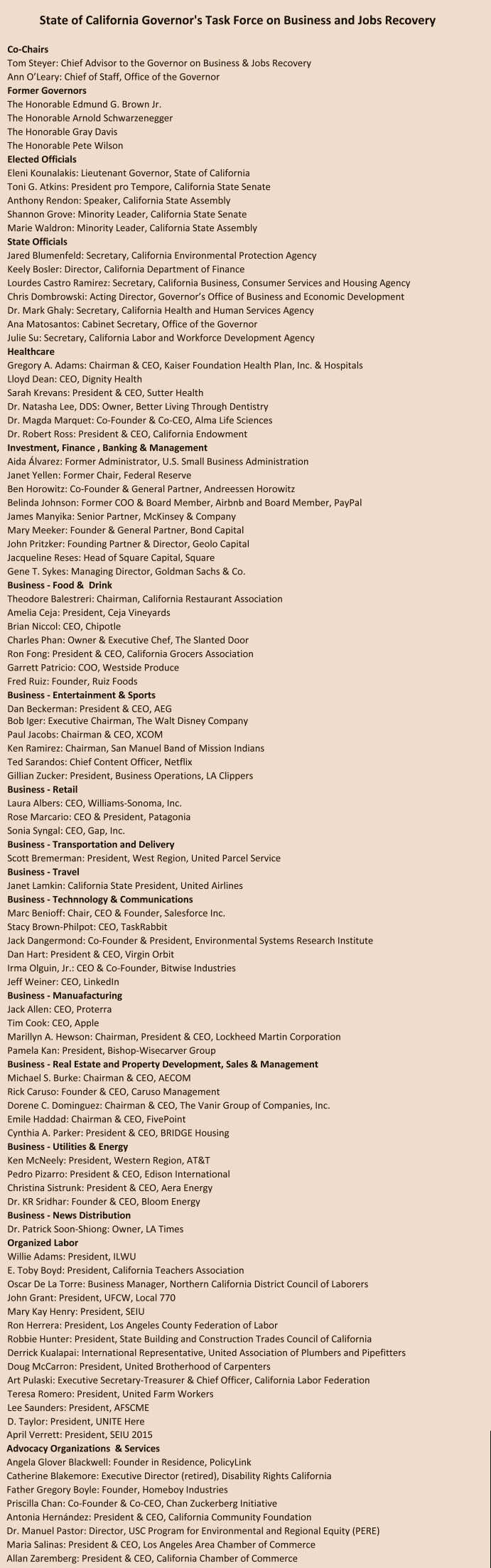
With that said, I trust Newsom's approach. And because I know most of them know how to do math, I also trust the group of people he has appointed to his Task Force on Business and Jobs Recovery (see below) to help California thread the needle required to stitch our economy back together while minimizing deaths.
Simply it is unconscionable that the majority of voters in over half the states support state governments that have abandoned the children. Consider this map:
The U.S. Climate Alliance
was founded in 2017 jointly by Washington Governor Jay Inslee, New York
Governor Andrew Cuomo, and California Governor Jerry Brown. At the time
Brown noted: "If the President is going to be AWOL in this profoundly
important human endeavor, then California and other states will step
up,"
As of July, twenty-four (24) of our states plus Puerto Rico and
American Somoa have become members.
On the other hand the voters of 26
states - which in 2016 produced 58%
of the U.S. carbon dioxide emissions with only 45% of the population of the states - have chosen to adhere to the Trump
point-of-view that corrupt corporate capitalists are of more value than
their own children and grandchildren.
On behalf of his voters, California Governor Gavin Newsom, the leader of the World's 5th Largest Economy, is actively challenging the leader of the World's Largest Economy, Donald Trump. With his
millions of supporters Trump has simply abandoned all responsibility for
addressing Climate Change thus failing to protect the next generations of Americans.
Attending the United Nations Climate Action Summit in New York last week, Governor Newsom gave Californians a chance to again take pride in our state's record of combating Climate Change.
At the opening ceremony for Climate Week Newsom made California's position clear with regard to the Trump Administration's actions rolling back federal environmental policy: “I don’t know what the hell happened to this country that we have a President that we do today on this issue, because it’s a damn shame. It really is. I’m not a little embarrassed about it — I’m absolutely humiliated by what’s going on.”
The new governor took advantage of the international stage to reinforce California‘s position as a climate leader, giving credit to Republicans and Democrats who held the office before him. During each news conference, panel and speech, Newsom reiterated a sober warning that California’s road ahead won’t be easy.
“Most of the what and why has been accomplished,” he told The Times before walking onto the floor of the U.N. General Assembly. “This is all about application. This is all about implementation.”
Former Gov. Arnold Schwarzenegger, a Republican, laid the foundation for the state’s cap-and-trade program, which requires companies to buy permits to release greenhouse gases into the atmosphere.
Under [Former Gov. Jerry] Brown, the state set bold goals to slash emissions 40% below 1990 levels by 2030 and generate 100% of the state’s retail electricity from renewable sources by 2045. Recent polls from the nonpartisan Public Policy Institute of California show that more than two-thirds of adults in California support the policies.
Governor Gavin Newsom of California and philanthropist and former New York City Mayor Michael Bloomberg have announced a new initiative that will use satellite data to monitor climate change in California.
The duo, along with Planet, an Earth-imaging company based in San Francisco, made the announcement Wednesday at the third annual Bloomberg Global Business Forum in New York. The event was held on the heels of the United Nations Climate Action Summit in the same city earlier this week.
Officially called Satellites for Climate Action, according to a press release from Bloomberg Philanthropies, the project "will bring together governments, philanthropists, environmental groups, and technology companies to use satellite technologies to monitor greenhouse gas emissions and turn satellite data into actionable information."
Newsom was among six governors from the U.S. Climate Alliance conferring with presidents, prime ministers and foreign government officials responsible for climate issues. The Alliance was formed in 2017 after President Trump announced his plans to withdraw from the Paris climate change accord. It has grown to include the leaders of 24 states and Puerto Rico.
But California has taken on Trump's policies with vigor. After all California, among the 50 states, ranks as:
The Nation's Largest by Economy;
The Nation's Largest by Population;
The Nations 3rd Largest by Area.
Were it a sovereign nation among 207 nations, California would rank as:
The World's 5th Largest by Economy;
The World's 36th Largest by Population;
The World's 59th Largest by Area.
Californian's simply cannot accept the conservative view that the private sector will take care of the Climate Change problem, someday, somehow, to the benefit of some but not others. Trump's policies are not exactly coherent but they do support the conservative view. The table below compares that view to the view that has evolved beginning with Schwarzenegger which has created the California Green and Gold Deal.
CALIFORNIA GREEN AND GOLD DEAL
CORE CONSERVATIVE POLICY
Yes, the climate is changing.
Yes, a changing climate likely will have significant
disruptive, and sometimes catastrophic, impacts.
Yes, we have reasonably accurate predictions of what those
impacts will be in the years 2025, 2050, and 2100.
Individuals and businesses should recognize that over the next
decades a need to adapt to changing climate conditions which may
arise, even requiring geographical relocation.
States should recognize that over the next decades there will
be a need to
adapt to changing climate conditions requiring
responsive socioeconomic and geographic planning.
Individuals and businesses, facilitated by state and federal
government policies and funding, must create technological
advances which will allow for adaptation to and reductions in
impacts from Climate Change.
California and other states have created, and must
continue to create,
complex Climate Change related policies and the bureaucracies to
implement them in concert with the nations of the world, to avoid or
reduce impacts from Climate Change.
Individuals and their businesses should be able to rely upon
federal and state agencies to aid with Climate Change
related life
threatening incidents and adaptation as the need arises.
Yes, the climate is changing.
Yes, a changing climate likely will have impacts, perhaps
significant ones which will harm some people.
No, we do not have an accurate prediction of what those impacts
will be in the years 2025, 2050, 2100 or 2200.
Individuals and businesses should recognize that over the next
decades a need to adapt to changing climate conditions which may
arise, even requiring geographical relocation.
Individuals and groups should recognize that over the next
decades a need to adapt to changing climate conditions may arise
requiring a responsive, evolutionary reorganization of society.
Individuals, through businesses, will create technological
advances which will allow for adaptation to and reductions in
impacts from Climate Change.
The United States and state governments should not create
complex economic and social policies, and the bureaucracies to
implement them, in response to Climate Change.
Americans should rely upon the private sector
economics to adapt to Climate Change life
threatening incidents, unavoidable geographic relocation, and
economic disruption as they arise.
The California Green & Gold Deal includes a myriad of State programs and policies which can be viewed by clicking on the various links below.
Californians do understand that this is an imperfect effort that keeps evolving, beginning in 2006 with California’s Global Warming Solutions Act signed by Schwarzenegger and extended in 2017 (see Brown, Schwarzenegger Celebrate Extension of Cap and Trade). (It's worth noting that this week it was reported that Schwarzenegger offered to lend is electric car to 16-year-old climate activist Greta Thunberg.)
Still, it is troubling that Washington Governor Jay Inslee, a Climate Change activist and one of the founders of the U.S. Climate Alliance, could not gain traction as a Democratic Presidential candidate. Then again, I guess it shouldn't be surprising. Of the first four 2020 Primary or Caucus states, three are not Alliance members - Iowa, New Hampshire, and South Carolina. You will, of course, continue to read who is ahead in those states. And the National Democratic Party will continue to support the old candidates who are leading by discussing such things as health care costs and income inequality, along with AOC's really bad Green New Deal.
And because of those states we will fail to meet Greta Thunberg's standards: "People are suffering. People are dying. Entire ecosystems are collapsing. We are in the beginning of a mass extinction. And all you can talk about is money and fairytales of eternal economic growth. How dare you! For more than 30 years the science has been crystal clear. How dare you continue to look away, and come here saying that you are doing enough, when the politics and solutions needed are still nowhere in sight."
This past weekend an event occurred critical to the continued success of the California Democratic Party - the 2019 California Democratic Party Convention.
From the press coverage of the Party’s Convention in San Francisco, you would never know an important decision was made. Unfortunately, the personality-oriented press covered the campaigning of 14 (of 23) declared Democratic Presidential candidates at that convention.
Unfortunately, past accomplishments - implemented policies such as low- or no-tuition college in their home states (i.e. Bernie Sanders' high tuition Vermont) - are not the measurement being used by the voters or the press to find an attractive candidate. In the 21st Century it is having an exciting personality and catering to bias, not ability and past policy successes, that appeal to Americans.
Fortunately, picking among the Democratic Presidential candidates at that convention was not on the agenda. Instead most of the delegates were looking at political reality.
The first reality facing the delegates to 2019 California Democratic Party’s convention was there will be a Presidential and Congressional election in 2020 which creates a set of facts:
In the 2020 Democratic National Convention, California's delegates will be pledged to potential nominees based on an complex primary vote apportionment system - no one candidate will get all 495 of the California delegates; 272 will be elected from Congressional Districts, 90 will be elected at-large, plus 133 will be California's Party Leaders and Elected Officials (PLEO's) of whom 54 will be pledged and 79 unpledged. At the end of the Presidential election process, California's Electoral College votes will go to the Democratic candidate regardless of the nominee.
Neither of California's U.S. Senators is up for election.
If the National Democratic Party shifts to the left in its Presidential nominee, even with smartly focused hard work a few California House seats that shifted to the Democrats in 2018 will shift back to the Republicans - not many, but combined with what happens across the nation maybe enough to cause the Democrats to lose the majority in the House.
Or maybe the economy will collapse in which case all bets are off regarding the national election.
The truth of the matter is that the national election necessarily must be almost irrelevant to the California Democratic Party's for 2020. That is because the second reality surrounding the 2019 California Democratic Party’s convention was there will be a state election in 2020 which creates the following set of facts:
Governor Gavin Newsom in 2018 ran on a vision that included guaranteed health care for all, a ‘Marshall Plan’ for affordable housing, a master plan for aging with dignity, a middle-class workforce strategy, a cradle-to-college promise for the next generation, and an all-hands approach to ending child poverty; his 2019 budget proposal before the Legislature represents an effort to move forward in these areas best served by the current Democratic supermajority in the State Senate and the Assembly.
With regard to policy, Convention delegates adopted 14 policy proposal resolutions that can be divided into 5 categories:
federal policy matters over which the state has virtually no control including the U.S. Census citizenship question, the Federal cannabis ban, the Muslim immigration ban;
existing state policy matters which the state already has the desired policy in place including Reproductive Rights and a Green New Deal (click to read 6 posts on The California Green & Gold Deal );
changes in existing state matters including an overhaul of Proposition 13 as it applies to non-residential property, tweaks to rent control law, a charter school moratorium proposal, support for a bill which just passed the Assembly limiting police use-of- force, ending a University of California labor dispute, and a prohibition of affiliation between publicly funded universities or hospitals and any religious-affiliated hospitals which “openly discriminate against women and LGBTQ patients” and require doctors to follow religious codes that conflict with the party’s platform;
criticizing a private non-profit organization, Kaiser Permanente, for not having adequate numbers of mental-health care clinicians available; and
setting Party internal policy by providing for sexual harassment and implicit bias training and establishing a boycott of the Terranea luxury resort near Los Angeles.
At stake in the 2020 election is the Democratic super-majority in the Legislature which is essential to achieving goals. A Party organization is needed that can do the hard work to retain that super-majority - the only important purpose for having the convention and about which a decision of some import was made.
What was not covered by the national press was the election Saturday evening of Rusty Hicks as the California Democratic Party chair.
Hicks, who won 57% of the vote in Saturday’s election running against six other candidates, is president of the Los Angeles County Federation of Labor, AFL-CIO, (LA Fed). It is comprised of over 300 local unions that represent over 800,000 workers in virtually every key industry – transportation and goods movement, entertainment and media, janitorial and hospitality services, education, construction, government, retail health care and communications.
In November 2014, Hicks, then 38, was unanimously elected to the position of President of LA Fed and was unanimously re-elected to a new 4-year term on December 18, 2017.
Back in 2006, Hicks became the LA Fed’s Political Director. Under his leadership, LA Fed’s political program facilitated important electoral wins and the passage of significant public policies, including raising Los Angeles’ minimum wage and affordable homes and good, local jobs for Angelenos (Build Better LA). In 2012, he led the effort to qualify and pass Proposition 28 modifying legislative term limits that brought new stability to the State Legislature.
Raised by a single mother in Fort Worth, Texas, Hicks saw first-hand the challenges of attaining the American Dream. His mother was a bookkeeper, his grandfather a grocery clerk and his grandmother a teacher’s aide. Their hard work inspired Rusty to a life of service to ensure that the voices of working people are heard on the job, in their communities, and at the ballot box. This is why Hicks served as the California Political Director for the 2008 Obama for America campaign.
Hicks holds the rank of Lieutenant in the United States Navy Reserve where he serves as an Intelligence Officer. In 2013, Rusty completed a one-year deployment to Afghanistan where he supported the Combined Joint Special Operations Task Force-Afghanistan. His accolades include the Defense Meritorious Service Medal, the Navy Achievement Medal, and the Afghanistan Campaign Medal.
He is also a graduate of Loyola Law School and Austin College. He resides in Pasadena with his wife, Sandra Sanchez, and their dog Charlie.
Bay Area activist Kimberly Ellis, who has served since 2010 as Executive Director of Emerge California that seeks to identify and help more women and minorities in California be elected to public office, received 36% of the vote. With Ellis appealing to supporters of Vermont Sen. Bernie Sanders and, having worked only in political activism, concerns were expressed that the recently floundering Party organization needed to regain the discipline and energy to retain the Democratic legislative majorities (and hopefully the current supermajorities).
Hicks had the backing of six of the state’s eight statewide officeholders,
most of the major unions and a wide range of California legislators and
members of Congress, all of whom were aware that despite its superficial reputation as a Democratic stronghold, California's electorate geography looks like the Assembly District map to the left. In fact, by-county results of Governor Gavin Newsom's election in 2018 is shown below.
According to news reports Hicks said he has plotted out a plan for his first 100 days as party leader, including increasing efforts to train grass-roots activists and to reach out to conservative and moderate areas of California, including the Central Valley.
Blue-collar union workers in solidly Democratic California are rejecting "Green New Deal" politics, a possible preview of troubles for 2020 presidential hopefuls in Rust Belt states like Pennsylvania and Ohio.
Robbie Hunter, president of the state Building and Construction Trades Council — which represents more than 400,000 workers — says that dozens of his members plan a major “Blue Collar Revolution” demonstration Saturday morning at the California Democratic Party convention in San Francisco, which will be attended by 14 of the Democratic presidential contenders and 5,000 delegates and guests.
The effort aims to send a message that the party is in danger of eroding a critical base if it continues to back the Green New Deal resolution being pushed in Washington, D.C. by Rep. Alexandria Ocasio-Cortez (D-N.Y.) and her allies. Hunter argues the measure's goals could endanger thousands of jobs in the Southern California oil industry alone.
“All it does is do what the Democratic Party seems to be very good at lately — which is export our jobs, while doing nothing for the end game, which is the environmental,’’ Hunter said.
“The Green New Deal may be the darling of the Democratic Party — but it really divides the Democrats on a fault line, which is more of the elites against the working class Democrats who are concerned about losing their jobs," said Jessica Levinson, a member of the Los Angeles Ethics Commission and a professor who teaches politics and ethics at Loyola Law School.
Lifelong union members “don’t necessarily want to be retrained’’ for other, greener work spots — “nor is it even possible,’’ says Levinson. She predicts with the 2020 election looming, Democratic leaders will have to wrestle with the fact that “unlike the Mueller report and impeachment and indictment — people vote on whether or not they’re going to lose their job.”
With the election of a leader from organized labor, the focus to win of the California Democratic Party ought to inspire a shift in other state Democratic Parties and the National Democratic Party. Across the nation Democrats have one, and only one, problem which can be seen on this map:
California Governor Gavin Newsom this past week invited any women living in the states that just passed abortion restriction laws who need an abortion to come to California. That also should have communicated the obvious. If you live in a state colored red, your problems won't be with the Supreme Court, the President, or Congress. Your problems will be with the members of your state legislature - they need to be replaced.
You achieve that by having state parties run by people who focus on getting Democratic candidates elected not on economic and social policy details. When you don't have that focus, preferring to talk among yourselves and looking down on the laboring class, you get abortion restriction laws and bathroom use restriction laws - in other words you lose bigly.
People who got elected have designed California's Green and Gold Deal, an approach that seeks to address the economic issues related to Climate Change policy. So far it has worked and it needs to continue that way. Otherwise, candidates entranced by the green lights off to the left will make us all losers.
In February 1980 Salvadorean Archbishop Óscar Romero published an open letter to US President Jimmy Carter in which he pleaded with him to suspend the United States' ongoing program of military aid to the Salvadoran regime. He advised Carter that "Political power is in the hands of the armed forces. They know only how to repress the people and defend the interests of the Salvadoran oligarchy." Romero warned that US support would only "sharpen the injustice and repression against the organizations of the people which repeatedly have been struggling to gain respect for their fundamental human rights."
On 24 March 1980, the Archbishop was assassinated while celebrating Mass in the chapel of the Hospital of Divine Providence, the day after he called upon Salvadoran soldiers and security force members to not follow their orders to kill Salvadoran civilians.
At the Archbishop's funeral a week later, government-sponsored snipers in the National Palace and on the periphery of the Gerardo Barrios Plaza were responsible for the shooting of 42 mourners.
As explained in the previous post the Salvadoran Civil War brutality was funded and managed by the United States during the Carter and Reagan Administrations. Investigations by the UN-created Truth Commission for El Salvador concluded that the extreme right-wing politician, founder of ARENA and death squad leader General Roberto D'Aubuisson had given the order. Human rights organizations judged the U.S. funded and directed Salvadoran government of that time to have among the worst human rights records in the hemisphere.
After the January 1992 Chapultepec Peace Accords ending the Salvadoran Civil War, the Clinton Administration cut off all aid and deported back to El Salvador thousands of Salvadorans with criminal records, all resulting in powerful criminal gangs dominating a country with extremely limited economic resources in which farms and businesses had been destroyed.
The resulting situation in El Salvador is the cause of the recent increase in immigration. It is the direct result of American intervention in the 1980's and '90's.
Over the past six months, events related to all of this included:
On Sunday, October 14, 2018, Pope Francis canonized Saint Óscar Arnulfo Romero y Galdámez.
On Friday, April 5, 2019, President Donald Trump visited the California/Mexico border to view some recently replaced border fence and further "explained" the immigration emergency that forced him to cut off all humanitarian U.S. aid to the people Saint Oscar Romero in 1980 pleaded to President Carter to save from violence and oppression.
"In a book filled with messages from dignitaries who toured the site before him — former President Obama made a symbolic visit in 2011 — Newsom said he wrote that when he was a young Catholic, he never imagined he would visit the martyr’s resting place as a governor of California trying to 'modestly live out some of the values that Saint Romero practiced.'
"'I think right now you have a president that talks down to people in this country, talks past them, demoralizing folks living here and their relatives in the United States,' Newsom said of President Trump. 'I think it’s important to let folks know that’s not our country, that’s an individual in our country, who happens at this moment to be president.'”
Newsom also said: "I don’t like people [from Central America] being called invaders. I don’t like the language coming from the Trump administration, I don’t like the rhetoric coming out of the administration. I want to understand. The rhetoric is so toxic coming out of the White House and it impacts people here in a very real way. I think having a counter-narrative, which is one of respect of the human condition and talks about the morality and ethics of calling people invaders.”
Trump, some California Republicans, and some in the news have attacked Newsom for advancing Progressive Pacific beliefs. His passion for "a counter-narrative...of respect of the human condition and talks about... morality and ethics" in this situation is strongly reminiscent of Eleanor Roosevelt.
Perhaps no mid-20th Century Progressive worked harder to achieve the ideal of securing human rights than "The First Lady of the World" Eleanor Roosevelt.
After the end of WWII she led the international process that resulted in the adoption of The Universal Declaration of Human Rights in December 1948. At the time of her death on November 7, 1962, she was the first Chair of the Presidential Commission on the Status of Women.
Progressives in the Progressive Pacific States of Hawaii, Washington, Oregon, and California have picked up her sword-of-persuasion hoping to restore Progressive polices within all the states of these United States.
California Governor Newsom is offering leadership-by-example in that effort by filling the U.S. political leadership vacuum. Working with a Democratic Legislature, with a strong sense of humane morality and ethics, he is continuing to advance a Progressive policy implementation agenda in California
the State that has the world's 5th largest economy,
the U.S. state with the largest population - having 38.6% more people than the next largest state and more people than the 20 smallest states combined,
the state that is home to more Salvadoran immigrants than the total population of either Wyoming or Vermont.
Newsom says he intends to help steer U.S. immigration policy just as former Gov. Jerry Brown influenced climate change policy—because California’s size, robust economy, diversity and political clout allow the state to “punch above our weight.”
“The one area that California should do more is on immigration policy,” he said today, the second of his three days on an official visit to El Salvador. He added that in the last decade, the state ceded that role to governors from more conservative border states. “That’s why I’m down here. That’s what I want to bring back in terms of the leadership that we want to advance for our state.”
Newsom said he’s relying on the powerful California congressional delegation—which includes Democratic House Speaker Nancy Pelosi of San Francisco and GOP House Minority Leader Kevin McCarthy of Bakersfield—and local leaders to work from the bottom up to compel changes in the Trump administration’s hostile approach to immigration from places such as Central America.
“We have a unique responsibility and an opportunity to advance a different conversation,” he said after a session with humanitarian, LBGT and women’s rights advocates in the small town of Panchimalco, about an hour outside of San Salvador.
El Salvador. When an American such as Donald Trump talks about stopping aid to El Salvador and decrying Salvadorean immigration, he/she is likely to be unaware of the fact that as far back as 1931 U.S. government policy has ranged from tacitly-accepting-to-actively-supporting brutal dictatorships and the slaughtering of tens of thousands of Salvadoreans.
Whether it
was La Matanza (The Massacre) of 1932 in which tens of thousands of peasants died in the ensuing chaos on the orders of former General President Maximiliano Hernández Martínez who led a coup d'état in December 1931; or
was the Salvadoran Civil War (1979–1992) that killed more than 75,000 people financed by the U.S. through military aid ($1–2 million per day to the government of El Salvador during the Carter and Reagan administrations) and directly managed (in 1983, US officers took over positions in the top levels of the Salvadoran military making critical decisions and running the war on the "rebels") that killed more than 75,000 people and included the deliberate terrorizing and targeting of civilians by death squads, the recruitment of child soldiers and other human rights violations (the Salvadoran Army's US-trained Atlacatl Battalion was responsible for the El Mozote massacre where more than 800 civilians were murdered, over half of them children, the El Calabozo massacre, and the murder of Jesuit scholars on the campus of José Simeón Cañas Central American University; or
is the current situation resulting in large numbers of migrants Trump is using as political pawns in his reelection campaign, a situation which is the direct result of the Clinton Administration cutting off all aid and deporting back to El Salvador thousands of Salvadorans with criminal records after the January 1992 Chapultepec Peace Accords, all resulting in powerful criminal gangs dominating a country with extremely limited economic resources in which farms and businesses had been destroyed.
It is Trump's Deplorables attitude that represents a good reason to support the idea of Calexit. But then Californian's let you down.
Too frequently it's just potential political suicide for a U.S. politician to want to have adequate information to formulate intelligent policy to address a problem. It seems 21st Century Americans want their politicians to be as ignorant and uninformed as Donald Trump, which is as ignorant and uninformed as they are.
If you examine the chart on the right you'll learn that there are 5.6 millions folks in the U.S. including the U.S. territory of Puerto Rico, who identify their heritage as Puerto Rican - Hispanic but not even close to Central American.
You'll also might be surprised to learn that there are 5.6 million folks in the U.S. who identify their heritage as Central American and no part of Central America is in the U.S.
Of those Central Americans, 2.3 million identify their heritage as Salvadoran, 680,000 of whom live in California. The total population of El Salvador is 6.4 million, so the U.S. Salvadoran heritage population is equal to 36% of the population of El Salvador, and California's is 11%.
You can, of course, choose to be as ignorant as you want about the "immigrant crisis" but you do end up looking as dumb as Fox News. As you can see Trump's favorite network indicated that Guatemala, Honduras and El Salvador are "Mexican Countries" apparently unaware that each of them and Mexico are separate countries. Trump's Deplorables think that stupidity is fine.
On November 6, 2018, California voters selected Gavin Newsom to become their next Governor. A few weeks later, as Governor-elect, Newsom was in Mexico for the inauguration of newly-elected Mexican President Andres Manuel Lopez-Obrado (known as AMLO).
[AMLO} said, you should actually go to Central America and see what’s happening to get a bigger sense of the issues that all of us are facing,
At the suggestion of the incoming Mexican presidency, Newsom concluded that the beleaguered nation — ground zero for many of key immigration concerns — would be a good place to start.
...Nearly half of the Salvadorean immigrants in the U.S. live in California, and their story is essential to our state story.
California is proudly a state of refuge ... and he is offering assistance to those at the border.
It would be a failure of our leadership not to seek a bigger picture of what’s happening there.
Newsom leaves for San Salvador, the capital of El Salvador, on April 7, returning on April 10. He will meet with top officials of the country, U.N. experts, and immigration experts.
He will be accompanied by Deputy Press Secretary Jesse Melgar.
The twist: Melgar’s dad arrived in the U.S. in 1980 as a young undocumented immigrant and refugee from the civil war in El Salvador. He applied for citizenship under Ronald Reagan’s amnesty program, became a naturalized citizen — and “today, his son is working for the governor of California,’’ Melgar says.
In the article linked above Los Angeles Times political columnist George Skelton said the trip made Newsom look like “an ambitious rookie governor trying to play world leader.” John Cox, the Republican candidate for Governor who lost to Newsom, called Newsom "Governor Grandstand."
Of course, former Governor's Gray Davis, Arnold Schwarzenegger, and Jerry Brown also traveled to Mexico. Schwarzenegger visited troops at the U.S. Army Garrison-Yongsan, South Korea, and traveled to Japan, China, and Russia and Brown traveled to China and Europe, both pursuing California's trade and climate policies.
It's understandable folks in the Rust Belt might not be aware that in California there are Californios (descended from the Spanish-speaking community which has existed in California since 1542) plus the remainder of the Hispanic population - the state's largest population group - whose ancestors are from Mexico and the Central American countries of El
Salvador, Guatemala, Honduras, and Nicaragua ( Los Angeles has the
United States' largest Central American community, as well as the
largest Mexican American community since the 1910s and
1920s).
We also have a border with Mexico. Plus California and all those countries have Pacific Ocean beaches.
As AMLO recommended it is a good idea for our Governor to get a personal feel for the basis for the immigration surge so that our state, at least, can develop humane policies to deal with the problems it creates.
But, of course, critics think Newsom should spend those four days, so very early in his four-year term, doing something else.
As noted in our Progressive Pacific Message website:
The late George Wallace, Alabama Governor and 1968 Presidential candidate pictured at the left, gained notoriety for tapping into an anti-intellectual bias that many politicians have used (though the quote shown is somewhat inaccurate as he said: "Pointy-head college professors who can't even park a bicycle straight ....").
That anti-intellectual bias, particularly when coupled with racial prejudice and/or class distrust, makes it is difficult to explain to far too many Americans the complex history that created the 21st Century United States....
In understanding both economics and politics, and more particularly how through human behavior they interface and interact, we run headlong into the different views of those "intellectual" types Wallace called "pointy-head" who inhabit the halls of universities and think tanks.
Gavin Newsom proffered a robust vision of what is needed to address California's problems:
“Guaranteed health care for all. A ‘Marshall Plan’ for affordable housing. A master plan for aging with dignity. A middle-class workforce strategy. A cradle-to-college promise for the next generation. An all-hands approach to ending child poverty.”
And then, after a few more rounds of research presentations, came California governor Gavin Newsom. Newsom took the podium to give a 5 p.m. speech—a last minute addition to the agenda—after sitting in the audience listening to at least half of the afternoon’s presentations.
I’m not sure the attendees expected anything more from California’s new governor than a repackaged stump speech; they stayed out of curiosity, politeness, and, perhaps, because the reception wouldn’t begin until Newsom finished.
But Newsom, speaking with no notes, had them at hello. Or, if not exactly hello, close: Newsom kicked off his remarks by bluntly stating what most Silicon Valley denizens think about the state government.
“California,” Newsom said, “is at the cutting edge of technology of 1973,” pointing out that the state’s Division of Motor Vehicles can’t even figure out how to access credit cards.
“I heard a conversation here talking about the technical illiteracy of people in my profession,” he said. “It is true.”
At that point, the crowd went silent. The usual rustles—of people shifting in their chairs, reaching for water bottles, pulling out cellphones, or opening laptops to check email—stopped cold. Newsom had their attention and kept it. He didn’t seem like an alarmist—although he did say the word “anxiety” over and over. He didn’t seem like a tech hater—he came off as someone who personally loves technology but can understand why it is freaking some people out. His talk focused on technology’s dark side, yet came off as hopeful.
“There is a lot of anxiety out there,” Newsom said, “and fear out there, and it’s real.”
Newsom began rattling off statistics, speaking rapidly without notes. “I read [PricewaterhouseCoopers]: 38 percent of jobs will be automated in the next 15 years. Then I relax because Bain comes out and says just 25 percent of the jobs in the next 20 years. Then Oxford says, that’s an old study, that 47 percent is only in 702 job categories, not all job categories. Then I got James [Manikya], which says it’s just 60 percent of current jobs that will be just 30 percent augmented.”
With that kind of conflicting information flying around, Newsom asked rhetorically, “what do you want me to do as a policymaker?”
Turning from statistics to recent anecdotal evidence about the disruption caused by AI, Newsom said, “I remember how excited we all were when we read about a company named Otto that drove those 46,000 cans of Budweiser in Colorado in a driverless truck. Then I met with Teamsters—they didn’t think it was that exciting.”
“I remember reading about Knightscope,” he continued. “One of the folks that work there said about the technology, these are robotic units that replace security guards. He said, ‘no pensions, no workers comp, no complaining.’ Whoa.”
And, Newsom said, consider robotic hamburger-maker Momentum Machines (now called Creator). “It’s going after 3.5 or 3.6 million fast-food workers…and the CEO of that company said our job is not to make employees more efficient, it’s to ‘obviate the need for them.’ Oh.”
“I was excited, finally went to Amazon Go. They have one in San Francisco. Fascinating. But there are 3.4 million cashiers who don’t think it’s that fascinating. What the hell do we do with them?”
How to address the workforce disruption AI is bringing? Retraining is part of it, but it will take bigger investments than those proposed so far, and it’s not just about retraining. “It’s not enough to teach you to code at 60 years old,” he said.
The state of California is not yet prepared to deal with the kinds of changes AI will bring, Newsom said, but he indicated that he’s hopeful that some of the people assembled through this newest Stanford organization will be able to help figure it out.
“We can’t play small ball anymore, we can’t play on the margins. [This] requires an order-of-magnitude change. We need your guidance, your counsel, and your empathy as well. We need to be educated on the world we are living in, on how real this change is, what machine learning is, what deep learning is…this language is new to us.
“The world we invented,” Newsom said, “is competing against us; we have to invest in maintaining our lead.”
All these changes, these new technologies, he indicated, are what is producing anxiety, and a mounting techlash.
“The techlash is real, in ways I shudder to even communicate,” Newsom said. “When I have people who embrace technology talking about data frackers, that’s a pejorative; it’s not just about privacy, or about some version of GDPR, it’s about real animus that’s being created in this winner-take-all world.”
Afterwards, the normal postconference chatter converged onto a single path. “What did you think of the event?” I heard person after person say. “Well-organized, the tech talks were pretty good, a bit arm-wavy, but what can you expect at the beginning of something like this,” were the general answers. And then there would be a pause, followed by someone saying, “But what about Gavin?”
“Gavin. Yes. Wow,” was the typical response, or something along those lines.
“He pulled out statistics that he clearly really understood, hadn’t just memorized, faster than I could, and it’s my field!” said one attendee. “And he had no notes!”
“He listened to the panels, and then synthesized it all into a coherent speech on the fly. How does he do that?” said another.
“The guy is just really, really smart,” I heard over and over, often with a note of surprise.
“He was optimistic,” one attendee told me, “but he also warned us. And he was right to do that.”
Because of technology, you can watch his 30 minute speech:
There were several conferences at Stanford that day and Newsom spoke at more than one. And he offered insight into his thoughts on economic ideology:
Gov. Gavin Newsom is taking a different path from those progressive 2020 Democrats who are tacking left and steering clear of the “capitalist“ label. On Monday, where he spoke at back-to-back Stanford business conferences, Newsom urged his party, as well as the business and investment community, to embrace “inclusive capitalism” — one that boosts development, housing and infrastructure that, he argues, will benefit state residents at every income level.
“I’m an entrepreneur. I believe in innovation. ... I believe in putting private capital to work. I believe in the entrepreneurial spirit that defines the best of this nation,’’ Newsom said in an interview with POLITICO. And Newsom said there was no doubt he was a fan of capitalism. “I think in an aspirational framework. So I believe very, very much in that camp,’’ he said. “And of course, it defines much of my life as well, someone who has the privilege of creating a lot of jobs in this state.”
Asked about the recent progressive Democratic push that has some in his party shying away from defining themselves as “capitalist” in the 2020 presidential contest, Newsom — who, with partners, owns the PlumpJack wine and entertainment empire — said his party should not avoid the term. “I think, frankly, the Democratic party could do well to reenergize that debate ... having an entrepreneurial mind to solve problems, and engaging the private sector in solving those problems.”
“Frankly it surprises me that it’s even controversial,’’ he told POLITICO. “Inclusive capitalism,” he said, means “we’re all in this together. It’s not just growth for growth’s sake. It means bringing a number of people along ... that we were going to have an economic growth and inclusion agenda.”
But Newsom isn't adhering to the existing pointy-headed intellectual version of "Inclusive Capitalism" in which as explained in Wikipedia (emphasis added:)"...Companies and non-governmental organizations can sell goods and services to low-income people, which may lead to targeted poverty alleviation strategies, including improving people’s nutrition, health care, education, employment and environment, but not their political power."
[Maher] was referring to the countries ranked highest in the 2019 World Happiness Report including Finland, Denmark, and Norway, which are all "socialism-friendly." The United States was ranked 19th, despite low unemployment and crime rates.
Instead of socialism replacing capitalism, Maher said socialism's influence in addition to capitalism could ease crushing economic pressures like healthcare.
"The right has a hard time understanding the concept that we don't want 'long lines for bread' socialism," Maher said. "We want 'you don't have to win the lotto to afford brain surgery' socialism."
"Happiness isn't only about what you have, it's also what you don't have to worry about," he added. "Turns out, freedom from the fear of ending up in a tent below the overpass is a really great freedom. It's called peace of mind."
Sometimes people forget that as explained by Wikipedia: "Socialism is a range of economic and social systems characterised by social ownership of the means of production and workers' self-management, as well as the political theories and movements associated with them." That is contrary to the entrepreneurial spirit Newsom discussed. But government taking steps to make healthcare affordable, even "single payer", is not socialism. If all the hospitals and clinics were government owned and run, that would be socialism.
Inclusive Capitalism Plus means first to not get too distracted in the philosophical questions and debate presented in the Wikipedia entry on Inclusive Capitalism. The real problem within the capitalist world is identifying the long-term value associated with a business engaging in society and the environment where no short-term income or asset growth can be identified. In fact, one of the problems with the current view of success is that all the measurements used to evaluate a company are short-term and don't quantify damage done to society and the environment.
The Coalition for Inclusive Capitalism is engaged in an effort titled the Embankment Project for Inclusive Capitalism (EPIC) which has produced and initial report worth reviewing. But that doesn't deal with the "Plus" meaning governmental intervention which the State of California under Newsom will be working on.
In the 21st Century, the Plus is complicated. The Democrats under Jerry Brown in 2012 did the most obvious thing - have the voters raise the income tax on high earners. That was/is controversial.
The thing is both articles can reflect facts. But the Los Angeles Times article contains the facts about the tax that underlie the choices people make. If you were a millionaire earning certain kinds of income from out-of-state sources, selecting another state to be your primary residence might have been the logical choice. But if the bulk of your earnings come from California sources - like Silicon Valley tech companies - the state will tax that income and will go after you to get the taxes. In that case moving won't help.
On the other hand, tax policy can be used to achieve public policy purposes. Examples include the following California tax credits among available targeted credits:
California Competes Tax credit, which is allocated and certified by the California Competes Tax Credit Committee, is available for businesses that want to come to California or to stay and grow in California;
College Access Tax credit, which is allocated and certified by the California Educational Facilities Authority, is available for taxpayers who contribute to the College Access Tax Credit Fund;
Donated Agricultural Products Transportation tax credit, offers 50% of the costs paid or incurred for the transportation of agricultural products donated to nonprofit charitable organizations;
New Donated Fresh Fruits or Vegetables tax credit offers 15% of the qualified value of the donated fresh fruits or vegetables made to California food banks, based on weighted average wholesale price;
Enterprise Zone Hiring tax creidt which is a hiring credit for employeres in an enterprise zone; New Employment tax credit, a credit available for a taxpayer that hires a full-time employee and pays or incurs wages in a designated census tract or economic development area, and receives a tentative credit reservation for that full-time employee.
As quoted above, Newsom intends to have the State develop programs on the following broad subject areas, addressing issues as the Plus:
Guaranteed health care for all.
A ‘Marshall Plan’ for affordable
housing.
A master plan for aging with dignity.
A middle-class workforce
strategy.
A cradle-to-college promise for the next generation.
Let's back up to the Newsom speech at the AI symposium quoted above which included the following:
Newsom kicked off his remarks by bluntly stating what most Silicon Valley denizens think about the state government.
“California,” Newsom said, “is at the cutting edge of technology of 1973,” pointing out that the state’s Division of Motor Vehicles can’t even figure out how to access credit cards.
“I heard a conversation here talking about the technical illiteracy of people in my profession,” he said. “It is true.”
What he didn't say is that most of those in his profession in Congress have the technical literacy of typical voters who first put them in office. (Yes, that "typical voter" likely includes you. Being able to use a "device" and its "Apps" well is similar to driving a car well - in the latter case you're not an auto mechanic and in the former case you're not technology literate.) And so this headline appears No longer a political winner: Silicon Valley is a minefield for 2020 hopefuls. The writer notes:
Even as tech entrepreneurs say the hearings lawmakers are holding in Washington to berate companies like Facebook and Google have done little more than highlight how ill-prepared Capitol Hill is to regulate the sector, they are chastened by the problems that have been exposed. Their posture toward regulation is no longer resisting it at all cost. Many are eager to see the giant firms that have generated the most unwanted attention forced to improve their business practices.
“It displays a total lack of intellectual curiosity about the digital revolution,” said Khanna, a progressive who has championed an “internet bill of rights” and antitrust rules opposed by some of the big firms in his district. Candidates should be focused on spreading the innovation economy to struggling parts of the country, rather than attacking it, he said. The companies, unlike Wall Street firms, remain extremely popular with voters, he added.
“It’s a mistake in the candidate messaging,” Khanna said. “They are disconnected from what people in Middle America want. Those voters want to partner with tech leaders to create economic opportunity. I have been with them in these places. Often, the tech leaders are treated like rock stars.”
Fortunately we in California have Newsom to lead us into the next decade even as we benefit from policies put in place in the last two decades - green energy and internet regulation.
For instance, using an Inclusive Capitalism Plus approach has allowed California to lead on Climate Change policy issues such as significantly shifting the electrical consumption in the worlds 5th largest economy to renewable energy sources. Yes, some problems have resulted, not the least of which is too much green energy at certain times. But that's what happens as we experiment with innovative technology.
And California is providing leadership in the process of regulating the internet which in a Union controlled by the reactionary right of Trump's Deplorables has led to such headlines as New California Internet Neutrality Law Triggers US Lawsuit.
Another headline from 2018 was California just became the first state with an Internet of Things cybersecurity law which includes, among other things, those chatty little devices with microphones, speakers, and even video screens and cameras we have around the house for convenience. As noted in that article: "While the rule is only state-wide, any device-makers who sell products in California would pass the benefits on to customers elsewhere. Several Internet of Things-related bills have been introduced in Congress, but none have made it to a vote."
Probably because California is both a Progressive Pacific State and home to Silicon Valley it can offer a long list of regulations designed to address 21st Century problems including, but not limited to:
Anti-Phishing Act of 2005 This law prohibits “phishing,” the act of posing as a legitimate company or government agency in an email, Web page, or other Internet communication in order to trick a recipient into revealing his or her personal information.
Computer Spyware This law prohibits an unauthorized person from knowingly installing or providing software that performs certain functions, such as taking control of the computer or collecting personally identifiable information, on or to another user’s computer located in California.
Cyberbullying This law defines bullying as one or more acts of sexual harassment, hate violence, or intentional harassment, threats, or intimidation, directed against school district personnel or pupils, committed by a pupil or group of pupils. Bullying, including bullying committed by means of an electronic act, as defined, including a post on a social network Internet Web site, is a ground on which suspension or expulsion may be based.
Library Patron Privacy Protects a library patron’s use records, such as written records or electronic transaction that identifies a patron’s borrowing information or use of library information resources, including, but not limited to, database search records, borrowing records, class records, and any other personally identifiable uses of library resources information requests, or inquiries.
California Online Privacy Protection Act This law requires operators of commercial web sites or online services that collect personal information on California residents through a web site to conspicuously post a privacy policy on the site and to comply with its policy. The privacy policy must, among other things, identify the categories of personally identifiable information collected about site visitors and the categories of third parties with whom the operator may share the information. An operator is in violation for failure to post a policy within 30 days of being notified of noncompliance, or if the operator either knowingly and willfully or negligently and materially fails to comply with the provisions of its policy.
Personal Information Collected on Internet This law applies to state government agencies. When collecting personal information electronically, agencies must provide certain notices. Before sharing an individual’s information with third parties, agencies must obtain the individual’s written consent.
Privacy of Personal Information Held by ISPs Although not specifically targeted to on-line businesses, this law requires all nonfinancial businesses to disclose to customers, in writing or by electronic mail, the types of personal information the business shares with or sells to a third party for direct marketing purposes or for compensation. Businesses may post a privacy statement that gives customers the opportunity to choose not to share information at no cost.
Reader Privacy Act Protects information about the books Californians browse, read or purchase from electronic services and online booksellers, who may have access to detailed information about readers, such as specific pages browsed. Requires a search warrant, court order, or the user’s affirmative consent before such a business can disclose the personal information of its users related to their use of a book, with specified exceptions, including an imminent danger of death or serious injury.
Reproductive Health Care, Online Privacy This law protects the personal safety of reproductive health care providers, employees, volunteers, and patients by prohibiting the posting of any such person’s home address, phone number, or image on the Internet, under specified circumstances.
Safe at Home Participants, Online Privacy This law provides participants in the Secretary of State’s confidential address program, Safe at Home (for victims of domestic violence or stalking and reproductive health care providers, employees, and volunteers) with the right to demand the removal if their personal information, including home address and phone number, from online search engines or databases, and imposes related obligations on the operators of such search engines and databases.
A few other states have adopted laws regulating technology. But few former slave states have done anything and the Red State members of Congress have pretty much prevented any meaningful regulation of the tech industry. The concept of "Inclusive Capitalism" confuses these folks and the "Plus" is an anathema.
The point here is that Californi since the beginning of the 21st Centurya has had a policy orientation similar to that more recently offered by the European Union: "As the EU relies on science, technology and innovation to secure its present and develop its future, reflecting on and anticipating societal impacts arising from current narratives embodied in EU policy is essential to ensure trust among citizens."
Unfortunately, California will have to battle the Union Army of the Red States as explained in the New York Times (emphasis added):
In Silicon Valley, Google, Facebook and other tech companies have been working for months to comply with the new [European Union] rules, known as the General Data Protection Regulation. The law, which lets people request their online data and restricts how businesses obtain and handle the information, has set off a panic among small businesses and local organizations that have an internet presence.
Brazil, Japan and South Korea are set to follow Europe’s lead, with some having already passed similar data protection laws. European officials are encouraging copycats by tying data protection to some trade deals and arguing that a unified global approach is the only way to crimp Silicon Valley’s power.
Europe is determined to cement its role as the world’s foremost tech watchdog — and the region is only getting started. Authorities in Brussels and in the European Union’s 28 member countries are also setting the bar for stricter enforcement of antitrust laws against tech behemoths and are paving the way for tougher tax policies on the companies.
The region’s proactive stance is a sharp divergence from the United States, which has taken little action over the years in regulating the tech industry. Most recently, the Trump administration has sought to cut taxes and roll back regulation, while pursuing an increasingly protectionist tack to shield tech companies from competition from China.
California has passed a digital privacy law granting consumers more control over and insight into the spread of their personal information online, creating one of the most significant regulations overseeing the data-collection practices of technology companies in the United States.
The new law grants consumers the right to know what information companies are collecting about them, why they are collecting that data and with whom they are sharing it. It gives consumers the right to tell companies to delete their information as well as to not sell or share their data. Businesses must still give consumers who opt out the same quality of service.
The legislation, which goes into effect in January 2020, makes it easier for consumers to sue companies after a data breach. And it gives the state’s attorney general more authority to fine companies that don’t adhere to the new regulations.
The California law is not as expansive as Europe’s General Data Protection Regulation, or G.D.P.R., a new set of laws restricting how tech companies collect, store and use personal data.
But Aleecia M. McDonald, an incoming assistant professor at Carnegie Mellon University who specializes in privacy policy, said California’s privacy measure was one of the most comprehensive in the United States, since most existing laws — and there are not many — do little to limit what companies can do with consumer information.