Thursday, January 13, 2011

You've got to be kidding - Brown's budget gimmick free????

A "gimmick" in the context of something like a budget plan means "a concealed, usually devious aspect or feature of something, as a plan or deal" according to Dictionary.com.

Coming into this year, newly elected Governor Jerry Brown seemed to be indicating that he would be offering a budget proposal that cut State General Fund spending to balance expected revenue but then would ask the voters to approve tax revenue increases to restore education and some other programs.

In a shocking interpretation of his presentation on Monday,  a number of stories in the press and blogs on line have appeared declaring Governor Brown's 2011-12 budget proposal "gimmick free." I don't know how he sells this spin!

The State Legislative Analysts Office in their analysis of the budget proposal lists in Figure 1 a total of 27 items used by Brown to reduce the deficit. Of those 27, in my opinion seven are not "gimmicks" and four may not be. The remaining 16 are clearly "gimmicks."

The core of his budget General Fund deficit-elimination proposal is to get the voters to approve a five year extension of the temporary tax increases put into effect in 2009. He then proposes to permanently shift some program expenses to local government along with some of that temporary revenue. When those extensions expire in five years, two things will be true. First, Brown won't be Governor. Second, the loss of revenue will not be the State's problem, but rather the problem of local government. If that whole thing is not a "gimmick" I don't know what is. I'm not even going to discuss the details of that in this post.

In terms of actual proposed budget cuts, his proposal offers a total of $7.0 billion in cuts. Using the Legislative Analyst list to find real cuts, they are as follows:


Looks like a worthwhile list to review. What does the Legislative Analyst have to say about them generally?
As we discuss in detail later in this report, our initial review of the Governor’s budget suggests that in some key program areas, the administration’s estimated savings are optimistic. These areas include some proposals in corrections, state employee health plans, and In–Home Supportive Services (IHSS). In addition, the budget plan includes $200 million of unallocated reductions to state operations for efficiency purposes. In some cases, the administration has not provided significant detail yet on how the savings from these proposals would be achieved. Historically, such lack of detail often has been associated with budget actions that fail to produce the desired level of savings.
More specifically, the first two items on the list are good goals. But as the Analyst says: "Historically, such lack of detail often has been associated with budget actions that fail to produce the desired level of savings."
Realities work against it. Costs beyond State control, such as fuel, are rising.

"Reduce UC and CSU budgets" simply means reduce General Fund contributions to those institutions by $1 billion. Simple enough. But Brown proposes that these reductions be reflected in operational costs without offering specifics. He doesn't want to see increases in tuition. In fact, he wants to keep student aid at current levels and he does this with a gimmick. As explained by the Legislative Analyst:
The Governor’s proposal would shift $947 million in Cal Grant costs from the General Fund to federal Temporary Assistance for Needy Families (TANF) funds. This fund swap would have no net effect on total funding for Cal Grants. As discussed later in the report, the TANF funds would be provided through an interagency agreement with the Department of Social Services, whose TANF funding would be freed up by the Governor’s proposed cuts in CalWORKs.
In other words, he's simply redirecting existing funds for one group of needy to another group of needy. That's ok, maybe, but it doesn't really cut total budget expenditures, though it moves some out of the General Fund. It's a gimmick to reduce the backlash at universities.

He's proposing to reduce state employee salary and insurance costs by $400 million through various cuts in pay and benefits. As the Legislative Analyst notes, that is not very likely.

He's proposing unallocated cuts in the General Fund contribution to the court system by $200 million. The Legislative Analyst notes this has been offset by such things as fee increases in the last few years. If that happens, it is not a reduction in expenses, it's an increase in fees. The Analyst suggests the courts could use electronic court reporting plus competitive bidding to reduce costs for court security. Yeah, let's just assume this is a fee increase.

The next five items on the list are reductions in health and human services. This is a complex set of recommendations that involve federal rules, shifting of funds allocated by ballot measures, etc.

The last item is a joke. It says "reduce Receiver’s inmate medical care budget." That refers to the fact that a federal judge took over the matter a few years ago because the State didn't conform to reasonable care. Every year Governor Schwarzenegger made that reduction and every year the federal judge did what he thought was right. It's a gimmick.

Now I have to point out that the Legislative Analyst included six items in the heading "Expenditure-Related Solutions" that aren't expenditure reductions. One has to admire Brown for convincing the press that these are somehow reductions. For example, one is "shift redevelopment funds to Medi-Cal and trial courts." The redevelopment funds are local government monies. Shifting them to cover state costs isn't a cut in expenses, it's a gimmick. It's incredibly complicated and unlikely to be achieved by 2011-12.

The press is already confusing the question of whether it might be a desirable goal with whether it is a goal that can be accomplished. Here's the Analyst's explanation:
For more than 50 years, state law has authorized cities and counties to create redevelopment agencies. The administration proposes to revise these laws to (1) dissolve the state’s 425 redevelopment agencies and (2) transfer their revenues (primarily, over $5 billion of annual property tax revenues) to local successor agencies. The successor agencies would use these funds to retire redevelopment debts and contractual obligations and make other payments described below. The successor agencies also would shift any unspent redevelopment housing funds to local housing authorities to use for low– and moderate–income housing.

In 2011–12, the successor agencies would use the redevelopment revenues to:

  • Pay redevelopment debts and obligations, estimated by the administration to cost $2.2 billion.
  • Offset $1.7 billion of state Medi–Cal ($840 million) and trial court ($860 million) costs.
  • Allocate $1.1 billion to schools and other local agencies pursuant to current laws that require redevelopment agencies to “pass through” some of their funds to affected local agencies.
  • Distribute $210 million to cities, counties, and special districts in proportion to these agencies’ current shares of the property tax.
Beginning in 2012–13, any property tax revenues remaining after the successor agencies pay redevelopment debt would be distributed to other local governments in the county. Distributions of these revenues generally would follow provisions in existing law, except that:
  • The additional K–14 district property taxes would augment their existing state funding (not offset state education spending) and would be distributed to districts throughout the county based on enrollment.
  • The property taxes that otherwise would be distributed to enterprise special districts would be allocated instead to counties. (These districts primarily are fee–financed water and waste disposal districts.)
The administration’s plan will require considerable work by the Legislature to sort through many legal, financial, and policy issues. Several voter–approved constitutional measures, for example, constrain the state’s authority to redirect redevelopment funds, use property tax revenues to pay for state programs, or impose increased costs on local agencies. In addition, the administration’s plan does not address many related issues, such as clarifying the future financial responsibility for low– and moderate–income housing (currently, a redevelopment program).

Although the administration’s approach to estimating the annual cost of redevelopment debt is reasonable, their assumptions regarding debt terms, interest rates, and other factors err on the side of understating debt costs. Our initial review indicates that the annual cost to pay these debts could be $1 billion or more higher than the administration assumes. If our initial review is correct, this would reduce the funds available for other purposes. For example, the Legislature may not be able to use $1.7 billion of these revenues for state programs and make $1.1 billion in pass–through payments to local governments.

The rationale for providing school districts with property tax revenues in addition to their existing property taxes is not clear. The administration’s proposal does not devolve more responsibilities to school districts. The distribution of these additional school property tax revenues would be uneven throughout the state, with schools in 15 counties (where there is little or no redevelopment) not getting additional property taxes and schools in counties (where there is extensive redevelopment activity) receiving significant sums. The distribution of these new property tax revenues further complicates an already complicated school finance system.
In other words, the proposal for the 2011-12 fiscal year is a gimmick. What Brown found out was that he couldn't stomach proposing a balanced 2011-12 budget. Or he's setting things up for failure so he can devastate the education system. Here's a comparison between what was spent in 2007-08, what Brown proposed. and what balanced General Fund disbursements would look like at the end of 2011-12 without a revenue increase:

The trade-off: drop 1 American from the middle class, add 4 elsewhere

Keeping an eye on the post-Great-Recession economy is always interesting. The Atlantic Magazine has a long article this month offering a great deal of information about how those in power (not government folks - they don't have any real power over the economy) view how things are going to change for us:
The good news—and the bad news—for America is that the nation’s own super-elite is rapidly adjusting to this more global perspective. The U.S.-based CEO of one of the world’s largest hedge funds told me that his firm’s investment committee often discusses the question of who wins and who loses in today’s economy. In a recent internal debate, he said, one of his senior colleagues had argued that the hollowing-out of the American middle class didn’t really matter. “His point was that if the transformation of the world economy lifts four people in China and India out of poverty and into the middle class, and meanwhile means one American drops out of the middle class, that’s not such a bad trade,” the CEO recalled.
I recommend this article, but it is quite imposing in its length as will be this post.

Anyway, how this change is slowly but incrementally progressing can be illustrated by an example I read about today.

I was perusing my news email and noticed this article:
It makes sense that an expert in electrical technology is getting into what could be a huge burgeoning market: the power infrastructure for cloud and mobile computing applications. General Electric plans to pay approximately $520 million for Lineage Power, of Plano, Texas, which provides DC power conversion technology.

As rationale for the deal, GE cites the potential $20 billion market for power conversion infrastructure, which is being accelerated by cloud computing services, mobile Internet access, and the spike in video and data applications.
Being a GE shareholder, I had to followup on this story. It is, of course, a "cleaned up for American general consumption" version of the news release. What we have here is the typical American-based mega-international-corporation spending a tiny portion of its huge cash reserves, cash partly protected by a recent government bailout, to make more cash with limited potential benefits the American middle-class workforce (if any at all), as the news release explains (emphasis added):
Lineage Power had revenues of approximately $450 million in 2010. The transaction is valued at approximately $520 million or eight times enterprise value on 2011 EBITDA basis. The deal is expected to close in the first quarter of 2011, subject to customary closing conditions, including receipt of regulatory approval. Lineage Power is headquartered in Plano, Texas, and has nearly 2,300 employees, with manufacturing operations in China, Mexico and India.
So we know that company has no employees building anything in the United States. Not that the company doesn't have employees in the U.S. They do have R&D, customer support, and administrative employees in Texas. In fact, at the beginning of The Great Recession the Dallas Business Journal reported:
Lineage Power has laid off 166 employees, according to a filing with the state's Texas Workforce Commission.

...The Mesquite facility is the headquarters for the company, which has 2,400 employees worldwide. It's also Lineage's primary research and development center. The layoff leaves it with 325 employees in Mesquite.

...The employees -- which included electrical and mechanical engineers, program and project management and materials handling people -- were laid off Jan. 15. The Workforce Commission's rapid-response team is assisting workers in finding other jobs, Stalnaker said.
When you go to the Lineage Power web site you learn that GE actually just acquired additional federal grant monies:
Lineage Power is excited to have been named the recipient of a U.S. Department of Energy (DOE) $2.4 million research and development grant to develop technologies that minimize the power loss and heat generation that occurs as electricity moves through the ever-growing wired, wireless, and broadband service provider infrastructures.
In an overall "FAQ Sheet" on the acquisition, GE offered the following corporate-speak assurances to Lineage employees:
12. Q: What changes should be expected by employees?

A: Prior to closing, the approximately 2,300 employees of Lineage Power should expect no changes as we will continue to operate in a business as usual manner between announcement and close of the transaction. Lineage Power employees are expected to remain focused on delivering the industry’s best customer experience, built on a foundation of great products, reliable service, and world-class operations. There is nothing more important than our customers.

GE and Lineage Power share a culture of energy technology innovation. GE values the employees that will be joining our team as part of this acquisition. Employee expertise and industry experience are important factors in GE’s decision to acquire Lineage Power. There are no plans at this time to alter the current direction of business operations and it is much too early to speculate on any functional changes.

GE does not anticipate closing any Lineage Power facilities. The global GE brand, supply chain scale and distribution network combined with growing market demand for power conversion products is anticipated to increase opportunities in the coming years. At closing, employees will learn more about GE benefits offerings.

Lineage Power employees have built an innovative and customer-centric company with a foundation of technology leadership and strong, long-term relationships with customers. GE will be working closely with Lineage Power’s management team to design an integration strategy that will build upon both companies’ existing expertise. We will communicate as openly and as frequently as possible as new information becomes available after the close of the transaction.
GE, of course, has it's own approach to R&D as indicated on its web site:


It's easy to project how the Lineage folks will be affected in the long term by this acquisition.

GE Energy already has a large field services operation in Houston where right now they're recruiting for a Engineering Services Manager - North America who will probably help "integrate" Lineage Power field support folks who don't mind moving from the Dallas-Ft. Worth area to Houston. Of course, selling their homes might be a bit of a problem, as explained in the Dallas Morning News last Friday:
Home sales in the Dallas-Fort Worth area have continued to slide. And prices are still drifting lower, albeit only slightly.

...Through the first 11 months of 2010, sales of single-family homes through the Realtors' Multiple Listing Service were down 7 percent from the same period of 2009.
Adding to this bad news, Tuesday's paper offered in this article "the percentage of Dallas-area homeowners facing foreclosure has inched higher after months of decline" and in this article we learn:
CoreLogic Inc. said Tuesday that Dallas-area prices fell by 3.9 percent in November compared with November 2009.

Even if you take out distressed property sales including foreclosures, CoreLogic estimates Dallas-area home prices were 1.4 percent lower in November than a year earlier.

Prices were down 3.3 percent in the Fort Worth area.
If they desire to remain with GE and keep their homes in the immediate Plano area, Lineage Power R&D personnel might be able to find positions as openings occur in the GE Health technical operation there.

This is an example of how the American post-Great-Recession economy has transitioned into a highly profitable corporate economy offering no real "growth sharing" to the American middle class. It involves one of those legendary American small businesses that created jobs.

How does one respond to the statement "if the transformation of the world economy lifts four people in China and India out of poverty and into the middle class, and meanwhile means one American drops out of the middle class, that’s not such a bad trade."

One might respond by saying why not lift four people in China and India out of poverty and into the middle class and, instead of buying a new yacht this year, in some imaginative, productive way, prevent the one American from dropping out of the middle class.

Of course, to truly understand that statement we need to understand what "middle class" as a "lifestyle" means in India, China, and Mexico compared to what it means in the United States.

The World Bank's definition of middle class households are those with annual incomes ranging from $4500 to $22,000.

Here at the beginning of our post-Great-Recession experience, those are the new numbers that will define achieving middle class in the new 21st-Century international economy as understood by those holding economic power around the world.

Tuesday, January 11, 2011

The Golden State to become The Brown State: The 5-Year Plan

 California is nicknamed "The Golden State." Adopted by the Legislature in 1968, it reflects back to the California Gold Rush which lasted about eight years. After that? The state has had its many economic periods, most like the Gold Rush, short lived, beginning with a boom and ending with bust.

In the late 1970's California was going through one of those booms, a real estate boom. It had some political fallout - Proposition 13. Then Governor Jerry Brown was partially responsible for that fallout, as explained in a previous post. Now he is Governor again and, due to his lack of foresight and leadership then and now, he is proposing to make California unofficially "The Brown State" in five years.

"Golden" reflects the hope and dreams of California. "Brown" reflects what the state's dreams have turned to. Jerry Brown's dad was also a Governor. Edmond G. "Pat" Brown's two terms as Governor were at the end of the "hopes and dreams" period and can be summarized as follows:
Brown's two terms were marked by an enormous water-resources development program. The California Aqueduct built as part of the program now bears his name. He also presided over the enactment of the California Master Plan for Higher Education, fair employment legislation, a state economic development commission, and a consumers' council.
He was the last Governor of "The Greatest Generation" which after WWII invested heavily in the future of the State. Since that time all generations have chosen to "invest" in themselves.

But that's the past. At the beginning of his third term in office, this week Governor Jerry Brown "2.0" has offered his first shot at 21st Century political leadership in the form of a budget proposal. After a big publicity run-up on the problems of the budget and how he would present it honestly to the Legislature and the public, he submitted an expenditure budget that is $25 billion higher than I thought possible.

But who am I? Brown is, it turns out, a miracle worker. Somehow he has taken a State General Fund cash crisis and turned it around. I prepared the following comparison sheet to discover what he has proposed:

It's actually a miracle. Despite the much criticized "smoke and mirrors" of one-time fixes, plus temporary tax increases plus taking funds from local government all used to balance the 2009-10 budget, Brown has been able to propose a budget that will not be reduced from that year, in terms of total cash paid out! And he did this without expecting much of an economic turn-around!

Hmmmm.  Maybe we'd better take a look at the income side of the ledger:

Obviously, this is all confusing, as is much of the 266 page 2011-12 budget summary. But if you notice a 25% increase in corporation tax revenue over the current year (15% increase over the "boom times" 2007-08 fiscal year) you immediately start to wonder about this miracle budget.

Wading through the text of the budget summary document, the answers are there:
To maintain funding for schools, fund public safety services at the local level, and to balance the budget, this proposal maintains current tax rates for another five years. The Budget also proposes to uniformly apply the single sales factor income allocation rules to certain corporate taxpayers and to eliminate an ineffective tax expenditure program. These proposals will generate $12 billion.

While most of the budget solutions are ongoing, the Budget includes some one-time savings and borrowing. These include $1.8 billion in borrowing from special funds, $1.7 billion in property tax shifts, $1.0 billion from Proposition 10 reserve to fund children’s programs, and $0.9 billion from Proposition 63 moneys to fund community mental health services. $8.2 billion of the budget gap is one-time in nature. Closing a portion of the gap with some one.time solutions is appropriate because a portion of the budget gap's one-time in nature.
Nothing too complicated here. It looks just like the solutions Governor Arnold Schwarzenegger and his Finance Director used. Oh, dumb me. Brown's Finance Director is Ana Matosantos who was Schwarzenegger's Finance Director.

So Brown proposes to balance the 2011-12 General Fund Budget using
  • one-time solutions involving moving money around between funds, agencies, and from local government,
  • a 25% increase in the corporation tax, and
  • a five-year continuation of the temporary tax increases implemented back in 2009-10, increases in the personal income tax, in the sales tax, and in the motor vehicle license tax.
One has to ask: "Why a five-year continuation of the temporary tax increases?"

The answer comes very quickly - Jerry Brown isn't planning on serving a second term this time as he would be 77 years old.

But what a mess he plans on leaving.

Tax revenues needed (in his words) to "maintain funding for schools" and "fund public safety services at the local level" would disappear in five years.

Then there is the whole government "Realignment" proposal which supposedly will be the answer to California's government funding problem.

First there is the spin on his law enforcement proposals:
Public safety in the community is more than public safety officials on patrol, management of the local jail, or fire prevention and response. Public safety is a community effort which involves the safety of children who are in the county child welfare system, the safety of adults through the Adult Protective Services program, as well as such supportive services as mental health and substance abuse treatment services, which people need to successfully change their lives.
In simpler language, he is proposing that "low level offenders" be housed in local jails or monitored by local probation departments. Counties, which have been and are laying off employees, will get some money for this, from the temporary five-year tax increase.

This will move issues of increasing costs away from the State back to the counties, as the prison overcrowding issue becomes less urgent, and it won't reach a crisis level for five years when it will be a local government problem. (He is also proposing to keep the courts under the state jurisdiction but transferring responsibility for court security back to the counties, again with funding from the 5-year tax increase continuations.)

Next we have the spin on reducing the cost of CAL FIRE:
Under this proposal, responsibility for fire protection and medical emergency response in these populated wildland areas will be assumed by local government. As a result, this proposal will ensure that local jurisdictions making land use decisions which result in housing development encroaching in wildland areas are also responsible for providing the necessary emergency response services associated with more highly populated land use patterns.

...It is estimated that this proposal will result in the realignment of up to $250 million of CAL FIRE’s fire protection program to local governments.
This would have been a thoughtful, significant proposal thirty years ago, back in 1981 in Brown's first stint as Governor. But since then, thousands of homes have been built in the urban-forest interface. They aren't going away (unless they burn down).

The entire budget for the Department of Forestry and Fire Protection is/has been around $750 million. The Brown proposal is to shift a third of that budget to local fire departments with some funding for five years.

The problem with that theory is that local agencies are not in a position to contract for helicopters and other aircraft. What will happen is that many more fires will get away from under-equipped local firefighters in that urban-forest interface area, moving into the state responsibility areas, making it significantly harder for a later response of CAL FIRE units to suppress creating a corresponding cost increase to the state.

The whole program will take several years to implement. I assume Brown hopes it will be at least five years before anyone notices the wildfire damage problem.

A whole series of mental health and social service programs are proposed to be shifted to counties, supposedly with revenues. Describing each and every one would take many, many more paragraphs here. So I'll limit the discussion here to the mental health proposal which would shift three programs to counties explained as follows:
The Early and Periodic Screening, Diagnosis, and Treatment (EPSDT) Program, which is a mandatory federal program under Medicaid designed to improve the health, including the mental health, of low.income children under the age of 21. The EPSDT program is funded by the General Fund and federal funds with the counties paying a 10.percent share of cost above a specified baseline.

Mental health managed care provides psychiatric inpatient hospital services and outpatient treatment services through county mental health plans. This program is funded with General Fund and federal funds.

State.mandated mental health services for special education students (AB 3632) are those services included in an Individual Education Plan (IEP) that county mental health must provide to have a student succeed in school. This mandate has been suspended for 2010-11.

Beginning in 2011-12, these three programs would be funded with Mental Health Services Act (Proposition 63) funds rather than General Fund, resulting in savings of $861 million. This would be a one-time use of Proposition 63 funds; beginning in 2012-13, these programs, as well as community mental health services currently funded with 1991 realignment funds, will be funded through the proposed revenue source.
This sounds plausible, except any reasonable person should ask: "Aren't Proposition 63 funds being used for other programs now?"  And many of us with short memories also need to ask: "What was Proposition 63?"

In 2004 the voters approved Proposition 63, levying a 1% income tax on personal income in excess of $1 million. That money was to be used as described in the ballot measure to remedy some of the more serious gaps in our mental health system.

In fact, these funds have been used extensively by counties for programs as intended, using the funds to match extensive federal funds. Brown's proposal is exactly the type of diversion of funds voters thought they were objecting to when they voted for Proposition 22 in the same election Brown was elected.

What Brown is really doing is adding to the burden of Proposition 63 funds three programs now funded by the General Fund, and he's handing them off to counties. This avoids the onerous task of he and the Legislature deciding to reduce mental health services, something their base constituencies would find objectionable.

Foolishly I thought Brown was going to offer a severely reduced balanced budget to the Legislature with a possible solution such as proposing to increase the Proposition 13 tax rate of 1% of assessed value to 1½% of assessed value to avoid completely devastating our systems to educate and care for children. I thought he was going to create a serious discussion about the future of California government rather than attempt to put it off for five years.

In five years, the opportunities to keep California "golden" will be even more severely constrained. This is some legacy the son of Pat Brown is going to leave us.

Of course, with these proposals he simply just restarted the same old political arguments....

Sunday, January 9, 2011

The Banker's White House, African Women, and Sprinkle Out Economics


The money was all appropriated for the top in the hopes that it would trickle down to the needy. Mr. Hoover didn’t know that money trickled up. Give it to the people at the bottom and the people at the top will have it before night, anyhow. But it will at least have passed through the poor fellow’s hands. - Will Rogers
Nothing in anything I read about Barack Obama would have led me to believe that in his Presidency we would see as his Chief-of-Staff William Daley, a man who
  • was President and CEO of Amalgamated Bank of Chicago;
  • was special counsel to President Clinton on issues relating to the passage of the North American Free Trade Agreement (NAFTA);
  • was a President of what we now know as AT&T;
  • was Midwest Chairman of J.P. Morgan Chase and Bank One Corp. to oversee post-merger operations; and
  • currently serves on the Boards of Directors of Boeing and Merck & Co.
In an Administration already awash in bankers, this is appalling and seems more so when on Friday Obama announced as his Chief Economic Advisor former Goldman Sachs advisor Gene Sperling.

Sperling was one of the principal Clinton Administration negotiators securing the passage of the Financial Modernization Act of 1999 that repealed large portions of the depression-era Glass-Stegall Act deregulating banks, securities firms and insurance companies, ultimately leading to the economic collapse of 2007.

I'm sorry. I just can't remember when the policy orientation of Democratic Party leaders merged with the views of international bankers. At one time, it was a Party that at least on the surface vehemently opposed "trickle down" economics.

Apparently, sometime in the past 30 years Democratic Party leaders embraced "sprinkle out" economics, and apparently did so in concert with Republican Party leaders.

Elected officials from both parties have watched as American corporations "sprinkled out" to other countries jobs that previously at least had "trickled down" some of the benefits of economic growth to ordinary Americans. It has become so bad that practically everyone acknowledges that in the midst of The Great Recession "recovery" American corporations are hiring thousands of workers, but just not in the United States.

These same elected officials "sprinkled out" our national debt to Chinese and Middle Eastern interests, people from whom we can't expect to find sympathy for what ordinary Americans understand is "The American Way."

Let's take a hard look Sperling's record, as an example of what's wrong with the Obama White House.

In 2008 while our economy collapsed because of his work on behalf of the banking industry during the Clinton Administration, according to Bloomberg New's analysis of financial disclosure forms Goldman Sachs paid Sperling $887,727 for advice on one of its charitable projects, known as "10,000 Women," which provides business education to women in poor countries.

It sounds like laudable work except that well over 10,000 American women were in the process of losing their homes - their small piece of the "Ownership Society" - while he earned over a million dollars that year (the rest came from speaking to hedge fund executives).

The problem with guys like Sperling, Daley, President Obama, and former President Clinton when he was in office is that they explore "growing" wealth as an intellectual scientific subject as if it is about increasing spinach production, expressing lofty thoughts about economic theory while carefully avoiding the obvious - the accumulation of obscene amounts of wealth by a relative few corporations and individuals around the world.

They reach to find evidence of successful women in Africa who have increased their income from less than $2,000 a year to as much as $5,000 a year. They never explore the idea that while the world's poor are seeing some economic growth, middle class women in the U.S., Europe, and Japan are seeing a greater relative loss of real income.

The potential is that the income of those successful African women and of those middle class women are going to reach a common level - at $15,000 - $18,000 a year in today's dollars. This is an income level that will marginalize the economic (and political) power of most people.

The Obama Administration is dismissing concern from the Political Left in much the same manner as the Bush White House essentially abandoned the Christian Right. Ironically, both groups are concerned about the welfare of the rapidly growing number of Americans on the margins of our economy. The two groups just don't approach solutions from the same perspective.

But neither group believes that the solution to improving the lives of ordinary people around the world is to increase the sales of yachts. Yes, just as economists report the recession is over, various sources report yacht sales are up in Texas, the European Union, "Communist" China and other parts of the Third World. I guess Sperling's advice to Goldman Sachs was so good those 10,000 women are buying yachts.

Advocating policies that improve the world-wide sales of yachts is exactly the image of White House economic policy for the past 20 years and appears will remain the policy orientation.

Wednesday, December 8, 2010

How compromise "works" in Washington

In an August post Taxing the "rich" and "not-rich" I offered an alternative to just extending the "Bush Tax Cuts" or just extending those tax cuts for folks who earn less than $200,000. I further noted on the subject November 7th:
It appears now that both parties are ready to screw around with the so-called "Bush Tax Cuts." That's because finding someone with any imagination or talent in Congress or the White House appears to be an impossible task....

...We won't get any policy changes. Just more name calling.
So having said that, ordinarily I would ignore the latest policy fiasco by the Obama White House with regard to the tax cuts and achieving compromise. But never in my wildest imagination could I have foreseen the dimwitted compromise proposal that appears to have come out of a few meetings between the President and the Republicans in Congress.

It's an "ignore-the-deficit, free-lunch-for-everyone" policy proposal. In what is a curious piece of irony, many Congressional Democrats and Republicans are balking while the White House is attempting to sell the deal. No one knows exactly what all is in the deal. Yes, it's one of those that has the feel of another Health Care Bill. For instance, if you were in Davenport, Iowa, you would have picked up the Quad City Times and read:
A deal to extend the Bush-era tax cuts also includes action on ethanol and biodiesel credits, U.S. Sen. Chuck Grassley, R-Iowa, said Tuesday.

The details aren’t clear yet, but Grassley told reporters that the ethanol and biodiesel tax credits would get a temporary extension, through 2011.

The biodiesel credit of $1 a gallon expired last year, and farm-state lawmakers have blamed the expiration for the idling of biodiesel plants.

The ethanol credit, at 45 cents per gallon, is scheduled to expire at the end of the year.

Grassley said the biodiesel credit extension also included applying it retroactively to 2010.

Many of the details of the tax compromise aren’t known. U.S. Sen. Tom Harkin, D-Iowa, said Tuesday he didn’t know whether the tax credits were in the deal or not.
You may be puzzling a moment wondering how such a policy proposal might have gotten into this deal, but keep in mind that when Obama was a Senator from Illinois, another corn producing state, he pushed these credits.

The compromise, for sure, includes continuing the income tax rates currently in effect at all income levels and retaining the 15% maximum rate on capital gains and dividends.

It also includes an estate tax of 35 percent on estates worth more than $5 million. There currently is no estate tax, but it is scheduled to jump to 55 percent on estates exceeding $1 million at the end of the year. So this compromise is a nice reduction for the wealthy families and a fine exemption for those in the upper reaches of the middle class.

It also includes a provision that allows businesses to expense the full cost of capital investments each year for the next two years. Apparently this is without any of the restrictions currently found in the Small Business Jobs Act of 2010 enacted in September that has a phase out for taxpayers having more than $2 million in annual eligible investment, may be taken only up to $500,000 of eligible investment, and is limited to current year taxable income.

This is the huge conglomerate version of the Small Business Jobs Act. Well, to be fair, it is unclear whether it is identical to the Administration proposal in October that would create or increase the size of a taxpayer’s net operating loss, which generally can be carried back for up to two years, and carried forward for up to twenty years. But where else are they going to get the outline for this provision?

It also includes a one year reduction in the Social Security withholding on employee's pay checks. The "FICA" withheld would drop from 6.2% on wages up to $106,800 to 4.2% resulting in a 16.1% reduction in FICA revenue. (You remember Social Security? It's that entitlement program that the recent special commission on the deficit said needed to cut benefits because it wouldn't have enough money.)

And, of course the proposal will extend unemployment benefits another 13 months for those who have been unemployed for an extended period of time.

One thing about it. The new increased debt created by this proposal will get new money into the economy. I can't see any way of avoiding having the Federal Reserve buy the Treasury Bonds that finance this just like they are currently doing to finance our increasing debt. It's a cool way of printing money.

As long as we're just printing money anyway, how about approving that $250 giveaway proposed for Social Security recipients who aren't getting a cost of living increase? But then, I guess they could just plant corn.

When you look at all this you have to say to yourself that voting in Congressional Republicans, who express serious concern about the deficit and oppose spending programs, offers real government largesse - something for almost everyone and a lot for the very wealthy. It feels like the Bush Years. Way to go guys!

And President Obama is a winner too because he finally can now prove that political compromise really works to benefit all. (That's sarcasm, in case I'm too subtle.)

Thursday, December 2, 2010

Jerry Brown brings out the dreamers, idealists, and fools

Outgoing Republican Governor Arnold Schwarzenegger called the California Legislature into Special Session this month to deal with the fact that the current 2010-11 General Fund Budget appears to be out of balance by at least $6 billion.

It appears that the majority Democrats will simply refer his proposals to committee and go home until January as is normally the case.

In January, incoming Democratic Governor Jerry Brown will offer his budget proposals which apparently Democrats think will be more acceptable than what Schwarzenegger's spokesman called "ugly cuts." His fellow Democrats must think that Brown will offer miracle solutions in response to the need to reduce General Fund expenditures by 42±% of 2007-08 cash expenditures.

When Jerry Brown was in the Governor's Office the last time, he talked about communications satellites which many now remember upon as forward thinking despite earning him the nickname "Governor Moonbeam." This was the 1970's and space was indeed the "new frontier" for the dreamers among us. And it is the dreamers among us who keep America moving forward.

Now, after his reelection to the Governor's Office, the press has started offering dream scenarios of Brown moving to create a new State Government, the idealists are setting expectations where Brown is going to resolve the State's budget problems without devastating education and welfare, and the fools in the Legislature seem to think some bright idea will make the deficit disappear.

Unfortunately, when you're Governor of California fantastical dreaming doesn't help you and your state, even if it has been the home of Disneyland for nearly 60 years.

In the 1970's Brown thought Californians should get out of their autos and stopped building much needed freeways. Besides contributing to the accidental deaths of thousands of Californians, this foolish and unrealistic dream ignoring the habits and desires of Californians and put the State's primary transportation system in a deep financial hole from which it has never recovered.

Now we read about his reputation for being cheap which will save everything. He has hunkered down dealing with the nitty-gritty details of the budget.  Let's take a side-trip to the real past here in order to show how the big picture tends to escape Jerry's view.

During his last stint as Governor in the 1970's, there were two 800 pound gorillas the Governor needed to confront.

The first of these gorilla's was the rapidly inflating real estate prices/values which resulted in rapidly growing property tax revenue which impacted heavily on the middle class. Brown reduced some spending at the state level, but didn't lift a finger to alter the growing spotlight on skyrocketing revenue - he proudly just stored the surplus revenue, creating what became known as the "obscene State surplus" during the Proposition 13 debate.

The second gorilla was a August 30, 1971, California Supreme Court decision - Serrano v. Priest - in which (with only one dissent) the court stated:
We are called upon to determine whether the California public school financing system, with its substantial dependence on local property taxes and resultant wide disparities in school revenue, violates the equal protection clause of the Fourteenth Amendment. We have determined that this funding scheme invidiously discriminates against the poor because it makes the quality of a child's education a function of the wealth of his parents and neighbors. Recognizing as we must that the right to an education in our public schools is a fundamental interest which cannot be conditioned on wealth, we can discern no compelling state purpose necessitating the present method of financing. We have concluded, therefore, that such a system cannot withstand constitutional challenge and must fall before the equal protection clause.
While he was earning the Governor Moonbeam nickname, these two gorillas remained at large here on Earth in California. By the time of Proposition 13 several years into Brown's tenure, neither Brown nor the Democratically controlled Legislature had adequately addressed Serrano, which offered an equity goal which at least partly could have been accomplished using most of the "obscene State surplus" to reduce property taxes while establishing some level of balance between rich and poor school districts.

Instead of providing leadership for the real world, Brown talked about satellite communications and Californians not relying on the automobile. While the former idea would become ripe for State use fifteen years later, the latter idea was reflective of just how out of touch with 95% of Californians Brown really was. It was Brown's failure as a leader to honestly address these issues before and after Proposition 13 was adopted that got us into the budget crisis he now is struggling with.

Californians are now are hopeful about Brown. He's rolling up his sleeves, working hard on understanding the budget crisis and his options, choosing not to go to the White House with other Governors. This image does not correspond to reality, again.

Brown was Governor from 1975-1983, so he understands budgeting. Brown has been the second most significant elected State Officer, just behind Governor, as State Attorney General during the entire period of The Great Recession. What is it Brown needs to study to gain an understanding of the State Budget situation and why didn't he fully understand it as a former Governor and current Attorney General?

As with all government, the State uses "fund accounting" which means that each fund, other than a general fund, derives revenues for specific purposes. Brown understood this 30 years ago.

Only two funds have an immediate, significant problem with no potential solutions in sight - the General Fund and the Unemployment Insurance Fund. (Despite the political pandering of the past few years encouraged by an uninformed press, California's two public employee retirement funds don't face potential default until 2030 and we're already correcting for that potential.) Unless he's deaf and blind because he's old, as Attorney General he had to be in touch with this reality.

On December 24, 2009, it was reported by the folks at Bloomberg that "California Governor Arnold Schwarzenegger, anticipating a $21 billion state budget deficit, plans to ask President Barack Obama to ease mandates and minimums on social programs to save as much as $8 billion."  Surely Attorney General Brown knew this. Even though when the Legislative Analyst's Office issued it's updated report this month quoting $24 billion as the deficit size and all major California newspapers reported it as a shocking surprise, it couldn't have been a surprise to Brown.

Cash disbursements from the State General Fund reached a high in fiscal year 2007-08 of $107.3 billion. By 2009-10 disbursements were cut to $86.7 billion. That was a $20 billion or 19% reduction. At the end of the  2011-12 fiscal year, another $25± billion reduction in General Fund spending will be needed.

Despite what the typical California voter thinks, the breakdown of cash expenditures for State Programs and Local Government Assistance from the General Fund was as follows in 2007-08:

Total Education $52.2 48.7%
Total Health & Human Services $28.7 26.7%
Total Prisons and Jails $9.5 8.8%
Total Debt Payments $3.6 3.4%
Total Resources Protection $1.4 1.3%
Capital Outlay $1.3 1.2%
Everything Else $10.6 9.9%
Total Cash Disbursements $107.3
Debt payments will be $6± billion in 2011-12 and cannot be reduced as the voters approved all that spending.

The bulk of spending for Prisons and Jails is under the control of a federal court, beyond the control of the Governor and Legislature. This is because the totally uninformed voters approved the three strikes law without authorizing at least a 20% income tax increase to cover the costs.

General Fund spending for Resources Protection (CalFire, environmental law enforcement, state parks, etc.) was cut 15% by the end of 2009-10. This November the uninformed voters foisted upon their collapsing State Government a new environmental program while simultaneously making it impossible to establish fees to support the program.

"Everything Else" which includes such things as the court system had been reduced by 42.5% by the end of 2009-10. (Brown already is saving an estimated additional one-fourth of one percent in the "Everything Else" costs by not hiring a Chief of Staff for which he has been lauded by some.)

If Brown is as knowledgeable, wise and competent as even the more conservative press is discussing, he must have known all this as Attorney General who previous served eight years as Governor.

Since Brown has pledge to not increase any taxes immediately, he must make most of the $25 billion in cuts out of:
  • Education which is an area saddled with voter approved spending mandates and 
  • Health and Human Services, expenditures that mostly benefit our children and further reductions in which will result in the loss of at least two federal dollars for each General Fund dollar not spent.
In both areas, by the end of 2009-10 spending had been cut about 20%.  Those were the "easy" cuts. Here's what the big picture might look like after another $25 billion in cuts are factored in on a formulaic basis:
STATE PROGRAMS & 2007-08 % of 2011-12 % of % of
LOCAL ASSISTANCE Actual Total Possible Total Cut
Total Education $52.2 48.7% $26.1 42.1% -50.0%
Total Health & Human Services $28.7 26.7% $14.3 23.1% -50.2%
Total Prisons and Jails $9.5 8.8% $8.5 13.7% -10.4%
Total Debt Payments $3.6 3.4% $6.0 9.7% 66.2%
Total Resources Protection $1.4 1.3% $0.7 1.1% -49.5%
Capital Outlay $1.3 1.2% $1.4 2.3% 9.9%
Everything Else $10.6 9.9% $5.0 8.1% -53.0%
Total Cash Disbursements $107.3
$62.0
-42.2%
Sure, there are always some things to be discovered and some innovations to be implemented. And perhaps shuffling duties around between State and local government can save some money. But this level of restructuring government deserves extensive serious policy discussion in an open forum by people who are aware of what it really means. Brown has a month for this, enough for any genius.

In fact, almost no one in the press understood the facts before the election and Brown made no effort to educate them. So the public was, and still is, ignorant of the facts. Now no one offers even a guess regarding how General Fund spending could be reduced 40% over the fours years from 2007-08 to 2011-12.

Rabid anti-government types attack State Employees. Cutting State employee costs is not going to do much. Of that 2007-08 General Fund expenditures shown above, around 10% is for state employee costs including pension contributions (other than the two university systems). When you must cut 40% and you can't function without employees, don't expect meaningful savings to come from reducing state employee costs.

This brings us to the economy. At best, California's economy is at rock bottom. We've lost more than a million jobs since November 2007 (exactly how many more is a statistician's game). No "recovery" that includes replacing those jobs plus adding those jobs needed to employ an expanding workforce will be seen in the next decade.

Within that context we have calls for keeping taxes low and even providing incentives to help grow our State's economy. All these proposals are absurd. It's as if they all prefer to ignore the fact that we have a huge loan coming due on our Unemployment Insurance Fund.

In it's latest report, the State Employment Development Department tells us that the Fund will have a "deficit" of $16 billion by the end of 2012. A Legislative Analyst's Office report entitled California's Other Budget Deficit: The Unemployment Insurance Fund Insolvency October report explained that the fund has been borrowing from the federal government to cover basic initial claims (not extended claims which are covered by the federal government). That $16 billion is not just a deficit, it is a loan, a secured loan with terms.

We have this loan because we didn't collect enough money from private sector employers for unemployment insurance over the past 20 years. We acted in a manner that inflated private sector profits between 1990 and 2010 by perhaps 1% overall.

Had the amount we borrowed since January 2009 been repaid within a year, it would be interest free. The interest rate is about 5% and interest cannot be paid from Unemployment Insurance Fund monies. It will likely be paid from General Fund monies. The past failure to collect from employers could cost schools or child health care $800 million a year in Unemployment Insurance Fund interest beginning in 2012.

Further, unless the Legislature increases Unemployment Insurance rates significantly in order to (a) start collecting enough to cover the next big economic collapse and (b) to repay the loan, the federal government will increase increase the federal rate on California employers from 0.8% to as high as 6.2%. Regarding this maximum rate, the Legislative Analyst's Office stated:
We note that even this $6 billion tax increase would not be enough, at this point, to address the insolvency problem and cover the projected fund deficit.
And the LAO further noted:
If the state fails to make interest payments on time, employers would immediately face the $6 billion in costs that might otherwise be phased in gradually as described above. The state would also lose its entire federal UI administrative grant, which is typically around $400 million annually, until the interest has been paid. Absent these federal funds, UI administrative costs would most likely be backfilled by the General Fund.
The Unemployment Insurance Fund situation, in terms of California's economy, is remarkable for how negative an impact it could have in attracting employers in the long term. The only relief that could possibly be obtained would be if the federal government altered its policy.That's one reason why it seems almost irresponsible that Brown chose not to travel to meet with Obama and the other Governors and members of Congress.

Perhaps he has noticed that the Republicans in Congress are willing to let extended unemployment benefits expire rather than drive up the federal deficit. Maybe he already knows that getting Congress to bail out an irresponsible California is a losing cause and he is developing solutions that won't negatively impact on the State's economic recovery. He probably knows this because in January the Republicans take control of the House of Representatives and California is a State the Republican Party detests.

Anyway, budget idea discussions are going on in Sacramento.

We hear rumors about reducing the programmatic requirements school districts have to meet in order to cope with reduced funding. Those that want to continue to provide certain educational services could do so, if they can find the money elsewhere. After Proposition 13 Districts in many wealthier areas were able to get approval of special per-parcel tax levies that helped cover lost income. It is likely that Serrano guidelines are not being met in California today. So why not make it worse?

We hear rumors about shifting some General Fund service responsibilities to "local government" which is a euphemism for "county." Creative local policies could be developed for such programs as child health care. At the same time, funding mechanisms would be provided  - such as authorizing "local governments" to raise taxes locally.

This would, of course, lead to huge discrepancies in services available depending on in which county you resided. And probably this would lead to a Serrano type case, as health and social service programs are federally supported statewide programs. Counties are just an administrative arm of the State of California, not some imaginary a separate government free to do things like reduce service to kids in the poorer counties only.

It will be interesting to hear what big picture, long term budget solutions will come from Brown's rolled-up shirt-sleeve, midnight oil work.

One thing seems certain. It will not be a proposal to increase the 1% property tax rate established in Proposition 13 to 1½% in order to establish a stable $20 billion revenue source for education.

After all, some alternative to traditional public education must exist so that spending can be cut, just like highway construction was cut last time Brown was Governor when he so successfully got Californians out of their cars....

Friday, November 12, 2010

The Magic Kingdom of California: leading the nation again

California has been the leader in national trends. We do things in a big way. The current situation with our government is no exception.

We began the angry taxpayer movement in 1978 when we voted for Proposition 13. In 30 years it has resulted in huge tax breaks for some of the largest corporate property owners in the State and established a social policy that keeps our more financially secure senior citizens in large homes where they pay low property taxes while a young family that buys a new smaller home gets to pay 3 to 7 times more taxes. And you thought we were a bastion of political liberalism, right?

It has made the funding of our government and schools unstable forcing government to exacerbate hard economic times rather than smooth out the impacts of recessions.

And now we are about to see over the next few years what it's like to live in a State where the budget for education and fighting wildfires has been cut 40-50% over a period of four fiscal years from 2007-08 to 2011-12.

It is clear that The Gubernator (Arnold Schwarzenegger) and Governor Moonbeam (Jerry Brown) are working together to prepare the denizens of The Magic Kingdom (the State of California) for a shock. What we can hope for is that it will be shock followed by awe.

Normally in December the Legislature meets and each house organizes itself, then everyone goes home until January. But the Gubernator has called The Deliberators (the Legislature) into a special budget session for December.

The Deliberators in the State Senate include 24 Democrats and 14 Republicans with two vacancies. One Democrat has never served in the Legislature, but is a former staffer. One Republican has no experience in the Legislature and will be trying to find the restrooms during the special budget session (in other words will have no idea what's going on).

The Deliberators in the State Assembly include 52 Democrats and 28 Republicans. Of the Republicans, 10 have never served in the Legislature but only 8 will be looking for the restrooms during the special session as 2 have significant lobbying experience. Of the Democrats, 14 have never served in the Legislature, though 6 are former staffers, leaving 8 looking for the restrooms during the special session.

So in January at the beginning of the 2011-2012 two year session, of The 118 Deliberators working with Governor Moonbeam, only 16 will be unfamiliar with most everything except where the restrooms are. So  term limits haven't left us with a totally inexperienced Legislature. We just have one in which nearly no one was in office during the last recession.

The only meaningful problem the State has right now is the budget. Getting The 118 Deliberators to keep focus on that problem will be like herding cats.

How bad is the problem? Well, since 2007-08, no serious effort has been made to deal with what the Legislative Analyst calls "a structural deficit." Instead, stupid budget tricks have been used to create a fantasy image of a balanced budget. But at the same time expenditures have been cut in the past three years, by $20 billion as noted in previous posts, while policy issues were never addressed.

The 2007-08 expenditures were the last numbers before The Great California Slump. While a $25 billion deficit has been identified for 2011-12, here's an example of the cumulative level of cuts that should be reviewed from a policy standpoint (click on the image to see a larger version):

For even Republicans among The Deliberators who are concerned we haven't cut enough government spending, a 42% budget reduction should be somewhat surprising. For Democrats who realize that Governor Moonbeam has said he will not increase taxes except with voter approval, panic should be setting in as more than half those cuts need to put in place in the next six months.

The level of demolition to our educational system will be catastrophic.

With regard to reducing the level of care of children through health and welfare programs, these programs will lose at least two federal dollars for each state General Fund dollar cut. (Forget the elderly and disabled, we have to throw them under the bus.)

State parks and environmental law enforcement will be competing with CalFire and all will lose. Bring out the padlocks for the park entrances. And who is going to spend money on enforcing those environmental regulations the voters just confirmed? In the same election, the voters eliminated the ability of the Legislature to levy fees to support enforcement.

We are about to institutionalize the adage that our late beloved President and Former Governor Ronald Reagan recited about recessions  "government is not the solution to our problems; government is the problem." He was our guy, so I guess we want to try it his way by having less government. (Well, not how he did it, but what he said.)

Other than to make permanent cuts of this magnitude, only one real option exists to improve revenue on a stable basis. Increase the Jarvis-Gann property tax rate from 1% of assessed value to either 1½% or 2%. The only issue is how much do we want to increase revenue - $20± billion or $40± billion?

Whether Governor Moonbeam could persuade the voters to approve such an increase is questionable.

But patches being discussed such as keeping in place the $8 billion from the 20% temporary sales tax increase from  5% to 6% and seeking approval of a 10% surcharge on income tax won't make much of a dent. And relying primarily on unstable sales and income taxes is part of the reason the Magic Kingdom is in this mess.

It is more likely we are going to demolish our State's government and school systems. How we go about reconstructing our governmental services will provide a peak into the future for the rest of the nation.

The Great California Slump has left us with a 1.4 million job loss. In September, nine of the nation's 13 metropolitan areas with an unemployment rate of 15% or higher were in California. Among metropolitan areas with a population of 1 million or more, Riverside-San Bernardino-Ontario had the second-highest unemployment rate in the U.S. at 14.8 percent, just behind the 15-percent jobless rate in Las Vegas-Paradise, Nev.

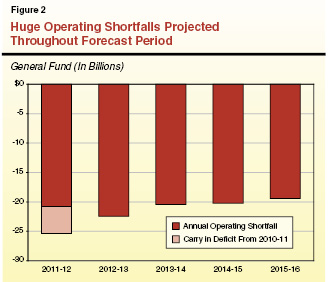
Nothing about this situation can lead one to believe that things will noticeably improve in this decade. Which leaves the government funding problem a permanent problem. If you have been reading my posts for the past two years, you know I've been saying that. Now the Legislative Analyst is saying it, offering charts like this:


So watch us here in The Magic Kingdom of California. We'll show you just how to put into effect a major government reduction that will be the conservative movement's dream. And Democrats will have to do it.

Thursday, November 11, 2010

State Controller's Report for October: look at the numbers and ignore the spin

The San Francisco Chronicle was the first of the major California newspapers to report on State Controller John Chiang's October financial statement. Partnered with Bloomberg which distributes the same article nationwide, the headline is California October Revenue Topped Budget Estimate by 4.6%, Controller Says.

The problem is nobody in the press seems to know how to compare these numbers to prior years or otherwise use them to see what's going on. A good reason exists for this.

Because of manipulations by the Gubernator and the Legislature of personal income tax withholding tables and the institution of drastic penalties for underpayment of corporate tax estimates, two of the key revenue numbers can't be compared from year-to-year. However, sales tax collections can be compared and can tell us what's going on with taxable sales.

When one adjusts for the fact that the sales tax rate is 6% of taxable sales in 2009-10 amd 2010-11 as opposed to 5% in 2006-07, taxable sales from July through October 2010 are down 18.0% from 2006-07.

It is true that during the same period last year taxable sales were down 19.4%. Yes we may have edged a slight gain during this period. The auto sales factor has to be taken into account because of the Cash for Clunkers program last year. But apparently it isn't a major factor. The California New Car Dealers Association publication California Auto Outlook reported:
...The market increased a marginal 0.2 percent in the Third Quarter. The apparent loss of market momentum was due primarily to relatively strong sales during the Third Quarter of 2009, when the market was given a boost by the Cash for Clunkers program.
So the 1.6% increase in taxable sales in July-October 2010 over the same period in 2009 is a fair indicator of growth in retail sectors other than auto sales. At this growth rate, by 2022 taxable sales will grow to 2006 levels.

Chiang, who knows better, tells us in his summary:
We are seeing indications that California has weathered the worst of the “Great Recession.” However, the road to full recovery is going to be a long one. Although current data on economic output in California is not available, we are fairly confident that the state’s economy has begun to grow again....
He then blathers on about employment and personal income which are not statistics generated by or used in his Department.

One could, like Chiang, spin a tale that the economy is growing again. Of course, the California Department of Finance estimates that the population growth rate between years is about 1%. And the U.S. Bureau of Labor Statistics indicates that, depending upon which index you wish to use, that the consumer price index has increased somewhere between 0.4% to 1.1%. So it's reasonable to conclude that the 1.6% increase in taxable sales means that per capita taxable sales in constant 2009 dollars shows no growth.

The Great California Slump has left us with an economy that crashed from 2008-2010. Based on the one statistic that we can rely upon - sales tax revenue - the California economy will remain at rock bottom for the foreseeable future.

Wednesday, November 10, 2010

The California $46 billion dilemma


Today the State Legislative Analyst issued an outlook for the State General Fund Budget:
Our forecast of California’s General Fund revenues and expenditures shows that the state must address a budget problem of $25.4 billion between now and the time the Legislature enacts a 2011–12 state budget plan.
It is surprising how close that is to what I wrote last Thursday:
Depending upon revenue, it appears that $20-$30 billion (23%-35%) needs to be cut from 2009-10 spending levels by 2011-12
And that is on top of the $20.6 billion we reduced cash expenditures from the 2007-08 level. It's our $46 billion dilemma.

It has been puzzling since the election to watch all the players in California State Government already maneuvering for some big positive change that will come about because the Governor is going to be a Democrat and the Democratic majority in the Legislature can adopt a budget by a majority vote in each house.

Doesn't anyone get it? In the San Francisco Chronicle after the election San Francisco School Board Member Rachel Norton blogged:
California faces a projected $21 billion budget shortfall for 2011-12...
As I started reading her post, I thought here's someone who gets it. But it soon became apparent that her education issues discussion was oriented to improvements in the schools, all still on the front burner. This seems to be a general approach to whatever ox or oxen is owned by the writer or speaker.

Hey folks! Your oxen are going to be gored to the point of severe crippling in the fiscal year 2011-12 budget. Look at the numbers. The actual cash spent in 2009-10 was already $20.6 billion below 2007-08. Assuming a need to cut $25 billion from 2009-10 cash outgo, here's what reality looks like (click on the chart to see a larger version):

What don't people understand? Even if by some miracle Governor Moonbeam and the Deliberators discover an extra $10 billion available for the year, the situation in the Magic Kingdom will be stark.

The State of California cannot print money. Nor can we borrow it. Even if we legally could, no one would loan it to us.

And so will Governor Moonbeam and the Deliberators go to the voters for a tax increase? Well for starters, there's that pesky problem of the 20% temporary sales tax increase that went into effect in April 2009 which will expire the end of June 2011. They increased the State's share of  the tax from 5% to 6% which produced $4,443,169,000 in cash in the fiscal year 2009-2010. That's $4.4 billion that will be going away.

So what are we to do? Ask the voters to approve that 20% sales tax increase on a permanent basis? That, along with a 10% surcharge on personal income tax which would generate about the same amount of money, would take care of the $8 billion in revenue losses. Sure, the voters will approve that. Now where will the remaining $17± billion come from? Here's how we will have to cut to balance the budget if the voters approve to continue the 20% sales tax increase and to put a 10% surcharge on the personal income tax:

Then there's the State's economy. The Legislative Analyst forecast is less pessimistic than mine. What supports that less pessimism view I'm not certain.

Nothing is worse for a State's economic future than a collapsing government. That is particularly true when you've cut education expenditures by 40%-50% over four years. What will a prospective employer contemplating a startup in or moving to California think about the situation with the State's previously highly regarded university system?

With regard to the Cal State University system, we learned today:
The California State University Board of Trustees has approved a 15% hike in undergraduate tuition, arguing that the action was an essential step to provide access to the Cal State system by more students.

The two-step increase will raise undergraduate fees 5%: $105 for the rest of the school year, and an additional 10% -- or about $440 -- for next year.
The fees (tuition) will become $4,884 for an academic year. The CSU system receives the same amount of money from the state as it did five years ago even though it has 25,000 more students.

The situation with the University of California is similar:
If approved by the UC regents in San Francisco next week, annual tuition for undergraduates would jump from $10,302 to $11,124 - about double what it was six years ago. Add in the mandatory fees, and the cost would rise to $12,150. Graduate level fees would also rise by 8 percent.

"We're down a billion dollars" from what the state gave to UC in the 2007-08 budget year, [U.C. President Mark Yudof] said Monday, explaining why he is asking for yet another increase. Last year, the regents hiked tuition by 32 percent, an increase that took effect this fall after a year of sometimes violent protests by students.
Already the egalitarian left wing is attacking the folks struggling to keep the Cal State University and University of California systems at somewhere near a respectable level.

And there's a certain irony that the conservative financial folks a Bloomberg news actually act as if this is news. Anyone who doesn't need to take off their shoes to count to 20 should have seen it coming, except perhaps the voters of California who live in the Magic Kingdom.

So what about Wall Street? From Bloomberg News in an article that says we may (?) face this deficit:
The new deficit figure comes as the state is preparing to sell about $14 billion of long- and short-term debt during the next two weeks. Standard & Poor’s rates California general- obligation debt A-, its fourth-lowest investment grade and the worst rating among states.
In other words, our State finances are in such disarray that it is comparable to the family member whose credit rating is so bad he borrows from loan sharks just to live. Now Governor Moonbeam and the Deliberators merely have to keep the State's legs from being broken by creating a solution to a 42.5% reduction in available funds since 2007-08, a problem that looks something:


Oh, and they need to do this by achieving a consensus among all interested parties

One other thing worth noting. California Controller John Chiang, who was just reelected to another four year term garnering 55% of the vote, on January 7 told KPIX veteran newsman Hank Plante that the State General Fund deficit could likely reach $35 billion. Given the problem with the Unemployment Insurance Fund, he was probably correct.

Sunday, November 7, 2010

Déjà Vu the other way around

On Wednesday, November 5, 2008 I posted a thread here with the title Obama's win is not a mandate for liberal social policy - consider California's Prop 8.

This time around Republican's took the House of Representatives. Big deal? Not really. They think it is, but they're wrong.

Not only do they not have a mandate for conservative social policy, they don't have a mandate for pro-corporate conservative economic policy. If any politicians believe the typical American voter wants to see multinational corporations and their executives continue to make more money for themselves instead of using revenue increases to employ more American workers at decent wages and benefits, they're delusional.

Anyway. It appears now that both parties are ready to screw around with the so-called "Bush Tax Cuts." That's because finding someone with any imagination or talent in Congress or the White House appears to be an impossible task.

In my August post Taxing the "rich" and "not-rich" I offered "My Plan" that involves letting the "Bush Tax Cuts" expire and, instead, adopt the following:
  • Triple the exemption for the filer (the "Yourself" box on the 1040 form) from $3,650 to $10,950, double the exemption per additional person ("Spouse" and dependents) from $3,650 to $7,300, and index that credit to the CPI for the future, a policy that has been needed for years.
  • Institute for businesses an Investment Tax Credit for tax years 2011 and 2012 with a carry over of unused credits into 2013 and 2014, up to a maximum total of $120,000, and only on purchases of new business equipment and rolling stock manufactured in the United States.
  • Institute for businesses an Employee Expansion Tax Credit for tax years 2011, 2012, and 2013 equal to the amount paid on the employers' share of Social Security (FICA) on jobs newly created and continuously filled for more than six months (compared to the September 2010 reported positions).
  • Institute for businesses and individuals a Newly Constructed Building Purchase Tax Credit for tax years 2011 and 2012 of $5,000, allowable on purchases of residential and commercial buildings constructed during the period of 2008-2011.
Of course, these are economy-oriented policy ideas. The Washington solution is to argue between the Obama Administration's proposal to keep the "Bush Tax Cuts" except for the highest income group versus the Republican proposal to keep the whole "Bush Tax Cuts" as is.

We won't get any policy changes. Just more name calling.

Thursday, November 4, 2010

The Magic Kingdom 2011: Governor Moonbeam and the Deliberators


The 2010 General Election is over and "The 2010 Meg Whitman Local TV Station Recovery Program" has ceased.

California generally bucked the trend of a Republican tide. Jerry Brown, hereinafter referred to as Governor Moonbeam, will become Governor on January 3, 2011.

At the same time, the new Legislature, hereinafter referred to as the Deliberators, will begin a two-year session. The makeup of the Deliberators changed slightly in that the Democrats actually gained two seats in the Assembly giving them 65% of the membership. In the Senate, they will continue to have 63% of the membership.

The voters in the State of California, hereinafter known as the Magic Kingdom, voted to allow a simple majority of the Deliberators in each house to adopt a State Budget. They also voted to:
  1. Add to the requirement for a 66.7% vote in each house to raise taxes by including more "fees" in the definition of "taxes" and reversing prior increases in conflict;
  2. Prevent the Legislature from borrowing or shifting certain gas taxes and redevelopment tax revenues to balance the State General Fund; and
  3. Not roll-back an existing provision that allows corporations
    • to income average future profits with the past few years losses,
    • to share tax credits among affiliated corporations, and
    • in the case of corporations doing business outside California to determine the portion of its taxable profits on in-California sales as opposed to a formula taking into account in-California payroll, California property ownership, and in-California sales.
Item 1 will increase State General Fund costs by at least $1 billion annually.

Item 2 will reduce funds allocated to the State General Fund by about $2 billion annually.

Item 3 will reduce State General Fund tax revenue by $2.3 billion annually over at least the next three fiscal years.

So, the voters of the Magic Kingdom with their left hands gave Governor Moonbeam and the Deliberators the ability to approve a State Budget with a majority vote. With their right hands, the voters of the Magic Kingdom reduced by $3 billion funds used needed to "balance" the General Fund and confirmed the elimination of $2.3 billion in corporation taxes collected in previous fiscal years.

Oh, and by the way, about $8 billion in revenue will disappear when temporary increases in the vehicle license fee and sales and income taxes expire July 1. And even the most optimistic analysts admit that the "balanced" General Fund Budget for the current year is at least $5 billion short. And, the bill comes due to repay at least $2 billion that the Gubernator and Deliberators siphoned from local governments in 2008. Oh, then there is that other 2010 General Election fact at the federal level, the Republicans took control of the House of Representatives assuring the end of federal stimulus money which provided $6 billion to local schools in 2009.

In a related subject, while the federal government may or may not extend the unemployment benefit period for millions of unemployed Californians next year, the odds that California will not have to start repaying the huge unemployment insurance fund loan beginning in 2012 have all but disappeared. That will result in an increase in direct payments by California employers to the federal government as explained in my last post.

Governor Moonbeam has indicated he will roll up his sleeves and start working. He's been thinking out loud that he doesn't need a Chief of Staff while he personally organizes his administration and prepares a revised General Fund Budget for the current year 2010-11 and a Budget for next year 2011-12.

We know that most of the easy one-time "gaming of the system" budget balancing techniques have been used up, such as shifting the last payroll of the year from June 30 to July 1. And we know, as discussed above, that:
  • The current budget as adopted is at least $5 billion short;
  • The election eliminated $5.3 billion of borrowing from local government and corporation taxes;
  • We are losing $8 billion in temporary revenue increases;
  • We likely won't be seeing about $6 billion in federal stimulus money in the future; and
  • We need to repay a minimum of $2 billion borrowed.
Depending upon revenue, it appears that $20-$30 billion (23%-35%) needs to be cut from 2009-10 spending levels by 2011-12. As a basis for budget preparation, here's the financial picture resulting from The Great California Slump comparing 2007-08 spending to 2009-2010 spending (click on the image below to see the table full size):
As Governor Moonbeam knows and you will note, by 2009-10 the State of California had already cut its spending from 2007-08 levels by $20.7 billion or 19.2%. Here's what Governor Moonbeam and the Deliberators are facing:
  • 47% of 2009-10 spending was for education (preschool - university), which many of the voters seem to have said they don't want cut, partly because cutting education is cutting California's chances for future economic growth;
  • 27% of 2009-10 spending was for the State's share of  Health and Human Services, an area which is problematic because for every $1 cut, anywhere from $1 to $3 of federal funds will not be spent in California during the budget year, reducing the State's economy accordingly; most cutting here impacts on children, the disabled, and the elderly and their caregivers, which seems like a good place to cut to avoid raising taxes on multistate/multinational corporations;
  • 9.6% of 2009-10 spending was for prisons and jails; most of this spending is controlled by a federal judge, so one can make more "pretend cuts" like the Legislature did in the adopted current year budget or put in an honest estimate of spending or release a bunch of prisoners;
  • 1.4% of 2009-10 spending was for Resources Protection including State Parks, CalFire, Fish & Game, and EPA enforcement of such things as the new environmental law the voters just confirmed; apparently closing the State Parks to fund enforcing the new law would be OK with the voters based on the election, but really you could eliminate the entire Resources Protection budget and not make a dent in the total needed cuts;
  • 5.7% of 2009-10 spending was for debt payments which will go up in future budgets and you can't do anything about it;
  • 2.1% of 2009-10 spending was for capital outlay - buying or building stuff that has a usuable life of several to many years; that would include things like replacing the 1970 payroll system and other squandering of tax money; and
  • 7.1% is everything else which includes the court system, the various elected official's offices, property tax relief, and a myriad of other things state and local government have to do and which was cut 42.5% already.
The Republicans Deliberators could join with Democrats to approve a $20-$30 billion tax increase. But that won't have to happen because Governor Moonbeam and the Deliberators have a voter mandate to balance the Magic Kingdom's budget with fairy dust, and they can do it on time since it only needs a majority vote now. Yeah, sure, good luck with that.