Wednesday, April 25, 2012

What's the purpose of an economy? A 2012 reminder what "a recovery" means in the lives of real people.

In October 2009 post here, a question was raised was: "What's the purpose of an economy?"

As I review headlines in the news media, it's obvious that the typical reporter covering the economy doesn't ask that question. And as I read the headlines in the news media, it's obvious that California's politicians don't ask that question.

To review, in that post I offered two different perspectives on the "purpose" of an economy. The first perspective is that of most 21st Century economists and international corporations.

It is about statistical data related to something called "productivity" measured in terms of computers recording data, data that could be about the production of food for people.

But it could be and, in the economic data we see reported, is frequently about robots that produce more robots designed to produce robots creating income for corporations retained in the bank accounts those corporations. The benefits of productivity are quantified only in the sense that electronic numbers representing value transfer between the producer and the entity receiving the product are acknowledged. In an obvious sense today, everything that the economists measure are really the results of computers exchanging data.

The other perspective is data about how well the economy is servicing the general populace as they attempt to meet their material needs. This can be found in statistics examining how well the economy is distributing among the people the resources necessary to acquire food, clothing, housing, health care, and education.

The following graph is a reminder that here in California, while The Great California Slump appears to have bottomed out, we are nowhere near a recovery if the purpose of an economy is to provide our people with income needed for food, clothing, housing, health care, and education.

It's nice that new unemployment claims are down. It's nice that the number of foreclosures is down. It's nice that as reported per capita personal income in California "grew at the fastest rate in five years during 2011" and is now only 4.75% below 2007, though we know it that income is distributed less equitably than in 2007.

Let's just not forget that we have a 1.4+ million job recovery gap and are not likely to see that number change significantly in this decade.

While The Great California Slump has bottomed out, it is not over, our economy has not recovered. As I wrote here in a previous post:
...The goal of our California grandfathers and fathers as reflected by the writings of Steinbeck and the speeches of Pat Brown were being achieved in the 30-year period from 1950-1980. In the next 30 years, 1980-2010, there has been a slow, but systematic decline in access to the middle class, culminating in the effects of The Great California Slump which I now believe will be the period from November 2007 through late-2017.
We are in the era created by Jerry Brown and his generation, not in the era created by Pat Brown and The Greatest Generation.

Tuesday, April 24, 2012

Moonbeam's unrealistic wishes and dreams will be very destructive

We are approaching government budget season here in the State of California, so again it's time to dream, to pretend, and to not engage in any in-depth thought about our future.

 On May 30, 2010, I posted the following:
It's fitting that Disneyland was created in California.

It's fitting because we now have two branches of state government that live inside the Magic Kingdom of the late 1950's - in two "lands" far away from reality. The Governor's Office has been relocated to Fantasyland. The Legislature has relocated to Tomorrowland.

Way too many of the voters of California also live inside the Magic Kingdom - in three radically different worlds far away from reality and incomprehensible to each other.

Some live in Main Street USA, a fictional early 20th century Midwest town totally without a corresponding community reality in 21st Century California.

Some live in Frontierland hoping to confront the challenges of the 21st Century with a muzzle loading rifle while wearing a coonskin cap - a reality that never existed in California even when Ronald Reagan was Governor.

Some live in Adventureland where crocodiles, hippos, and other "African Queen" dangers, completely foreign to and absent from 21st Century California, fill people with fear and consume tremendous amounts of their psychological energy.
On April 3, 2011, I posted:
It's clear now, with the election of Jerry Brown, Californian's put the perfect Governor in Fantasyland - Governor Moonbeam - to replace The Gubernator.
California had serious budget problems when Brown was running for Governor in 2010. Almost all those problems stemmed from his pandering to the public and the press when he was previously Governor (1975-83).

For whatever reason, Californians refuse to believe this. The mainstream press, as was the case before, seems to think Brown isn't the problem. But slowly, some old-timers have started remembering openly, such as Sacramento Bee columnist Dan Walters who recently wrote:
While Brown opposed Proposition 13, the era's landmark anti-tax measure, he quickly embraced it after its passage in 1978, declared himself to be a "born-again tax cutter," and sponsored a hefty state income tax cut as he sought re-election to a second term.

Whether California was under siege from crime is questionable, but Republicans bludgeoned Democratic politicians as soft on crime, and Brown didn't want to be a victim.

He and legislators responded with lock-'em-up crime measures aimed at putting more felons behind bars. California's prison population, about 20,000 inmates, started climbing, and late in his governorship, Brown agreed to place a small construction bond issue on the ballot.
What Walter's didn't explain was that one of the reasons Prop 13 passed was a repeating of a descriptive term "obscene state surplus" coined by Moonbeam 1.0's fellow Democrat Jesse M. "Big Daddy" Unruh.

Unruh, then State Treasurer who previously was the powerful Speaker of the California State Assembly from 1961 to 1969, was displeased with Brown. Brown was pleased with himself because of the surplus. He had refused to use any of it to offset huge rises in property tax revenue created by extreme real estate value growth.

It was the first time the voters who approve of Brown discovered they dislike his policy. But somehow, California voters had by 1978 begun to separate in their minds politicians from policy.

Proposition 13 passed and, despite denials by anti-tax politicians and bloggers, became the basis of the financial problem that plague our State and local governments.

And as Walter's points out, the State's problems were exacerbated by "let's don't try to lead, let's get reelected" policies regarding crime and prisons adopted by Brown and his fellow Democrats in the Legislature back then.

As Walter's goes on to explain without offering any opinion on future implications, confronted with horrendous prison overcrowding the U.S. Supreme Court ordered the State to fix the problem including reducing the prison population to "only" 137.5 percent of design capacity by mid-2013. Brown and the Legislature have responded using a policy they call "realignment" which is a euphemism for "passing the buck" by sending lower-level felons from prison into county jails and maybe, or maybe not, funding the costs the counties will incur.

Oh, and they plan to ask the U.S. Supreme Court to permit 145 percent of design capacity, which would allow 5,000 to 6,000 more inmates. In other words, our political leaders are telling us it's ok to house in our prisons nearly 50% more people than they were designed to house.

The Bee in another article tells us about the Moonbeam-led State Corrections Department:
Officials estimated the department would see its workforce cut by about 6,400 staffers as a result of the long-term plan, and allow the prison system to meet the requirements of court-ordered mandates on crowding, health-care and mental health by the end of next year.
If you believe this, I have some State-owned bridges to sell you.

In the meantime, Governor Moonbeam and the Legislators are singing a blue tune about the fact that the budget is out of balance by some amount between $7 billion to $14 billion. In another recent post, Walter's noted:
With the state budget mired in deficits, Gov. Jerry Brown and legislators, especially his fellow Democrats, are searching under every fiscal rock for money to spend.

That search has spawned an odd syndrome involving what could be three big pots of money – a competition among liberals over how they should be spent if, indeed, they materialize.
What Walter's is telling us is that it's an election year. Our legislators are struggling to keep reality from intruding on the State Budget until after November.

The sad part of the situation is that in January 2011, newly-reelected Governor Moonbeam could have presented a balanced proposed 2011-12 Budget. Yes, the cuts in schools, care for the aging and the young, courts, wildfire fighting capabilities, etc., would have been drastic, maybe even catastrophic. But by this year, California's self-destructive middle class voters would have been forced to confront reality.

Now Moonbeam and the Democratic Legislature have taken California's government services down a road preferred by the radical right. They are offering a completely inadequate, useless "tax the rich and the poor" tax increase initiative measure which they tell us with a straight face will prevent further cuts.

While singing his blue tune about the budget, Governor Jerry "Moonbeam" Brown keeps up a deception, but sometimes I wonder of these song lyrics apply:
The result of this deception
Is very strange to tell
For when I fool the people
I fear I fool myself as well!
In the meantime, California's once-proud public education system - from pre-school to graduate school - has become a shadow of the promise it offered the children of The Greatest Generation.

In the meantime, California's progressive programs to care for the elderly, the disabled, and the children of poverty are becoming comparable to Mississippi's.

In the meantime, California's once-strong, booming economy that existed from 1950 through 1980 has completely stagnated, buried in goofy ideas about taxation, environmentalism, and "green" potential.

At the risk of repeating myself too often:
We are approaching government budget season here in the State of California, so again it's time to dream, to pretend, and to not engage in any in-depth thought about our future.

It's fitting that Disneyland was created in California.

It's fitting because we now have two branches of state government that live inside the Magic Kingdom of the late 1950's - in two "lands" far away from reality. The Governor's Office has been relocated to Fantasyland. The Legislature has relocated to Tomorrowland.

Way too many of the voters of California also live inside the Magic Kingdom.

It appears that Californians have become moonbeams themselves, believing these Magic Kingdom song lyrics:
When you wish upon a star
Makes no difference who you are
Anything your heart desires
Will come to you

If your heart is in your dream
No request is too extreme
When you wish upon a star
As dreamers do
Unfortunately, embracing Governor Moonbeam's unrealistic wishes and dreams will be very destructive.

Thursday, April 5, 2012

Good grief folks, it's California. Don't support wise public policy!

Sometimes I wonder if California really is run by the crazies.

So far, two of the state's major newspapers have literally said we cannot support carefully crafted, wise public policy basically because Governor Jerry "Moonbeam" Brown, the Democratic Legislative Leaders, and teachers unions prefer unwise, poorly designed public policy.

We have two competing initiative measures circulating to get enough signatures to get on the November ballot.

One was prepared by Molly Munger and supported by the California PTA. Munger's measure would increase income taxes in a progressive manner on every income earner in California except the poorest workers among us. It is the one tax increase measure now circulating specifically aimed at improving California's economic future by educating California's children for a 21st Century economy.

In February the Sacramento Bee's Editorial Board said: "Munger makes a compelling case that this is a once-in-lifetime chance to invest directly in the improved education of California's children." But that wasn't good enough for them to back Munger's measure over the one proposed by Governor Moonbeam. They clearly said it would be better to focus on dumping more money into the State General Fund as the measure sponsored by Governor Moonbeam would do.

So far, in the past week The Los Angeles Times has published an Op-Ed piece and a piece by their Capitol Journal columnist explaining that Munger's measure is better but we have to support Moonbeam's.

The venerable Times Capitol Journal columnist George Skelton explained as he tells Munger to step aside (emphasis added):
No public poll — or recent private survey that I'm aware of — shows Munger's tax initiative with any real chance of passing voters' muster in November.

...Munger became increasingly frustrated with Brown after repeatedly trying to unite with him on a school funding proposal and being rebuffed.

Actually, Munger's tax measure makes more public policy sense than Brown's. It just makes less sense politically.
Of course, Skelton has repeatedly endorsed Moonbeam's measure and attacked Munger. This is the first time he's clearly acknowledged: "Munger's tax measure makes more public policy sense than Brown's." How could people know Munger's measure is better? Up to this point, not by reading Skelton in the Times.

The other piece published in the Times was an Op-Ed piece by Jim Newton in which he says:
Both measures start with the recognition that California is deeply in debt and that even years of cutting haven't brought it into balance. Brown would address that shortfall with a combination of a sales tax increase and a tax hike on income of more than $250,000 a year. In economic terms, that's not an ideal approach. It increases the tax burden on the poorest Californians, who pay a greater percentage of their incomes in sales taxes and who can least afford to pay higher taxes, and the richest Californians — those whose incomes gyrate most wildly with the economy and thus contribute to the instability in the state's revenue collections.

Munger's proposal, by contrast, avoids sales taxes altogether and boosts state income taxes by 1% across the board. That still means that high-income taxpayers would shoulder most of the burden because the income tax is progressive, but they wouldn't shoulder all of it. And taxpayers at all levels would have to chip in. That's more stable and more widely distributed than Brown's plan....

Brown's plan has the advantage of focusing its burdens on the poor, who don't vote much, and the rich, of whom there aren't very many....

...Munger's pitch is simple: California's educational system is tragically broken, and voters, even voters who don't usually like taxes, have said they are willing to pay something to fix it.
But nobody in the press has even hinted at the idea they'll support Munger's measure over Moonbeam's.

It's sad, really. If you read Munger's measure which practically nobody does, it offers serious solutions to our biggest economic problem and does so in a manner designed to avoid the problems of our dysfunctional State Government.

It wisely cuts out of the decision-making process politicians in the serially floundering Legislature plus the Governor, leaving it all to school boards.

Because it relocates to local school boards decision-making on how within certain guidelines the money is to be spent, it cuts the statewide union lobbyists out of the picture, forcing local teachers to work with locals school boards.

And it prevents the new funds from being used for administration.

And it even gets more taxes from the wealthy even though the press generally says Moonbeam's measure is a "tax the rich" measure.

And it.... I could go on and on, but I've already done that in a previous post.

It's disturbing that our serious, responsible California press can't support Munger's measure, though they admit it is much better public policy, because according to them the voters would prefer to extract money from the poorest working people among us, as well as from the richest among us, to dump into the State General Fund for the Legislature and Governor to play with.

Yeah, right.

Saturday, March 17, 2012

The "compelling, once-in-a-lifetime chance to invest directly in the improved education of California's children" tax increase initiative

Recent news reports in California's major newspapers indicate that there is one, maybe two, rarely three, tax increase initiatives circulating for signatures worth mentioning in stories regarding the State's budget problems. Reading those stories, you would never know there are nine (9) tax increase measures circulating right now. All have been discussed in previous posts.1

Now we read in the press that Governor Jerry "Moonbeam" Brown and the California Federation of Teachers (CFT) have negotiated a compromise that could permit a jointly sponsored initiative rather than continue with their current two competing initiatives, which are the ones that have received most of the press coverage.

The compromise measure would basically be Brown's initiative but with the sales tax increase dropped to ¼% while at the upper end of the income tax the increase would be higher, similar to the CFT initiative. The sales tax would still expire in 2016, but the income tax hike would be extended two more years. It has been submitted to the Attorney General.

Moonbeam is getting a lot of criticism about this compromise because it significantly shifts the tax increase proposal into the "class warfare" camp of taxing only the very wealthy, the so-called 1%. Moonbeam's gyrations with the CFT are not the primary subject of this post, however.

We Californians are being diverted from considering our state's problems. Most of the time, debate and discussion found in those news stories (as well as the comments about those stories on various web sites) all seem to be occurring between ideologues who either...
  1. want to eliminate all government or
  2. want to solve all social problems by providing more money to government.
Lost in the midst of this rhetoric about tax initiative proposals are...
  1. the goals to be accomplished with the additional money,
  2. what period of time the additional tax levies will need to be in effect to accomplish those goals, and
  3. the potential impact of the tax increase alternatives on real people and California's economy.
What one might think are the critical issues remain completely undebated and under-reported, lost in spin, with Moonbeam's camp being the best at spinning.

The fact is that Moonbeam and the CFT simply want money for the State General Fund to patch the significant holes that resulted as a side effect of The Great California Slump, which began with The Great Recession, created a significant loss of jobs in the private sector, and has destabilized the California economy.

Giving the Legislature and the Governor more tax money to spend however they see fit doesn't seem like a very good way to address The Great California Slump. From 1997-98 through 2010-11, cumulative disbursements from the State General Fund have exceeded cumulative receipts from revenue by a whopping $46.7 billion. This $46.7 billion deficit spending was approved at the time by the Legislators and the Governors. It is disturbing because we could have just as easily had a "rainy day fund" of $27± billion without any tax increases in the past four years.2

It's difficult to muster any positive feelings for a tax increase that doesn't specifically address improving California's economic future. Educating California's children for a 21st Century economy is the one clear way we can improve things for future generations.

One of the initiative measures being circulated for signatures right now was developed by activist heiress Molly Munger working with the California PTA. It receives far less press attention than the ones proposed by Moonbeam and the CFT even though the Sacramento Bee Editorial Board said:
Munger makes a compelling case that this is a once-in-lifetime chance to invest directly in the improved education of California's children. If her timing were different, and if Munger had first attempted to get her proposal passed through the Legislature, we'd be tempted to support it.
The Bee's Editorial Board knows no one could get any tax measure through the Legislature. It also knows Munger filed her measure before Brown. But they had to come up with some excuse to say that it represents "a compelling case that this is a once-in-lifetime chance to invest directly in the improved education of California's children," but....

The case Munger makes is compelling because her measure is far, far better than Governor Brown's precisely because Munger's focuses on improving the education and hopefully the economic potential of the next generation.

Munger's measure is complicated but carefully crafted. Here's a summary of how it would work if adopted:
  1. It provides for increased income taxes beginning January 1, 2013 and, unless renewed by the voters in November 2024, ending on December 31, 2024; it is the only measure circulating now that provides revenue beyond 2016 and still provides an end date, 2024, when the voters can reexamine whether its been effective and whether it is still needed; virtually every economist says that the economic dislocation in California created by The Great California Slump will last well beyond 2016.
  2. In a single concession to the political power structure of the state, for fiscal years between 2012-13 and 2016-17, it allocates 30% of the funds resulting from the tax increase to a fund from which school bond debt can be paid; the net effect is to lessen the pressure of The Great California Slump on the General Fund by whatever that 30% revenue represents, which Munger hopes the Legislature will use to prevent further drastic cuts in programs that provide food and medical care to children.
  3. The remainder of the funds (which after 2016-17 means all of the funds) are to go into a California Education Trust Fund (CETF) to be allocated 85% to K-12 school funding and 15% to early childhood education.
  4. The Trust Fund is to be supervised by a Fiscal Oversight Board; the measure states: "The members of the Board are the State Controller, State Auditor, State Treasurer, Attorney General, and Director of Finance. The Fiscal Oversight Board shall be responsible for ensuring that CETF funds are distributed exactly as provided by this Act and are used solely for the purposes set forth in this Act"; note that no member of the State Legislature nor any appointee of the Legislature is on this Board, a fact which is not lost on the politicians.
  5. Recognizing that in California income tax revenue is subject to wild swings up and down, the measure provides for a mandatory five year averaging of growth in income tax revenue to determine the increase in each year's revenues to be available for spending; no matter how much pressure the Fiscal Oversight Board may get from various constituencies, huge spending increases because of one-time revenue increases will not be possible, a fact which is not lost on the politicians or special interests; this would avoid the problem of the new revenue being spent hiring too much staff and creating too many special programs in years when income tax revenue is very high, thereby creating in the lean years the problem of having to lay off that staff and ending the programs.
  6. The K-12 monies will be distributed to school districts, county offices of education, governing boards of independent public charter schools, and the governing bodies of direct instructional services provided by the state (such as the California Schools for the Deaf and the California School for the Blind) based upon the number of students they teach; the funds must supplement state, local and federal funds committed for public K-12 schools and early care and education as of November 1, 2012, and shall not be used to supplant or replace the per capita state, local or federal funding levels that were in place for these purposes as of that date (there is a provision for a CPI adjustment and an exception for an overall reduction in federal funds).
  7. The measure provides complicated, but concise and clear, provisions for establishing and funding an Early Childhood Quality Improvement and Expansion Program generally under the supervision of the elected California State Superintendent of Public Instruction, not the Legislature.
  8. In contrast to the projected budget deficits of around $13 billion a year, it is conservatively estimated that the measure will generate about $11 billion the first year, increasing over time; from a logical standpoint this compares favorably against the other measures that would generate between one-third to two thirds of that amount, at a minimum at least $4 billion short of balancing the budget, while claiming in Moonbeam's measures, to guarantee "solid, reliable funding for schools, community colleges, and public safety while helping balance the budget and preventing further devastating cuts to services for seniors, middle-class, working families, children and small businesses"; Munger's measure makes no wild claims. 
  9. Detailed restrictions to avoid siphoning off money for uses other than education, including prohibiting "lending" of the funds" and detailed audit provisions including public review are included in the measure, all under the oversight of the Fiscal Oversight Board.
Munger's measure does not offer the same emotional content as the CFT measure or the Moonbeam-CFT compromise measure. Here is a comparison of impact of the measures on various levels of taxable family income (meaning a two-earner family):

As can be seen from this chart, the Brown-CFT Compromise measure would increase by a whopping 27% taxes paid by a family with a taxable income of $10,000,000. It would also increase by about 3.5% taxes paid by a family with a taxable income of $14,642. And it would increase by about 1% taxes paid by a family with a taxable income of $136,118.

Munger's measure measure would increase by "only" 18% taxes paid by a family with a taxable income of $10,000,000. It would not increase taxes paid by a family with a taxable income of $14,642. But it would increase by about 14% taxes paid by a family with a taxable income of $136,118 because it retains a progressive income tax model that requires everyone to share in the support of education.

The difference between the measures is one appeals to the idea that we can simply tax the rich to solve our problems, an idea that has a strong emotional appeal right now. Many want to ignore the idea that there is a limit on how much California can attempt to tax the so-called wealthy "1%". The simple fact is that companies can move their "headquarters" out of California. And if their executives and major investors move their "primary" residences out of California (keeping both the Carmel "beach bungalow" and the Tahoe "cabin", of course), those taxable profits from future high tech IPO's would leave California also.

It is dangerous when a politician like Brown chooses to compromise with those selling the emotions of class warfare. He could have backed Munger's measure as does the California PTA.

I describe Brown's approach as The Moonbeam Complex Free Up General Fund Money and Fix Nothing Tax Increase Initiative because that is what it is. Yes, some of the money will be applied to education and public safety, but much of it will free up State General Fund monies for the Legislature and Governor to play with. Because the taxes expire in 2016, they offer no potential solution to problems resulting from The Great California Slump. And in terms of any meaningful policy goals, Moonbeam's measure offers nothing.

California voters have good reasons to approve Munger's measure as it represents a thoughtful approach to the future of our State. They should reject any of the measures carrying Brown's endorsement.


1This post is a followup to a series of posts beginning in December 2011 on tax initiative proposals:
2Here is the past fourteen years of the State General Fund cash disbursements and cash receipts from revenues (from the June Year End Statements prepared by the State Controller):
Apparently, we simply cannot keep from spending more than we are willing to pay in taxes. And yet, in hindsight we could have been responsible with our tax money during that period leaving us with a sufficient rainy day fund that, without any tax increases, could have carried us through 2020, something like this:
Yes, that's hindsight. But the conservative right has been given their anti-tax argument handed to them on a platter by irresponsible Legislators pandering to constituencies, the latter being us.

Saturday, February 25, 2012

The Cloud versus the Gray Whale


Preface

As noted here last month, the first two posts in this blog were about wave energy projects and the Gray Whale. one was a "reprint" of a 2007 Op Ed piece I wrote during the Bush Administration that was published in The Great Western Pacific Coastal Post, one the country's now defunct newspapers. It was posted here in July 2008 with a followup.

It seemed incomprehensible that rational people in California were seriously planning the installation of wave electricity generating and transmission facilities in the migration route of the Eastern North Pacific Gray Whale.

After discovering in January that the Obama Administration is continuing that effort, on January 22, 2012, another post seemed appropriate. A U.S. Government sponsored report by Georgia Tech researchers was issued last summer indicating that waves off California's coastline could generate more than 140 terawatt hours of electricity a year -- enough to power 14 million homes -- if tidal and wave energy was developed to its maximum potential.

It was hard to accept the truth that a significant effort is being put into an "attack-by-dismissal" effort with regard to the Eastern North Pacific Gray Whale. Apparently accurate information needs to be more broadly disseminated. This lengthy post is an attempt to do that by:
  1. Providing basic information about the endangered Eastern North Pacific Gray Whale population and emphasizing that the United States is the only nation along its migration route that offers no protection;
  2. Explaining that in The Information Age the demand for electricity is growing dramatically in an environmentally unfriendly way and describing why;
  3. Describing current planning for the installation of wave energy power plants in the migration route of the Gray Whale which could occupy 10% of  available ocean within California state waters from Point Conception northward;
  4. Outlining the ideological twist that developed within the technology community that has taken the form of a world view defining any large power generation facility other than those depending on fossil or nuclear fuels  as "green" despite the fact humans have no significant experience with large-scale solar or wave energy power plants and an environmentally poor record with wind energy power plants;
  5. Reviewing examples of current documents supporting wave energy power plant development which dismiss the need to acknowledge the unique presence of Gray Whale migration route along the entire North American coastline;
  6. Suggesting what must be done with regard to wave energy power plant development on the Pacific Coast to assure a safe habitat for the Gray Whale.

  About the Gray Whale

First, the basics from Wikipedia:
The gray whale, Eschrichtius robustus, is a baleen whale that migrates between feeding and breeding grounds yearly. It reaches a length of about 16 m (52 ft), a weight of 36 tonnes (35 long tons; 40 short tons), and lives 50–70 years. The common name of the whale comes from the gray patches and white mottling on its dark skin. Gray whales were once called devil fish because of their fighting behavior when hunted. The gray whale is the sole living species in the genus Eschrichtius, which in turn is the sole living genus in the family Eschrichtiidae. This mammal descended from filter-feeding whales that developed at the beginning of the Oligocene, over 30 million years ago.
In a 2007 study published in the Proceedings of the National Academy of Sciences of the United States researchers at Stanford University and the University of Washington determined from DNA studies that the likely historical Pacific gray whale population before industrial whaling began in the 19th century was between 76,000 and 118,000. The study explains:
These levels of genetic variation suggest the eastern population is at most at 28–56% of its historical abundance and should be considered depleted. If used to inform management, this would halve acceptable human-caused mortality for this population from 417 to 208 per year. Potentially profound ecosystem impacts may have resulted from a decline from 96,000 gray whales to the current population. At previous levels, gray whales may have seasonally resuspended 700 million cubic meters of sediment, as much as 12 Yukon Rivers, and provided food to a million sea birds.
The Gray Whale became extinct in the North Atlantic in the 18th Century.1

In the Pacific Ocean, one distinct population of not more than 130 individuals have a migratory route between the Sea of Okhotsk and southern Korea. This population is protected under law.

Another Pacific Ocean population of 18,000±20% individuals, technically known as the Eastern North Pacific Gray Whale, which is the primary focus here, migrates from Alaska to Baja California along this route:

In their breeding grounds in Baja California, Mexican law protects these whales while still permitting whale watching.

Gray whales are protected under Canada's Species at Risk Act which obligates Canadian governments to prepare management plans for the whales and consider the interests of the whales when permitting development.

The State of Oregon lists Gray Whales as "Endangered" in its Threatened, Endangered, and Candidate Fish and Wildlife Species.

The State of Washington lists it as "Sensitive" on its Species of Concern List.

The State of Alaska and the State of California do not provide any listing or other acknowledgement to protect Gray Whales.

The U.S. Government does not provide any protection. This wasn't always the case.

When in 1970 the estimated population had declined to approximately 12,000, Gray Whales were listed as Endangered by the U.S. Government under the Endangered Species Act. In 1994, it was delisted when the population was estimated to be approximately 23,000. In 1999/2000, over one-third of the population died as a result of starvation. Current estimates place the population at 18,000±20%.

Complex political problems prevent the federal government from relisting the most ancient Baleen whale alive. Some are quick to point out that this involves disputes with Native Americans over traditional whaling rights.

A more honest appraisal acknowledges the Gray Whale migration route that runs from Baja California north up the entire North American continent. When listed as Endangered by the U.S. Government, the existence of these animals significantly complicated, if not actually prevented, coastal and continental shelf development in California, Oregon, Washington and Alaska.

U.S. Government listing pitted the Gray Whale against all types of shipping traffic, oil rigs, marine pollution, industrial noise, fishing entanglements, bottom trawling, industrial development, and military and non military sonar.

And if the Gray Whale were relisted, it would pit them against wave energy power plants on the U.S. Pacific Coast.

The previously mentioned U.S. Government sponsored Georgia Tech study offers an interactive map which indicates where wave power energy generators should be built which allows you to compare it with the map of the Gray Whale migration route above:


About The Cloud's Demand for More Electricity

We all know the arguments over climate change, dependence on foreign oil, the problems with fossil fuels, etc.

We, particularly those of us in California, know that we should be walking and riding bicycles as a first choice, public transit as a second choice, all instead of using our cars. We don't do that. We'll buy electric cars and pretend we've done something about energy. But we do change out light bulbs. Any success we have in reducing our use of energy we know is right.

While I still use my handy desktop computer to store data - my "distributed" computing machine - I also have an iPad and a Kindle Fire which connect to "The Cloud." That's where computing is going - with all The Information Age information stored in huge centralized centers full of servers with large energy demands.

Ever hear of Quincy, Washington [LINK REPLACED 6/30/2017 AS SITE NO LONGER AVAILABLE]? It's a potato farming community surrounded by a lot of open land. Oh, and there is around 2,308,000 sq. ft. of data center facility space (including current projects and additional phase build-outs). Quincy is home to data centers run by Microsoft, Yahoo, Intuit, Vantage, and Sabey. The Grant County Public Utilities District from Wanapum and Priest Rapids dams generates power at a cost of around $0.025 per KW/h.


This is the reality of the second decade of the 21st Century - a huge expansion of demand for electrical energy to feed data centers while we gradually eliminate distributed data storage in businesses and homes.

"The Cloud" is the symbol of our huge 21st Century appetite for more electricity.

The 20th Century was the period of a shift, from The Industrial Age to The Information Age.

The Industrial Age is defined as the time when human enterprise transitioned from a manual labor and draft-animal–based economy to a machine-based manufacturing, reaching its pinnacle in the mid-20th Century. From that time on, we continued to produce things using machine-based manufacturing, made more efficient by the marrying of computers to the machines.

But now The Information Age allows us to store, manipulate, and share around the world, share with other people and manufacturing machines, huge amounts of detailed information about the world around us.

The Information Age needs electricity, basically a commodity produced by power plants. In the process of expanding our electricity supply we are shifting from depending solely on power plants that rely on limited resources such as coal, oil, and uranium that produce obviously toxic waste to wind, solar and wave power plants. And this is being done in big ways in large facilities designed to generate thousands of gigawatts of power.

It is no coincidence that General Electric has developed a variation on its jet turbine engines to create small part-time fossil fuel based power plants to sit with wind and solar power plants. These turbine power plants will kick in when the wind quits blowing at wind power plants or when night or dense cloud cover reduces the output of solar power plants.

It isn't that we have become green environmentally friendly folks. We aren't going to modify our behavior, turn off our TV's and start reading books from the library by sunlight only, writing and keeping records with pencil and paper or even using mechanical typewriters and calculators. We aren't going to sufficiently reduce our energy footprint by shifting from our current cars to bicycles instead of electric cars. We are going to consume more electricity.

It's critical to know that we have a mixed-to-bad record in our shift to "alternative energy."

We simply have no evaluation of the long term impact of the world's installed solar photovoltaic power plant capacity (no, not those panels on some homes and commercial buildings) which reached 39.8 GW at the end of 2010. Nonetheless, we are building solar power plants at a rapid rate without taking time to study the impact of the current installations. And we are building ones that are not photovoltaic.  In Nevada we have under construction a solar heat tower,  the main feature of a different type of solar power plant, where all of the sun's rays reflected by mirrors, called heliostats, are aimed at the tower to heat molten salt which creates steam to drive a turbine, one of many such solar heat technology systems under construction in the U.S.

This follows the pattern of development of wind energy power plants - build some, then rapidly build more. Even the simple problem of abandoned wind turbines described as follows was not considered:
This upsets some people, including Paul Gipe, a local wind energy expert and chairman of the Sierra Club Kern-Kaweah chapter. Gipe calls a turbine that is no longer being used with no attempt to repair it or put it back into service derelict or dead.

"Derelict turbines are the most visible to you as you drive through the Tehachapi Pass," Gipe said, calling derelict turbines "nothing more than vertical trash."
One environmental impact associated with wind turbines should cause wave energy power plant advocates a moments pause - bird kill. As noted in this 2005 USA Today story about Altamont Pass:
The big turbines that stretch for miles along these rolling, grassy hills have churned out clean, renewable electricity for two decades in one of the nation's first big wind-power projects.

But for just as long, massive fiberglass blades on the more than 4,000 windmills have been chopping up tens of thousands of birds that fly into them, including golden eagles, red-tailed hawks, burrowing owls and other raptors.

After years of study but little progress reducing bird kills, environmentalists have sued to force turbine owners to take tough corrective measures. The companies, at risk of federal prosecution, say they see the need to protect birds. "Once we finally realized that this issue was really serious, that we had to solve it to move forward, we got religion," says George Hardie, president of G3 Energy.
And then there's this 2012 story:
...The huge turbines of the Los Angeles Department of Water and Power's wind farm in the Tehachapi Mountains north of Los Angeles have recently killed two more golden eagles — bringing the total of these endangered birds killed by the turbines' blades at the Pine Tree facility to eight.

According to the Los Angeles Times:


The death rate per turbine at the $425-million [Pine Tree] facility is three times higher than at California's Altamost Pass Wind Resource Area [near Livermore], where about 57 golden eagles die each year. However, the Altamont Pass facility has 5,000 wind turbines — 55 times as many as Pine Tree.
Wind turbine blades may spin up to 200 miles per hour, making it difficult for these flying predators to avoid them as they concentrate on scanning the ground for prey. According to Los Angeles Department of Water and Power spokesman Brooks Baker, the department is attempting to develop a bird and bat protection plan. Biologist Ileene Anderson of the Center for Biological Diversity claims that the real problem is the location of the wind turbines, and the appropriate response is to redesign the wind farm and put a moratorium on any new construction until the problem is corrected. Audubon California's Garry George maintains that before any new wind farms are built, years of research should be devoted to the behavior of birds which might fly near the turbines.
It is important to note that the discussion here is about impact on a U.S. Government listed Endangered species, an impact from U.S. Government sponsored and permitted development. It is an impact that should have been obvious and anticipated, but apparently it took time to discover "this issue "was really serious" before "we got religion."

Any Gray Whales reading this must be upset about the implications for wave energy power plants. The U.S. Government removed the Whales from the Endangered species listing. And we humans don't even have the courtesy to remove junk from the environment should we cease to use it.

The Apples and Googles and Microsofts and Intuits and Amazons and Facebooks are for the most part based on the Pacific Coast. It's no coincidence that the Microsoft headquarters are 160 driving miles from Quincy, Washington. In The Information Age these companies have the money, they drive the economies, and, as I've noted in other posts, their executives are getting visits from the President and governors because they are learning how to convert wealth into political power. And their business and wealth, all of it, depend upon electricity.

If the California Energy Commission says the California coastline offers the technical potential of between seven and eight gigawatts of wave power, and some official state agency called the California Ocean Protection Council is cheering on development of wave energy, and the Federal Energy Regulatory Commission is processing permits for wave energy power plants on the Pacific Coast in the migratory pathway of the Gray Whale, we're going to see wave energy power plants.

About Wave Energy Power Plants

At this point, one should pause a moment and then turn to Dictionary.com for some guidance.

When one thinks of a "farm" one usually thinks "land or water devoted to the raising of animals, fish, plants, etc.: a pig farm; an oyster farm; a tree farm".

When one thinks of a "park" one usually thinks "an area of land, usually in a largely natural state, for the enjoyment of the public, having facilities for rest and recreation, often owned, set apart, and managed by a city, state, or nation."

What official documents and news stories discuss as a wave energy "farm" or "park" is not a "farm" or a "park' but a "wave energy power plant." These are electricity generating facilities like a "nuclear power plant" or "coal-fired power plant."

And some sense of scale is needed to understand what wave energy power plant development means for official state agencies in California and the Federal Government.


Through the California Gray Whale Coalition. I became aware of a November 2008 study prepared for two State agencies, the California Energy Commission and the California Ocean Protection Council. The report is titled DEVELOPING WAVE ENERGY IN COASTAL CALIFORNIA: POTENTIAL SOCIO-ECONOMIC AND ENVIRONMENTAL EFFECTS.

In this report, we can get a sense of what the corporate and government technocrats see when they talk about wave energy "farms" and "parks". You also need to understand the ambitious level of California's planning. Consider this from the study:
According to a report by the California Energy Commission (PIER 2008), California wave energy resources indicate a theoretical potential of 38 gigawatts with an estimated technical potential of between seven and eight gigawatts, or about a quarter of 2006 demands. Although legal, social, economic and, indeed, environmental factors are likely to reduce this fraction further, wave energy has the potential to become a major contributor to California’s energy needs. (p. 7)

...The geographic scope of this paper includes all California state waters, but emphasizes the region from Point Conception north to the Oregon Border (Figure 1.1), where wave energy projects are most likely to be sited....

...California state waters extend from the shoreline to three nautical miles offshore, and this nearshore area coincides with where WEC technology is likely to be installed and deployed, due to logistical and economic reasons.

...The California Energy Commission (2008) estimates that commercial WEC projects may have a generating capacity of 100 to 150 megawatts. A commercial project could involve one large overtopping or oscillating water column device, or a large number of point absorber or attenuator devices. Commercial or network scale wave farms could occupy up to several square miles of the marine environment. Desirable sites feature depths up to 100 meters, locations within 10 miles of the coast, and proximity to onshore electric transmission lines with sufficient feed-in capacity. Such locations are likely to also be productive fishing grounds and high-traffic areas near port communities, and development at a commercial or network scale could generate significant impacts on diverse coastal marine stakeholder groups. (pp.24-25)
One has to do a little math here. The starting point is eight gigawatts from 100 megawatt wave energy power plants each involving about 2 square miles. That's 80 wave energy power plants involving about 160 square miles (102,400 acres) of ocean within 3.5 miles (about 3 nautical miles) of the coast of California.

Looking from Point Conception northward, subtracting problematic formations, protected areas, and areas of high shipping traffic, it appears they are considering a serious study area of about 500 miles of California's coastline, 3.5 miles out from land, or an area of 1,750 square miles ocean, of which 10%± would be devoted to wave energy power plants, if the technocrats had their way.

Finally, one has to understand that on September 23, 2008, the world's first experimental wave energy power plant was officially opened in Portugal, at the Aguçadoura Wave Park. Because of mechanical problems, it shut down in November 2008. Because of the financial collapse of the Australian company Babcock & Brown (the project's primary investor) due to the global economic crisis, it is unlikely that the project will ever be reopened because the technology is out of date.

In other words, the length of time of actual human experience with what California is ambitiously planning to construct in the Gray Whale migration path is two months and was a failure. Don't misunderstand from this. Proposed wave energy power plant projects exist in various states of development. For a list, see this chart at Wikipedia. And many individual wave energy converters (WEC) of different types have been deployed.

But while the physical problem we're exploring here are modifications to the ocean environment of migrating whales, a more immediate problem is really "technocrats" and their efforts to dismiss the problem in official documents in order to make short term economic gains. This is an ideological world view problem.

About the Technocrats

As used here, technocrats refers to the management and employees of private corporations or public agencies who perceive reality through the ideology of the so-called Third Industrial Revolution.

The "Third Industrial Revolution" is a human historical advancement world view developed by economist Jeremy Rifkin. It has been endorsed by the European Parliament which is, to keep matters simple, the legislative body of the European Union, itself primarily an organization oriented to economics.

If there is a "Third" Industrial Revolution, then of course there must have been a "First" and a "Second."

The "First" is what most of us know as "The" Industrial Revolution - the one where, in the later part of the 18th century, human enterprise transitioned from a manual labor and draft-animal–based economy to a machine-based manufacturing. The steam engine accelerated the transition while also accelerating the burning of fossil fuels like coal. Rifkin's thought is that steam-powered technology transformed printing into the primary communication tool to manage the First Industrial Revolution (Rifkin is into the whole "information management" concept, which apparently has its precedents in the late 1700's). Whatever your focus, we know that humans at the time marveled at the wonder of the technology of their time.

The "Second" Industrial Revolution was not so clearly recognized as separate from the "First" at the time. Wikipedia explains to us that according to this world view in the first decade of the twentieth century, electrical communication converged with the oil-powered internal combustion engine, giving rise to the Second Industrial Revolution. The electrification of factories ushered in the era of mass-produced manufactured goods, the most important being the automobile. Thousands of miles of telephone lines were installed, and later radio and television were introduced, recasting social life and creating a communication grid to manage and market the far-flung activities of the oil economy and auto age. Humans at the time also marveled at the wonder of the technology of their time.

The "Third" Industrial Revolution coincides in a timely manner with our discovery that in the process of creating the first two ages of marvel and technological wonder, we might have gotten a few things wrong, maybe overdid it a bit, creating problems like climate change. But never fear, we are now in a new age of marvel and technological wonder where internet communication and renewable energies technology is giving rise to a new distributed energy revolution, one that could open the door to a new fuel era and new era of “distributed capitalism.” What could possibly go wrong?

Well, for one thing, we have already seen that The Cloud needs infrastructure - with one big piece being many more power plants. At this point we need to make it clear that this "Third" Industrial Age world view, or Weltanschauung, simply isn't what's happening. In Quincy, the electricity is coming from hydroelectric power plants. In California, we have large solar energy power plants proposed to be built in the desert area on federal land. As the California Energy Commission website indicates solar power plants generating 4.2 Gigawatts have been approved so far.

We build coal-fired power plants in areas we can get coal. We build oil-fired power plants where we can get oil. We build solar power plants where there is intensive sun. We build wind power plants where its generally windy. We build hydroelectric power plants where we can dam rivers. And we build wave energy power plants on our coastline. Again, these things aren't energy "parks" or "farms", they're power plants. They aren't a home or business owner putting a few solar panels on a roof. They're power plants.

Rifkin's thinking was not necessarily wrong-headed. What is wrong is those ideas have transitioned from some good ideas for discussion to an ideology. All over the web, you can learn that Rifkin is the founder and chairperson of the Third Industrial Revolution Global CEO Business Roundtable, comprising more than 100 of the world's leading renewable energy companies, construction companies, architectural firms, real estate companies, IT companies, power and utility companies, and transport and logistics companies.

This ideological thinking led to a newspaper article on the California wave energy potential which includes this:
Wave energy uses a variety of devices placed in the ocean to generate electricity, but the technology has not been widely used in the United States. The Department of Energy is sponsoring three demonstration projects off the coast of Oregon, in Washington's Puget Sound area and in Maine.

Currently, California has no wave energy project up and running, but the California Ocean Protection Council says one project off the coast of San Onofre has received a preliminary permit. The permitting process is complex and involves several federal and state agencies, including the Federal Energy Regulatory Commission and the Bureau of Ocean Energy Management.

"Wave energy projects have a very low profile -- much lower than a wind turbine," Mike Reed, team leader for water-power technologies at the Department of Energy, said in an interview. "The devices are located two to three miles off shore -- you can't see them from the shore."
In other words, if you're an ideological technocrat you think wave energy power plants are good because they
  1. produce electricity (mainly more electricity, an absolutely necessary "goodness"),
  2. aren't burning fossil fuels (an economically and environmentally necessary change that permits the use of the politically protective "green" mantle), and
  3. they don't disturb the view from your oceanfront home (a completely selfish, human-centric perspective common to technology types who describes themselves as "green" oriented).
And wow! The California Ocean Protection Council is helping with the permit process for these low profile wave energy power plants.

All this is because we have a new "world view", a term explained in Wikipedia "is from the German word Weltanschauung, a concept fundamental to German philosophy and epistemology and refers to a wide world perception. Additionally, it refers to the framework of ideas and beliefs through which an individual, group or culture interprets the world and interacts with it." From the point of view of Gray Whales this world view might be akin to what one infamous German described in his book: "The program of a Weltanschauung represents a declaration of war against an existing order of things, against present conditions."

But the Gray Whales should be confident knowing that this time around we won't screw things up now that we are in a new age of marvel and technological wonder.

About Technocrat-Prepared Wave Energy Documents

It would not be an overstatement to say that official federal and state government documents associated with wave energy and wave energy power plant projects reflect the confused "Third Industrial Age" ideology.

As noted earlier, from our technocrats here in California we have the November 2008 study prepared for the California Energy Commission and the California Ocean Protection Council titled DEVELOPING WAVE ENERGY IN COASTAL CALIFORNIA: POTENTIAL SOCIO-ECONOMIC AND ENVIRONMENTAL EFFECTS which offers this thinking:
Gray Whale: Potential for Interaction: High

Gray whales are one of the most commonly sighted whales off California with approximately 18,000 individuals migrating or resident in nearshore waters. The entire northeastern Pacific population of gray whales may migrate through or reside within habitat slated for WEC/wave parks in California. The potential for interaction is high due to this extreme habitat overlap. Potential interactions include entanglement and subsurface collision potential with WEC and associated supports, increased vulnerability to predation, changes to prey availability, and foraging behavior (of resident whales). Gray whales were formally listed as "Endangered", but have been delisted. (pp. 138-139)

6.1.4.6 Electromagnetic Field (EMF) Considerations

Electromagnetic fields (EMF) have been shown to affect a host of higher vertebrates (Kirschvink et al. 2001), though little is known about the effects of EMF on marine mammals. Some studies indicate dolphins, porpoises and whales respond to the magnetic portion of an electromagnetic field (Scottish Government 2007). Based on this information, the primary concern may be for the physiological effects of EMF and/or if the marine mammals occupy an area around wave energy converters (Fernie and Reynolds 2005). Further investigation is needed in this area. (p 130)

Benefits to California

In 2006, the California Legislature passed the California Global Warming Solutions Act (AB 32). Among other important requirements, this legislation requires the California Air Resources Board to adopt regulations such that greenhouse gases are reduced to 1990 levels by 2020. Wave energy could assist in reducing California’s greenhouse gas emissions by providing a renewable and reliable energy source. Other benefits to California include job creation and other forms of economic opportunity. Wave energy could meet a significant proportion of the state’s energy demand. While significant technological and economic issues remain, ecological issues, at this stage, appear manageable. (p. 5)
Let me summarize what it says for any Eastern North Pacific Gray Whales out there reading this.

Facts Presented. The Eastern North Pacific Gray Whale will most assuredly have problems with the mere physical presence of wave energy equipment and we don't know anything about the effects on whales of electromagnetic fields that affect a host of higher vertebrates, except that some studies indicate they respond to the magnetic portion of an electromagnetic field.

Conclusion Reached. Ecological issues appear manageable.

The report is not an environmental impact report either under federal law or CEQA. It obviously was written as requested by California officials to cheer on development of wave energy.

To be fair, the "Abstract" provided at the beginning reflects a "suitably cautious" disclaimer tone for humans:
Dramatic ecological, social, or economic effects are not clearly indicated by this study, but a strong case for caution is supported when developing wave energy conversion technology off the California coast. Impacts to human activities, wave exposure, benthic communities, fishes, birds and mammals are all virtually certain, but the impacts’ magnitudes and the cumulative effects remain difficult to anticipate.
From the point of view of Gray Whales, the use of the "get-out-of-jail free card" is disturbing:
Gray whales were formally listed as "Endangered", but have been delisted.
This card was played in the environmental documents of a permitted wave energy power plant in Oregon, sponsored in part by the Pacific Northwest Generating Cooperative (PNGC), a group of utility cooperatives located in Oregon, Idaho, Washington and Montana. It is the Reedsport OPT Wave Park project to be owned and operated by Reedsport OPT Wave Park, LLC., an "affiliate" of Ocean Power Technologies (OPT).

In the January 2010 REEDSPORT OPT WAVE PARK - FERC PROJECT NO. 12713 - APPLICATION FOR A MAJOR LICENSE (Vol IV, Appendix A pp 4, PDF pp. 8) we learn:
Gray Whale

The gray whale is a large baleen whale that is composed of an eastern and western stock (Figure 6). The eastern stock inhabits the Pacific Coast and was de-listed from federal protection in 1994. The western stock is found along the Korean coastline and remains classified as endangered.
And in the chart on the following page the reader is informed:
Species was delisted in 1994 and is making a marked recovery. Population is currently over 20,000 individuals.
On page Appendix A-11 (PDF page 15) the document states:
2.2 Cetaceans - ESA Listed

OPT has contacted NMFS and requested information on species in the project vicinity that are protected under the ESA, most recently in a letter dated October 11, 2007 and during various phone conversations and meetings. Federally listed threatened or endangered cetacean species that may occur in the project area are listed in Table 2.
The Gray Whale is conspicuously absent from the table. The NMFS is the National Marine Fisheries Service and the Gray Whale was delisted. From its web site (emphasis added):
NOAA's National Marine Fisheries Service is the federal agency, a division of the Department of Commerce, responsible for the stewardship of the nation's living marine resources and their habitat. NOAA's National Marine Fisheries Service is responsible for the management, conservation and protection of living marine resources within the United States' Exclusive Economic Zone (water three to 200 mile offshore). ...Under the Marine Mammal Protection Act and the Endangered Species Act, NOAA's National Marine Fisheries Service recovers protected marine species (i.e. whales, turtles) without unnecessarily impeding economic and recreational opportunities....
As I explained previously, the State of Oregon Department of Fish and Wildlife lists the Gray Whale as Endangered. Curiously, Volume II (pp. 9-4 & 5) of the project study assures us:
Other Wildlife

■ Oregon Department of Fish and Wildlife. 1993. Oregon wildlife diversity plan. Portland, Oregon. [Online] http://www.dfw.state.or.us/wildlife/diversity/.

The Oregon Fish and Wildlife Commission adopted the Oregon Wildlife Diversity Plan in 1993 and updated it in 1999. The plan established the goals, objectives, and strategies for the ODFW’s Wildlife Diversity (formerly Nongame) Program. The Diversity Plan includes a list of state-designated endangered, threatened, and sensitive species. State-listed species that may occur in the vicinity of the proposed project are discussed in Sections 5.C.3. and 5.C.4. Because the proposed Reedsport Project is not expected to adversely impact state-listed wildlife, OPT believes that the Reedsport Project is consistent with the Oregon Wildlife Diversity Plan.
Any hope I had that the State's listing is mentioned in the indicated Sections was initially dashed, When I checked Section 5.C.3. I first found the same exact language quoted above referring to the delisting by the U.S. Government including the table. But, on pp. 5-66 & 67 (PDF pp 139-140) we have a long discussion of the Gray Whale including this paragraph:
Gray whales are a success story for recovery of endangered species with current populations estimated to be over 20,000 whales (Rugh et al. 1999; NOAA 2007d). The population is thought to be near pre-exploitation population levels (NMFS 2002). Even though gray whales are not federally listed as endangered, they are listed as endangered on Oregon’s state threatened and endangered species list.
This language uses the dismissive "get-out-of-jail free card" by noting the delisting by the U.S. Government in a State that lists the species as Endangered.

Nonetheless, the project documentation includes a Study Plan (beginning on Volume II Page Appendix C-26 PDF p. 477) that does include the Gray Whale. What we need to keep in mind is the wave energy power plant involved is described as follows (Volume II p. Appendix C-1 PDF p. 452):
The project would consist of deployment and operation of 10 PowerBuoy® wave energy converters (WEC) having a total capacity of 1.5 megawatts (MW), to be located approximately 2.5 miles (4 kilometers) off the coast of Gardiner in Douglas County, Oregon (Figure 1). The ½-mile-by-½-mile (0.25 square miles) project area represents the area within which the 10-PowerBuoy array would be deployed. The actual footprint of the constructed array is expected to be only about 1,000 feet by 1,300 feet (300 meters by 400 meters) or approximately 30 acres (0.05 square miles), excluding the navigation safety zone.
This 0.25 square mile 1.5 megawatt wave energy power plant must be considered in the context of the ambitious California plan discussed above that anticipates allocating 160 square miles to generate eight gigawatts from commercial projects each with a generating capacity of 100 to 150 megawatts.

Given the small size of the Oregon project, the study results will be of limited benefit to FERC and California agencies. And the study does not anticipate evaluating the effects of electromagnetic fields.

Nonetheless, this project represents the best one could hope for as the Marine Mammal Institute of Oregon State University was funded by the Oregon Wave Energy Trust to conduct an ongoing study. The problem is that there is an Oregon Wave Energy Trust which is primarily an advocate for the use of wave energy.

About The Future

In the early 1950's the conventional wisdom of Americans based on spin around the then world view of those in corporate technology was the future was to include nuclear power. It sounded promising. But to the public "nuclear" brought to mind bombs. So there was some skepticism.

That didn't prevent the development of nuclear power plants. The 104 commercial reactors at 65 nuclear power plants in the United States produce about 20% of the nation's power and 13–14% of the world's electricity.

Now, of course, the Three Mile Island accident in 1979, the Chernobyl disaster in 1986, and the Fukushima Daiichi nuclear disaster in 2011 have created serious concerns around the world.

And then there's the other little problem, waste, which was essentially dismissed from consideration. From Wikipedia:
Disposal of nuclear waste is often said to be the Achilles' heel of the industry. Presently, waste is mainly stored at individual reactor sites and there are over 430 locations around the world where radioactive material continues to accumulate. Experts agree that centralized underground repositories which are well-managed, guarded, and monitored, would be a vast improvement. There is an "international consensus on the advisability of storing nuclear waste in deep underground repositories", but no country in the world has yet opened such a site.
Am I asserting that constructing 80 wave energy power plants on the coast of California would be akin to building four nuclear power plants the size of the Southern California Edison’s San Onofre Nuclear Generating Station at locations near Santa Barbara, Monterey, San Francisco and Eureka?

Given our lack of knowledge about the impact wave energy power plants, I would suspect a Gray Whale would answer "yes" particularly in light of the failures to anticipate obvious impacts associated with wind energy, as well as nuclear energy. 

But as I said above,
  1. the California Energy Commission says the California coastline offers the technical potential of between seven and eight gigawatts of wave power,
  2. some official state agency called the California Ocean Protection Council is cheering on development of wave energy, and
  3.  the Federal Energy Regulatory Commission is processing permits for wave energy power plants on the Pacific Coast within the migratory pathway of the Gray Whale.
 We're going to see wave energy power plants.

What is needed immediately is a serious plan to address the potential impact on Gray Whales by wave energy power plants on the U.S. Pacific Coast.

It must begin with an acknowledgement that we don't have any idea what the impact would be and that we have to move slowly to permit studies to be completed.

We need to understand that as with the construction of dams, we may discover we have to remove what we build.

And most importantly, we need to reject any dismissal of the danger to Gray Whales by stating the species was "dislisted" by the U.S. Government.


1 Recently one individual has been sighted in the Mediterranean region leading to speculation that the gradual melting and recession of Arctic sea ice with extreme loss in 2007 opened the Northwest Passage sufficiently to permit the occasional curious individual to explore.

Saturday, February 11, 2012

About the economy in California....

Politicians and the press in California keep leaving us with the impression that the end of The Great California Slump is almost here.

My favorite pronouncements come in State Controller John Chiang's monthly State General Fund cash flow report. For instance the report for December said:
The economic recovery continues in the Golden State, and is even accelerating past the U.S. in many areas. Still, the failure of the additional $4 billion in revenues to materialize...means that there are still many tough decisions ahead.
For January in his report released this week he told us:
January missed the 2011-12 Budget Act’s estimate by an even wider margin, coming in $1.2 billion less than projections....

Year to date, the State is $3.7 billion short of revenues so far....

Outside of the state’s finances, the economy continues to gain steam and has begun to outpace the remainder of the U.S.

So the State's economy is doing well, but it just doesn't show up in Chiang's tax revenue numbers.
Yeah, right.

Governor Jerry "Moonbeam" Brown's Finance Department put out a two page memo in response to the latest release by Chiang which ...well... I'll just quote it here:
...However, estimated payments in December and January were down over 13 percent. This pattern is very atypical. In fact, a similar pattern has only occurred once in the last twenty years.

While concerning, it is not clear what the lower December and January receipts or the atypical pattern of personal income tax receipts in 2011 means for final payments in April, or for the revenue that the state should expect for the 2012 tax year. It is possible that taxpayers did not pay sufficient cash through their estimated payments – as was the case in 2007 — and will make it up with strong final payments in April. Alternatively, it could be that capital gains were lower in 2011 than was forecast. Such a reduction could be the result of taxpayers, because of market conditions in late 2011, delaying their sales of stock from late 2011 into early 2012. If that is the case, the current revenue shortfall could be largely eliminated through strong estimated payments in April and June. However, it is also possible that the capital gains forecast was too high and that the dropoff will not be offset by additional gains in 2012. If this is the case, the capital gains forecast will likely be reduced for 2012 and subsequent years as well. The bottom line is that possible explanations for the lower receipts are numerous, but the actual cause is very uncertain.
What is clear is that Moonbeam's Administration has no idea what's going on, but keeps looking in-house for history, ...well... 20 years of history, not even back to Moonbeam's first term... that would offer some explanation. While pushing for his temporary, inadequate revenue tax increase plan that's going to solve all problems, Governor Moonbeam has been running around the state focusing his fawning press on tech industry, which as I've explained here many times doesn't create new jobs, just replaces jobs they eliminated a few years ago and will eliminate again a few years from now.

The press keeps reporting significant growth in employment. They get this from news releases issued by the California Employment Development Department and the U.S. Department of Labor. The problem is the statistics used for those news releases are based on "household surveys" and the data is "seasonally adjusted".

But they also produce other related statistics. For instance these include an "employer survey" without "seasonal adjustments." And then there are the number of jobs reported by employers in quarterly employee withholding tax forms, a number never reported in the press.

The problem is the surveys and the quarterly employee withholding tax forms don't seem to match as shown in this graph (click on the graph for a larger version):

It seems that the numbers used in the news releases (the reliable household survey data seasonally adjusted) show that in the last quarter of 2011 we had 164,649 fewer jobs than in the first quarter of 2001, ten years ago. But apparently the unreliable employers en masse lied in their quarterly tax returns reporting 884,168 fewer jobs than in in the first quarter of 2001, ten years ago.

It's confusing. The seasonally adjusted household survey shows that we have 894,213 fewer jobs than we did in the last quarter of 2007. The unadjusted employer survey shows 1,010,433 fewer jobs than in the last quarter of 2007. And the lying employers show 1,115,108 fewer jobs than in the last quarter of 2007.

But jobs aren't everything to economists, the press, and politicians. We have home sales data, for instance. According to Bloomberg News Sales of Existing U.S. Houses End 2011 on High Note and the California Association of Realtors reported "sales of existing single-family homes in the Golden State posted an annual increase for the sixth straight month in December."

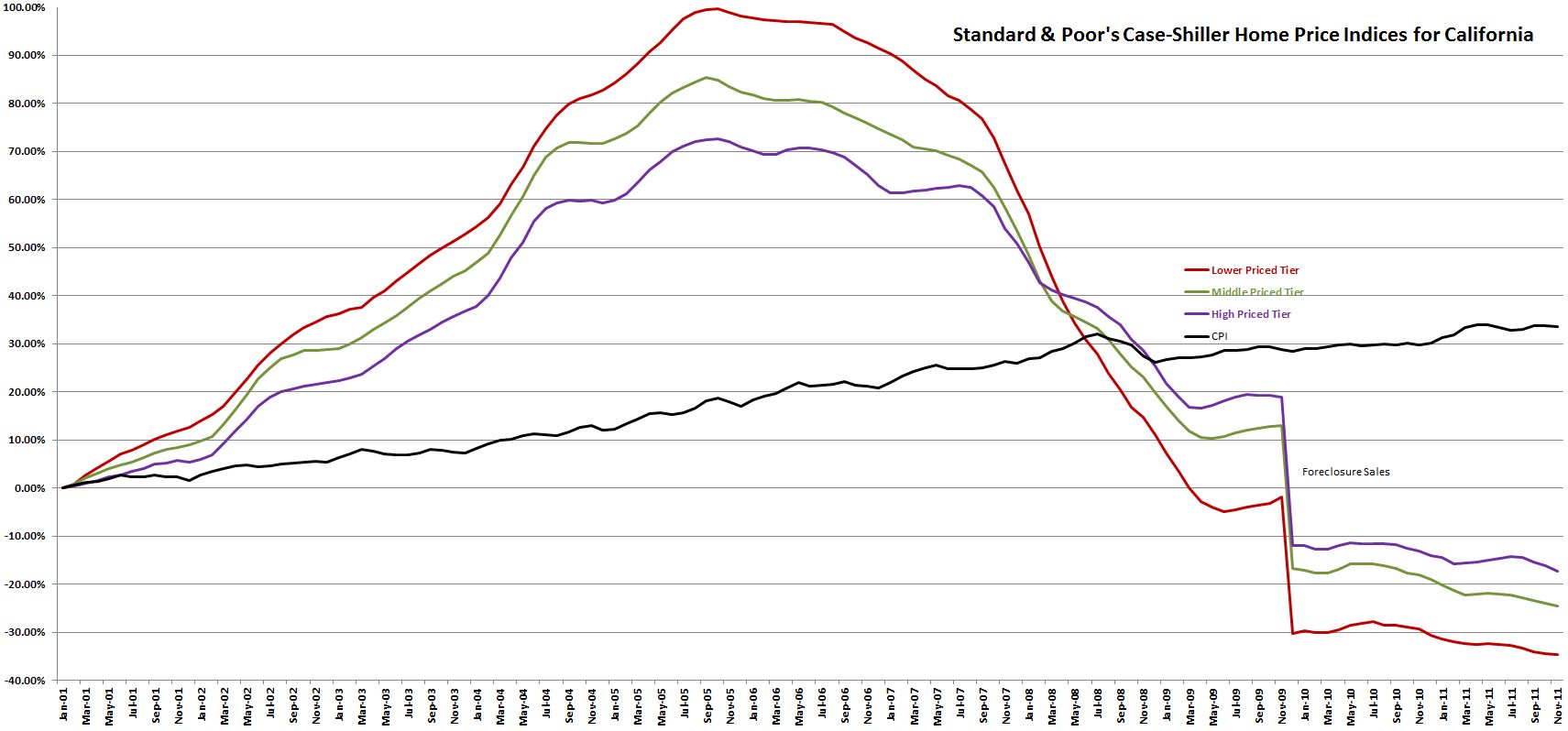
Except what the data means is that more homes actually sold including foreclosure homes. The Standard & Poor's Case–Shiller Home Price Indices for California show the following:
As indicated by this chart, the primary source of wealth for Californian's - their homes - experienced a sales price bubble between late 1995 and late 2005 and a bubble burst beginning in mid-2006 through today. Broken down by pricing tiers, you find that the selling price of lower priced homes fell by two-thirds between mid-2006 and now while higher priced homes fell about 50%. What can be seen from a large graph is that selling price went over a cliff at the end of 2009 because foreclosure sales kicked in, causing the average sales price to drop by 5% in one month.

As I've said before, The Great California Slump will continue for many years. Too bad Moonbeam's Finance Department doesn't have the nerve to look outside their files for numbers about the economy. But I suppose if I worked from Moonbeam, I wouldn't do that either.

Wednesday, February 8, 2012

A license conferring human dignity, is it a matter for any government?

Thirty years ago I wrote a column for the now defunct newspaper the Great Western Pacific Coastal Post in which I noted that the marriage contract is the only binding legal contract most Americans will enter into without knowing the terms thereof and which terms can be modified at any time by a state legislature with the approval of the state governor.

At the time I wrote that column, in California Jerry Brown was Governor and the Legislature was dominated by Assembly Majority Leader Willie Brown. At the time, I asked: "Why would any Californian turn the most important contract of their lives over to the whims of the Brown Brothers?"

In a November 2008 post here It's time to privatize marriage! I noted:
To understand the difference between the religious component and the civil component, consider this. A couple could be "married" by the Pope on the steps of the largest Catholic church in the country and the marriage would not be legally valid in any state without a license issued by a government clerk. Yet in many places, a marriage ceremony performed by such a clerk pursuant a license issued by that clerk would be valid anywhere else in this country. The validity of a "marriage" in America is all about a government license and nothing about the beliefs of the couple involved.

It wasn't always this way. Prior to the Civil War, Americans would have been startled at the idea that they would have to get the government’s permission to get married. Our Founding Fathers had no understanding of marriage in that context. Americans must remember that marriage license laws were introduced in America mostly to prevent blacks from marrying whites, in other words to write into law racial discrimination based on beliefs of the sincere American majority.
This week the 9th U.S. Circuit Court of Appeals rendered a decision on Proposition 8. Proposition 8 was an initiative proposition passed in November 2008 which added the following section to the State Constitution:
SEC. 7.5. Only marriage between a man and a woman is valid or recognized in California.
The Appellate Court majority pointed out that the words of Proposition 8 doesn't alter any legal elements of a relationship because "under California statutory law, same-sex couples had all the rights of opposite-sex couples."

According to the Appellate Court majority, Proposition 8 "stripped same-sex couples of the ability they previously possessed to obtain from the State...an important right—the right to obtain and use the designation of 'marriage' to describe their relationships. Nothing more, nothing less."

The Appellate Court majority said—using nice words and legal language—that the voters cannot re-institutionalize bigotry using the ballot box. The majority said Proposition 8 "has no effect, other than to lessen the status and human dignity of gays and lesbians in California, and to officially reclassify their relationships and families as inferior to those of opposite-sex couples."

The majority said pursuant to the Fourteenth Amendment to the United States Constitution the State did not have that authority, either through the legislature or the voters.

What can be understood from this is that within the world generally, a legal authorization—normally a license issued by a local government bureaucrat—to use the word "marriage" is required and that license confers a certain level of human dignity upon people.

Proposition 8 was a response to a California Supreme Court decision In re Marriage Cases (2008) 43 Cal.4th 757 [76 Cal.Rptr.3d 683, 183 P.3d 384].

On May 15, 2008, the California Supreme Court ruled in a 4–3 decision that laws directed at gays and lesbians are subject to strict judicial scrutiny and that marriage is a fundamental right under Article 1, Section 7 of the California Constitution, thereby holding unconstitutional the previously existing statutory ban on same-sex marriage embodied in two statutes, one enacted by the Legislature in 1977, and the other through the initiative process in 2000 (Proposition 22). The Court's ruling also established that any law discriminating on the basis of sexual orientation is constitutionally suspect.

Most importantly, according to the ruling the California Constitution gave people in same-sex committed relationships the right to apply the term "marriage" to their relationship.

In November 2008, Proposition 8 was passed by the voters amending the State Constitution basically taking the subject away from the California Supreme Court and taking away from people in same-sex committed relationship the right to apply the term "marriage" to their relationship.

California, of course, already had laws providing for recognition of domestic partnerships and permitting same-sex couples to raise children. So, basically all Proposition 8 did take away from people in same-sex committed relationship the then existing Constitutional right to apply the term "marriage" to their relationship.

In saying that the State could not do that, the U.S. Appellate Court majority this week did not rule to legalize same-sex marriage, though that would be the ruling's effect in California only. The opinion was clear about that. This ruling does not make it easy for the U.S. Supreme Court to overturn or even want to agree to hear an appeal on the case.

The Appellate Court decision plays to the current U.S. Supreme Court majority preference to consider matters of law in the narrowest of ways in order to render a decision. It normally does not want to take a case like this full of unique issues related to one state and use it to render a broad decision applicable to every state in the Union.

On the other hand, the U.S. Supreme Court members might find it difficult to ignore that the granting of rights to a State marriage license prior to Proposition 8 was not via legislation but by the California Supreme Court through In re Marriage Cases overturning both legislation and a statute adopted by initiative, which can be viewed as judicial activism.

Regardless of what the courts do, in my opinion the Appellate Court confirmed my opinion that we should no longer have marriage licenses issued by government.

With that said, we still live in a much larger world full of laws, traditions, customs, and habits. Because of issues of recognition of marital status in other states and countries, Californian's would need a limited law that says something like:
Section 1. Parts 2, 3 and 4 of Division 3 of the Family Code are hereby repealed.

Section 2. Part 1 of Division 3 of the Family Code is hereby repealed and replaced as follows:

PART 1. CERTIFICATE OF MARRIAGE.

Section 320. Any County Clerk of any County upon application of any two persons who are residents of California older than 17 shall issue a certificate of marriage which shall be recognized in other states and countries regarding the determination of the marital status of those two persons.

Section 321. Prior to receiving a certificate of marriage from a County Clerk pursuant to Section 320 hereinabove, the applicants shall either (1) submit a marriage contract consistent with Part 5 of Division 4 of this Code with said County Clerk to be recorded as a public record or (2) register as domestic partners pursuant to Division 2.5 of this Code. A certificate of marriage issued pursuant to Section 320 shall confer no additional rights, privileges, or obligations in California.

Section 322. Applicants for a certificate of marriage shall appear together in person before the county clerk or deputy county clerk to obtain the certificate of marriage.

Section 323. The certificate of marriage which shall be a public record shall show all of the following: (a) the identity of the parties to the marriage, (b) the parties' full given names at birth or by court order and their mailing addresses, (c) the parties' dates of birth, and (d) whether the parties have filed for recording a marriage contract or are registered as domestic partners.

Section 324. Persons who received a marriage license from another jurisdiction outside California or prior to the effect date of this section who received a marriage license in California shall hereafter be entitled to and subject to all the rights and privileges and obligations granted to domestic partners by California law.

Section 325. Nothing herein shall preclude any two persons who hold or are eligible to apply for a certificate of marriage to have a ceremony or other private or public event to solemnize their marriage. Such ceremony or other private or public event shall not replace a certificate of marriage issued by a County Clerk.
Unfortunately, such a law is necessary because government is still embroiled in the personal affairs of people. It is unfortunate because, as our Founding Fathers would recognize, such relationships as marriage aren't necessary nor appropriate subjects for government interference nor should laws exist solely to give a government bureaucrat the ability to confer human dignity on some people and not others.


Here are the first five paragraphs of what is now known as the Perry v Brown decision:
Prior to November 4, 2008, the California Constitution guaranteed the right to marry to opposite-sex couples and same-sex couples alike. On that day, the People of California adopted Proposition 8, which amended the state constitution to eliminate the right of same-sex couples to marry. We consider whether that amendment violates the Fourteenth Amendment to the United States Constitution. We conclude that it does.

Although the Constitution permits communities to enact most laws they believe to be desirable, it requires that there be at least a legitimate reason for the passage of a law that treats different classes of people differently. There was no such reason that Proposition 8 could have been enacted. Because under California statutory law, same-sex couples had all the rights of opposite-sex couples, regardless of their marital status, all parties agree that Proposition 8 had one effect only. It stripped same-sex couples of the ability they previously possessed to obtain from the State, or any other authorized party, an important right—the right to obtain and use the designation of 'marriage' to describe their relationships. Nothing more, nothing less. Proposition 8 therefore could not have been enacted to advance California's interests in childrearing or responsible procreation, for it had no effect on the rights of same-sex couples to raise children or on the procreative practices of other couples. Nor did Proposition 8 have any effect on religious freedom or on parents' rights to control their children's education; it could not have been enacted to safeguard these liberties.

All that Proposition 8 accomplished was to take away from same-sex couples the right to be granted marriage licenses and thus legally to use the designation of 'marriage,' which symbolizes state legitimization and societal recognition of their committed relationships. Proposition 8 serves no purpose, and has no effect, other than to lessen the status and human dignity of gays and lesbians in California, and to officially reclassify their relation ships and families as inferior to those of opposite-sex couples. The Constitution simply does not allow for "laws of this sort." Romer v.  Evans, 517 U.S. 620, 633 (1996).

"Broader issues have been urged for our consideration, but we adhere to the principle of deciding constitutional questions only in the context of the particular case before the Court." Sweatt v. Painter, 339 U.S . 629,631 (1950). Whether under the Constitution same-sex couples may ever be denied the right to marry, a right that has long been enjoyed by opposite-sex couples, is an important and highly controversial question. It is currently a matter of great debate in our nation , and an issue over which people of good will may disagree, sometimes strongly. Of course, when questions of constitutional law are necessary to the resolution of a case, courts may not and should not abstain from deciding them simply because they are controversial. We need not and do not answer the broader question in this case, however, because California had already extended to committed same-sex couples both the incidents of marriage and the official designation of 'marriage,' and Proposition 8's only effect was to take away that important and legally significant designation, while leaving in place all of its incidents. This unique and strictly limited effect of Proposition 8 allows us to address the amendment's constitutionality on narrow grounds.

Thus, as a result of our “traditional reluctance to extend constitutional interpretations to situations or facts which are not before the Court, much of the excellent research and detailed argument presented in th[is] case[] is unnecessary to [its] disposition." Id. Were we unable, however, to resolve the matter on the basis we do, we would not hesitate to proceed to the broader question—the constitutionality of denying same-sex couples the right to marry.