Saturday, May 5, 2018


  American voter ignorance of the fire sector
  puts the U.S. real economy constantly at risk
  as China acts to provide for its next generation

As we discussed in the first post of this series, ignorance of economics is not bliss but rather exposes the children and grandchildren of the ignorant to "black Misfortune's baleful train!"

Bill Clinton adviser James Carville famously coined as a campaign strategy for the 1992 Presidential Election “The economy, stupid,” a phrase that stuck in the minds of politicians since that time. Yet, despite its frequent repetition, it is an empty phrase that offers advice on how to get elected but no good advice for government action regarding the economy.

Since then regarding the economy, while corporate giants focus on yesterday's earnings American politicians and government have become even less effective at providing for your children and grandchildren.

In the case of 21st Century economics, meaningful new terminology has entered the discussion including:
  • Black Swans
  • Gray Rhinos
  • shadow banking
  • the real economy
  • the fire sector
In the 21st Century if you...
  1. believe in democracy, 
  2. live in a democratic nation and participate in elections, and 
  3. want your children and grandchildren to be able to live in at least a “moderately prosperous society,” 
...then you must know enough about these terms to determine if who you are voting for wants that for your children and grandchildren.

Let us begin with the Black Swan/Gray Rhino, terms which conceptually derive from the commonly used "elephant in the room."


The Baleful Spectres of The Black Swan and The Gray Rhino

Economic theory today has incorporated the concepts of Black Swan and Gray Rhino events. Using the black swan and gray rhino as metaphors for threats to the one's well being somehow seems Asian to an American. Indeed, the Chinese government embraced the terms Black Swan and Gray Rhino in a front-page editorial in the official newspaper, China Daily, on July 17, 2017, which said:

    Since the 18th National Congress of the Communist Party of China in late 2012, the top leadership has attached great importance to guarding against financial risks and taken a range of financial regulatory measures to bring financial risks under control in China.
    Given that the [financial] sector is susceptible to any uncertainties, acute risk awareness is needed. Precautionary measures should be taken to prevent not only "black swan" but also "gray rhino" events, and any measure introduced should achieve tangible effects.
    China should better control the "chief valve" of credit to defuse a financial risk at the source. At the same time, it should improve its emergency response mechanism and put in place a set of complete contingency measures to preempt and address liquidity risks, credit risks, the risk of shadow banking business, abnormal capital market fluctuations and real estate bubbles. It should also better supervise emerging online financial products and services, which have largely fallen outside the current supervisory system.

Black Swan events were discussed by Nassim Nicholas Taleb, a Lebanese–American essayist, scholar, statistician, former trader, and risk analyst, whose work and 2001 book Fooled By Randomness focus on problems of randomness, probability, and uncertainty.

Based on the Taleb's Black Swan event criteria:
  1. The event is a surprise (to the observer).
  2. The event has a major effect.
  3. After the first recorded instance of the event, it is rationalized by hindsight, as if it could have been expected; that is, the relevant data were available but unaccounted for in risk mitigation programs. The same is true for the personal perception by individuals.
Michele M. Wucker, an American author, commentator and policy analyst specializing in the world economy and crisis anticipation,  introduced the term "Gray Rhino" at the World Economic Forum Annual Meeting in Davos, Switzerland in January 2013. Unlike highly improbable "Black Swans", Gray Rhinos are highly probable, high impact yet neglected threats.

Recently in an interview Michele Wucker explained how the American government gets it wrong:

    In Wucker’s opinion, the expansionist monetary policy applied by central banks around the world is a “Gray Rhino”. The policy intends to “help economies come back to life, after the great crisis”.
    “Unfortunately most of that money has gone into financial markets, into circulation, into real estate. Actually, into rhino horns. The price of the rhino horns is a bubble,” she said.
    Only a small part of that money has gone into the real economy, “to help create jobs and to move things forward."

Economists refer to her rhino horns as the fire sector   which we will explore later. But first we need to understand "shadow banking."


Shadow banking is explained by The Economist as follows:

    Politicians and economists who often have little in common, unanimously agree that shadow banking, left to its own devices, has the potential to trigger another financial collapse. What are shadow banks?
    The term "shadow bank" was coined in 2007 by Paul McCulley of PIMCO, a big bond fund to describe risky off-balance-sheet vehicles hatched by banks to sell loans repackaged as bonds. Today, the term is used more loosely to cover all financial intermediaries that perform bank-like activity but are not regulated as one. These include mobile payment systems, pawnshops, peer-to-peer lending websites, hedge funds and bond-trading platforms set up by technology firms. Among the biggest are asset management companies. In 2013 investment funds that make such loans raised a whopping $97 billion worldwide. Companies looking for cash also lean on bond markets that offer extraordinarily low interest rates. Globally, between 2007 and 2012, firms thus raised $1.7 trillion by issuing corporate bonds. Money-market funds that invest in short term securities like US treasury bills have taken off too.

The phrase "shadow banking" contains the pejorative connotation of back alley loan sharks. Many in the financial services industry find this phrase offensive and prefer the term "market-based finance." The problem is shadow banking has many of the features of loan sharks. They tend to create an over-leveraged economy. But instead of breaking legs to collect, shadow banking breaks the economy as we saw in 2008 when high-risk real estate loans created an inflated market price for housing in the United States.

Unlike in the United States, China's leaders, and particularly President Xi, are focusing financial regulation on this segment of the economy as explained by the China Daily in Asset managers enter new era. While not yet as over-leveraged as the United States, China's shift to a market economy has created the potential for a crash, with impacts comparable to the 1930's Great Depression in the United States and Western Europe. It is clear that in Xi's mind if the leadership cannot minimize the risk in China, and mitigate any impact should an international debt-based crash occur, they have failed.

In January from the privately owned Hong Kong newspaper South China Morning Post reported China’s asset-management growth plummets after sweeping regulations rain down on shadow banking sector which seems to indicate that the new regulatory program is working. Of course, unlike in the "freedom-loving" United States where in the banking industry rich white executives received seven figure bonuses following the 2008 Great Recession, some corrupt finance executives have been prosecuted and jailed in China during the process of review.

The International Monetary Fund (IMF) April 18, 2018, Global Financial Stability Report Press Briefing advised:

    Vulnerabilities may make the road ahead bumpy and could put growth at risk....
    This all suggests that policy actions are needed in several spheres. Central banks should continue to normalize monetary policy gradually, and they should communicate their decisions clearly. Regulators should address financial vulnerabilities by deploying and developing prudential tools. Policymakers should ensure the post-crisis regulatory reform agenda is implemented, and they should resist calls for rolling back reforms.

The last sentence was really targeted at Americans, particularly the United States Congress and President. Although the Dodd-Frank Act (Wall Street Reform and Consumer Protection Act) is now seven years old, its requirements have yet to be finalized and take effect in all the ways that were originally intended. On Wednesday March 14, the Senate in a bipartisan vote quietly approved plans to roll back key banking rules in the Act. When the House also approves the bill, President Donald Trump is expected to sign it into law further setting the U.S. economy up for a "Great Depression" level failure.


The ascendance of a FIRE economy in the United States

A problematic difference within the structure of the American economy had become established at about the time of the beginning of the Reagan administration - the real economy versus the fire sector.


Simply put, as shown in the top graph by the beginning of Clinton's first term manufacturing output was valued lower than the fire sector  (Finance, Insurance, Real Estate which also includes shadow banking). In 1950 manufacturing is the largest component of the real economy. By 2015 it was less than 10% of the U.S. economy.

I don't have a PhD in economics, but I do understand the real economy concept, as opposed to the paper economy. Simply put,  the real economy is that part of the economy that is concerned with actually producing goods and services (which does include construction), as opposed to the part of the economy that is concerned with transactions in the fire sector  (which does not include construction).

In the second chart above, we have the economy broken down in sectors, the three of which not colored red are considered the real economy.

First we have the "Production Sector" which includes all activity related to producing things:
  • beginning with activities like farming, mining, ranching, logging, etc., that involves obtaining raw materials; and
  • then moving on to all manufacturing, construction, etc., that involve creating goods from raw materials to be utilized by folks.
Then we have the "Goods Handling Sector" which involves transporting and storing raw materials and goods plus wholesale and retail activities which ultimately get the goods to the general population.

Finally, the "Services Sector" reflects all activities of value in the form of services. Care needs to be taken when considering services. We hear about a "service economy" but we don't give it much thought. In economics, a "service" is a transaction in which no significant physical goods are transferred and for which:
  • services cannot be stockpiled or securely stored for later consumption;
  • it is not possible to objectively assess the value gained from a service activity as services are produced and consumed simultaneously;
  • the service provider must deliver the service at the time of service consumption;
  • the service consumer is inseparable from service delivery;
  • when the service has been completely rendered to the consumer, this particular service irreversibly vanishes; and,
  • the service can never be exactly repeated as the time, location, circumstances, conditions, current configurations and/or as signed resources are different for the next delivery.
This is not to say services have no value. But when you have your hair cut, you cannot resell the hair cut. Of course, the same can be said for goods that are consumed immediately which is why restaurants are the food service industry as they really cannot be said to sell goods. And there is what is being called the "virtual economy" which somehow seems exotic. In fact, it is social media, gaming, etc., simply an element of the "service economy" conducted on the internet.

The fire sector indicated in the red bar is not part of the real economy.


Economist Michael Hudson has for a number years been trying to communicate with Americans that this is a lurking disaster. As Hudson explained in 2016:

    FIRE is an acronym for Finance, Insurance and Real Estate. Basically that sector is about assets, not production and consumption. And most people think of the economy as being producers making goods and services and paying labor to produce them – and then, labor is going to buy these goods and services. But this production and consumption economy is surrounded by the asset economy: the web of Finance, Insurance, and Real Estate of who owns assets, and who owes the debts, and to whom.
    So a financialized economy is a debt-leveraged economy, whether it’s real estate or insurance, or buying an education, or just living. And debt leveraging means that a larger proportion of assets are represented by debt. So debt equity ratios rise. But financialization also means that more and more of people’s income and corporate and government tax revenue is paid to creditors. There’s a flow of revenue from the production-and-consumption economy to the financial sector.
    ...Wall Street is interjecting itself into the economy, so that instead of the circular flow between producers and consumers, you have more and more of the flow diverted to pay interest, insurance and rent. In other words, to pay the FIRE sector. It all ends up with the financial sector, most of which is owned by the 1%. So, their way of formulating it is to distract attention from today’s debt quandary by saying it’s just a cycle, or it’s “secular stagnation.” That removes the element of agency – active politicking by the financial interests and Wall Street lobbyists to obtain all the growth of income and wealth for themselves. That’s what happened in America and Canada since the late 1970s.

The difficulty in the United States is that people sense that something is wrong, but whether they are on the left or right or in the center of the political spectrum most Americans buy into some sort variation on the BS from folks representing  the fire sector advocating for "Free Market Capitalism". And if those people ask questions, they get a chart like the one on the right buttressing the idea that a services sector is picking up the slack.

But as can be seen in the bar chart above comparing 1950 to 2015 and the graph to the left, while the real economy has grown, unfortunately  the fire sector continues to grow faster and it is benefiting "the wealthy 1%" by expanding the debt and siphoning off revenue from the real economy which reduces the ability of the real economy to grow.

And while both political parties have embraced this trend, President Donald Trump's personal wealth derives from not only real estate but from incurring debt which he has a history of failing to repay.

The current reality is that within the United States no branch of the federal government would ever effectively address  the fire sector growth as a systemic problem.

China, however, has developed policy on this which the American press either doesn't understand or chooses to ignore in deference to the American fire sector.

In October of 2017 the Communist Party of China (CPC) held its 19th National Congress (they are held every five years) during which policy guidelines were outlined. The CPC expects the private sector as well as the government to implement those guidelines and expects the government to enforce those guidelines when privately owned or publicly owned businesses do not comply.

Most Americans confuse the government of China with the CPC because of their unfamiliarity with China.

In the last post, the personage holding the position that nominally heads the Chinese government, its President, was introduced. But it is important to understand that one man cannot govern 1.4 billion people. China has local, provincial, and national government, the latter of which has four separate branches. And China has politics which as mentioned in the last post can sometimes result in chairs being thrown.

The government system of China will be outlined in the next post.


  Governing 1.4+ billion people is a challenge that
  has no historical parallels; what Americans need
  to know about 21st Century China's government

For Americans in general, to understand a civics course about 21st Century Chinese government requires setting aside all those novels and movies about 20th Century East Germany, the Soviet Union of Stalin, and ...drumroll... the quarter century of China ruled by Chairman Mao.

Further it requires applying an equal amount of skepticism to the idea of a struggle between
  1. Socialism with Chinese Characteristics for a New Era and
  2. Capitalism with American Characteristics for the Technology Era. 
Socialism with Chinese Characteristics for a New Era represents an organized and centralized attempt in the 21st Century of one group to adapt a 19th Century economic ideology to benefit 1.4 billion people living on 3.6 million square miles of land area (390± people per square mile).

Capitalism with American Characteristics for the Technology Era represents the ongoing decentralized response in the 21st Century of many groups to an 18th Century ideology as impacted by intermittent corporate distortions affecting 0.3 billion people living on 3.5 million square miles of land area (85± people per square mile).

The "State" is, of course, government. In addition to a dominant political party, China has government in which the participants have jobs to do, though they are also involved in party politics just as American government participants are involved in party politics. Just as we are taught in school about our governments, we need a basic understanding of Chinese government.


Government in China

The following is a Chinese governmental organization chart:

If you find this confusing, it doesn't really get any better when you get into the "Local People's" level which is represented in the following organizational chart:

 As one stares at those charts, one knows that "politics" underlie all of those boxes. The "Local People's" level will not be discussed further except to offer these excerpts from a long entry in Wikipedia which is worth a look:

    Due to China's large population and area, the administrative divisions of China have consisted of several levels since ancient times. The constitution of China provides for three de jure levels of government. Currently, however, there are five practical (de facto) levels of local government: the provincial (province, autonomous region, municipality, and special administrative region), prefecture, county, township, and village.
    Since the 17th century, provincial boundaries in China have remained largely static. Major changes since then have been the reorganization of provinces in the northeast after the establishment of the People's Republic of China and the formation of autonomous regions, based on Soviet ethnic policies. The provinces serve an important cultural role in China, as people tend to identify with their native province.
    The village level serves as an organizational division (census, mail system) and does not have much importance in political representative power. Basic local divisions like neighborhoods and communities are not informal like in America, but have defined boundaries and designated heads (one per area).
    In urban areas, every subdistrict of a district of a city administers many communities or neighborhoods. Each of them have a neighborhood committee to administer the dwellers of that neighborhood or community. Rural areas are organized into village committees or villager groups. A "village" in this case can either be a natural village, one that spontaneously and naturally exists, or an administrative village, which is a bureaucratic entity.

Chinese politics is much more of an art form than the politics of the U.S. or Russia, requiring careful observation and interpretive skills. In China, the government structure is more complex, less obvious, and reflective of the fact that China has 1.379 billion people, over 4 times as many as the U.S. It also is consistent with the fact that China historically - meaning over millenniums, not years or centuries - has had an autocratic centralized government except for periods of disarray during invasions from outside the "empire."

Like Russia and the U.S. there is the big picture of the whole nation and "provincial" governments with localities such as cities. You need not consider further than looking at this map which includes Hong Kong, Inner Mongolia, and Tibet to realize that in this country the size in area of the United States "it's not simple":

Across this geography live people of 56 recognized ethnic groups speaking 292 living languages. Contrary to what most Americans believe, freedom of religion is guaranteed by China's constitution but religious issues in the country are overseen by the State Administration for Religious Affairs. The nature of that oversight has not always been supportive.

Religion is a good subject to use to see why government is complicated. While the table at the left indicates numbers, the reliability of that information makes it more indicative than statistically accurate. Nonetheless, it does indicate that their are minority religions.

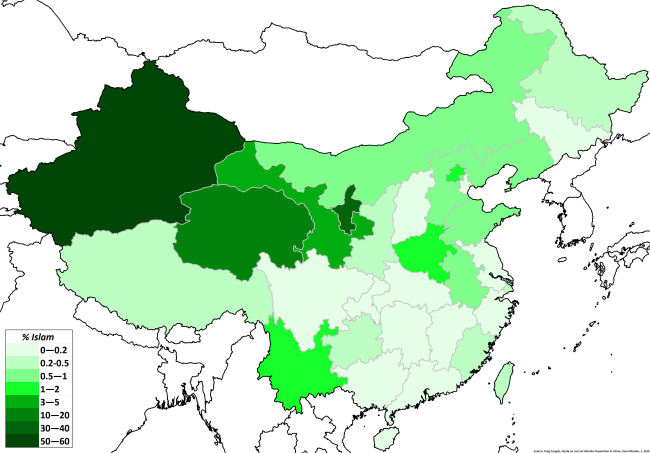
And the indicative nature has to be considered with the size of the population. For instance there are 22+ million Muslim citizens, most located in the northwest as indicated in the map on the right below. These are not immigrants from the Middle East, but rather are descendants of people who have lived in the area for centuries.

The majority of Han Chinese have something in common with the many American Christians. They have a problem with how the government deals with Muslims. Consider how difficult it is for the Chinese government to deal with a relatively small group of religious militants within a much larger Islamic population of 22+ million, all of whom are from families that have considered the area home since the time of the Roman Empire or earlier.

You must understand that within China the interplay of competing interests of all types is an undercurrent that usually cannot be seen in the familiar American forum of overblown news stories describing near shooting wars in the U.S. between ideologues steeped in bigotry nor in critical news stories of ham-fisted suppression by the autocratic Russian government of Putin which includes killing potentially effective political opponents.

To even begin to fathom what's going on in China requires understanding the structure of Chinese government. Because Americans and the American press are so enamored with celebrities, they are hampered when trying to discern what is going on in China. Confusion starts with the legislative branch.
 
Legislative Branch

In terms of government in China you must be aware of the existence of both the National People's Congress (NPC) and the Chinese People's Political Consultative Conference (CPPCC or PPC) which meet annually for just two weeks. [And you must remember that they are not the National Congress of the Communist Party of China (NCCPC) which meets every five years, anymore than the Democratic National Convention or the Republican National Convention which meet every four years are houses of Congress.]

Much like the Continental Congress functioned as the provisional government of the United States from September 5, 1774, to March 1, 1781, the Chinese People's Political Consultative Conference (CPPCC or PPC) was the de facto legislature of the People's Republic of China (PRC) after China's revolution from 1949 to 1954. In 1954, the Constitution transferred this function to the National People's Congress (NPC).

Today the role that CPPCC plays in the Chinese government is stated only in the preamble of the PRC Constitution:

    The Chinese People’s Political Consultative Conference, a broadly based representative organization of the united front which has played a significant historical role, will play a still more important role in the country’s political and social life, in promoting friendship with other countries and in the struggle for socialist modernization and for the reunification and unity of the country. The system of the multi-party cooperation and political consultation led by the Communist Party of China will exist and develop for a long time to come.

The CPPCC has been described as somewhat analogous to an advisory legislative upper house such as the British House of Lords and there have been occasional proposals to formalize this role in the PRC Constitution. We will explore further the CPPCC's role after considering the  National People's Congress (NPC).

The National People's Congress (usually abbreviated NPC) is the national legislature of the People's Republic of China. With 2,980 members in 2018, it is the largest parliamentary body in the world.

Under China's Constitution, the NPC is structured as a unicameral legislature, with the power to legislate, the power to oversee the operations of the government, and the power to elect the major officers of state. It holds annual sessions every spring, usually lasting from 10 to 14 days.

The electoral system is pyramidal. Delegates to the National People's Congress are elected for five-year terms by the provincial people's assemblies, who in turn are elected by lower level assemblies, and so on through a series of tiers to the local people's assemblies which are directly elected by the electorate.

There is a limit on the number of candidates in proportion to the number of seats available. At the national level, for example, a maximum of 110 candidates are allowed per 100 seats; at the provincial level, this ratio is 120 candidates per 100 seats. This ratio increases for each lower level of people's assemblies, until the lowest level, the village level, has no limit on the number of candidates for each seat.

The NPC meets for about two weeks each year at the same time as the CPPCC, usually in the Spring, called the "National Lianghui" (The National Two Meetings), making important national level political decisions. It can
  • amend the Constitution and oversee its enforcement;
  • enact and amend basic law governing criminal offences, civil affairs, state organs and other matters;
  • elect and appoint members to the central state organs; and
  • determine major state issues.
Which brings us back to the CPPCC.

The CPPCC, as noted above, functions as political advisory body consisting of delegates from a range of political parties and organizations, as well as independent members. It is intended to be more representative and be composed of a broader range of people than is typical of government office in the People's Republic of China.

Previously dominated by senior figures in real-estate, state-owned companies and the children of revolutionaries who helped the Communist Party gain power in 1949, this year more than half of the 2,158 delegates to the Chinese People’s Political Consultative Conference attended the meeting at the Great Hall of the People for the first time.

The composition of the CPPCC changes according to national objectives and priorities. For instance, with traditional business sectors such as real estate and energy deemed to be too closely associated with corruption (more than 20 property tycoons "dropped out" in 2018), replacements this year came from technology companies.

Consider how the 2,200 positions on the CPPCC are currently allocated among source organizations and cultural/social/economic sectors:
Seats for Political Parties (536 in all)
  •      Communist Party of China (97)
  •      Revolutionary Committee of the Kuomintang (65)
  •      China Democratic League (65)
  •      China Democratic National Construction Association (64)
  •      China Association for Promoting Democracy (45)
  •      Chinese Peasants' and Workers' Democratic Party (45)
  •      China Party for Public Interest (29)
  •      September 3 Society (44)
  •      Taiwan Democratic Self-Government League (20)
  •      Independent (62)
Seats for People's organizations (307 in all)
  • Communist Youth League of China (9)
  • All-China Federation of Trade Unions (60)
  • All-China Women's Federation (64)
  • All-China Youth Federation (28)
  • All-China Federation of Industry and Commerce (61)
  • China Association for Science and Technology (43)
  • All-China Federation of Taiwan Compatriots(15)
  • All-China Federation of Returned Overseas (27)
Seats for Sectors (1357 in all)
  • Sector of Literary and Art (142)
  • Sector of Science and Technology (110)
  • Sector of Social Science (71)
  • Sector of Economics (149)
  • Sector of Agriculture (67)
  • Sector of Education (113)
  • Sector of Sports (21)
  • Sector of Press and Publication (44)
  • Sector of Medicine and Health (88)
  • Sector of International Friendship Activists (42)
  • Sector of Social Welfare and Social Security (37)
  • Sector of the Ethnic Minorities (101)
  • Sector of Religion (65)
  • Specially Invited Hong Kong Dignitaries (124)
    •     Democratic Alliance for the Betterment and Progress of Hong Kong (25)
    •     Business and Professionals Alliance for Hong Kong (4)
    •     Hong Kong Federation of Trade Unions (2)
    •     Liberal Party (Hong Kong) (4)
    •     New Century Forum (1)
    •     New Territories Association of Societies (2)
  • Specially Invited Macao Dignitaries (29)
    •     Macau United Citizens Association (1)
    •     Macau Business Interest Union (1)
    •     Macau Union of Professional Interests (2)
    •     Progress Promotion Union/General Union of the Macao Residents' Associations (1)
    •     Union for Development/The Women's General Association of Macau (1)
  • Other Specially Invited Dignitaries (Including members of People’s Liberation Army and People's Armed Police) (154)

Of course, a majority of members in the CPPCC are among the 89.45 million members of the Communist Party of China. But one should not entirely dismiss the outreach effort and the fact that non-governmental members of the Communist Party of China are part of a broad spectrum of interests from within the Chinese population.

One must not minimize the ongoing interactions between NPC and CPPCC members that occurs between annual sessions. Nor should one minimize the ongoing interactions between NPC members and members of the provincial people's assemblies and lower level assemblies.

Between these sessions, power is exercised by the Standing Committee of the National People's Congress (NPCSC) which contains about 150 members. It has the constitutional authority to modify legislation within limits set by the NPC, and thus acts as a de facto legislative body.  It also has the power to interpret the laws of the PRC, including its constitution, as constitutional and legal interpretation is considered to be a legislative activity rather than a judicial one. While the Supreme People's Court actually decides cases, an interpretation is of written laws and the Constitution is defined as legislative in nature and not judicial. It is led by a Chairman, currently Li Zhanshu, China's top legislator who is completely unknown to 99% of Americans.

In terms of officials in relation to the the legislative structure, the Presidium of the National People's Congress nominates the President and Vice President of China, the Chairman, Vice-Chairman, and Secretary-General of the Standing Committee of the NPC, the Chairman of the Central Military Commission, and the President of the Supreme People's Court for election by the NPC.

The functions of the Presidium are defined in the Organic Law of the NPC, but not how it is composed. In practice its name list is raised by the Standing Committee of the National People's Congress of last term, and then revised and passed by the preparatory meeting of NPC, which is presided over by the Standing Committee of the National People's Congress. After the Presidium elected, the Session of NPC is presided over by the Presidium.

The 178-member Presidium is composed of senior officials of the Communist Party of China, the state, non-Communist parties and All-China Federation of Industry and Commerce, those without party affiliation, heads of central government agencies and people's organizations, leading members of all the 35 delegations to the NPC session including those from Hong Kong and Macao and the People's Liberation Army.

The President conducts and hosts state visits on behalf of the People's Republic. Under the constitution the "state visit" clause is the only presidential power that does not stipulate any form of oversight from the National People's Congress.

Nonetheless, the President has the power to promulgate laws, select and dismiss the Premier (prime minister) as well as the ministers of the State Council, grant presidential pardons, declares a state of emergency, issue mass mobilization orders, and issue state honours. In addition, the President names and dismisses ambassadors to foreign countries, signs and annuls treaties with foreign entities. According to the Constitution, all of these powers require the approval or confirmation of the National People's Congress.

Executive Branch

The State Council, constitutionally synonymous with the Central People's Government (particularly in relation to local governments), is the chief administrative authority of the People's Republic of China. It is chaired by the Premier, currently economist Li Keqiang, and includes the heads of each governmental department and agency. (In the politics of the People's Republic of China, the Central People's Government forms one of three interlocking branches of power, the others being the Communist Party of China and the People's Liberation Army.)

As the chief administrative organ of government, the State Council's main functions are to formulate administrative measures, issue decisions and orders, and monitor their implementation; draft legislative bills for submission to the NPC or its Standing Committee; and prepare the economic plan and the state budget for deliberation and approval by the NPC. The State Council is the functional center of state power and clearinghouse for government initiatives at all levels. With the government's emphasis on economic modernization, the State Council clearly acquired additional importance and influence. (The State Council controls the Ministry for National Defense but does not control the People's Liberation Army, which is instead controlled by the Central Military Commission.)

The State Council meets every six months. Between meetings it is guided by a Standing Committee that meets weekly. The standing committee includes the premier, one executive vice premier, three vice premiers, and five other state councilors (one of whom serves as Secretary General of the State Council, and two of whom concurrently serve as ministers).

The Council has 35 members: the premier, one executive vice premier, three other vice premiers, five state councilors (of whom two are also ministers), and 25 additional ministers and chairs of major agencies. The State Council directly oversees the various subordinate People's Governments in the provinces, and in practice maintains membership with the top levels of the Communist Party of China.

The Premier of the State Council of the People's Republic of China, sometimes also referred to informally as the "Prime Minister", is the Leader of the State Council of China), the head of government and holds the highest rank (Level 1) in the Civil Service. The Premier is formally approved by the National People's Congress upon the nomination of the President. Both the President and the Premier are selected once every five years.

The vice-premiers and state councilors are nominated by the premier, and appointed by the president with National People's Congress' (NPC) approval. Each vice premier oversees certain areas of administration. Each State Councilor performs duties as designated by the Premier. The secretary-general heads the General Office which handles the day-to-day work of the State Council.

There are 25 ministries each of which supervises one sector. Also there are 38 centrally administered government organizations that report directly to the state council. The heads of these organizations attend full meetings of the state committee on an irregular basis.  There are commissions which outrank ministries and set policies for and coordinate the related activities of different administrative organs. Offices deal with matters of ongoing concern. Bureaus and administrations rank below ministries.

The Judicial Branch

The judicial branch includes the National Supervisory Commission, the Supreme People's Court and the Supreme People's Procuratorate. We must note here that the judicial branch is more complex than the U.S. federal justice system but less complex if one were to include the justice systems of the 50 states. If one were trying to compare it to another country, the French system might offer some parallels while the English/U.S. systems offer almost none. Use the links above to learn more


The Military Branch

Some might argue that the military is not a separate branch. But structurally within the government it has too many parallels to Judicial Branch to not treat it as such. The following is an organizational chart:


The military branch includes the People's Liberation Army, People's Armed Police and People's Liberation Army militia, all supervised by the Central Military Commission of the People's Republic of China, supervised by the Standing Committee of the National People's Congress.

The PLA consists of five professional service branches: the Ground Force, Navy, Air Force, Rocket Force, and the Strategic Support Force. It also has a militia service branch, the PLA Militia. The PLA is the world's largest military force, with a strength of approximately 2,285,000 personnel. It is the fastest modernizing military power in the world, with significant defense projection capabilities. Recently, it has been rapidly developing and commissioning new arsenals including stealth technology, directed energy weapons, hypersonic missiles, etc.

The Chinese People's Armed Police Force (PAP) is a Chinese paramilitary police force. It has statutory authority to:
  • respond to riots, terrorist attacks or other emergencies;
  • guard government buildings at all levels (including party and state organisations, foreign embassies and consulates);
  • provide security to public corporations and major public events; and 
  • fire rescue duties. 
It includes the China Coast Guard and provides support to the PLA Ground Force during wartime. The PAP has a commander, a political commissar and several deputy commanders and deputy political commissars.

[It should be noted that the PAP does not do routine policing. The Ministry of Public Security (MPS) in the Executive Branch is the principal police and security authority of the People's Republic of China and the government agency that exercises oversight over and is ultimately responsible for day-to-day law enforcement. It currently has 1.9 million officers. Before 2006 local municipal police under the MPS formally were usually unarmed with firearms routinely in contrast to the soldiers of the People's Armed Police (PAP), however they are armed with expandable batons and incapacitant sprays. Sometimes, multiple use tactical knives are issued to the policemen. Since2006 they have been trained in the use of and have been issued sidearms.]

Organizationally the People's Liberation Army is still carefully supervised by the Central Military Commission of the Chinese Communist Party Central Committee. But today both the state and the party commissions are identical in membership, actually forming one identical institution under two different names.

The chairman of the Central Military Commission of the People's Republic of China, elected by the National People's Congress, is the commander-in-chief of the armed forces.  The 11-man commission issues directives relating to the PLA, including senior appointments, troop deployments and arms spending. Almost all the members are senior generals, but the most important posts have always been held by the party's most senior leaders to ensure absolute loyalty of the armed forces which over the millennia has a history of challenging the emperor.

The one personage who, as we've discussed in a previous post, has a kind of celebrity status, Xi Jinping, is President of the People's Republic of China, Chairman of the Central Military Commission, and General Secretary of the Communist Party of China. When you understand the Chinese system, while you cannot call him a dictator, it is most certainly fair to note that he is "the first among the oligarchs."


The Communist Party of China


Within this 21st Century reality in both the United States and China the normal routines of life go on for most people.

Both countries have governments. And historically every few years (5 years in China and 4 years in the United States) dominant political parties (one in China, two in the United States) have met nationally for several days to determine how best to have government govern. (In both countries the participation of minor political parties occurs with various limited results.)

In the United States most of the participants in the national Democratic and Republican political party meetings are determined by the popularity of Presidential candidates which, more and more, is based upon the celebrity status of political personalities. With 1.4 billion people, China's system must be different.

The following is the organization chart for the Communist Party of China (CPC):

The membership of the Communist Party of China (CPC) in 2017 was 89.45 million. That is more people than the total population of the 32 smallest states in the United States. But it is only 6%+ of the 1.4 billion population of China.

Some Americans try to compare that Communist party membership number to party voter registration in the United States.  Golly gee whiz, the Democratic Party has about 44.7 million registered voters while the Republican Party has about 32.8 million.

But those U.S. numbers cannot even predict the approximate votes cast by Democratic registered voters and Republican Party registered voters for candidates from their own party, much less represent the number actually participating in party organization functions at the local level which is minimal. In contrast to the Communist Party of China, U.S. political party participation is minimal.

To join the Communist Party in China, an applicant must be approved. In 2014, only 2 million applications were accepted out of some 22 million applicants. Admitted members then spend a year as a probationary member. In contrast to the past, when emphasis was placed on the applicants' ideological criteria, the current CPC stresses technical and educational qualifications.

Members are expected to participate and work, not criticize and complain all the time. There are numerous party committees at all levels of government which are appointed by the party congresses at all those levels of government. It is in those committees and congresses that policy is created. Final control, however, tends to be top down. But even that is not simple.

The role of the Party is to make certain that the goals and policies for the people as formulated and framed within the Party are achieved in China by assuring that resources and human energy is directed to achieve those goals.

In fact, the CPC still embraces democratic centralism, a principle conceived by Russian Marxist theoretician Vladimir Lenin which entails democratic and open discussion within the Party on policy on the condition of unity in upholding the agreed upon policies within government. This isn't a state democracy any more than the U.S. government is a state democracy (think of gun control policy when in the U.S. it pretty clear that a substantial majority of the population supports regulation and Congress absolutely refuses to adopt regulation).

Perhaps the most difficult idea for Americans to understand is the deep belief of the Chinese in the one-party-dominant system of China which seemingly constitutes an institutionalized oligarchy, meaning a form of power structure in which ultimate power rests with a small number of people, officials of the Communist Party.

Before exploring the truth of that, one thing needs to be made clear. Despite what you may read elsewhere, the Chinese do not literally embrace Marxist theory. The current generation understands that men like Mao won the war ending the century of humiliation - that period of intervention, imperialism, and slaughter by Great Britain, Russia, France, Japan and the United States in China between 1839 and 1949.

But they also understand that Mao, who died in 1976, almost lost the peace at least partly because of ideology. As a result, the economic ideology of the CPC has been evolving beginning in 1978.

Within the framework of CPC democratic centralism, beginning in 1978 new economic thinking has been incorporated at various times known as socialism with Chinese characteristics, Deng Xiaoping Theory, Three Represents, the Scientific Outlook on Development and Xi Jinping Thought on Socialism with Chinese characteristics for a New Era.

But that still doesn't explain away the institutionalized oligarchy which should be rejected by freedom loving people, like in America. Yeah, right. A response to that is offered in a footnote.1

Now that we've explored a "short" primer regarding the government of China, we need to consider the economic policy put in place in the March 2018 NPC and CPPCC session. Unfortunately we cannot depend upon the American press to give us a comprehensive picture even though it was a significant subject well discussed in a very important international conference this month, as we shall explain next.

__________________________
Footnotes:

1 Some American's get hung up on the issue of freedom. The goal of these posts is to discuss cultures and economies, but if "truth, justice, and the American way of freedom" are going to get in the way....

Pretend for a moment that you are a Chinese person who has received a decent education, perhaps even having spent some time in the United States. And you are fluent in reading English.

From your perspective the problem is that any ongoing news coverage of China caters to a knee-jerk reaction in too many Westerners, as we shall see. Americans start writing about the horrors of Marxist ideology because "proper" American thinking about freedom begins and ends with getting rich, with a side thought of being able to criticize others without retribution.

The American idea of a "big picture view" is a 72-inch TV screen. They freely express concerns about authoritarian rule in China while being ignorant of their own country which is built on the pain of native Americans - the largest population in world history to be subjected to government-sponsored genocide.


And it is as if they don't understand that Capitalism, which has an "-ism" at the end of the word. It is an economic ideology every bit as much as is Socialism and the evils of both ideologies when rigidly applied are real.

In much American writing, a government implementation of Socialism is an attack on freedom while the U..S. government's implementation of Capitalism is not even acknowledged despite the fact that it is much of the subject matter of the Constitution.

Most certainly most white Americans do not understand what "authoritarian" means or how it has been carefully implemented by governments in the U.S. to support Capitalism.

According to the Oxford English Dictionary authoritarian means "favoring or enforcing strict obedience to authority, especially that of the government, at the expense of personal freedom."

You know, of course, that the United States has the highest incarceration rate in the world.

The reason for this most Americans understand clearly. The United States has a set of government implemented laws that are based on a very subjective morality that has deliberately selective racial and religious bigotry components that would have been unacceptable in all other countries of the West in 1999.

The "Black Lives Matter" movement didn't arise because the United States offers the most authoritarian-free government possible to its people. If you're a black American, you live in a fearful world created by a police state not unlike Nazi Germany. If you read that as an overstatement, you are an "in-denial probably-white American" or participant in the police state culture.

If the enforcement of strict obedience to authority at the expense of personal freedom is what defines "authoritarian", then the United States is the most authoritarian country in the world. The People's Republic of China (PRC) doesn't even come close with an incarceration rate somewhere between Canada and Luxembourg.

Of course, in China the expression of opinion regarding political, economic, and social issues is subject to government restriction. And that includes a lack of freedom of the press. Whether within the United States today that is considered good or bad depends on

  1. whether people think that the press is an obstacle to their objectives and
  2. whether you believe the myth that entertainment can be defined as the press.
But one has to wonder about a people...

  1. that know their country has the highest incarceration rate in the world, 
  2. that know that most of the incarcerated are black and brown males, 
  3. that know that "a." and "b." were the result of a deliberate choice by white people, and
  4. that, without acting to stop it, know that their police are killing people (black and brown males) at a rate not seen in any other "first world" country but is frequently seen in the most backward of countries engaging in genocide,
...but who still think that the United States does not have authoritarian governments at all levels.

Pretend for a moment that you are a Chinese person who has received a decent education, perhaps even having spent some time in the United States. Would you think a system built on Capitalist ideology that imprisons many thousands of people - the highest per capita incarceration rate in the world - is much better than imprisoning a relative handful of people for being outspoken against the Communist Party? Would you think a system built on Capitalist ideology that has uniformed police killing more people in the street than any country in the world because of their race is much better than one built on Socialist ideology that kills people who engage in and advocate revolution?

But these posts are about the economic future of our children and grandchildren. So pretend for a moment that you are an American who knows practically nothing about the world's most populous nation which by many standards has the largest economy in the world. Since many understand that this nation, China, has already begun to replace the United States as the leader of the world, it is likely that it will be very important in the lives of your children and grandchildren.


  As the Chinese plan to make life better for
  their grandchildren, Trumpworlder's ardently
  struggle to make America second-rate again

The Goal of a Moderately Prosperous Society (Xiaokang society)

The Chinese text in the picture above is from the Shijing (Classic of Poetry), the oldest existing collection of Chinese poetry comprising 305 works dating from the 11th to 7th centuries BC.  Within it is the Confucian ode “Min lao” written in the 9th century B.C. Here is a translation of the "Min lao" with an interpretation in the 2017 review Yearning for the Lost Paradise: The “Great Unity” (datong) and its Philosophical Interpretations:

The people indeed are heavily burdened,
But perhaps a little ease (xiaokang) may be got for them.
Let us cherish this centre of the kingdom,
To secure the repose of the four quarters of it.
Let us give no indulgence to the wily and obsequious,
In order to make the unconscientious careful,
And to repress robbers and oppressors,
Who have no fear of the clear will (of Heaven).
Then let us show kindness to those who are distant,
And help those who are near;
Thus establishing (the throne of) our king.

    This ode shows a clear political message:

  1. the masses resort to a moral leadership (“cherish this centre of the kingdom”) that will 
  2. guide them to a peaceful era of social redistribution (“a little ease may be got for them”);
  3. this is the conduct to be followed both for the homeland and internationally (“show kindness to those who are distant, and help those who are near”); and
  4. this conduct will be a model for the world at large (“establishing the throne of our king”).

In January Jung-kyu Kim, director of ACA Investments, a Pan-Asian private equity firm headquartered in Singapore, wrote an article Why Does China Pursue a “Moderately” Prosperous Society? in which he noted:

    In his New Year address, Chinese President Xi Jinping reiterated his commitment to “building a Moderately Prosperous Society in all aspects.” As far as I can tell, no Western media made a note of this comment. Come to think of it, Xi’s address at the 19th National Congress, delivered on October 18, 2017, was also called “Secure a Decisive Victory in Building a Moderately Prosperous Society in All Respects.” In the speech Xi mentioned a Moderately Prosperous Society no less than 15 times. It was all over Chinese headlines, even though hardly any outside observer commented on it. What is going on?
    The little-mentioned term is in fact the key to understanding the contradiction lying at the heart of the Chinese Communist Party.

Indeed! What is going on when hardly any outside observers bother with what the President of the most populous nation with the worlds largest economy says in a speech? Unfortunately, the problem is that those in the North Atlantic/Mediterranean oriented Western press are basically ignorant of Asia, they have no sense of Chinese history (effectively the oldest continuing culture in the world), and they don't have any idea what has happened within Chinese government since the end of the third quarter of the 20th Century.

Chinese leader Deng Xiaoping used the terms Xiaokang society in 1979 as the eventual goal of Chinese modernization. Tell that to an American, even a reporter working for the mainstream media, and 99-in-100 would respond "who?" And that's a problem because those odds of recognizing that name wouldn't be much better in the Trump White House and I'm not sure they would have been much better in the Obama Administration.

Jung-kyu Kim was right, of course, when he said of "moderately prosperous society" that "the little-mentioned term is in fact the key to understanding the contradiction lying at the heart of the Chinese Communist Party." But it goes much further than that. For any nation, it is the key to effectively competing with 21st Century China.

So let's go back to that last quarter of the 20th Century when the plan for the current economic success of China was established. If you need to identify a person who brought about the late-20th Century change it was Deng Xiaoping. After Chairman Mao's death, Deng led his country through far-reaching market-economy reforms. But here is where it helps to understand the structure of Chinese government as explained in the previous post.

Beginning soon after Mao's death Deng served five years as Chairman of the National Committee of the Chinese People's Political Consultative Conference and Vice Chairman of the Communist Party of China. He then served eight years Chairman of the Central Military Commission of the state and Chairman of the Central Military Commission of the Party.

And yet, at no time was Deng President or Premier or Party Chairman.

Two years after his official retirement during his January and February of 1992 “Southern tour” to Guangzhou, Shenzhen, Zhuhai and Shanghai - the pioneering provinces and cities which led China's economic reforms,  Deng explained he did not believe that the market economy was synonymous with capitalism or that planning was synonymous with socialism.

He said, "planning and market forces are not the essential difference between socialism and capitalism. A planned economy is not the definition of socialism, because there is planning under capitalism; the market economy happens under socialism, too. Planning and market forces are both ways of controlling economic activity".

While embracing the move to open the economy to market forces might have been a good idea, the biggest problems with Capitalism - significant economic inequality, corruption, greed - rapidly appeared. China's current strategy is to continue with a mixed economy while tightening up on the the Finance, Insurance and Real Estate (FIRE) sector's corruption and greed through financial regulation and criminal prosecution plus finding ways to mitigate economic inequality.

Still, current Chinese President Xi Jinping has continued to embrace the goal of a moderately prosperous society or the three millennia old ideal of xiaokang for the people. According to President Xi Jinping, China's development model will be driven by “innovation, co-ordination, green, openness and sharingË® known as the Five Major Development Concepts.


Explaining the Five Major Development Concepts in detail would require at least five very long boring posts. Instead, here are links to five half hour TV news pieces on YouTube created for state-owned China Central Television by Robert Lawrence Kuhn who you probably don't know but can read about on Wikipedia. These videos can give you a sense of China's economic situation and plans.
[To learn more about China, its history and culture, watch the six episode The Story of China at PBS.org.]

If the lack of coverage of Xi's New Year's Speech is puzzling, the failure of the Western press to cover the 2018 Boao Forum for Asia Annual Conference is troubling.


The Boao Forum for Asia Annual Conference and the American press


As everyone knows this year's very significant The Boao Forum for Asia Annual Conference was being held in the second week of April. You didn't? Oh...well...it's not entirely your fault if you don't know about The Boao Forum for Asia.

There was almost no news coverage in the American press. To make matters worse Bloomberg dismissively said "Boao Forum for Asia, China’s answer to Davos." Actually, no, that misrepresents the truth.

Proposed in 1998 by Fidel V. Ramos, former President of The Philippines, Bob Hawke, former Prime Minister of Australia, and Morihiro Hosokawa, former Prime Minister of Japan, The Boao Forum for Asia (BFA), a nongovernmental and nonprofit international organization with a fixed conference date similar to "Davos", was formally inaugurated on February 27 2001.1

China is not Asia. Yes, Boao, Hainan Province, China serves as the permanent site of BFA Headquarters. Since 2002, BFA has been holding its annual conference at Boao. But it isn't China's version of anything. With that said, China is the largest economy in the world. So when China shifts its economic policy the Boao Forum Annual Conference will focus on the implications.

Ironically, among all the foreign news outlets and financial news outlets stories was a New York Times story with the headline Xi Jinping Promotes Openness at a China Forum Rife With Restrictions. In that story the prejudiced correspondent wrote:

    Yet even as Ms. Lagarde and Mr. Xi talked about that openness, forum attendees were unable to use Google, log on to Facebook or post to Twitter about the event unless they found a way to bypass China’s army of internet censors. In fact, aspects of the forum stand in stark contrast with the many ways China remains closed and intransigent.

In fact at that very time the story on the front page of every newspaper in America was about Facebook CEO Mark Zuckerberg's appearance before the House Energy and Commerce Committee on the matter of Facebook allowing both foreign nations and both commercial and political marketing sites access to the personal information of most users, presumably including the writer of the NYT story. There is more than a small amount of weirdness that she would choose to complain about not being able to "log on to Facebook" because the Chinese government regulates it while the U.S. government, which created the basic internet technology, permitted Russians to influence our elections through Facebook and other internet sites.

The Agenda of the 2018 Forum indicates the depth of discussion and opportunities for learning about the future of the world's economy from an Asian view:


Consider the three agenda items at the left below from among the many. Each offers a distinction between how the Chinese are viewing the future versus how the Trumpworld views the future.

The first - "From Big to Great" - with some irony uses Trump's buzzword "great" to point out that "big" may not be great when it comes to determining what makes good business sense. 

The second - "Financial Risks: Black Swan, Grey Rhino, & the Minsky Moment" - was discussed in a previous post (a Minsky Moment refers to a sudden major collapse of asset values which occur because long periods of prosperity and increasing value of investments lead to increasing speculation using borrowed money, a term coined by Paul McCulley who also coined the term "shadow bank").

While the Trumpworld politicians are trying to eliminate Dodd-Frank, China has made a priority in reducing the risks from speculative lending. In fact, unlike the United States in 2008, China is prosecuting bankers who have basically put the economy at risk to make themselves rich.

Finally, while Trumpworld is putting officers of major corporations in official government positions to make sure government decisions benefit the corporations, China is working to eliminate self-serving connections between government officials and the business community.

Based on observing both inside their government and what happens in the United States, the Chinese know that it is important to keep government regulators independent from the business community they regulate.

Americans, on the other hand, know from their own history that...oh, wait...Americans generally don't know their own history.

For instance, Republican Warren G. Harding, the 29th president of the United States, died in 1923 during his first term. At the time of his death, Harding was one of the most popular presidents, but the subsequent exposure of scandals that took place under his administration such as Teapot Dome eroded his popular regard, as did revelations of an affair by Nan Britton, one of his mistresses. In historical rankings of the U.S. Presidents, Harding is often rated among the worst.

The Teapot Dome Scandal involved an oil reserve in Wyoming which was one of three set aside for the use of the Navy in a national emergency. Naturally, the oil industry thought it should be developed. Edward L. Doheny, owner of the Pan American Petroleum & Transport Company, one of the largest oil companies in the world in the 1920s, received the rights following a series of shady maneuvers which ultimately resulted in Secretary of the Interior Albert Fall being convicted of accepting a bribe.

Then there was the Justice Department scandal involving payoffs from alcohol bootleggers to secure either immunity from prosecution or the release of liquor from government warehouses. And there was the Veterans' Bureau scandal. The Bureau was run by Charles Forbes who had sought to get full control of veterans' hospitals and their construction in his bureau. Harding agreed to the transfer as the politically-powerful American Legion backed Forbes and personally denigrated those who opposed him. Forbes then defrauded the government in the post WWI hospital construction allowing inflated billings, with the two construction companies getting the contracts dividing the profits with Forbes and the bureau's chief counsel.

And, of course, Harding has a 15-year affair with one woman while another woman was his mistress with whom he had a child. One biographer wondered why Harding's infidelity was held so much against him, given that Grover Cleveland was elected president in 1884 although it was known he had a mistress and may have fathered a son out of wedlock! (Cleveland was the only president in American history to serve two non-consecutive terms in office and during the Gilded Age as his second administration began, disaster hit the nation when the Panic of 1893 produced a severe national depression, which Cleveland was unable to reverse.)

Warren Harding appointed Herbert Hoover as Secretary of Commerce. Hoover held this position of responsibility for the regulation of American business and international trade during the entire Roaring Twenties period when the United States gained dominance in world finance, until he ran for and became President on March 4, 1929. Six months later, on September 4, 1929, the American economy began its collapsed into The Great Depression and did not recover for more than a decade until WWII.

It is very uncomfortable to consider the course of events and men leading America in the 1920's because of the current situation in the White House and Congress. It is even more uncomfortable when one realizes how Atlantic-centric the American press international coverage is, much as it was in the 1920's.

Jung-kyu Kim quoted above regarding the lack of Western press coverage of Xi's New Year's Speech co-wrote a book The Great Equal Society: Confucianism, China and the 21st Century which offers the core message that inner morality, first expounded by Confucius millennia ago, will resonate on both sides of the Pacific. The book provides a sweeping survey of the hot topics of dysfunctional government, crony capitalism, and the erosion of ethics in both Wall Street and Main Street.  In the book we see the new challenge to America akin to the 1960's space race:

    We hope that China seizes the Confucian vision and realises a society which can serve as an inspiration for the rest of the world, If China becomes just another America … with its materialist values, military expansionism and environmental degradation, then the world will have no reason to welcome its emergence. If China becomes a model civilisation … achieving a healthy and prosperous society [while] projecting a magnanimous and intelligent leadership globally - in a way that America is currently failing to do - then the world will surely laud and embrace its rise.
    What matters is not popular mandate per se but having able and selfless leaders. If the party can continue to produce such leaders, then the Chinese people will be only too happy to acknowledge its mandate of heaven.

The challenge for a nation is to have able, selfless leaders capable of offering magnanimous and intelligent leadership. Can the now celebrity-oriented American political system dependent upon popular vote compete against China's single party oligarchy in such a challenge?

If not, the United States will return to its pre-20th Century status of being a second-rate economic power by the end of the 21st Century, but without the availability of the 19th Century economic safety valve of the "go west young man" policy (which was, of course, dependent upon the state-sponsored genocide of the Native Americans).


__________________________
1On February 27, 2001 representatives from...

  • the Republic of the Philippines, 
  • the Commonwealth of Australia, and 
  • Japan
...the proposing countries - met with representatives of 23 other countries...

  • Bangladesh, 
  • Brunei Darussalam, 
  • Cambodia, 
  • China, 
  • India, 
  • Indonesia,  
  • Iran, 
  • Kazakhstan, 
  • Kyrgyz Republic, 
  • Laos, 
  • Malaysia, 
  • Mongolia, 
  • Myanmar, 
  • Nepal, 
  • Pakistan,  
  • Korea, 
  • Singapore, 
  • Sri Lanka, 
  • Tajikistan, 
  • Thailand, 
  • Turkmenistan, 
  • Uzbekistan, and
  • Viet Nam 
...to declare the establishment of Boao Forum for Asia. In 2006 Israel and New Zealand were added and in 2016 the Maldives was added to the formal sponsoring nations.

Or to put it another way, its membership list includes representatives of business and government from Australia, Bangladesh, Cambodia, China, France, Germany, Hong Kong, India, Indonesia, Iran, Israel, Japan. Kazakhstan, Korea, Laos, Macao, Malaysia, Maldives, Mongolia, Nepal, New Zealand, Pakistan, Philippines, Russia, Saudi Arabia, Singapore, Sri Lanka, Sweden, Switzerland, Taiwan, Tajikistan, Thailand, United States, Uzbekistan, and Vietnam.

American business members include The Boston Consulting Group, Nielsen, Western Digital Corporation, Rockefeller & Co., PayPal Inc., Seagate, UPS, Mars, Incorporated, JPMorgan Chase & Co., Xcoal Energy & Resources, Wal-Mart Stores, Inc., Pfizer Investment Co., Ltd., Visa, Worldwide Pte. Limited,  Medtronic, Wyeth Nutrition Co., Ltd., and Lennar International.

The current 12 member Board of Directors includes from the United States Henry M. Paulson, Jr. who has served as Chairman of the Board of Directors for The Nature Conservancy and was Co-Chairman of its Asia/Pacific Council, and Chairman of The Peregrine Fund, Inc.. Oh, and he also was the 74th Secretary of the Treasury from July 2006 until January 2009.

Monday, March 19, 2018

As the California Democratic Party crumbles (continued)
  Some California Democrats have discovered that
  California may prevent the takeover of the House

As noted previously in As the California Democratic Party crumbles (continued): California Democrats abandon key elections to monied interests per 2010 Prop 14 voter wishes and As the California Democratic Party crumbles: California's Democrats meet to create a winning year, only being anti-Trump may not be a panacea, the biggest single problem for Democrats in California is small-d democrats.

In the LA Times article today California's free-for-all primary election rules could surprise everyone in 2018 ... again we can read that indeed there is a problem here in the most Democratic of states that literally might prevent the Democrats from taking over the U.S. House of Representatives. Regarding the upcoming open primary the article notes: "The nonpartisan California Target Book now counts 60 Democrats running in the 14 districts currently represented by Republicans."

The article discusses the fact that Katie Merrill, whose Fight Back California political action committee is betting the bank on the seven Republican districts won by Democrat Hillary Clinton in 2016, has a real fear.

    Recent polling by Merrill's PAC found significant potential for GOP candidates in Southern California's hottest races to finish first and second — even though a plurality of those surveyed said they would "definitely" vote Democratic. That includes seats being vacated by Reps. Darrell Issa (R-Vista) and Ed Royce (R-Fullerton) and the reelection effort of embattled Rep. Dana Rohrabacher (R-Costa Mesa).
    Merrill said her group prefers to spend its money solely against Republicans but may have to help at least one Democrat stand out in some of those crowded primary contests. "We're going to have to shift our focus," she said.

As I wrote previously California Democratic Party doesn't want to offend even one Democrat who has an oversized ego. So they didn't endorse anyone to end up in the top two in any Congressional district where it is important. That's the California Democratic Party I've come to know and hate.

The Democrats are likely to lose their ⅔rds majority in the one or both houses of the Legislature at least partly because of the dumb democrats (small-d) who get to vote on implementing ideas that are ...dumb... such as the open primary.

But maybe this is all good, because I'm not sure the Democrats deserve to be able to set a policy agenda anywhere until they figure out that winning elections is the only "top group" priority for a political party. After a party wins then they can worry about structuring and implementing "second level" priorities - if they don't win, it doesn't matter what those second level priorities are.

Of course, those "second level" priorities should be policy structured and implemented so they can win two, four, and six years later.

Sunday, March 18, 2018

How the maintream media just discovered old news about elections and Facebook responded meaninglessly and you "liked" it adding to the data

Yesterday's New York Times with great fanfare offers us yesterday's ...no, years old... news. It appears they spent lots of money on reporter and editorial time finding out about something they could have learned from other news sources in 2016, or even as far back as 2013. And of course the rest of the mainstream media which apparently was equally ignorant has picked it up.


A little over a year ago, I wrote the post Why you should fear Trumpism's Steve Bannon: war with China within 8 years and other reasons.

I said: "If you're interested in how the world was radically changed by a young PhD candidate Michal Kosinski beginning in 2008 read The Data That Turned the World Upside Down...." Further elaborations were include, but that linked article published in 2016 by the Millennial news site Vice Motherboard included everything Americans needed to know about the use of Facebook member data and other data sources to steal from and mislead those Facebook members.

I also referenced a post-election Forbes piece Why Big Data Wasn't Trump's Achilles Heel After All which was a mea culpa by Bernard Marr, an expert on big data, analytics, and metrics who has worked with many of the world’s leading companies and governments on how to answer their most critical business questions using data and metrics. He acknowledges that an article he'd written in June 2016 about Trump's lack of data use was based on his own lack of information.

After telling you that this experimental voter manipulation was going on in the 2014 mid-term election, the New York Times article notes:

    An examination by The New York Times and The Observer of London reveals how Cambridge Analytica’s drive to bring to market a potentially powerful new weapon put the firm — and wealthy conservative investors seeking to reshape politics — under scrutiny from investigators and lawmakers on both sides of the Atlantic.
    Christopher Wylie, who helped found Cambridge and worked there until late 2014, said of its leaders: “Rules don’t matter for them. For them, this is a war, and it’s all fair.”
    They want to fight a culture war in America,” he added. “Cambridge Analytica was supposed to be the arsenal of weapons to fight that culture war.”

What is troublesome here is that neither the government of the Obama Administration nor any of the 50 state governments including tech fumbling California had a clue after 2014.

And the big mainstream press, which the Democratic establishment relies upon, reported this as news yesterday and today.

Besides the fact that the old establishment ignores the Vice news sources because, hey, the Vice folks are just kids, the truth is the old political establishment, which still can't technically relate to the internet as more than "pipes" and still can't secure their smart phones, needed to step aside before 2014 for people who can tell the important modern technology from consumer technology like safer autos and more reliable refrigerators.

Perhaps the time has come for some people to accept the fact that timely important news is not going to appear in the mainstream media because the mainstream media relies upon "important" people in New York and Washington. If you don't check the sources to listed to the right, or some similar source not dependent upon people over 60 talking to each other, you're likely uninformed about many, many important stories that will startle the Democrats in 2020.

The fact that Michal Kosinski's work with two other Cambridge researchers - David Stillwell and Thore Graepel - has been available online in PDF format since 2013 should trouble the Democratic establishment. It was in the news in 2013. Rebecca J. Rosen, now a senior editor at The Atlantic, who oversees the Business Channel, at about age 29 in 2013 wrote:

    With remarkable accuracy, researchers from the University of Cambridge and Microsoft have been able to discern people's gender, sexuality, age, race, and political affiliation, based solely on their Facebook likes. With significantly less accuracy, they've also tried to predict certain personality traits.... It's possible to see how, with a much larger corpus, even certain subtleties of personality could be recognized deep within the idiosyncratic data of Facebook likes.
    ...Just as we humans can make judgments about another person's intelligence, sexuality, or political leanings based on a scattershot set of clues -- entertainment preferences we know them to have or opinions we know them to hold -- a computer can do much the same. Its inputs may come by way of Facebook likes, but its process is familiar.

And from The Telegraph 2013 article 'Like' curly fries on Facebook? Then you're clever written by a similarly young journalist alert Neoliberals learned:

    Now researchers at Cambridge’s Psychometric Centre have joined forces with Microsoft to analyse more than nine million ‘likes’.
    Michal Kosinski, its operations director, said ‘liking’ curly fries was a very strong predictor for high intelligence.
    Kosinski, an internet entrepreneur, said they hoped to commercialise the analytic technology they had developed.

But it did not turn out be Kosinski who made the system commercially successful.

It was the privately held firm Cambridge Analytica. The father-daughter billionaire family team of Robert and Rebekah Mercer hold a significant stake in the company. The Mercer's are "card-carrying" Neoliberals who in addition to The Mercer Family Foundation, run by Rebekah, donate to the Heritage Foundation (Rebekah is a board member), the Cato Institute, the Media Research Center, the Club for Growth, American Crossroads, Freedom Partners Action Fund, the Goldwater Institute, and numerous other Neoliberal political organizations.

They were key financial benefactors for Breitbart News and were the ones who first introduced Steve Bannon to Donald Trump. Steve Bannon, of course, was on the Cambridge Analytica Board of Directors at its founding.

The fact that the members of Neoliberal community are technologically aware and curious seems to indicate they're wise in a time when wisdom about the 21st Century should be valued, a wisdom that is lacking in other American political communities. For instance, Democrats spend their time in Hollywood with people whose skills will be replaced by computers by mid-century.

In the meantime, with a loud hurumph Facebook just suspended Cambridge Analytica and its parent company SCL Group. Outstanding! Consider this from The Data That Turned the World Upside Down:

Kosinski and his team tirelessly refined their models. In 2012, Kosinski proved that on the basis of an average of 68 Facebook "likes" by a user, it was possible to predict their skin color (with 95 percent accuracy), their sexual orientation (88 percent accuracy), and their affiliation to the Democratic or Republican party (85 percent). But it didn't stop there. Intelligence, religious affiliation, as well as alcohol, cigarette and drug use, could all be determined. From the data it was even possible to deduce whether someone's parents were divorced.

The strength of their modeling was illustrated by how well it could predict a subject's answers. Kosinski continued to work on the models incessantly: before long, he was able to evaluate a person better than the average work colleague, merely on the basis of ten Facebook "likes." Seventy "likes" were enough to outdo what a person's friends knew, 150 what their parents knew, and 300 "likes" what their partner knew. More "likes" could even surpass what a person thought they knew about themselves. On the day that Kosinski published these findings, he received two phone calls. The threat of a lawsuit and a job offer. Both from Facebook.

In other words, Facebook knew what was going on six years ago. But Facebook is quintessential American company admired by most Americans.  And six years ago Facebook held its initial public offering and, at that time, it was the largest technology IPO in U.S. history. Facebook offered 421,233,615 shares at a price of $38 per share and raised $16.007 billion through that offering. Let's see, make $16 billion or protect America? No red-blooded American would criticize the choice to take the money.

So whoopee today that Facebook suspended companies that a half a decade ago laid the groundwork for the rich to get richer with the support of foolishly stupid Americans.

The fact is that much of the current important news cannot be found in the mainstream or Alt-Right or social media. As in the past, today much of the significant news first appears in narrowly-focused or technical media. "Back then" only a few specialized professionals could read it. But since the beginning of the 21st Century it has been immediately available to us all. And those who can use that knowledge will find it more rapidly than in decades past.

The Neoliberals read about the research in 2013 and were experimenting with it in 2014. The Democratic power structure was reading movie reviews.

In other words, if unlike Hillary and her campaign staff, you actually know both how to secure and to use use your phones and computers on the internet, then you pick up news about new ways to use data to manipulate groups of people for commercial or political ends. You understand that generally the public couldn't give a crap about the details of your policy proposals.

Right now the Republican and Democratic Parties are struggling with the 2018 midterm elections. That's their jobs.

Also, the Neoliberals are planning 2020 election strategy using 2018 to experiment. I wonder what new tools they've refined.

And the group opposing them ...wait, there isn't any group working to oppose the Neoliberals in the 2020 election just like no such national group of progressive organizations existed to work in 2014 on the 2016 election. In fact, there are no center or left-of-center groups comparable, much less hundreds of them financed by billionaires.