It does matter who will be the Democratic Presidential candidate in November. So Super Tuesday's primaries are important to Hillary Clinton and Bernie Sanders and other Democrats.
But looking at the big picture, it matters more who will be elected President, the Democratic candidate or Donald Trump (or one of those other Republican losers). And Super Tuesday is interesting more because of what the press doesn't note than what they have noted so far.
Three Super Tuesday primaries are being held in states that, absent the death of the candidate, in November will vote for the Democrat - Massachusetts, Minnesota, and Vermont. Five Super Tuesday primaries are being held in states that, absent the death of the candidate, in November will vote for the Republican - Alabama, Alaska, Georgia, Oklahoma, and Texas. Four Super Tuesday primaries are being held in states that historically are Presidential election swing states - Arkansas, Colorado, Tennessee, and Virginia.
So what does that mean? Well, as we all know Presidents are not elected by a majority of the voters but rather by the majority of the Electoral College votes.
Let's take the South Carolina results from the past two weeks because there is a 99.9% chance that South Carolina's nine Electoral College votes will go to the Republican. In November if the Republican candidate was Barney Fife, he would get the nine electoral college votes from South Carolina.
Hillary Clinton won in the South Carolina primary. Against Barny Fife in November, she would get no electoral college votes. Being popular with South Carolina Democrats will most likely be meaningless in November. Now I'm not picking on South Carolina Democrats. It will also be meaningless for November who wins the primaries in California in June because California's 546 Electoral College votes will go to the Democrat.
On Super Tuesday, who wins in the Democratic primary in Massachusetts, Minnesota, Vermont, Alabama, Alaska, Georgia, Oklahoma, and Texas will tell you nothing about whether a candidate will get enough Electoral College votes to beat Barney Fife in November.
The outcome in Arkansas, Colorado, Tennessee, and Virginia will tell you who has a chance to get those Electoral College votes. But look carefully at the turnout in those Democratic primaries compared to the Republican turnout.
If, say, the Republican winner in each of those states is Donald Trump and more registered Republicans turn out than registered Democrats, that will be an indicator of who could get the total of 39 Electoral College votes from those states - again Arkansas, Colorado, Tennessee, and Virginia.
Note that unlike the press, when it comes to the November election, the only election that will matter, I don't care who wins the Democratic primary in Oklahoma or Texas. I'm hoping it will be the winner in Arkansas, Colorado, Tennessee, and Virginia so that the Democratic Party will nominate a possible winner.
The old system of "smoke filled rooms" picking the candidate the party professionals think might have a chance to win looks less-and-less like a really bad system.

Monday, February 29, 2016


Saturday, February 27, 2016
Bernie Offers Simple Lies Just Like Trump to Get Enthusiastic College Age Supporters Working for Him
Because I'm old and isolated from the current college-age crowd, I did not understand Bernie Sander's appeal to the college age crowd. But after reading stories with quote after quote from college students, I get it.
He repeatedly offers up his idea of tuition-free public colleges. And in May 2015, the month after he announced his candidacy for President, he introduced his College for All Act. Golly gee, that sounds really good.
Being a skeptic, I immediately checked out how that has worked in his home state of Vermont where he must have successfully implemented it.
Well, actually no. He apparently hasn't sold the idea in his tiny home state of Vermont. In fact, it costs in-state students at Castleton University (formerly known as Castleton State College) $10,248 a year compared to $7,194 a year at California's Humboldt State University (formerly known as Humboldt State College).
So just to clear things up, in the tiny state of Vermont, Bernie-the-Leader hasn't even gotten the tuition cost down to California's level. Or maybe he never even tried. Maybe he just found a way to stir impressionable college students.
Incidentally, what you discover about tuition is that it is, at best, less than a third of the cost of a year at college. And that Vermont college website misleads by showing a total not incluidng books, supplies, transportation, and miscellaneous costs, which are indicated on the California web site. You college students are smart enough to add and subtract, right? So figure it out.
But, hey, free tuition as a democratic socialist idea is a proven solution to a major problem. Well, not exactly, or maybe not at all. I won't repeat the discussion found in this NPR story Fact-Check: Bernie Sanders Promises Free College. Will It Work?
Instead, I'm going to suggest that you budding socialist college students who are feeling the Bern study what happened when the Scottish National Party took power in Scotland in 2007 and eliminated tuition fees at public universities.
A Centre for Research in Education Inclusion and Diversity, University of Edinburgh, study concluded that that the free tuition plan essentially redistributed 20 million pounds from poor students to rich ones. That's a curious program for a socialist government to implement. But hey, that wouldn't happen with Bernie's leadership steering a right wing Republican controlled House of Representatives, right?
Whenever a politician, be it Donald Trump or Bernie Sanders, appeals to your self-interest with simple ideas, do some research! Otherwise you may end up feeling like a simpleton.
If you are a democratic socialist you should have serious concerns about state universities in this country. Google "corporations fund state universities" to give yourself something to worry about.
Monday, February 15, 2016
Replacing Scalia
The strategic choices for a Democratic win
I'm sure the late Supreme Court Justice Antonin Scalia would be both startled and grinning at just how fast the Republican Presidential candidate lineup and Senate Majority Leader Mitch McConnell turned mourning his death into a divisive debate.
A Possible 2-Year Recess Appointment
By dying on February 13, 2016, Supreme Court Justice Antonin Scalia instantly created a whirlpool of procedural speculation. Congress is in its normal President’s Day recess. The Senate last met on Thursday, February 11, during which it approved a “conditional adjournment resolution” for the Senate not to meet again until Monday, Feb. 22. The House met on Friday and at the close of business adopted the same adjournment resolution thus making it a concurrent resolution which you can view here.Even Fox News' well respected Congressional Reporter Chad Pergram acknowledges "Both bodies of Congress are operating in the perfect parliamentary status in which a recess appointment would be applicable."
What Pergram is referring to is Article II, Section 2, Clause 3 of the Constitution which states: "The President shall have Power to fill up all Vacancies that may happen during the Recess of the Senate, by granting Commissions which shall expire at the End of their next Session.”
Ironically Republicans became so incensed about some NLRB appointments in 2012 that they sued President Obama resulting in NATIONAL LABOR RELATIONS BOARD v. NOEL CANNING ET AL. (2014)12-1281. Much deliberately inaccurate information about how that case applies to the current situation is being bandied about by the news. If you read the decision, key language makes it clear that a recess appointment made right now, before February 22, to replace Scalia would be perfectly legal pursant to Canning (emphasis added):
A Senate recess that is so short that it does not require the consent of the House under that Clause is not long enough to trigger the President’s recess-appointment power. Moreover, the Court has not found a single example of a recess appointment made during an intra-session recess that was shorter than 10 days.In this case, the House has consented to the recess, the Senate clearly isn't in session to act on any matter, and this situation does follow the traditional practice.
Historical practice also strongly favors the broader interpretation. ...The Court is reluctant to upset this traditional practice where doing so would seriously shrink the authority that Presidents have believed existed and have exercised for so long.
Although the Senate’s own determination of when it is and is not in session should be given great weight, the Court’s deference cannot be absolute. When the Senate is without the capacity to act, under its own rules, it is not in session even if it so declares.
Additionally, one provision of the recess appointment clause apparently confuses pundits (emphasis added) - "which shall expire at the End of their next Session." As indicated on the Senate web site, the current session of Congress began Jan 4, 2016, and will end sometime in December assuming they follow normal practice. The next session will begin in January 2017 and end in December 2017. Thus, a recess appointment today could effectively be a two year appointment which even the Conservative journal the National Review explains.
There are enough cases on the current SCOTUS docket of serious concern to liberals and to the Obama legacy to make this approach tempting. But this approach could create a single issue for the Republicans to use to galvanize their voters and many independents. So far every indication is that it is not as tempting to the Obama Administration as creating a high-profile issue-oriented confrontation with Republicans in a Presidential election year.
The Long Game - A Democratic President and Senate
Former Constiutional Professor President Obama might decide to play the long game. He could begin by embracing a preference stated by Senate Democrats as described in the Washington Post:...In August 1960, the Democrat-controlled Senate passed a resolution, S.RES. 334, “Expressing the sense of the Senate that the president should not make recess appointments to the Supreme Court, except to prevent or end a breakdown in the administration of the Court’s business.” Each of President Eisenhower’s [three] Supreme Court appointments had initially been a recess appointment who was later confirmed by the Senate, and the Democrats were apparently concerned that Ike would try to fill any last-minute vacancy that might arise with a recess appointment. Not surprisingly, the Republicans objected, insisting that the Court should have a full complement of Justices at all times.Instead, Obama could nominate a candidate - let's assume he won't nominate a rabid lefty. All the current Republican Presidential candidates have embraced the words of Senate Majority Leader Mitch McConnell who stated the Senate should not confirm the nominee. This could focus the election on issues, some of which haven't even been discussed in debates. As even a conservative Wall Street Journal columnist discussing the impact of Scalia's death on the Republican candidates wrote:
The only person who may benefit more than Ted Cruz from Justice Scalia’s unexpected death is Hillary Clinton. Her campaign’s biggest challenge has been trying to convince young female voters that the fight for gender equality has not yet been accomplished. It’s hard to think of a more visceral example to make that argument than this.Of course, his understanding of the situation was far too limited.
Every major segment of the progressive electorate can be energized by cases now before the Court. In addition to women's reproductive issues, cases already taken up affect environmentalists and climate change policy, voting rights and political representation in communities of color, university admissions and race, the fate of undocumented immigrants, mandatory union dues, and more. And, of course, the Democrats can beat a constant background drum rhythm about the Citizens United decision and campaign finance.
If a Republican-controlled Senate fails to seriously consider an Obama nomination, they likely will stimulate voter turnout which the Democrats need to win. If they do seriously consider an Obama nomination, they will end up creating high profile discussion about the issues and emphasize how important the election is for progressives, stimulating voter turnout.
A high voter turnout will assure a Democratic win for the Presidency. And an issue focused, Senate-aware voter will likely be energized about Senate elections in a year when 24 Republican Senate incumbents are up for re-election compared to 10 Democrats. That is bad news for Republicans.
Of course, choosing this long-game option could fail.
Option 3 - Do It All
A third option has been suggested by one writer:Why not instead appoint a temporary Justice, someone old enough for it to be the capstone to a distinguished career, and then a different, younger, person for the permanent position. Make the temporary appointment someone very very liberal (Patrica Wald? Stephen Reinhardt?); make the permanent appointment someone more moderate.It's worth considering.
A Potential Surprise Legacy
In any event, Scalia has left an unexpected legacy, if President Barack Obama, Hillary Clinton and Bernie Sanders don't blow it.That legacy could be a generation of younger voters who have learned that while it may be fun to get involved in a Presidential election, the fact is that under the Constitution every President has very limited power when it comes to domestic issues (as opposed to foreign policy).
Without a campaigning to assure a majority of the Senate and the House of Representatives will support your President, your enthusiastic campaigning is really just throwing your President under the bus when it comes to issues like the economy, discrimination, abortion, etc.
Thursday, February 11, 2016
Hillary Clinton's Dilemma: the Centrist Third Way Policies of Bill's Presidency vs. Young Women
Bernie Sanders is popular among young women Democrats. That is not because they are uninformed, but because they and their generation have suffered the most from the fallout of Bill Clinton's era of economic prosperity for everyone but the middle-class and the poor.
As one observer has noted, the Hillary Clinton campaign has failed to create a "story of Hillary Clinton" that lends itself to effective campaigning. Her history could write such a story, but apparently somebody thinks she can discuss a wide range of issues in a bland way and get elected. She can't and here is why.
Hillary has to carry the weight of Bill Clinton's Presidency. That was not a very "progressive" period in the White House, more pro-capitalism and far more conservative than today's Democratic voters. She must repudiate the centrist Third Way philosophy of governance embraced by Bill.
I say "repudiate" because she can't disown Bill's Presidency as in the first year of his Presidency he quickly set up the Task Force on National Health Care Reform, headed by First Lady Hillary Rodham Clinton, to come up with a comprehensive plan to provide universal health care for all Americans.
That health care plan remains the most prominent national proposal associated with Hillary Clinton, dubbed by Republicans at the time "Hillarycare" a full 15 years prior to Obama's election. But Hillarycare can be viewed from hindsight and if anything it was at least as (if not more) insurance company oriented and provider oriented than Obamacare.
The core element of the proposed plan was an enforced mandate for employers to provide health insurance coverage to all of their employees. But it required each US citizen and permanent resident alien to become enrolled in a qualified health plan and forbade their disenrollment until covered by another plan. It proposed the establishment of corporate "regional alliances" of health providers to be subject to a fee-for-service schedule. It did list minimum coverages and maximum annual out-of-pocket expenses for each plan. And, yes, people below a certain set income level were to pay nothing.The act listed funding to be sent to the states just for the administration of this plan, beginning at $13.5 billion in 1993 and reaching a whopping $38.3 billion in 2003. I have no idea what it would cost today, but a "single-payer plan" would likely be cheaper.
A "single-payer plan" has never been proposed by the Clintons. Most voting Democrats in their gut favor "Medicare for all" and hate insurance companies. And the irony is today young adults find themselves buying health insurance directly because of either or both their circumstances and post-Obamacare choices of many employers. If I were those young people instead of an old person on single-payer Medicare, I'd probably feel the Bern also.
Then we have Bill Clinton's free-wheeling banking policies. There was the Gramm-Leach-Bliley Act, which repealed the Glass-Steagall Act, a cornerstone of Depression-era regulation. He also signed the Commodity Futures Modernization Act, which exempted credit-default swaps from regulation. In 1995 Clinton loosened housing rules by rewriting the Community Reinvestment Act, which put added pressure on banks to lend in low-income neighborhoods. Heated political debate by Bill Clinton notwithstanding, these policies certainly played a role in creating a permissive lending environment that led to The Great Recession and to the bank bailout. Logically, informed young Democrats today attribute part of their financial woes to Bill Clinton.
On the "Morning Joe" show the morning after the New Hampshire Primary Donald Trump explained the New Hampshire results: "The only thing he [Bernie Sanders] does know, and he’s right about, is that we’re being ripped off; he says that constantly; and I guess he and I are the only two that really say that."
Trump is right. And while pundits dismiss this as pandering to voters' anger and frustration, both Trump and Sanders frame the problem as that of the political economy of intertwined economic and political systems. All working class voters, not just the younger ones, know that there is something like this wrong in our country and believe correctly that this does them harm. The informed young Democrat realizes that the path to their stress was paved by Bill Clinton.
Hillary has a big problem to overcome. The schoolgirl who campaigned for Barry Goldwater as an adult has an image as conservative Democrat on economic issues and her campaign people seem to have no memory of the basics. "It's the economy, stupid" is a slight variation of the phrase "The economy, stupid" which James Carville had coined as a campaign strategist of Bill Clinton's successful 1992 presidential campaign against sitting president George H. W. Bush.
What "It's the economy, stupid" means is there are no other issues that matter to the voters if you aren't in front of key issues associated with the economy. The Clinton Campaign in fact does have a detailed economic plan. It's something that probably could get pushed through Congress over a period of time. If you are a middle-of-the-road Republican or a Conservative Democrat it would appeal.
But from a democratic socialist point of view it's full of "trickle-down" proposals - incentives in the form of tax breaks to encourage employers to compensate employees through profit sharing plans which frequently will mean giving employees shares in the company while taking tax breaks. It might be possible to not only get it through Congress but get widespread implementation because it is a corporate tax break that sounds beneficial to employees. It would be beneficial unless the company's stock tanks. (Have you checked your 401(k) in the past two months!)
Then we have to look further at the social polices of the Clinton Administration which, so far, tend to define Hillary ideologically.
There was the Violent Crime Control and Law Enforcement Act of 1994 which even Bill Clinton acknowledges resulted in at the federal level an increase in incarceration of mostly black men which led to prison overcrowding and it did encourage states to do a number of things that had the same result. The legal system relied on plea bargains to minimize the increased case load which was predictable. The bill expanded the death penalty. Most startling to many is that the bill effectively eliminated the ability of lower income prison inmates to receive college educations during their term of imprisonment, thus ensuring the education level of most inmates remains unimproved over the period of their incarceration.
There were a number of good intentions in the bill, but in the end its economic impact on the poor has been terrible. The only saving grace for Hillary Clinton, who gave a speech supporting the bill, is that Bernie Sanders voted for the bill after giving one of his Democratic Socialist speeches filled with platitudes.
One can't discuss the social policies of the Clinton Administration without discussing the Personal Responsibility and Work Opportunity Reconciliation Act of 1996 (PRWORA). A Republican bill, President Bill Clinton signed PRWORA into law on August 22, 1996, saying it was the "best chance we will have in a long, long time" to fulfill his 1992 campaign promise of "ending welfare as we know it." According to a Washington Post article at the time:
Further there are those that remember Bill Clinton signed the Defense of Marriage Act. In a June 1996 interview in the gay and lesbian magazine The Advocate, Clinton said, "I remain opposed to same-sex marriage. I believe marriage is an institution for the union of a man and a woman. This has been my long-standing position, and it is not being reviewed or reconsidered." Yes, he did criticize it as "divisive and unnecessary." And in more recent times he acknowledged part of his reason for signing the bill was to avoid associating himself politically with the then-unpopular cause of same-sex marriage while he was running for reelection. Like it or not, Hillary needs to recognize that the inaccessibility to same-sex marriage had significant negative economic impacts on gays and lesbians. And only one House Republican, only 65 House Democrats, and Independent Bernie Sanders voted against DOMA.
Unfortunately, Bill Clinton embraced the centrist Third Way philosophy of governance. It is a hopeful philosophical construct that seeks the pursuit of greater egalitarianism in society through action to increase the distribution of skills, capacities, and productive endowments, while rejecting income redistribution as the means to achieve this. In doing this, it pretends to be a kind of change on democratic socialism that Bill Clinton embraced. To quote one Republican we all know: "I gotta ask the supporters of all that, 'How's that hopey, changey stuff working out?'"
The problem is the centrist Third Way is not a variant on democratic socialism or even the philosopihical traditions of the New Deal and Great Society. It is a deviant. And every well-informed young black lesbian who grew up in a single-parent household knows this.
Now I have to let a young woman explain her view in this quote from an article by Clio Chang, an editorial intern at the New Republic and former a policy associate at The Century Foundation:
But I would suggest that those women who make that "I won't vote for Hillary just because she is a woman" statement read in its entirety an article also in the New Republic titled Hillary’s Missing Girls which reminds me why as the grandfather of two women under 30 I feel the need to vote for Hillary partly because she is a woman while acknowledging that I wouldn't vote for Sara Palin just because she's a woman:
As one observer has noted, the Hillary Clinton campaign has failed to create a "story of Hillary Clinton" that lends itself to effective campaigning. Her history could write such a story, but apparently somebody thinks she can discuss a wide range of issues in a bland way and get elected. She can't and here is why.
Hillary has to carry the weight of Bill Clinton's Presidency. That was not a very "progressive" period in the White House, more pro-capitalism and far more conservative than today's Democratic voters. She must repudiate the centrist Third Way philosophy of governance embraced by Bill.
I say "repudiate" because she can't disown Bill's Presidency as in the first year of his Presidency he quickly set up the Task Force on National Health Care Reform, headed by First Lady Hillary Rodham Clinton, to come up with a comprehensive plan to provide universal health care for all Americans.
That health care plan remains the most prominent national proposal associated with Hillary Clinton, dubbed by Republicans at the time "Hillarycare" a full 15 years prior to Obama's election. But Hillarycare can be viewed from hindsight and if anything it was at least as (if not more) insurance company oriented and provider oriented than Obamacare.
The core element of the proposed plan was an enforced mandate for employers to provide health insurance coverage to all of their employees. But it required each US citizen and permanent resident alien to become enrolled in a qualified health plan and forbade their disenrollment until covered by another plan. It proposed the establishment of corporate "regional alliances" of health providers to be subject to a fee-for-service schedule. It did list minimum coverages and maximum annual out-of-pocket expenses for each plan. And, yes, people below a certain set income level were to pay nothing.The act listed funding to be sent to the states just for the administration of this plan, beginning at $13.5 billion in 1993 and reaching a whopping $38.3 billion in 2003. I have no idea what it would cost today, but a "single-payer plan" would likely be cheaper.
A "single-payer plan" has never been proposed by the Clintons. Most voting Democrats in their gut favor "Medicare for all" and hate insurance companies. And the irony is today young adults find themselves buying health insurance directly because of either or both their circumstances and post-Obamacare choices of many employers. If I were those young people instead of an old person on single-payer Medicare, I'd probably feel the Bern also.
Then we have Bill Clinton's free-wheeling banking policies. There was the Gramm-Leach-Bliley Act, which repealed the Glass-Steagall Act, a cornerstone of Depression-era regulation. He also signed the Commodity Futures Modernization Act, which exempted credit-default swaps from regulation. In 1995 Clinton loosened housing rules by rewriting the Community Reinvestment Act, which put added pressure on banks to lend in low-income neighborhoods. Heated political debate by Bill Clinton notwithstanding, these policies certainly played a role in creating a permissive lending environment that led to The Great Recession and to the bank bailout. Logically, informed young Democrats today attribute part of their financial woes to Bill Clinton.
On the "Morning Joe" show the morning after the New Hampshire Primary Donald Trump explained the New Hampshire results: "The only thing he [Bernie Sanders] does know, and he’s right about, is that we’re being ripped off; he says that constantly; and I guess he and I are the only two that really say that."
Trump is right. And while pundits dismiss this as pandering to voters' anger and frustration, both Trump and Sanders frame the problem as that of the political economy of intertwined economic and political systems. All working class voters, not just the younger ones, know that there is something like this wrong in our country and believe correctly that this does them harm. The informed young Democrat realizes that the path to their stress was paved by Bill Clinton.
Hillary has a big problem to overcome. The schoolgirl who campaigned for Barry Goldwater as an adult has an image as conservative Democrat on economic issues and her campaign people seem to have no memory of the basics. "It's the economy, stupid" is a slight variation of the phrase "The economy, stupid" which James Carville had coined as a campaign strategist of Bill Clinton's successful 1992 presidential campaign against sitting president George H. W. Bush.
What "It's the economy, stupid" means is there are no other issues that matter to the voters if you aren't in front of key issues associated with the economy. The Clinton Campaign in fact does have a detailed economic plan. It's something that probably could get pushed through Congress over a period of time. If you are a middle-of-the-road Republican or a Conservative Democrat it would appeal.
But from a democratic socialist point of view it's full of "trickle-down" proposals - incentives in the form of tax breaks to encourage employers to compensate employees through profit sharing plans which frequently will mean giving employees shares in the company while taking tax breaks. It might be possible to not only get it through Congress but get widespread implementation because it is a corporate tax break that sounds beneficial to employees. It would be beneficial unless the company's stock tanks. (Have you checked your 401(k) in the past two months!)
Then we have to look further at the social polices of the Clinton Administration which, so far, tend to define Hillary ideologically.
There was the Violent Crime Control and Law Enforcement Act of 1994 which even Bill Clinton acknowledges resulted in at the federal level an increase in incarceration of mostly black men which led to prison overcrowding and it did encourage states to do a number of things that had the same result. The legal system relied on plea bargains to minimize the increased case load which was predictable. The bill expanded the death penalty. Most startling to many is that the bill effectively eliminated the ability of lower income prison inmates to receive college educations during their term of imprisonment, thus ensuring the education level of most inmates remains unimproved over the period of their incarceration.
There were a number of good intentions in the bill, but in the end its economic impact on the poor has been terrible. The only saving grace for Hillary Clinton, who gave a speech supporting the bill, is that Bernie Sanders voted for the bill after giving one of his Democratic Socialist speeches filled with platitudes.
One can't discuss the social policies of the Clinton Administration without discussing the Personal Responsibility and Work Opportunity Reconciliation Act of 1996 (PRWORA). A Republican bill, President Bill Clinton signed PRWORA into law on August 22, 1996, saying it was the "best chance we will have in a long, long time" to fulfill his 1992 campaign promise of "ending welfare as we know it." According to a Washington Post article at the time:
Clinton's acquiescence to a bill far less generous to the poor than the one he initially proposed strips an issue that GOP presidential candidate Robert J. Dole had planned to use against the president in this fall's campaign. But it also revealed a deep ideological fissure in Clinton's own party....That Hillary Clinton supported the bill even in 2008 when she was supporting Obama for reelection is clear from a New York Times article which has been quoted regularly because it can be quoted out of context:
But there was unusually sharp criticism from liberals. "My president – he's a winner . . . and the kids are the losers," said Rep. Charles B. Rangel (D-N.Y.).
Actually, the bill was not as devastating to the poor as expected as forcing families to rely on work instead of government money went comparatively well from 1996 to 2000 because the economy was booming. But there is a timing problem for Hillary as explained in this AP article:Mrs. Clinton expressed no misgivings about the 1996 legislation, saying that it was a needed — and enormously successful — first step toward making poor families self-sufficient.“Welfare should have been a temporary way station for people who needed immediate assistance,” she said. “It should not be considered an anti-poverty program. It simply did not work.”
More than 1 million low-income residents in 21 states could soon lose their government food stamps if they fail to meet work requirements that began kicking in this month.What has been saving the Clinton campaign on this issue is explained in this article:
...Recent experience in other states indicates that most of those affected will probably not meet the work requirements and will be cut off from food stamps.
For many people, "it means less food, less adequate nutrition. And over the span of time, that can certainly have an impact on health — and the health care system," said Dave Krepcho, president and chief executive of the Second Harvest Food Bank of Central Florida. Advocates say some adults trying to find work face a host of obstacles, including criminal records, disabilities or lack of a driver's license.
The work-for-food requirements were first enacted under the 1996 welfare reform law signed by President Bill Clinton and sponsored by then-Rep. John Kasich, who is now Ohio's governor and a Republican candidate for president.
What’s missing from Bernie’s “full-throated” progressive agenda, however, is welfare.But as the article reports Sanders voted against the bill and harshly condemned it in his 1997 book. As he begins to campaign outside states that have overwhelmingly white middle-class populations, this could become a serious problem for Clinton.
While Sanders frequently repeats and laments the statistic that one in five American children live in poverty, neither he nor Clinton has put forward a specific plan to address it. And neither spends much time talking about food stamps, housing subsidies, or the Earned Income Tax Credit, all essential programs for the poor.
Further there are those that remember Bill Clinton signed the Defense of Marriage Act. In a June 1996 interview in the gay and lesbian magazine The Advocate, Clinton said, "I remain opposed to same-sex marriage. I believe marriage is an institution for the union of a man and a woman. This has been my long-standing position, and it is not being reviewed or reconsidered." Yes, he did criticize it as "divisive and unnecessary." And in more recent times he acknowledged part of his reason for signing the bill was to avoid associating himself politically with the then-unpopular cause of same-sex marriage while he was running for reelection. Like it or not, Hillary needs to recognize that the inaccessibility to same-sex marriage had significant negative economic impacts on gays and lesbians. And only one House Republican, only 65 House Democrats, and Independent Bernie Sanders voted against DOMA.
Unfortunately, Bill Clinton embraced the centrist Third Way philosophy of governance. It is a hopeful philosophical construct that seeks the pursuit of greater egalitarianism in society through action to increase the distribution of skills, capacities, and productive endowments, while rejecting income redistribution as the means to achieve this. In doing this, it pretends to be a kind of change on democratic socialism that Bill Clinton embraced. To quote one Republican we all know: "I gotta ask the supporters of all that, 'How's that hopey, changey stuff working out?'"
The problem is the centrist Third Way is not a variant on democratic socialism or even the philosopihical traditions of the New Deal and Great Society. It is a deviant. And every well-informed young black lesbian who grew up in a single-parent household knows this.
Now I have to let a young woman explain her view in this quote from an article by Clio Chang, an editorial intern at the New Republic and former a policy associate at The Century Foundation:
Is it so outlandish to think that the circumstances in which each generation grew up would affect their political preferences? Particularly when those circumstances are of immense historical importance, like the Great Recession? While those who entered the workforce during Bill Clinton’s presidency may remember his legacy as an era of economic prosperity, that wealth hasn’t trickled down to today’s millennials. Two decades later, they are just as likely to hear criticisms of Clinton’s policies, such as welfare reform, DOMA, and mandatory minimum sentences. Indeed, when you take into account the root causes of the financial crisis, income inequality, and wage stagnation, the Clinton years start to look like part of a neoliberal-conservative consensus, as opposed to a liberal outlier between two Bush administrations. At a time when more young voters seem to be following all the correct steps for success—graduating high school, getting a college degree—but are still floundering, it’s no wonder that they are drawn to Sanders’s stacked-deck rhetoric.As an old person who is a registered Democrat, who became disenchanted as a Young Democrats delegate to the California Democratic Council in 1964, Chang's article is understandable and she did a good job of explaining the point of view of young women who say they won't vote for Hillary just because she is a woman.
While Hillary is not her husband’s keeper—and is certainly running on a much more progressive agenda—she is tied to several of her husband’s policies. Take, for example, the welfare reform bill (for which Hillary rounded up votes in Congress), which is now highly criticized for having contributed to keeping millions of women and children in deep poverty. Or her past comments about black children in gangs being super-predators. Clinton has not promoted these policies in her campaign, but she has not rejected them either. And, while Bill and his supporters may have seen conciliatory politics as the only option for a liberal in his position, millennials (especially black millennials, as Michelle Alexander points out) are now left dealing with the mainly negative results of that pragmatism, souring them towards Hillary’s entreaty for a similar approach to governance.
But I would suggest that those women who make that "I won't vote for Hillary just because she is a woman" statement read in its entirety an article also in the New Republic titled Hillary’s Missing Girls which reminds me why as the grandfather of two women under 30 I feel the need to vote for Hillary partly because she is a woman while acknowledging that I wouldn't vote for Sara Palin just because she's a woman:
According to a recent Washington Post study, 63 percent of young women identify as feminist and 45 percent have taken to social media to express their views on women’s rights. They are informed and active on issues like sexual assault and reproductive rights. They eagerly critique the representation of women in the media. But when it comes to casting a vote, they act like we already live in a post-feminist age. This, despite the fact that women still only make up 20 percent of Congress and 5 percent of Fortune 500 CEOs and still earn only 78 cents to a man’s dollar. As Sheryl Sandberg memorably put it: “If NASA launched a person into space today, she could soar past Mars, travel all the way to Pluto and return to Earth 10 times before women occupy half of C-suite offices. Yes, we’re that far away.”I would prefer that the Hillary Clinton campaign, which has already moved slightly away from the centrist Third Way, move much further toward the political philosophy represented by the economic policies of Presidents Franklin Roosevelt and Lyndon Johnson. That would be better for America and for those critical Millennial Democratic women and for a very large number of unemployed young men. And it might help Hillary get nominated.
The thinking among young women voters seems to be that voting for Hillary, at least in part because she is a woman, is not a confirmation of equality. They’re right: it’s not. But we don’t live in an equal world; gender still matters, and matters a lot. Women will only be equal in American society when their presence as candidates and leaders ceases to be remarkable, when they are just as likely to be elected president as men.
Though it’s noble, pretending the world is gender-blind doesn’t make it so. Does it really make sense to ignore gender in America’s presidential election, a race of world-changing significance, when, on the whole, and in most aspects of life, the world doesn’t? If companies didn’t think about gender, they wouldn’t have made any progress in correcting workplace inequities. If colleges didn’t think about race, they wouldn’t create diverse communities. It is strange that a society so self-conscious and reflective about demographic disparities tries to put these aside when it comes to filling the highest and most powerful job in the country. And it’s important to remember that we didn’t put those concerns aside in 2008: Electing the first black president was meaningful for black and white Americans alike. Eight years ago, it would have been preposterous to suggest that voting for Obama in part because of his blackness was a mark against the struggle for progress. Why has our thinking changed when it comes to a woman?
Saturday, February 6, 2016
How the next President will be elected (Hint: the voters don't elect the President)
This year's Presidential primary elections are riveting weekly entertainment, much like American Idol.
Unfortunately when the voting is done there are two winners who will face off against each other in another election that is much like a boxing match. Following all the trading of punches and cheering by the avid fans, the results will be determined by a group of "judges" not the fans.
As was discovered in 2000 by the uninformed American, the voters of the United States don't elect the President. Let me say that again. The voters of the United States do not elect the President. Instead, pursuant to the Constitution which was handed down to the Founding Fathers by God (well, it might as well as have been that way since we nearly worship the document), the President is selected by the members of the Electoral College.
Pursuant to the Constitution, delegations of members of the Electoral College from each state "come together" in their state to cast their "preference" for President based upon the majority of votes cast for President in their respective states. The candidate that gets 270 or more Electoral College votes becomes President. (In the unlikely case there is no winner in the Electoral College, the Republican House of Representatives will appoint the President. The House of Representatives is Republican because grass roots Republicans think it is really important to work hard to control the House of Representatives.)
Let me now qualify what I am about to say. If the candidates end up being Republican Donald Trump and Democrat Bernie Sanders, history offers little help in predicting who will win. Otherwise....
History assures us that the 148 electors from following states will vote for the Democratic candidate: California, Connecticut, Delaware, D.C., Hawaii, Massachusetts, Minnesota, New York, Oregon, Rhode Island, Vermont, and Washington.
History assures us that the 144 electors from following states will vote for the Republican candidate: Alabama, Alaska, Arizona, Georgia, Idaho, Kansas, Mississippi, Nebraska, North Carolina, North Dakota, Oklahoma, South Carolina, South Dakota, Texas, Utah, and Wyoming.
History indicates that the 94 electors from the following states are available to the Democrats to give away: Illinois, Maine, Maryland, Michigan, New Jersey, Pennsylvania, and Wisconsin. In other words, these states are likely to vote for the Democratic Party electors unless the Democratic candidate becomes unacceptable to Independents and some Democrats. If the Democrats win these electors, than they need to win "only" 28 more.
History indicates that the 14 electors from the following states are available to the Republicans to give away: Indiana and Montana. In other words, these states are likely to vote for the Republican Party electors unless the Republican candidate becomes unacceptable to Independents and/or some Republicans. If the Republicans win these electors, than they need to win "a whopping" 112 more.
The "more" electors will come from these states (the number of electors in each state is indicated): Arkansas 6, Colorado 9, Florida 29, Iowa 6, Kentucky 8, Louisiana 8, Missouri 10, Nevada 6, New Hampshire 4, New Mexico 5, Ohio 18, Tennessee 11, Virginia 13, West Virginia 5, and Wyoming 3.
Winning the Presidency isn't critical to the Republican agenda. Seventy percent of state legislatures, more than 60 percent of governorships, 55 percent of attorneys general and secretaries of state are all under Republican control. Republicans control 247 seats in the House of Representatives compared to 188 Democratic seats. Republicans control 54 seats in the U.S. Senate compared to 46 Democratic seats. So winning the Presidency isn't critical to the Republican agenda.
Nonetheless, the Republicans should be voting for the candidate who will not end up turning off some Republican voters and independent voters in Indiana and Montana. And for Republicans it is imperative that their candidate appeal to all Republican voters plus independent voters in Arkansas, Colorado, Florida, Iowa, Kentucky, Louisiana, Missouri, Nevada, New Hampshire, New Mexico, Ohio, Tennessee, Virginia, West Virginia, and/or Wyoming.
The Republicans should nominate Florida Senator Marco Rubio to try to block the Democrats from winning Florida. That would leave the Democratic candidate having to fight for votes in Arkansas, Colorado, Iowa, Kentucky, Louisiana, Missouri, Nevada, New Hampshire, New Mexico, Ohio, Tennessee, Virginia, West Virginia, and/or Wyoming.
The next President will get to appoint one or more Supreme Court Justices. This is critical to the liberal/progressive policies and programs of the Democrats. Further, if the Democratic candidate doesn't win, the Republican President will have a Republican Senate and House. At this time, the Republicans are formulating a plan to undo most liberal/progressive policies and programs should the Democrats give away the Presidency, the only branch of the United States government they control. Winning the Presidency is a do or die matter for the Democrats.
So all the primary BS notwithstanding, in the primaries the Democrats (and other liberals, progressives, or populists) should be voting for the candidate who they are sure will not end up in the general election turning off many regular Democratic voters and a lot of independent voters in downstate Illinois, Maine, Maryland, Michigan, New Jersey, Eastern Pennsylvania, and Wisconsin. Further, in the primaries the Democrats should be voting for the candidate who could appeal to all Democratic voters plus independent voters in the general election in Arkansas, Colorado, Florida, Iowa, Kentucky, Louisiana, Missouri, Nevada, New Hampshire, New Mexico, Ohio, Tennessee, Virginia, West Virginia, and/or Wyoming.
One thing is for certain. To win the Presidency, it doesn't matter how popular a candidate is with the "base" or "core" of the party during the American Idol phase (the primaries). In the November general election he or she must be acceptable to a broad range of voters.
Or maybe it will be Trump v Sanders. In that case it will be interesting to see what the regular voters who don't succumb to the American Idol approach will do with two candidates whose music isn't at all familiar nor comfortable and whose image is unappealing. In that situation they will be the voters who will determine who gets to be the next President.
Friday, February 5, 2016
Bernie Instead of Hillary - You've Got to be Kidding!
I'm watching friends and family deciding to support Bernie Sanders
against Hillary Clinton for the Democratic Presidential nomination. I'm
saying to myself: "You've got to be kidding!"
Initially I was stunned that after years of fighting for Affirmative Action I'm hearing women "progressives" saying they won't vote for Hillary just because she would become the first woman President. They rationalize saying it would be discriminatory. I think: "When did they start thinking like the right wingers on the Supreme Court who opposed affirmative action?"
Do they really want to pass up this opportunity? But that's not even my greatest puzzlement.
Bernie Sanders versus Hillary Clinton - what's the difference? As one writer put it:
I don't understand why people don't remember the Clinton health care plan of 1993 which made Hillary a political target for the right and which is a lesson I'm sure she hasn't forgotten. From Wikipedia:
Progress like this is almost never more than incremental in our country and takes time. Obamacare was passed because of the price Hillary paid in 1993. But let's face it, the biggest criticism from the left is that it wasn't revolutionary and contains compromises. Yes, that's true. That's how it has to be done.
The last Democratic President to successfully obtain a revolutionary policy change from Congress was Lyndon Johnson. He was a powerhouse in Congress before he became President, and we all know that he wasn't and couldn't have been elected President before 1964. But he got the Civil Rights Act of 1964 passed albeit a compromise version.
What people seem to forget is that in July 1965, after he was overwhelming elected President he got Medicare passed. In fact historians argue that Johnson's presidency marked the peak of modern liberalism in the United States after the New Deal era. Johnson is ranked favorably by some historians because of his domestic policies and the passage of many major laws, affecting civil rights, gun control, wilderness preservation, and Social Security.
Nonetheless, we should not forget that in achieving his revolutionary success in the Civil Rights Act, he did destroy the Democratic coalition created by Franklin Roosevelt that included the South.
Some argue that Bernie Sanders is going to get a revolution if he becomes President. You've got to be kidding. Neither he nor Hillary have that kind of clout with the current Congress. And as we have seen before, there is no way all these newly aware "populist" supporters of his are working hard on Congressional elections this year and will remain active for the Congressional elections in 2018.
So you have to ask yourself, do you really want to watch on Fox News some nitwit saying something like "How's that hopey, changey revolution working out for ya?"
In the meantime, let's not forget that Bernie is a politician and doesn't have some sort of clean, perfect lefty record.
In 1993, Sanders voted against the Brady Bill, which mandated federal background checks and imposed a waiting period on firearm purchasers in the United States and in 2005 he voted for the Protection of Lawful Commerce in Arms Act which prevents firearms manufacturers and dealers from being held liable for negligence when crimes have been committed with their products.
This doesn't make him bad, it makes him a politician who sometimes disappoints his supporters.
But why on Earth would Democrats want to nominate a grumpy old man over the person who could be the first woman President of the United States? Could this group delusional thinking prevail? You've got to be kidding.
Initially I was stunned that after years of fighting for Affirmative Action I'm hearing women "progressives" saying they won't vote for Hillary just because she would become the first woman President. They rationalize saying it would be discriminatory. I think: "When did they start thinking like the right wingers on the Supreme Court who opposed affirmative action?"
Do they really want to pass up this opportunity? But that's not even my greatest puzzlement.
Bernie Sanders versus Hillary Clinton - what's the difference? As one writer put it:
"It’s 'theory of change' debate at its core: one candidate intends to fight for progress through incremental gains; the other candidate believes a president can uproot the existing political system and replace it, institutional limits be damned."The institutional limits are real and if Sanders were to win the Presidency, the Congressional wagons would immediately circle to defend the status quo.
I don't understand why people don't remember the Clinton health care plan of 1993 which made Hillary a political target for the right and which is a lesson I'm sure she hasn't forgotten. From Wikipedia:
Opposition to the Clinton plan was initiated by William Kristol and his policy group Project for the Republican Future, which is widely credited with orchestrating the plan's ultimate defeat through a series of now legendary "policy memos" faxed to Republican leaders.Derthick's description of the proposal sounds a lot like the Patient Protection and Affordable Care Act (Obamacare) that was adopted 17 years later.
"The long-term political effects of a successful... health care bill will be even worse — much worse... It will revive the reputation of... Democrats as the generous protector of middle-class interests. And it will at the same time strike a punishing blow against Republican claims to defend the middle class by restraining government." - William Kristol memo, "Defeating President Clinton's Healthcare Proposal" 12/93
Op-eds were written against it, including one in The Washington Post by conservative University of Virginia Professor Martha Derthick that said:
"In many years of studying American social policy, I have never read an official document that seemed so suffused with coercion and political naivete ... with its drastic prescriptions for controlling the conduct of state governments, employers, drug manufacturers, doctors, hospitals and you and me."
Progress like this is almost never more than incremental in our country and takes time. Obamacare was passed because of the price Hillary paid in 1993. But let's face it, the biggest criticism from the left is that it wasn't revolutionary and contains compromises. Yes, that's true. That's how it has to be done.
The last Democratic President to successfully obtain a revolutionary policy change from Congress was Lyndon Johnson. He was a powerhouse in Congress before he became President, and we all know that he wasn't and couldn't have been elected President before 1964. But he got the Civil Rights Act of 1964 passed albeit a compromise version.
What people seem to forget is that in July 1965, after he was overwhelming elected President he got Medicare passed. In fact historians argue that Johnson's presidency marked the peak of modern liberalism in the United States after the New Deal era. Johnson is ranked favorably by some historians because of his domestic policies and the passage of many major laws, affecting civil rights, gun control, wilderness preservation, and Social Security.
Nonetheless, we should not forget that in achieving his revolutionary success in the Civil Rights Act, he did destroy the Democratic coalition created by Franklin Roosevelt that included the South.
Some argue that Bernie Sanders is going to get a revolution if he becomes President. You've got to be kidding. Neither he nor Hillary have that kind of clout with the current Congress. And as we have seen before, there is no way all these newly aware "populist" supporters of his are working hard on Congressional elections this year and will remain active for the Congressional elections in 2018.
So you have to ask yourself, do you really want to watch on Fox News some nitwit saying something like "How's that hopey, changey revolution working out for ya?"
In the meantime, let's not forget that Bernie is a politician and doesn't have some sort of clean, perfect lefty record.
In 1993, Sanders voted against the Brady Bill, which mandated federal background checks and imposed a waiting period on firearm purchasers in the United States and in 2005 he voted for the Protection of Lawful Commerce in Arms Act which prevents firearms manufacturers and dealers from being held liable for negligence when crimes have been committed with their products.
This doesn't make him bad, it makes him a politician who sometimes disappoints his supporters.
But why on Earth would Democrats want to nominate a grumpy old man over the person who could be the first woman President of the United States? Could this group delusional thinking prevail? You've got to be kidding.
Saturday, June 27, 2015
The Obergefell Decision As A Teaching Moment
Some think that this week's Obergefell v. Hodges (2015) Supreme Court decision is a "teaching moment" arising from a great victory. Such a decision by the Supreme Court when considered in a school environment needs significant context and discussion.
Fortunately, it is relatively easy to put it in context by comparing it to Brown v. Board of Education (1954).
In 1954 reporters who observed the Supreme Court in the Brown case were surprised by the 9-0 unanimous decision. Prior to the ruling, there were reports that the court members were sharply divided and might not be able to agree. The attendance of Justice Robert H. Jackson who had suffered a mild heart attack and was not expected to return to the bench until early June 1954 was also a surprise. Perhaps to emphasize the unanimity of the court, Justice Jackson was in his assigned seat when the court convened.
In the 2015 Obergefell case this week the Supreme Court ruled 5-4.
The signficant difference between the Brown and Obergefell decisions with regard to the Supreme Court is clear and can be taught:
Brown required continued legal intervention in all parts of this country to achieve compliance and was replaced with defacto school segregation based upon the "localness" of school districts continuing to this day. Racial discrimination, indeed even hatred, continues also.
Obergefell is about two adults having a right to the equal protection of the law in order to access the benefits arising from a state-issued marriage license. The decision is the right thing to do. But it is not going to make the homophobia go away. The issue couldn't even draw the vote of a sixth justice as the Obamacare ruling did earlier in the week.
Plans are already being made in some parts of the nation to resist same sex marriage because of homophobia, in many cases rising to the level of hatred. Even Obamacare creates anger, as the "conservatives" are already planning their continued efforts to undo the law.
The real teaching opportunity here can be found in the opinions of the four justices dissenting from the Obergefell ruling, both their written legal ones plus their prior and subsequent verbal ones. In the end, could it all be about people wanting to look down upon and wanting to feel superior to others, even to the point of systemically denying access to health care to other "lessor" human beings?
Regarding the Obergefell ruling, don't we need to consider how the institutionalized basis of homophobia evolved, which revered writings advocate that prejudice? And how do you explain that in a public elementary school environment?
Fortunately, it is relatively easy to put it in context by comparing it to Brown v. Board of Education (1954).
In 1954 reporters who observed the Supreme Court in the Brown case were surprised by the 9-0 unanimous decision. Prior to the ruling, there were reports that the court members were sharply divided and might not be able to agree. The attendance of Justice Robert H. Jackson who had suffered a mild heart attack and was not expected to return to the bench until early June 1954 was also a surprise. Perhaps to emphasize the unanimity of the court, Justice Jackson was in his assigned seat when the court convened.
In the 2015 Obergefell case this week the Supreme Court ruled 5-4.
The signficant difference between the Brown and Obergefell decisions with regard to the Supreme Court is clear and can be taught:
- In Brown even those justices who had reservations about the legal basis for the decision recognized that it was the morally right thing to do.
- In the Obergefell decision there was barely a majority of the justices who thought it was the right thing to do and the expressions of some of the dissenting justices reflect deeply felt moral outrage at the majority's ruling.
Brown required continued legal intervention in all parts of this country to achieve compliance and was replaced with defacto school segregation based upon the "localness" of school districts continuing to this day. Racial discrimination, indeed even hatred, continues also.
Obergefell is about two adults having a right to the equal protection of the law in order to access the benefits arising from a state-issued marriage license. The decision is the right thing to do. But it is not going to make the homophobia go away. The issue couldn't even draw the vote of a sixth justice as the Obamacare ruling did earlier in the week.
Plans are already being made in some parts of the nation to resist same sex marriage because of homophobia, in many cases rising to the level of hatred. Even Obamacare creates anger, as the "conservatives" are already planning their continued efforts to undo the law.
The real teaching opportunity here can be found in the opinions of the four justices dissenting from the Obergefell ruling, both their written legal ones plus their prior and subsequent verbal ones. In the end, could it all be about people wanting to look down upon and wanting to feel superior to others, even to the point of systemically denying access to health care to other "lessor" human beings?
Regarding the Obergefell ruling, don't we need to consider how the institutionalized basis of homophobia evolved, which revered writings advocate that prejudice? And how do you explain that in a public elementary school environment?
Monday, February 3, 2014
I'd Like to Teach the World America to Sing in Perfect Harmony....
Coke is not my favorite soft drink, but they have a commendable television commercial
history. Take a look at their 1971 commercial which still puts a lump in
my throat...
During the Super Bowl, Coke ran an ad entitiled "It's Beautiful." I liked the ad.
Ask yourself what's the one significant thematic difference between these ads (other than the song)?
After contemplating the matter a bit, the new ad brought out the pessimist in me. And apparently it sure enough evoked reactions from reactionaries that justifies my pessimism, according to news reports.
It seems that the folks at Coke, or at least some of them, believe they now have to try to inspire American's to sing in harmony.
That is a sad statement about America.
Saturday, February 1, 2014
The Drought: Why Californians north of the Tehachapi Mountains want to divide California
Different headlines and stories covering the one subject are Amid drought, California agency won't allot water and California officials forecast ‘zero’ water deliveries and California drought could force key water system to cut deliveries with the latter being from the LA Times.
The very lengthy first story from the AP in its lead paragraph tells us (emphasis added):
The second story from the Sacramento Bee in its lead paragraph tells us:
The third story from the LA Times in its lead paragraph tells us:
Of course, the LA Times story lead is accurate because if it rains 40" in Northern and Central California over the next few months things will be swell. Golly gee, don't alarm all those with those Southern California lawns.
However, the real impact is only now being alluded to. While all the articles offer some agriculture facts, this statement in the AP article tells what it means beyond the rest of us facing water shortages simply being inconvenienced:
Down further in the Bee's article:
The prices of California agricultural products could skyrocket. And that isn't just avocados for your Superbowl party guacamole or lemon juice for lemonade.
The California rice industry annually produces more than 2 million tons of rice. An average of 60 percent of the annual rice crop goes on America's dinner table, into sushi restaurants, made into beer, rice mixes and even pet food. Exports markets are also a key destination for California rice. Countries such as Japan, Korea, Taiwan and Turkey account for 40 percent of annual production.
But the Times tells this to the millions of readers living in LA LA Land:
Now on to today's above-the-fold front page stories:
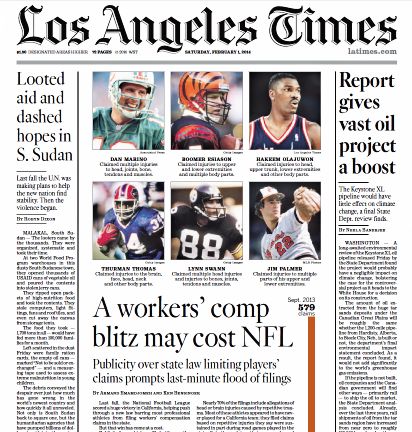
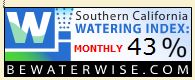
Of course a story on the problems of the NFL is what's important to most California Southlanders. California farmers are tearing out crops as Southlanders ask "Dear, what's the lawn watering index on the MWD web site" to figure out their frequency of lawn watering (click the index below if you don't believe it):
The very lengthy first story from the AP in its lead paragraph tells us (emphasis added):
Amid severe drought conditions, California officials announced Friday they won't send any water from the state's vast reservoir system to local agencies beginning this spring, an unprecedented move that affects drinking water supplies for 25 million people and irrigation for 1 million acres of farmland.
The second story from the Sacramento Bee in its lead paragraph tells us:
State officials announced Friday that 29 water agencies serving 25 million people across California can expect “zero” water deliveries from the State Water Project this summer because of the worsening drought.
The third story from the LA Times in its lead paragraph tells us:
Officials Friday said that for the first time ever, the State Water Project that helps supply a majority of Californians may be unable to make any deliveries except to maintain public health and safety.
Of course, the LA Times story lead is accurate because if it rains 40" in Northern and Central California over the next few months things will be swell. Golly gee, don't alarm all those with those Southern California lawns.
However, the real impact is only now being alluded to. While all the articles offer some agriculture facts, this statement in the AP article tells what it means beyond the rest of us facing water shortages simply being inconvenienced:
The timing for of Friday's historic announcement was important: State water officials typically announce they are raising the water allotment on Feb. 1, but this year's winter has been so dry they wanted to ensure they could keep the remaining water behind the dams. The announcement also will give farmers more time to determine what crops they will plant this year and in what quantities.
Farmers and ranchers throughout the state already have felt the drought's impact, tearing out orchards, fallowing fields and trucking in alfalfa to feed cattle on withered range land.
Down further in the Bee's article:
State and federal officials announced that starting today, water diversions from the Delta, a crucial wildlife habitat and California’s largest freshwater source, will be minimized to serve only urban areas and health and safety purposes. No water will be diverted for farms.
In addition, some 5,800 junior water rights holders across the state – mainly farms – will receive notices next week that they must reduce their water diversions from streams. And water quality rules in the Delta will be adjusted, which will increase salinity for some water users in the region and may affect wildlife.
The prices of California agricultural products could skyrocket. And that isn't just avocados for your Superbowl party guacamole or lemon juice for lemonade.
The California rice industry annually produces more than 2 million tons of rice. An average of 60 percent of the annual rice crop goes on America's dinner table, into sushi restaurants, made into beer, rice mixes and even pet food. Exports markets are also a key destination for California rice. Countries such as Japan, Korea, Taiwan and Turkey account for 40 percent of annual production.
But the Times tells this to the millions of readers living in LA LA Land:
But the practical effect is less stark because most water districts have other sources, such as local storage and groundwater, to turn to. Officials stressed that the cut did not mean faucets would run dry.
The Metropolitan Water District of Southern California, the state project's largest customer, has said it has enough supplies in reserve to get the Southland through this year without mandatory rationing.
Now on to today's above-the-fold front page stories:
Of course a story on the problems of the NFL is what's important to most California Southlanders. California farmers are tearing out crops as Southlanders ask "Dear, what's the lawn watering index on the MWD web site" to figure out their frequency of lawn watering (click the index below if you don't believe it):
Tuesday, January 21, 2014
To A God Unknown: Steinbeck, Stine, and Medieval California
After a time of wandering, Joseph came to the long valley called Nuestra Señora, and there he recorded his homestead. Nuestra Señora, the long valley of Our Lady in central California, was green and gold and yellow and blue when Joseph came into it. The level floor was deep in wild oats and canary mustard flowers. - from To A God Unknown by John SteinbeckIn his 1933 novel To A God Unknown, John Steinbeck tells an allegorical tale of the California experience. The protagonist, Joseph, comes to California to create his future. He discovers a place of apparent wealth and promise. And indeed he appears to be achieving all that he dreams. But over time, tragedies strike and a drought undoes his life work.
The story is about the arrogance of Californians who hold the belief that their efforts as humans, individually and collectively, create orderly wealth in a place where natural wealth has always existed in its own order of things.
In the "California Gold Rush" from 1848 to 1853 some 12 million ounces of gold was removed from the streams of "Gold Country" before hydraulic mining was used on ancient gold-bearing gravel beds that were on hillsides and bluffs in the gold fields sending large amounts of gravel and silt, in addition to heavy metals and other pollutants, into streams and rivers. Once the gold was depleted, gravel and silt remained in the areas affected.
Farmers followed the miners to extract another kind of wealth. In the Sacramento Valley and the Sacramento-San Joaquin River Delta reclamation districts were formed to prevent the flooding of farm lands by building an extensive levee system. In the same period, dams with water diversion and canal projects were proposed and subsequently built to move water into the desert areas of the Southern San Joaquin Valley and all of the State south of the Tehachapi Mountains in the California Aqueduct. Water became "Liquid Gold" for Californians as it seemed quite plentiful in the 1950's.
New Californians hadn't read To A God Unknown. Instead they believed that water was an endless resource of wealth for future Californians. Lands that once were orchards in Southern California. the San Francisco Peninsula, and Santa Clara County, and farms in the Central Valley became subdivisions of housing for large populations, urban/suburban populations that were now dependent upon that water for human consumption competing with the remaining agricultural interests. In 2009 the Southern San Joaquin Valley has become the first area in the State to suffer significantly from the continuing drought as reported in a previous post.
People in cities may forget the soil for as long as a hundred years, but Mother Nature's memory is long and she will not let them forget indefinitely. - Henry Cantwell Wallace.At the time of that 2009 post, "The Great California Slump" had resulted in a considerable disruption to the California economy, disruption that continues today, disruption caused by simple greed.
We must lay hold of the fact that economic laws are not made by nature. They are made by human beings. - Franklin D. Roosevelt
People need to be cautious because anything built by man can be destroyed by Mother Nature. - Russel L. Honoré
At that point, the idea of a drought that could destroy an economy was only understood by California's long declining population of non-corporate farmers, some "pointy headed" academics, and a very few true environmentalists (not the kind that see important solutions in electric cars), all of whom had been speaking out for years to a deaf population.
The remainder of Californians continued to believe in the Golden Cities myth that drove the Spanish to explore and conquer in the 15th-18th centuries. Continuing that heritage, Californian's prefer to hear Governor Jerry "Moonbeam-the-Spinmaster" Brown tell us we can move out of this time of continuing economic crisis into another period of wealth-building by embracing fun-but-already-stale technology. That Southern San Joaquin Valley drought was just an anomaly, not warning that California is subject to Mother Nature's memory and she is prodding our memory.
We 21st Century Californian's need to become familiar with history of the soil that we have chosen to squat on to create an economy, perhaps by first looking up from our portable devices long enough see the nature of what we occupy.
After we have gained some familiarity with the soil under our feet and cities, Californian's should use their portable devices to access a convergence of studies done in the mid-1990's (and later ones based upon that '90's groundwork) to learn three facts: (1) the 20th Century Californian experienced far fewer extreme dry years and more wet years than the Californian's who lived here the preceding three centuries who offered anecdotal reports of extreme droughts, reports generally ignored by most except than those few who listened like Steinbeck; (2) starting around 900 AD California suffered two droughts, one lasting 220 years (from A.D. 892 to A.D. 1112) and the other 140 years (from A.D. 1209 to A.D. 1350); and (3) during the past 3,500 years, most of the time the "California experience" was much drier than the "normal"165 year American California experience.
John Steinbeck's second novel To A God Unknown published in 1933 was later acknowledged as the hardest for him to write, taking him more years than his better known works. Part of the problem is that he initially tried to adapt a play written by a friend but kept adding context based upon facts as he understood them. And what he understood from the generations of Californians who preceded him was the truth about the land and the water, a truth we need to face.
About every thirty years there have come periods of rainlessness to Central and Southern California. These desolating years seem to come creeping up out of lhe white desert to warn the west that it will one day die as the desert has died. They are like the Reminders of Death at an Egyptian feast ....Joe's "terror" came from a normal California weather cycle. Twenty years ago in 1993, Scott Stine, Ph.D, of the Department of Geography and Environmental Studies at California State University, Hayward, completed a research study entitled "Extreme and Persistent Drought in California and Patagonia During Mediaeval Time" which was subsequently published in June 1994 in the academic journal Nature. In it he offers the evidence, now supported by others, that indeed before and after the year 1000 AD California had two droughts that lasted well over 100 years.
And now the periodic drought had settled on the land. Little by little, year on year the water was sucked from the ground. The hills looked gaunt and hungry and pale. The bones of many thousands of starved cattle were whitening on the ground. Two families of Waynes packed up their possessions and drove away. Joe watched his dying land with terror and with loathing. - From an early draft of To A God Unknown by John Steinbeck
In May 2001 the website Sierra Nature Notes: The Online Journal of Natural History News in the Sierra Nevada published a followup article by Stine "The Great Droughts of Y1K" in which he explained what he believed to be the weather pattern associated with the 100+ years droughts:
One may reasonably ask why these droughts occurred. The simple answer lies in the wintertime configuration of the "storm track" (a.k.a. the "jet stream" and the "polar front") over the northeastern Pacific. When the storm track persists over California for much of the winter (as it did, say, in 1982, ‘83, 86, and ‘96), many Pacific cyclones are steered over the state, and we accumulate much precipitation. When the track lies to the north of California, the fronts are steered away, and the region remains dry. This latter case prevailed during the 1976-77—the one period of our instrumental record dry enough to provide an analog to the Medieval droughts. Nineteen seventy-seven, it turns out, was not only the driest winter on record over much of California, it was also the wettest winter on record over much of Alaska. Simply put, rather than the storm track bowing south over California, in 1976-77 it bowed north over Alaska, and held there.This year we saw that very same weather pattern as illustrated by this one recent satellite image:
Evidence is now emerging that the "dry-winter-in-California, wet-winter-in-Alaska" model holds true not only for 1976-77, but for much of upper Medieval time as well....

That persistent weather pattern indeed created the current drought situation in California. The real question for Californian's is whether the pattern will be seen regularly over the next decades? And if so, will Californian's come to understand that we are living off the artificial and transient wealth structure created over the last 165 years? And if we come to understand it, will that understanding come too late? And if it doesn't come too late, will we respond with sufficient energy and speed to successfully prevent a major disruption in our economy?
After all, we Californian's are the people who in the San Joaquin Valley allowed ground subsidence to happen from pumping too much groundwater as explained below (from a USGS website):
What is critically needed now at the beginning of the 21st Century would be very expensive and complex. And it is needed immediately. It can be summarized in two statements:
This photo shows the approximate location of maximum subsidence in the United States, identified by research efforts of Dr. Joseph F. Poland (pictured). The site is in the San Joaquin Valley southwest of Mendota, California. Signs on pole show approximate altitude of land surface in 1925, 1955, and 1977.
In this case, excessive groundwater pumping allowed the upper soil layers to dry out and compress and compact, which is by far the single largest cause of subsidence. Soil compaction results in a reduction of the pore sizes between soil particles, resulting in essentially a permanent condition—rewetting of the underground soil and rock does not cause the land to go back up in altitude. This results in a lessening of the total storage capacity of the aquifer system. Here, the term "groundwater mining" is really true.

- Virtually all of the urban areas of Southern and Coastal California need to quit transporting water from distant rivers and switch to desalinization for municipal water. To do so we need to get rid of silly ideas like the Governor's expensive bullet train, the funding for which would fund some of the preliminary engineering needed to solve the urban water crisis.
- Farming and ranching within California requiring large water transfers from distant sources and/or over-pumping of groundwater should cease. These activities need to become sustainable using local water resources wisely.
Joseph leaned back against his saddle again, and suddenly he chuckled. "I will go," he said. "I will take every means. Look, Juanita. You know this place, and your ancestors knew this place. Why did none of your people come here when the drought started. This was the place to come."Four currently living generations of Californian's have been trying to achieve the California Dream, each one thinking his or her Dream is unique. It is the same Dream described by Steinbeck and like all dreams, in reality it can become an ordeal.
"The old ones are dead," Juanita said soberly. "The young ones may have forgotten." - from To A God Unknown by John Steinbeck
Dr. Stine's 1993 study was reviewed in a less academic article in the July 19, 1994, New York Times article "Severe Ancient Droughts: A Warning to California"which at the end offered the following observation:
But in the end, he said, a reprise of the medieval droughts would simply overwhelm California's efforts to cope. And he said: "We don't need 200 years of drought to bring us down. At some point, in the 9th year, or the 15th year or the 19th year, the damage is done and it doesn't matter any more."In the 20th Century the rain came breaking up each comparatively short dry cycle with wet years. Whether that will continue in the 21st Century without a decade or more of drought is unlikely. Dr. Stine explains it well in the Sierra Nature Notes article:
...Persistent droughts, moderate by Medieval standards but strident relative to our "normal" conditions of the past 150 years, drew lakes and rivers well below their modern levels on numerous occasions during the past two millennia, most recently during the late 18th and early 19th centuries. Indeed, increasing evidence indicates that there is little that is climatically "normal" about the past century - and- a-half; it appears, in fact, to be California’s third- or fourth-wettest century-scale period of the past four or more millennia.The challenge is to not have our grandchildren explaining to their children that the worst case scenario happened because our generations thought bullet trains or smart phones deserved our attention and financial resources. We do not want to regret our failure to see the soil as did Steinbeck's Joseph Wayne:
Since statehood, Californians have been living in the best of climatic times. And we’ve taken advantage of these best of times by building the most colossal urban and agricultural infrastructure in the entire world, all dependent on huge amounts of water, and all based on the assumption that runoff from the Sierra Nevada will continue as it has during the past 150 years. Yet even in these best of times we have run out of surplus water, and we fight over allocation.
And time passed and Joseph grew grey too.... "I should have known," he whispered.... "I am the land," he said, "and I am the rain." - from To A God Unknown by John Steinbeck
Tuesday, December 3, 2013
Microsoft Surface Pro 2 - Your business future needs the most convenient power PC ever created!
It's clear to me the Surface Pro 2 will set the standard for business
and other serious computing in the future. Microsoft is a company that
has been successful dominating the business market thereby being a part
of the world's economic productivity increase filling an essential role
in the offices of most businesses and governments. They are so dominant
that most of the news stories and blogs aren't extolling their dominance
but rather about how some have struggled successfully to get rid of
Windows and how well competitors are doing.
Now for some reason Microsoft seems think it needs to compete with Apple in the leisure content device business and Sony in the game box business. Perhaps it's the pundits and experts who equate short-term consumer sales volume with success - the "what did you earn this morning, who cares about next year or five years from now" mentality. But just maybe Microsoft has found the course to follow for the long-term future.
This week we read about the Black Friday sales of the new Microsoft XBox One which supposedly outsold the new Sony Playstation 4. That's apparently important news for Microsoft because the news also keeps reporting that the Surface (non-Pro version) is still not competing well against the iPad.
The fact is the Surface (non-Pro) 2 with Windows RT and either 32 or 64 GB of storage can compete in the tablet market. And because it has a version of Microsoft Office (yes, including Outlook) on it, it will interface effectively in most business environments. However, it's designed to compete in the consumer marketplace, not really in the business-to-business sales rat race.
But the Surface Pro 2 is something different. And here's where the pundits and maybe even Microsoft marketers are missing the point.
"Ready to own the most productive tablet on the planet?" That is the marketing tag line used by Microsoft. It doesn't really get to the point. "Your business future needs the most convenient power PC ever created!" would be a better, or at least a companion, tag line.
Let me make my point clear - the Surface Pro 2 is a Windows 8.1 PC. It has the power of any Intel-processor-based Windows OS desktop or laptop computer seen in the most up-to-date business or home office. The fact that it is in tablet form with a built-in touch-screen monitor is merely a handy plus. It replaces this...


The "PC" Hardware.
Like all "desktop" computers, the Surface Pro 2 needs to be connected to all the peripherals when it's used at your desk. Here's what we did.
The Pro 2 has one USB 3.0 port and an HDMI port. We chose to connect it to a Plugable UD-3900 USB 3.0 Universal Docking Station. This provides a SuperSpeed USB 3.0 (5 Gbps) link from the Pro 2 to our network via wire, two additional USB 3.0 ports and four USB 2.0 ports, as well as offering an additional monitor and audio connection.
But we needed more USB 2.0 ports. My wife's existing desktop computer peripheral setup included 6 USB 2.0 devices (keyboard, mouse, scanner, laser printer, label printer, and backup hard drive). So we connected to one of the Docking Station's USB 2.0 ports a Plugable 7 Port High Speed USB 2.0 Hub. We replaced her old monitor with a HP Pavilion 23TM 23-inch Touchscreen LED Monitor which requires a USB 2.0 connection (for the touchscreen function which is functionally an additional "mouse" connection). Additionally, we've added a Samsung DVD+/-RW Slim USB 3.0/2.0 external drive.
Since her readily accessible data storage needs require substantial disk space (among other factors, she manages our 50,000+ music tracks), two USB 3.0 WD My Passport Ultra 1TB Portable External Hard Drives were attached to the Docking Station.
Voilà, we have a desktop computer with a 4th Gen Intel® Core™ i5-4200U Processor (1.6 GHz with Intel Turbo Boost up to 2.6 GHz), with Intel HD Graphics 4400, with 8 GB RAM (Dual-channel LPDDR3), and an internal 256 GB solid state drive plus two 1 TB hard disk drives.
Everything in this hardware configuration works well so far. Because it works so well we proceeded to create the same basic setup for me. One of the most impressive things about the Surface Pro 2 is that they don't get hot - in fact, running for 18 hours they don't seem to get very warm. The HP Touchscreen monitor doesn't get very warm. And the Plugable Docking Station and the WD My Passport external hard drives don't get very warm. Heat is the enemy of computer equipment. That I'm not hearing fans and still there's no heat is impressive and bodes well for the equipment life. But I know I'm tempting fate.
Application Software.
You have to understand that my wife and I ran a computer services business through the 1980's, beginning with a Tandy Model II in 1980. For us there is system software and application software. We understand that ultimate limit on application software is determined by the system software.
Like it or not, by the mid 1980's we found ourselves stuck with the Microsoft operating system. One can argue for other systems today. But Windows 8.1 on a Surface Pro 2 offers access to the broadest choices of productive application software because Microsoft operating systems have never locked out software vendors like Apple has. And while I was working with Unix and Xenix machines in the 1990's, open-source Linux doesn't offer software vendors the market or profit potential leaving IT "departments" in the majority of organizations feeling insecure.
Don't get me wrong. We hate Word. We like to have full, complete control of the format of our documents. If you have used WordPerfect, you cannot understand why people use Word. On the other hand, we use Excel and Access. Why not? And yet, I absolutely refuse to allow Outlook on my desktop. Mozilla Thunderbird works more like I would design an email program. And Anytime Organizer is about as close to perfect calendar software as we can find.
While we must have Adobe's Acrobat Pro (whatever the lastest version number) to communicate and to save documents, I love Corel's PaintShop Pro for photo editing. There's really nothing you can do with Adobe photo software you can't do with PaintShop Pro X6 which costs $75.00 to purchase. And Corel's VideoStudio Pro has incredible features for video editing - $55.50 at Amazon.
We both use what one would call "hobby" software. But we use software that the advanced "hobbiest" needs, versions of which are still not available on any other operating system.
None of this Windows OS software, and the myriad of other application software choices we use, can be run on any tablet but one that has a full version of Windows. We can have this anytime, anywhere we have our Surface Pro 2 tablet. But before moving on to the tablet concept, Windows 8.1 deserves discussion.
Windows 8.1.
The obvious thing about the introduction of Windows 8 was the onslaught of attacks it received when it was introduced. It reminded me of the Vista release, which in retrospect was a bit of a disaster for Microsoft. But after Vista, Windows 7 was acknowledged as a solid OS. And Windows 8.1 is similarly a solid OS.
First let's get rid of the arguments about how good the other tablet operating systems are. Everything you can do on a Windows computer, everything you have done for years, browse networks and the internet, copy and manipulate files, run any of the thousands of Windows supported peripheral or accessory devices, you can do on a Surface Pro 2 with Windows 8.1. (And many of us tech types are discovering we can run a few pieces really old Windows software on Windows 8.1, but that's another story.) It isn't a criticism of Apple's IOS or Android to say they can't compete. They were operating systems designed to run leisure content devices and smart phones.
You can set up Windows 8.1 to boot into the traditional desktop you've used for years. You can set it up with your application software icons on your taskbar or desktop as you have always done. (I'm not conceding to those who use that word "app" as a synonym for application software ... thanks for nothing Steve Jobs wherever you are.)
Mine with my custom desktop background picture and with Firefox open to Wikipedia looks like this:

What is absent in Windows 8.1 is that traditional "Start Menu" in the lower left corner. But it's really just relocated.
I'm frankly puzzled by all the grumbling about the missing "Start Menu". First off, I didn't like the "new" Start Menu that we inherited from Vista in Windows 7. In fact, I used a piece of 3rd party software to create an XP-type (really Windows 95) Start Menu. At least the Windows 8.1 Start Menu offers the convenience of the touch app system popularized by the iPhone and iPad (and Android devices).
If you do as we do, you set 8.1 to boot to the traditional desktop. Instead of having to click on a small taskbar icon, you get the Start Menu by pushing the "Windows" key or clicking on the icon at the left end of the taskbar. On my computer this is how the new start menu appears:

If you need to get to a full listing of your application software ...oops, here I have to concede to the term apps... you click a down arrow (or touch screen sweep down) and have a much easier to read and digest app form display of all your programs/apps. And that disiplay includes many OS administrative functions. Also, that icon on the left end of desktop taskbar when right clicked gives you access to many OS administrative functions. And then there is that pull-out menu system on the right side of your desktop for a different access point. For the first time since XP, I'm not missing that old start menu.

There are changes from Windows 7 just like there were changes from the Window 95/98/Me format to XP format. If you use Windows 7, you'll find Windows 8.1 quite comfortable after you set things up, like you had to do with every Windows upgrade. In fact I have installed it with the dual boot option with Windows 7 on our remaining "big box" computer.
The Tablet.
One cannot ignore the fact that this computer is in tablet form. We bought iPad "1's" early on, fully recognizing that the iPad was, and was intended to be, a leisure content consumption platform. To date, there has been no chance that either an iPad or an Android tablet could function as our "business computers."
During Apple's Q2 2012 earnings call in April 2012, CEO Tim Cook said that "anything can be forced to converge, but the problem is that products are about tradeoffs, and you begin to make tradeoffs to the point where what you have left doesn't please anyone. You can converge a toaster and a refrigerator, but those things are probably not gonna be pleasing to the user."
Like many things people say without having a competitor's product to even stare at, Cook was wrong. Unplugged from the docking station, our desktop computers fully function as tablets. Further, with the HDMI output plugged into our TV, it is a fully functional IPTV device using the normal apps plus offering through a selection of normal browsers (IE, Firefox, Chrome) full access to any IPTV source.
As a leisure content consumption platform, while the Windows App Store had 130,892 total apps as of December 1, it does not yet have as many of the "fun" apps available to users of the iPad or an Android tablet. I suspect in time most will get there. As of December the top five free apps in the U.S. are Facebook, Netflix, Skype, Google Search, and Hill Climb Racing. The top five paid apps are Asphalt 8 Airborne, Asphalt 7 Heat, Fruit Ninja, Rayman Jungle Run, and Angry Birds Star Wars.
The only comment I can make is that if I'm going to walk off a subway platform because my eyes are fixed on my tablet, I would hope that I would not be consuming leisure content, but rather completely engrossed in preparing a thorough analysis on my latest space-time hypothesis using a combination of complex application software.
Nonetheless, if there turns out to be some app we can't live without or wait for, we can run an Android emulator on our Surface Pro 2's or use our iPad "1's".
In summary, contained in this hardware is a desktop computer that also is an IPTV device and a tablet, albeit one with its type cover that weighs 33% more than the latest iPad with a cover though about the same as my iPad "1" with its cover. That weight is the only Tim Cook type of tradeoff I could find in the hardware.
And so, within Windows 8.1 the serious developer can now create apps not only for Android, but for Microsoft device. Further she can run her small business from the same hardware platform while maintaining a complex Access data base, keeping accounting records that will keep her CPA and IRS happy, using complex Excel spreadsheets, preparing presentations, writing documentation and correspondence, paying her bills onlline using a browser (or an app), keeping complex genealogical records, playing solitaire and Angry Birds, listening to music and watching movies, managing her email and calendar. And if she wants, she can unplug her Surface Pro 2 from her office desktop peripherals and continuing doing all of that on her tablet-form PC at the coffee shop or while lounging on her bed at home.
That's the Microsoft view of the future, Mr. Cook. Even though you don't yet have an OS X Mavericks Intel i5 tablet you still have one advantage - no wise parent will allow their six-year-old to play with their Surface Pro 2 because it is far more than a leisure content consumption platform. So while the Surface Pro 2 is all the parent needs to own, they may need buy an iPod Nano for the kid though a Windows 8.1 Phone may also be in the kid's future.
Now for some reason Microsoft seems think it needs to compete with Apple in the leisure content device business and Sony in the game box business. Perhaps it's the pundits and experts who equate short-term consumer sales volume with success - the "what did you earn this morning, who cares about next year or five years from now" mentality. But just maybe Microsoft has found the course to follow for the long-term future.
This week we read about the Black Friday sales of the new Microsoft XBox One which supposedly outsold the new Sony Playstation 4. That's apparently important news for Microsoft because the news also keeps reporting that the Surface (non-Pro version) is still not competing well against the iPad.
The fact is the Surface (non-Pro) 2 with Windows RT and either 32 or 64 GB of storage can compete in the tablet market. And because it has a version of Microsoft Office (yes, including Outlook) on it, it will interface effectively in most business environments. However, it's designed to compete in the consumer marketplace, not really in the business-to-business sales rat race.
But the Surface Pro 2 is something different. And here's where the pundits and maybe even Microsoft marketers are missing the point.
"Ready to own the most productive tablet on the planet?" That is the marketing tag line used by Microsoft. It doesn't really get to the point. "Your business future needs the most convenient power PC ever created!" would be a better, or at least a companion, tag line.
Let me make my point clear - the Surface Pro 2 is a Windows 8.1 PC. It has the power of any Intel-processor-based Windows OS desktop or laptop computer seen in the most up-to-date business or home office. The fact that it is in tablet form with a built-in touch-screen monitor is merely a handy plus. It replaces this...
...with this...
...but it is also a PC...
The "PC" Hardware.
Like all "desktop" computers, the Surface Pro 2 needs to be connected to all the peripherals when it's used at your desk. Here's what we did.
The Pro 2 has one USB 3.0 port and an HDMI port. We chose to connect it to a Plugable UD-3900 USB 3.0 Universal Docking Station. This provides a SuperSpeed USB 3.0 (5 Gbps) link from the Pro 2 to our network via wire, two additional USB 3.0 ports and four USB 2.0 ports, as well as offering an additional monitor and audio connection.
But we needed more USB 2.0 ports. My wife's existing desktop computer peripheral setup included 6 USB 2.0 devices (keyboard, mouse, scanner, laser printer, label printer, and backup hard drive). So we connected to one of the Docking Station's USB 2.0 ports a Plugable 7 Port High Speed USB 2.0 Hub. We replaced her old monitor with a HP Pavilion 23TM 23-inch Touchscreen LED Monitor which requires a USB 2.0 connection (for the touchscreen function which is functionally an additional "mouse" connection). Additionally, we've added a Samsung DVD+/-RW Slim USB 3.0/2.0 external drive.
Since her readily accessible data storage needs require substantial disk space (among other factors, she manages our 50,000+ music tracks), two USB 3.0 WD My Passport Ultra 1TB Portable External Hard Drives were attached to the Docking Station.
Voilà, we have a desktop computer with a 4th Gen Intel® Core™ i5-4200U Processor (1.6 GHz with Intel Turbo Boost up to 2.6 GHz), with Intel HD Graphics 4400, with 8 GB RAM (Dual-channel LPDDR3), and an internal 256 GB solid state drive plus two 1 TB hard disk drives.
Everything in this hardware configuration works well so far. Because it works so well we proceeded to create the same basic setup for me. One of the most impressive things about the Surface Pro 2 is that they don't get hot - in fact, running for 18 hours they don't seem to get very warm. The HP Touchscreen monitor doesn't get very warm. And the Plugable Docking Station and the WD My Passport external hard drives don't get very warm. Heat is the enemy of computer equipment. That I'm not hearing fans and still there's no heat is impressive and bodes well for the equipment life. But I know I'm tempting fate.
Application Software.
You have to understand that my wife and I ran a computer services business through the 1980's, beginning with a Tandy Model II in 1980. For us there is system software and application software. We understand that ultimate limit on application software is determined by the system software.
Like it or not, by the mid 1980's we found ourselves stuck with the Microsoft operating system. One can argue for other systems today. But Windows 8.1 on a Surface Pro 2 offers access to the broadest choices of productive application software because Microsoft operating systems have never locked out software vendors like Apple has. And while I was working with Unix and Xenix machines in the 1990's, open-source Linux doesn't offer software vendors the market or profit potential leaving IT "departments" in the majority of organizations feeling insecure.
Don't get me wrong. We hate Word. We like to have full, complete control of the format of our documents. If you have used WordPerfect, you cannot understand why people use Word. On the other hand, we use Excel and Access. Why not? And yet, I absolutely refuse to allow Outlook on my desktop. Mozilla Thunderbird works more like I would design an email program. And Anytime Organizer is about as close to perfect calendar software as we can find.
While we must have Adobe's Acrobat Pro (whatever the lastest version number) to communicate and to save documents, I love Corel's PaintShop Pro for photo editing. There's really nothing you can do with Adobe photo software you can't do with PaintShop Pro X6 which costs $75.00 to purchase. And Corel's VideoStudio Pro has incredible features for video editing - $55.50 at Amazon.
We both use what one would call "hobby" software. But we use software that the advanced "hobbiest" needs, versions of which are still not available on any other operating system.
None of this Windows OS software, and the myriad of other application software choices we use, can be run on any tablet but one that has a full version of Windows. We can have this anytime, anywhere we have our Surface Pro 2 tablet. But before moving on to the tablet concept, Windows 8.1 deserves discussion.
Windows 8.1.
The obvious thing about the introduction of Windows 8 was the onslaught of attacks it received when it was introduced. It reminded me of the Vista release, which in retrospect was a bit of a disaster for Microsoft. But after Vista, Windows 7 was acknowledged as a solid OS. And Windows 8.1 is similarly a solid OS.
First let's get rid of the arguments about how good the other tablet operating systems are. Everything you can do on a Windows computer, everything you have done for years, browse networks and the internet, copy and manipulate files, run any of the thousands of Windows supported peripheral or accessory devices, you can do on a Surface Pro 2 with Windows 8.1. (And many of us tech types are discovering we can run a few pieces really old Windows software on Windows 8.1, but that's another story.) It isn't a criticism of Apple's IOS or Android to say they can't compete. They were operating systems designed to run leisure content devices and smart phones.
You can set up Windows 8.1 to boot into the traditional desktop you've used for years. You can set it up with your application software icons on your taskbar or desktop as you have always done. (I'm not conceding to those who use that word "app" as a synonym for application software ... thanks for nothing Steve Jobs wherever you are.)
Mine with my custom desktop background picture and with Firefox open to Wikipedia looks like this:
What is absent in Windows 8.1 is that traditional "Start Menu" in the lower left corner. But it's really just relocated.
I'm frankly puzzled by all the grumbling about the missing "Start Menu". First off, I didn't like the "new" Start Menu that we inherited from Vista in Windows 7. In fact, I used a piece of 3rd party software to create an XP-type (really Windows 95) Start Menu. At least the Windows 8.1 Start Menu offers the convenience of the touch app system popularized by the iPhone and iPad (and Android devices).
If you do as we do, you set 8.1 to boot to the traditional desktop. Instead of having to click on a small taskbar icon, you get the Start Menu by pushing the "Windows" key or clicking on the icon at the left end of the taskbar. On my computer this is how the new start menu appears:
If you need to get to a full listing of your application software ...oops, here I have to concede to the term apps... you click a down arrow (or touch screen sweep down) and have a much easier to read and digest app form display of all your programs/apps. And that disiplay includes many OS administrative functions. Also, that icon on the left end of desktop taskbar when right clicked gives you access to many OS administrative functions. And then there is that pull-out menu system on the right side of your desktop for a different access point. For the first time since XP, I'm not missing that old start menu.
There are changes from Windows 7 just like there were changes from the Window 95/98/Me format to XP format. If you use Windows 7, you'll find Windows 8.1 quite comfortable after you set things up, like you had to do with every Windows upgrade. In fact I have installed it with the dual boot option with Windows 7 on our remaining "big box" computer.
The Tablet.
One cannot ignore the fact that this computer is in tablet form. We bought iPad "1's" early on, fully recognizing that the iPad was, and was intended to be, a leisure content consumption platform. To date, there has been no chance that either an iPad or an Android tablet could function as our "business computers."
During Apple's Q2 2012 earnings call in April 2012, CEO Tim Cook said that "anything can be forced to converge, but the problem is that products are about tradeoffs, and you begin to make tradeoffs to the point where what you have left doesn't please anyone. You can converge a toaster and a refrigerator, but those things are probably not gonna be pleasing to the user."
Like many things people say without having a competitor's product to even stare at, Cook was wrong. Unplugged from the docking station, our desktop computers fully function as tablets. Further, with the HDMI output plugged into our TV, it is a fully functional IPTV device using the normal apps plus offering through a selection of normal browsers (IE, Firefox, Chrome) full access to any IPTV source.
As a leisure content consumption platform, while the Windows App Store had 130,892 total apps as of December 1, it does not yet have as many of the "fun" apps available to users of the iPad or an Android tablet. I suspect in time most will get there. As of December the top five free apps in the U.S. are Facebook, Netflix, Skype, Google Search, and Hill Climb Racing. The top five paid apps are Asphalt 8 Airborne, Asphalt 7 Heat, Fruit Ninja, Rayman Jungle Run, and Angry Birds Star Wars.
The only comment I can make is that if I'm going to walk off a subway platform because my eyes are fixed on my tablet, I would hope that I would not be consuming leisure content, but rather completely engrossed in preparing a thorough analysis on my latest space-time hypothesis using a combination of complex application software.
Nonetheless, if there turns out to be some app we can't live without or wait for, we can run an Android emulator on our Surface Pro 2's or use our iPad "1's".
In summary, contained in this hardware is a desktop computer that also is an IPTV device and a tablet, albeit one with its type cover that weighs 33% more than the latest iPad with a cover though about the same as my iPad "1" with its cover. That weight is the only Tim Cook type of tradeoff I could find in the hardware.
The Future.
Because Microsoft's core business is the Windows OS business, the Microsoft Store and Microsoft ads seem to be supporting third party Windows computer manufacturers/retailers like Dell and HP as well as their own Surface line. In a way, that takes away from the Surface Pro 2. But it also tells me that Microsoft built the Surface Pro 2 to make a point to the other Windows OS hardware manufacturers. Hopefully they'll get the point and focus on replacing the average Windows desktop computer with hardware even better, or maybe cheaper, than the Surface Pro 2.
In the meantime, one needs to be aware of the gaming side of the equation. Right now Windows 8.1 offers an Xbox app that, from a serious gamers standpoint, is very limited. Nonetheless, we are now seeing the initial rollout of what Microsoft has termed a unified development path for its Windows 8.1, Windows Phone 8.1 and Xbox environments. In a meeting with financial analysts, the new Windows Chief Terry Myerson recently noted:
...We really should have one silicon interface for all our devices. We should have one set of developer APIs on all our devices. And all of the apps we bring to end users should be available on our devices.It has already been confirmed that Windows 8.1 Apps will run on the Xbox One. And Microsoft introduced on December 3 a beta version of Project Spark. It is game-maker software for Windows 8.1, Xbox 360, and the new Xbox One console. It will allow developers, enthusiasts, and gamers to build a game within a game. Players can build custom worlds, characters, and animations from an Xbox One or a Windows 8.1 PC to play across both platforms.
And so, within Windows 8.1 the serious developer can now create apps not only for Android, but for Microsoft device. Further she can run her small business from the same hardware platform while maintaining a complex Access data base, keeping accounting records that will keep her CPA and IRS happy, using complex Excel spreadsheets, preparing presentations, writing documentation and correspondence, paying her bills onlline using a browser (or an app), keeping complex genealogical records, playing solitaire and Angry Birds, listening to music and watching movies, managing her email and calendar. And if she wants, she can unplug her Surface Pro 2 from her office desktop peripherals and continuing doing all of that on her tablet-form PC at the coffee shop or while lounging on her bed at home.
That's the Microsoft view of the future, Mr. Cook. Even though you don't yet have an OS X Mavericks Intel i5 tablet you still have one advantage - no wise parent will allow their six-year-old to play with their Surface Pro 2 because it is far more than a leisure content consumption platform. So while the Surface Pro 2 is all the parent needs to own, they may need buy an iPod Nano for the kid though a Windows 8.1 Phone may also be in the kid's future.
Sunday, January 20, 2013
When a "balanced budget" will seriously hurt California's school children: The Bare Bones Era - 2013

Last year Governor Jerry Brown, the California Teachers Association (CTA), and the California School Boards Association (CSBA) chose to oppose the tax measure drafted by Molly Munger and supported by the California PTA in favor of their own compromise measure that had virtually no chance of helping teachers and children in the classrooms.
Anyone who could read would recognize Brown's Proposition 30 was a selfish measure designed to promote the Brown brand, the bigotry of taxing the rich but not the middle class where the real money (and the teachers) can be found, and keeping the Legislature in charge of how the money will be spent.
The Sacramento Bee described the Munger/PTA measure as follows: "Munger makes a compelling case that this is a once-in-lifetime chance to invest directly in the improved education of California's children." It then endorsed the Brown/CTA measure as did all the influential newspapers in the State.
The voters approved Brown's measure. Why not, as they thought it would get them better schools for their children at minimal cost to themselves, particularly compared to the Munger/PTA measure. And, after all, how could the California Federation of Teachers be wrong? Well here's how.
In Sunday, the same stupid Sacramento Bee reporter who carefully gave Brown all the space he needed for spin wrote a story headlined: California retreats on class-size reduction.In it he explains that a local district now has 31 kids in a kindergarten class, up from 20. The Bee offers pictures about which one reader notes:
Count the kids in each photo - even the camera can not capture all 30 children. If the camera can not see what is happening in a classroom with that many children, how can one teacher possibly account for what is going on with each child, let alone each and every table of workers? How can one teacher give individual attention to each precious child when she is constantly on guard and looking out with her other eye trying to supervise 29 others?California missed its chance to help the kids and teachers in the classroom. And with any luck (all bad for California), Brown will get reelected because nobody will know what happened, particularly the CTA and most of its membership, the CSBA and most of its membership, and the Legislature and most of its membership.
Subscribe to:
Posts (Atom)